

How to Know When to Replace Your HVAC in Oregon
Knowing when should you replace your HVAC in Oregon can save you from a breakdown on the hottest day of summer or the coldest night of winter. As a Rogue Valley homeowner, your system works hard through wildfire smoke seasons, summer heat events, and wet, chilly winters — all of which accelerate wear faster than many national averages suggest.
Here is a quick-reference guide to help you decide:
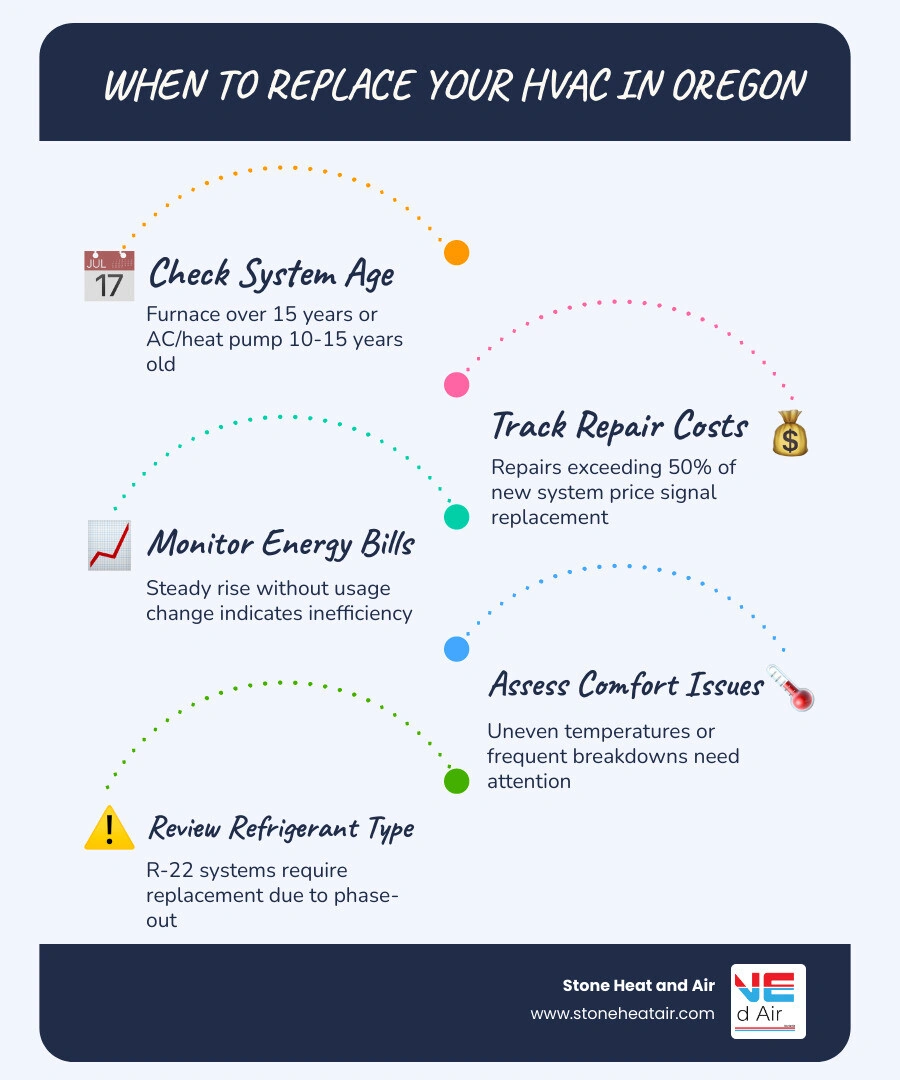
Replace your HVAC in Oregon if any of the following apply:
• Your furnace is 15 or more years old
• Your air conditioner or heat pump is 10 to 15 years old and showing problems
• Repair costs exceed 50% of the cost of a new system
• Your system uses R-22 refrigerant, which is no longer manufactured
• Energy bills have steadily risen without a change in usage habits
• You are experiencing uneven temperatures, poor airflow, or frequent breakdowns
• The system has needed emergency repairs two or more times in the past two years
If none of those apply and your system is under 10 years old with a solid maintenance history, repair is usually the smarter move.
Oregon's climate is not one-size-fits-all. West of the Cascades, mild and wet winters are the norm. In the Rogue Valley — where Central Point and the surrounding communities sit — summers push past 100°F and winters bring freezing nights. That range puts real stress on heating and cooling equipment year-round, often shortening the window between "needs a repair" and "needs a replacement."
The good news is that a planned replacement — done on your schedule, not your system's — means you can take advantage of Oregon rebate programs, avoid emergency pricing, and choose the right system for your home rather than whatever is available in a pinch.
When should you replace your hvac in oregon terms you need:
• how long does an hvac system last in southern oregon
• how pacific northwest weather affects hvac lifespan
• how to extend the life of your hvac system
Typical Lifespan of Heating and Cooling Systems in Oregon

Every heating and cooling system has a natural expiration date, but local environmental conditions dictate whether your equipment will reach its golden years or retire early. In Southern Oregon, our weather is highly diverse. Homeowners in Central Point and the Rogue Valley face blazing summer afternoons and freezing winter nights. Meanwhile, those in Brookings deal with coastal dampness and salty air, Roseburg residents experience humid river valley transitions, and Klamath Falls homes face high-altitude, sub-zero winter temperatures.
These distinct microclimates directly impact system longevity. For instance, coastal moisture in Brookings can accelerate rust and corrosion on outdoor condenser coils. In contrast, the heavy wildfire smoke that settles into the Rogue Valley during late summer forces systems to run continuously under high resistance, clogging filters and putting immense strain on blower motors.
Understanding these regional pressures helps you realistically gauge how much life is left in your equipment. To dive deeper into how our local weather shapes system longevity, read our guide on How Long Does an HVAC System Last in Southern Oregon. If you are looking to maximize the years you get out of your current setup, check out our practical tips on How to Extend the Life of Your HVAC System.
How Old Is Too Old for an HVAC System in the Rogue Valley?
When evaluating your home comfort setup, it is helpful to break down the expected lifespans of individual components:
• Gas Furnaces: Typically last 15 to 20 years. Because they only run during the heating season, their mechanical wear is concentrated. However, as they age, the risk of a cracked heat exchanger increases, which poses a serious carbon monoxide safety hazard.
• Central Air Conditioners: Generally last 10 to 15 years in the Pacific Northwest. While our summers are shorter than those in the South, the intense heat spikes we experience mean your AC runs at peak capacity when it is active, accelerating wear.
• Heat Pumps: Because they provide both heating and cooling, heat pumps operate year-round. This dual-season workload means they accumulate twice as many operating hours, typically resulting in a lifespan of 10 to 15 years.
If your equipment is approaching or has surpassed these age thresholds, it is officially on borrowed time. To learn more about the risks and inefficiencies of running aging equipment, explore our detailed analysis: How Old Is Too Old for an HVAC System.
Key Signs That Point to an HVAC Replacement
Age is not the only factor that dictates when should you replace your HVAC in Oregon. Often, your system will send clear warning signs that its operating days are numbered. Recognizing these red flags early allows you to plan a replacement before an emergency occurs.
• Frequent and Compounding Repairs: If you find yourself calling for service multiple times over a single season, your system is crying out for retirement.
• Rising Utility Bills: Have you noticed your energy bills climbing even though your usage habits remain the same? As motors, compressors, and heat exchangers wear down, they require more electricity or gas to produce the same amount of heating or cooling.
• Uneven Temperatures and Poor Airflow: If some rooms feel like iceboxes while others are stifling, your system’s blower or compressor may no longer have the strength to distribute air effectively through your ductwork.
• The R-22 Refrigerant Dilemma: If your air conditioner or heat pump was installed before 2010, it likely relies on R-22 refrigerant (commonly known as Freon). Since the EPA completely banned the production and import of R-22, refilling a leaking system has become incredibly costly and environmentally unsustainable.
• The 2026 Refrigerant Transition: In 2026, the HVAC industry is undergoing major regulatory shifts, including phase-outs of older R-410A systems in favor of more environmentally friendly, low-GWP (Global Warming Potential) refrigerants. Upgrading now ensures your new system complies with modern environmental standards and will be easy to service for decades to come.
To help you weigh your options during a system breakdown, we have put together a comprehensive resource on When to Repair vs Replace Your HVAC System.
When Should You Replace Your HVAC in Oregon Instead of Repairing It?
To remove the guesswork from this decision, professional technicians and smart homeowners rely on two classic industry rules of thumb:
1. The 50% Repair Rule: If a single repair estimate costs more than 50% of the price of a brand-new, fully installed replacement system, always choose the replacement. Investing significant money into a system that is already near the end of its lifespan is rarely a wise financial move.
2. The 5,000 Rule: Multiply the age of your system by the cost of the recommended repair. If the resulting number is greater than 5,000, replacement is generally the smarter, more cost-effective choice. If the number is under 5,000, a repair is likely justified.
For example, if a 12-year-old heat pump needs a major repair, multiplying 12 by the repair cost will easily exceed the 5,000 threshold, signaling that your money is better spent on an upgrade. For a deeper look at these decision-making frameworks, consult our HVAC Repair or Replace Guide 2026.
When Should You Replace Your HVAC in Oregon? Sizing Up Your Options
If you have decided that replacement is the best path forward, the next step is determining what type of system fits your home and lifestyle. Home heating and cooling technology has advanced rapidly, providing Southern Oregon homeowners with highly efficient choices that did not exist a decade ago.
One of the first questions we hear is whether to replace the entire system or just a single broken component (like replacing an outdoor AC condenser while keeping an older indoor furnace). In almost all cases, replacing the entire matched system is highly recommended. Modern HVAC systems are engineered to work as cohesive units. Pairing a brand-new, high-efficiency outdoor unit with an aging, inefficient indoor air handler or furnace prevents the new system from reaching its rated efficiency, can void the manufacturer's warranty, and often leads to premature system failure.
To help organize your thoughts before making a decision, take a look at our list of Questions to Ask Yourself Before an HVAC Upgrade.
Deciding Between a Heat Pump, Gas Furnace, or Ductless System
The best heating and cooling configuration depends on your specific location in Southern Oregon, your home’s existing infrastructure, and your comfort priorities.
• Electric Heat Pump — Best Suited For: Rogue Valley & Coastal areas (Central Point, Brookings, Roseburg) — Key Advantages: Provides both heating and cooling; incredibly efficient in moderate temperatures — Efficiency Level: Very High (Up to 20+ SEER2)
• Gas Furnace + AC — Best Suited For: High-altitude or cold-winter areas (Klamath Falls, mountain foothills) — Key Advantages: Reliable, high-heat output during extreme sub-zero winter temperatures — Efficiency Level: High (Up to 97% AFUE)
• Ductless Mini-Split — Best Suited For: Historic homes, additions, or homes without existing ductwork — Key Advantages: Precise zone control; no energy loss through ducts; highly customizable — Efficiency Level: Maximum (Up to 30+ SEER2)
In the mild, coastal climate of Brookings or the transitioning valley of Roseburg, an electric heat pump is often the most efficient year-round solution. However, if you live in Klamath Falls, where winter temperatures regularly plunge below freezing, a dual-fuel hybrid system (combining a high-efficiency gas furnace with an electric heat pump) offers the ultimate balance of comfort and energy savings. For homes without ductwork, ductless mini-splits allow you to heat and cool individual zones independently, eliminating the need for invasive remodeling.
Rebates, Incentives, and Regulatory Requirements in 2026
In 2026, upgrading your HVAC system in Oregon is more financially attractive than ever due to a variety of available incentives. By choosing high-efficiency equipment, you can leverage multiple programs to significantly offset your initial investment:
• Energy Trust of Oregon: Offers substantial cash-back incentives for qualifying smart thermostats, ducted heat pumps, and ductless mini-splits. These incentives are available to customers of PGE, Pacific Power, NW Natural, Avista, and Cascade Natural Gas.
• Oregon HP3 Program: Administered by the Oregon Department of Energy, this program provides targeted incentives for heat pump installations, particularly in rental properties and new construction.
• Savings Within Reach: An income-qualified program through the Energy Trust of Oregon that provides higher incentive tiers to make energy-efficient upgrades accessible to more families.
• Federal Tax Credits: Under the Energy Efficient Home Improvement Credit, homeowners can claim a 30% federal tax credit (up to $2,000) for installing qualified heat pumps.
Navigating these programs requires clear, detailed documentation from your installer. To learn how to read and compare your options, see our guide on Understanding HVAC Replacement Service Quotes.
Navigating Local Permits and Codes for Your Oregon HVAC Upgrade
When replacing an HVAC system in Oregon, compliance with state and local regulations is mandatory. Under the Oregon Mechanical Specialty Code, a mechanical permit must be filed with your local building authority before any replacement work begins. This rule applies to all projects, including "same-for-same" swaps where you are replacing an old unit with a new one of the same type.
Oregon does not issue permits at the state level; instead, they are managed by local building departments in jurisdictions like Jackson County, Douglas County, Curry County, or Klamath County.
Additionally, any contractor performing this work must hold an active license with the Oregon Construction Contractors Board (CCB). Working with a licensed professional ensures your installation meets all safety, structural, and electrical standards, and guarantees that your system will pass its final local safety inspection.
Preparing for Your HVAC Replacement Day
A successful HVAC replacement starts long before the installation truck arrives at your home. Upgrading your system is a major home improvement project, and proper preparation ensures the process goes smoothly and safely.
Before installing new equipment, a professional technician must perform a Manual J load calculation to ensure your new system is sized perfectly for your home's square footage, insulation levels, and window layouts. Sizing is critical: an oversized system will short-cycle constantly, leading to uneven temperatures and premature wear, while an undersized system will run continuously without ever keeping you comfortable.
Additionally, our team will inspect your existing ductwork. Over time, ducts can develop leaks, sag, or accumulate debris. We also measure the system's static pressure to ensure your ductwork can handle the airflow of a modern, high-efficiency system.
To learn more about how a properly planned installation pays off over time, read about Why HVAC Replacement Is a Smart Investment and see How a New HVAC System Increases Home Value.
What To Expect When You Replace Your HVAC in Oregon
On the day of your installation, you can expect our professional technicians to follow a structured, efficient process to minimize disruption to your household:
1. Site Preparation: We will lay down protective drop cloths to safeguard your flooring and furniture along the work path.
2. System Decommissioning: The old equipment is safely disconnected. This includes recovering and containing old refrigerant according to EPA Section 608 guidelines so it does not escape into the atmosphere.
3. Physical Installation: The new indoor evaporator coil, furnace or air handler, and outdoor condenser or heat pump are positioned and secured.
4. Line and Electrical Connections: Technicians run new refrigerant lines, establish electrical connections, and install a new smart thermostat if requested.
5. System Testing and Commissioning: We perform static pressure tests, check refrigerant charges, and run the system through complete heating and cooling cycles to verify peak performance.
6. Homeowner Walkthrough: We will show you how to operate your new system, program your thermostat, and explain how to change your filters.
A modern, highly efficient comfort system is a major selling point if you ever decide to move. To see how this upgrade appeals to prospective buyers, read our article: Does a New HVAC Help Sell Your Home Faster.
Frequently Asked Questions about Oregon HVAC Replacement
How long does it take to replace an HVAC system?
A standard residential HVAC replacement typically takes 4 to 8 hours to complete. If your project requires extensive ductwork modifications, electrical panel upgrades, or zoning installations, it may extend into a second day. We always provide a clear timeline before work begins so you can plan your schedule accordingly.
Can I replace just the outdoor AC unit or heat pump?
While it is technically possible, it is highly discouraged. Modern systems rely on matched indoor and outdoor components to achieve their high-efficiency ratings. Mixing a new outdoor unit with an old indoor coil can cause performance issues, accelerate system wear, and will likely void your manufacturer's warranty.
Do I need a permit to replace my HVAC system in Oregon?
Yes. The Oregon Mechanical Specialty Code requires a mechanical permit for all HVAC replacements statewide. A licensed contractor will handle the permit application process and coordinate the final inspection with your local building department to ensure your system is fully compliant and safe.
Conclusion
Investing in a new heating and cooling system is one of the most impactful decisions you can make for your home’s comfort, safety, and monthly utility bills. When you recognize the signs that your system is ready for retirement, planning a proactive replacement ensures you stay in control of your indoor climate.
At Stone Heating & Air, we are proud to serve homeowners throughout Central Point, the Rogue Valley, and across Southern Oregon, Roseburg, Brookings, and Klamath Falls. As a Carrier-certified installer, we are dedicated to providing meticulous attention to detail, honest recommendations, and expert craftsmanship.
Whether you need 24/7 emergency service or want to protect your investment with our exclusive Stone Comfort Membership Club, we are here to treat your home like ours.
Ready to upgrade your home comfort? Visit our comfort services page to schedule your professional system assessment today!