

Should I Repair or Replace My HVAC System? Here's How to Decide
Should I repair or replace my HVAC system is one of the most stressful questions a homeowner can face — especially when it happens on the hottest day of summer or the coldest night of the year in the Rogue Valley.
The short answer depends on a few key factors:
• System age — ACs over 10–12 years and furnaces over 15 years are strong replacement candidates
• Repair cost vs. replacement cost — if the repair exceeds 50% of a new system's price, replace it
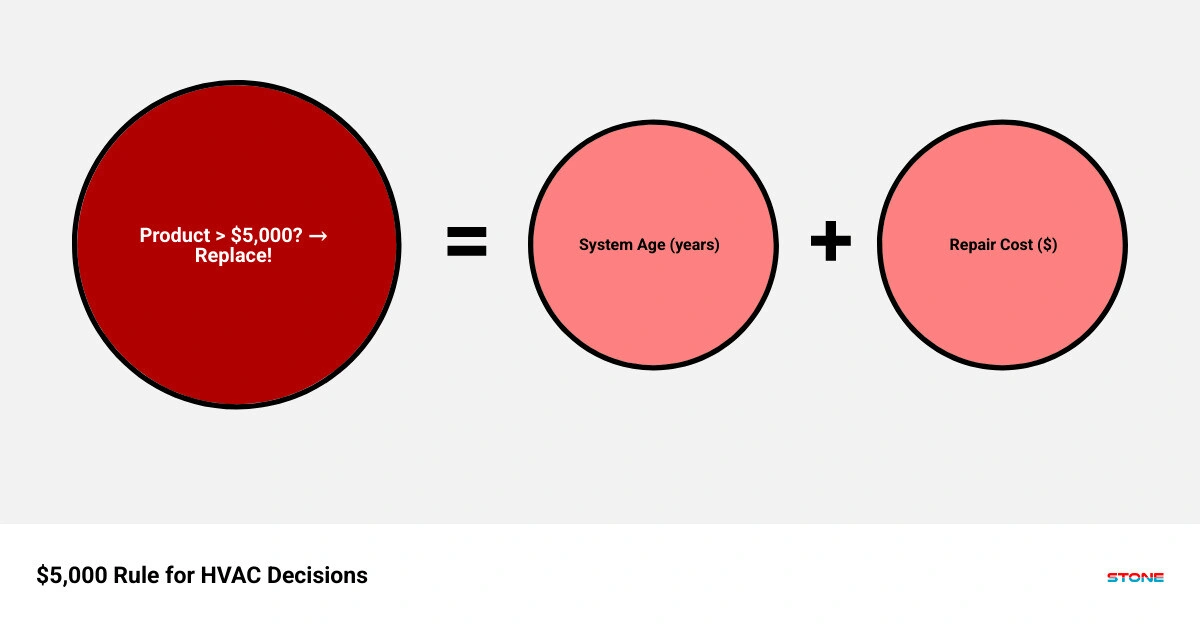
• The $5,000 Rule — multiply your system's age by the repair cost; if the result is over $5,000, replacement is usually the smarter move
• Repair history — three or more repairs in the last three years is a clear warning sign
• Safety issues — cracked heat exchangers, carbon monoxide risks, or R-22 refrigerant dependency mean replace immediately, no math needed
Most homeowners only think about their HVAC system when something goes wrong. By then, the pressure to decide fast can lead to costly mistakes — either overpaying for a repair that buys just a few more months, or replacing a system that still had years of reliable service left.
This guide gives you a clear, honest framework to make the right call — without the guesswork.
The $5,000 Rule and Financial Decision Frameworks
When we visit homes in Central Point or Medford, we often see homeowners struggling with the "sunk cost fallacy." This is the idea that because you just spent money on a repair last year, you should keep fixing the unit to "get your money's worth." Unfortunately, with aging HVAC equipment, this often leads to a "repair spiral" where you end up spending the price of a new system one invoice at a time, while still dealing with an old, inefficient machine.
To take the emotion out of the decision, we recommend using the $5,000 Rule. It is a simple piece of math that provides a clear financial threshold. Here is how it works:
System Age (in years) x Repair Estimate = Your Score
If your score is over $5,000, the investment in a repair is likely a poor use of your funds. For example, if you have a 12-year-old air conditioner that needs a $600 blower motor replacement, your score is $7,200. Since $7,200 is greater than $5,000, our recommendation would lean toward replacement. Conversely, if that same $600 repair is needed on a 6-year-old unit, the score is $3,600, making the repair a much more reasonable investment.
Beyond this rule, we also look at the 50% Rule. This guideline suggests that if a single repair quote exceeds 50% of the value of a brand-new system, you should almost always choose the upgrade. Major components like compressors or heat exchangers often fall into this category.
Finally, consider the Financial Amortization. If a new, high-efficiency system lasts 15 to 20 years, you can look at the total investment as a yearly "comfort cost." Every year an old, failing system stays in your home, it isn't just costing you repair bills; it is also costing you in higher utility payments and reduced reliability. When you view the decision through this lens, Should I Repair or Replace My HVAC System? becomes a question of long-term asset management rather than just an emergency expense.
I'm wondering: should i repair or replace my hvac system for my home in Central Point?
Living in Southern Oregon means we experience a wide range of weather. From the triple-digit heat in the Rogue Valley during July to the biting frosts in Klamath Falls, our HVAC systems work incredibly hard. If you are sitting in your Central Point home wondering should i repair or replace my hvac system, you need to look at the specific context of your unit’s life and performance.
Is my unit too old? should i repair or replace my hvac system based on its age?
Age is the most significant indicator of a system's "risk profile." While some units are built like tanks and seem to run forever, most modern HVAC equipment has a predictable retirement zone.
• Air Conditioners (12–15 years): In our region, AC units take a beating. Once a unit passes the 10-year mark, it enters the "watch list." By 15 years, internal components like the compressor and coils are often nearing the end of their functional life.
• Furnaces (15–20 years): Gas furnaces generally last longer than ACs because they have fewer moving parts exposed to the elements. However, once a furnace hits 15 years, the risk of a cracked heat exchanger increases significantly. You can find more details on these timelines in our guide on When to Replace Your Furnace.
• Heat Pumps (10–15 years): Because heat pumps provide both heating and cooling, they run year-round. This constant operation means they often reach their "old age" sooner than a dedicated furnace. If your heat pump is over a decade old and starting to struggle, it’s time to start planning for its successor.
If your system is in these age ranges, even a "small" repair should be viewed with caution. Replacing a part on a 17-year-old furnace is often like putting a brand-new engine in a car with 300,000 miles — the rest of the machine is still worn out.
With rising utility bills, should i repair or replace my hvac system to save energy?
Have you noticed your monthly bills creeping up even though you haven't changed your thermostat settings? This is a classic sign of a system in decline. As HVAC units age, they lose efficiency due to dirt buildup, motor wear, and declining refrigerant levels. Research shows that an HVAC system can lose 5% to 10% of its efficiency for every decade of service.
If you find yourself calling us for service more than three times in a three-year span, your system is effectively on "speed dial" for failure. These frequent, smaller repairs are often symptoms of systemic fatigue. When a system reaches this point, it is usually running non-stop just to keep up with the Rogue Valley's temperature swings, which further drives up your energy consumption.
Upgrading to a modern system can often reduce your monthly heating and cooling costs by 20% to 40%. For many of our neighbors in Roseburg or Brookings, those savings alone help offset a significant portion of the investment over time. If you’re tired of the "sticker shock" every time you open your utility bill, it might be Is It Time to Replace AC? or your heating unit.
Efficiency Ratings and the Impact of Outdated Technology
The world of HVAC technology has changed drastically since your current system was likely installed. As of May 2026, the standards for efficiency and environmental safety have reached new heights, making older units look like relics of a different era.
When evaluating should i repair or replace my hvac system, you must consider the "Efficiency Gap."
• SEER2 (Seasonal Energy Efficiency Ratio): This measures cooling efficiency. Older units might have a SEER rating of 8 or 10. Modern minimums are now much higher, with high-end models reaching SEER2 ratings of 20 or more. Switching from a SEER 10 to a SEER 16 unit can reduce your cooling electricity usage by more than 35%.
• AFUE (Annual Fuel Utilization Efficiency): This applies to furnaces. An old "standard" furnace might have an 80% AFUE, meaning 20 cents of every dollar you spend on gas literally goes up the chimney. Modern condensing furnaces can reach up to 98% AFUE.
• HSPF2 (Heating Seasonal Performance Factor): This measures the efficiency of heat pumps in heating mode. Higher numbers mean more heat for less electricity.
Perhaps the biggest technological "red flag" is R-22 Refrigerant (Freon). If your system was installed before 2010, there is a high chance it uses R-22. This refrigerant has been phased out globally due to its impact on the ozone layer. In 2026, R-22 is incredibly scarce and expensive. If your old R-22 system develops a leak, the cost to recharge it can be astronomical — often making a repair a "losing proposition." We strongly advise against investing major money into an R-22 unit.
To help you understand the difference, take a look at this comparison between a typical 2010 model and a 2026 high-efficiency unit:
• Cooling Efficiency — 2010 Standard Model: 10–13 SEER — 2026 High-Efficiency Model: 18–25 SEER2
• Heating Efficiency — 2010 Standard Model: 80% AFUE — 2026 High-Efficiency Model: 96–98% AFUE
• Refrigerant Type — 2010 Standard Model: R-22 (Phased out) — 2026 High-Efficiency Model: R-410A or R-454B
• Blower Motor — 2010 Standard Model: Single-speed (On/Off) — 2026 High-Efficiency Model: Variable-speed
• Sound Levels — 2010 Standard Model: Loud (75+ decibels) — 2026 High-Efficiency Model: Ultra-quiet (under 60 dB)
For a deeper dive into what these numbers mean for your specific home, check out our HVAC Replacement Guide.
Safety Hazards and Critical System Failures
While financial math and efficiency ratings are important, safety is the one area where we don't compromise. There are certain failures where the answer to should i repair or replace my hvac system is always "replace."

The most dangerous failure we encounter is a cracked heat exchanger in a gas furnace. The heat exchanger is the metal component that keeps the combustion gases (like carbon monoxide) separate from the air that blows through your vents. If this metal cracks due to age or overheating, odorless, colorless, and lethal carbon monoxide can leak into your living spaces. Because a heat exchanger is the "heart" of the furnace and is incredibly labor-intensive to replace, a crack in an out-of-warranty unit almost always warrants a full system replacement.
Other critical safety "red flags" include:
• Frequent electrical shorts: This can indicate brittle, aging wiring that poses a fire risk.
• Scorching or soot: If you see black marks around your furnace burners, it’s a sign of "rollout" or improper combustion, which is a major fire and health hazard.
• Repeated refrigerant leaks: Beyond the cost, leaking refrigerant is an environmental hazard and can eventually lead to a catastrophic compressor burnout.
When safety is at stake, we prioritize your family's well-being above all else. In these cases, we often recommend looking at Furnace Replacement in Medford or your local area immediately to ensure your home remains a safe haven.
Maximizing Comfort and Value in the Rogue Valley
A new HVAC system is more than just a "box that blows air." It is an investment in your daily quality of life. Modern systems offer levels of comfort that older units simply cannot match.
One of the biggest complaints we hear in Southern Oregon is about humidity — either it's too dry in the winter or "sticky" during those humid summer afternoons. Modern variable-speed technology allows your system to run at lower speeds for longer periods. This doesn't just save energy; it also provides superior dehumidification and eliminates those annoying "hot and cold spots" in your home. Instead of the system blasting on and then shutting off (the "all or nothing" approach), a variable-speed unit adjusts its output to maintain a perfectly steady temperature.
Furthermore, a new HVAC system is a massive selling point if you ever decide to put your home on the market. Potential buyers in places like Klamath Falls or Central Point are often wary of older homes with "original" HVAC equipment. They see a 20-year-old furnace as a looming multi-thousand-dollar expense. By upgrading now, you enjoy the comfort and low bills today, and you increase your HVAC Upgrade Value for tomorrow.
Finally, don't forget about Indoor Air Quality (IAQ). Modern systems can be paired with advanced filtration and purification technologies that remove allergens, dust, and even viruses from your air. If you suffer from seasonal allergies (which are quite common in the Rogue Valley!), a new system can make your home a much more breathable environment.
Frequently Asked Questions about HVAC Replacement
What is the $5,000 rule for HVAC?
The $5,000 rule is a decision-making tool where you multiply the age of your HVAC unit by the estimated cost of the repair. If the total is greater than 5,000, it is generally more cost-effective to replace the system rather than fix it. For example, a 10-year-old unit with a $600 repair equals 6,000, signaling it’s time for an upgrade.
Should I replace my HVAC if I plan to sell my home soon?
It depends on the condition. If the system is currently broken or poses a safety risk, you will likely have to repair or replace it to pass inspection. However, if it's just old but working, you might choose to offer a "home warranty" or a credit to the buyer. That said, a brand-new, high-efficiency system can be a major marketing feature that helps your home sell faster and for a better price.
Can I replace just the outdoor unit or the indoor unit?
While it is technically possible in some rare cases, we almost always recommend a full system replacement. HVAC systems are designed as "matched pairs." If you put a brand-new, high-efficiency outdoor AC unit with a 20-year-old indoor coil, the system will not reach its rated efficiency, the warranty may be voided, and the old component will likely fail shortly after, leaving you with another repair bill.
Conclusion
Deciding should i repair or replace my hvac system doesn't have to be a "high-stakes guessing game." By looking at the age of your system, applying the $5,000 rule, and considering the safety and efficiency of modern technology, the right path usually becomes clear.
At Stone Heat and Air, we pride ourselves on providing honest, fair recommendations. We aren't here to "sell" you a system you don't need, but we also won't let you throw good money after bad on a system that is past its prime. Whether you are in Central Point, Medford, or anywhere across the Rogue Valley, we treat your home like ours.
If you’re tired of the constant repairs and want to explore your options for a more comfortable, efficient home, we are here to help. We offer 24/7 emergency service for those times when your system gives up at the worst possible moment, and our exclusive "Stone Comfort Membership Club" is the best way to ensure your new system stays in peak condition for years to come.
Ready to find the perfect solution for your home? Explore our Heating Replacement Services or contact our team today for a professional evaluation. We’ll help you keep your cool, no matter what the Oregon weather throws your way.