

Why HVAC Replacement Is a Smart Investment for Rogue Valley Homeowners
Understanding why HVAC replacement is a smart investment can save you from years of rising energy bills, unpredictable breakdowns, and costly repair cycles that never seem to end. If your system is aging, struggling to keep up with Southern Oregon summers or Rogue Valley winters, or demanding repairs more often than it should, you may already be past the point where fixing it makes financial sense.
Here is a quick summary of the core reasons HVAC replacement pays off:
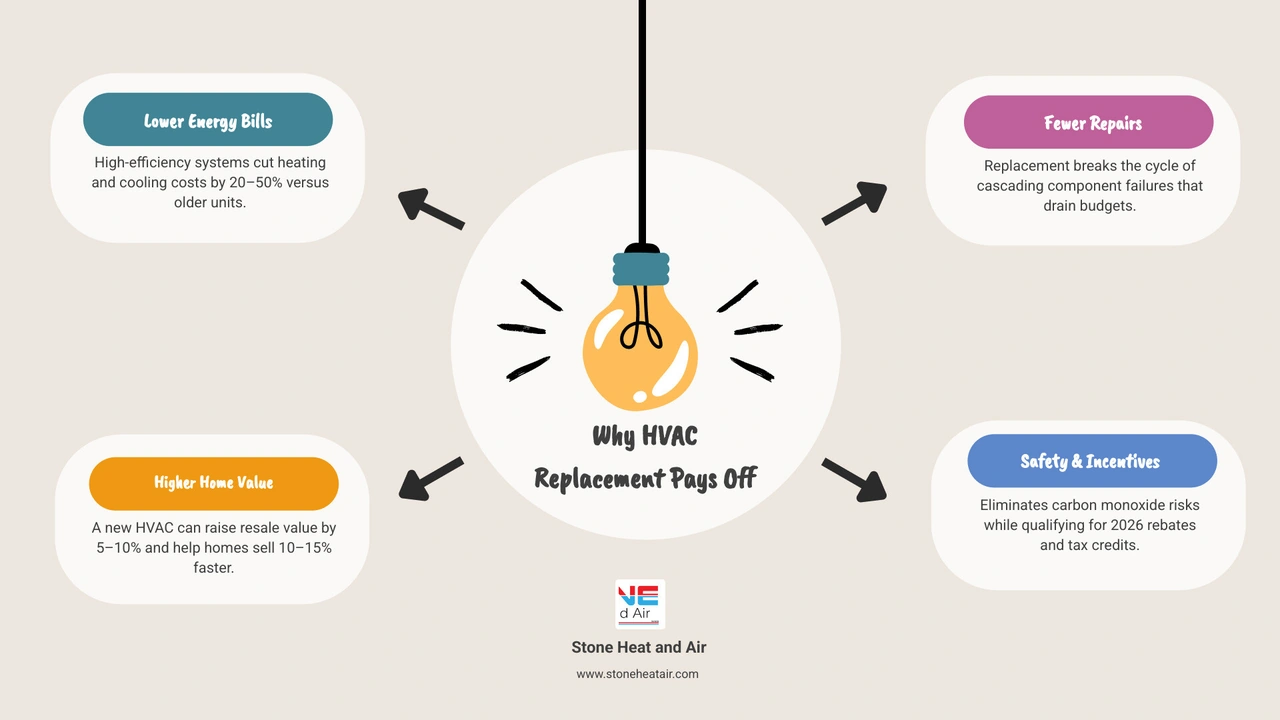
• Lower energy bills: Modern high-efficiency systems can reduce heating and cooling costs by 20–50% compared to older units.
• Higher home value: A new system can increase your home's resale value by 5–10% and help it sell 10–15% faster.
• Fewer repairs: Replacing an aging system stops the cycle of cascading component failures that drain your budget over time.
• Better comfort and air quality: Variable-speed technology, improved filtration, and precise humidity control make your home noticeably more comfortable.
• Safety: New systems eliminate risks like cracked heat exchangers and carbon monoxide leaks associated with older equipment.
• Financial incentives: 2026 rebates and tax credits can offset a significant portion of your replacement costs.
Heating and cooling account for 30–50% of the average homeowner's energy bill, according to the U.S. Department of Energy. When your HVAC system is old or inefficient, that percentage climbs — and the money you spend on repairs only delays the inevitable. At some point, continuing to patch an aging system is not a money-saving strategy. It is a sunk cost on a machine that is already near the end of its life.
This guide walks through the financial framework, comfort benefits, safety considerations, and property value impact of replacing your HVAC system — so you can make a confident, informed decision.
Common why hvac replacement is a smart investment vocab:
• does a new hvac help sell your home faster
• how a new hvac system increases home value
The Financial Framework: When to Stop Repairing
Deciding whether to repair or replace your heating and cooling system does not have to be a guessing game. When a major component fails, homeowners often experience a wave of anxiety. Should you fix it one more time, or is it time to move on? To remove the emotion from this decision, we use clear, objective mathematical frameworks that help determine when continuing to repair an aging unit is simply throwing good money after bad.
Two of the most trusted guidelines in the industry are the 50% Rule and the $5,000 Rule.
The 50% Rule is straightforward: if the quoted cost of a repair exceeds 50% of the price of a brand-new system, replacement is almost always the smarter financial move. Investing a significant sum into a system that is already past its prime is like putting brand-new performance tires on a shopping cart—it might look like a fix, but the underlying machine is still fundamentally limited.
The $5,000 Rule takes system age into account. To apply this formula, you multiply the age of your system in years by the repair quote. If the resulting number is greater than 5,000, we recommend replacing the system. For example, if you have a 12-year-old air conditioner that needs a major repair, multiplying 12 by the repair quote will quickly show whether you are crossing that threshold. If the math points to replacement, you are far better off putting those resources toward a modern, warrantied system.
By using these frameworks, you can avoid the dreaded "repair spiral"—a frustrating cycle where one aging component fails, putting extra stress on other parts and leading to a cascade of expensive service calls. If you want a deeper look at how to navigate these decisions, check out our guides on When to Repair vs Replace Your HVAC System and the HVAC Repair or Replace Guide 2026.
How System Age Dictates Your Next Steps
The age of your equipment is the single most critical factor in deciding its future. Like any hard-working mechanical system, HVAC components have a natural lifespan. In the Rogue Valley, our systems work incredibly hard. We experience scorching, dry summer days that regularly break triple digits, followed by chilly, damp winter months that keep our furnaces and heat pumps running around the clock.
Because of these regional climate demands, the typical lifespans for equipment in our area generally fall into these ranges:
• Central Air Conditioners: 12 to 15 years
• Heat Pumps: 10 to 15 years (due to year-round operation for both heating and cooling)
• Gas Furnaces: 15 to 20 years (though efficiency drops significantly in their final years)
When a system enters the double-digit mark, its internal components have endured years of thermal expansion, contraction, and mechanical wear. Even if a 14-year-old system is still running, its internal efficiency has likely degraded, meaning it is consuming far more electricity or gas than it did when it was new. To understand how age impacts your specific setup, read more about How Long Does an HVAC System Last in Southern Oregon and evaluate How Old Is Too Old for an HVAC System.
Evaluating the True Cost of the Repair Spiral
Many homeowners view repair bills as isolated incidents. You pay for a capacitor this summer, a fan motor next spring, and a contactor the following winter. However, these individual failures are often symptoms of systemic decline. This is what we call the "repair spiral."
When an older component begins to fail, it forces the surrounding parts to work much harder. For example, a dying blower motor might run too hot, drawing excessive electrical current and causing the system to trip breakers. This strain can eventually cause the evaporator coil to freeze, which in turn can flood liquid refrigerant back into the compressor, destroying it. What started as a minor motor issue quickly spirals into a catastrophic system failure.
Furthermore, older air conditioning units manufactured before 2010 rely on R-22 refrigerant. Because R-22 was completely phased out by the EPA due to its environmental impact, servicing these older systems has become incredibly expensive. Finding R-22 is difficult, and a simple refrigerant leak repair can quickly become financially impractical. When you review your choices, keeping these hidden long-term risks in mind is essential. For more help decoding what goes into a replacement estimate, check out our guide on Understanding HVAC Replacement Service Quotes.
Why HVAC Replacement Is a Smart Investment for Modern Homeowners
When you upgrade your home's heating and cooling, you are not just buying a metal box to sit in your backyard or garage. You are investing in your family's daily comfort, health, and financial peace of mind. Modern systems represent a massive leap forward in technology compared to units built just ten years ago. If you are starting to plan an upgrade, it helps to review these critical Questions to Ask Yourself Before an HVAC Upgrade to ensure you select the perfect system for your lifestyle.
Why hvac replacement is a smart investment for energy savings
The most immediate and satisfying return on your investment comes in the form of lower monthly utility bills. Older heating and cooling systems operate on outdated efficiency standards. Today, air conditioners and heat pumps are rated by SEER2 (Seasonal Energy Efficiency Ratio 2), and furnaces are rated by AFUE (Annual Fuel Utilization Efficiency).
Upgrading from a 10-year-old AC unit to a modern, high-efficiency model can save you up to 40% on cooling energy costs alone. When you combine a high-efficiency system with proper duct sealing and home weatherization efforts, you can expect to save anywhere from 20% to 50% on your overall energy bills.
Look for systems carrying the ENERGY STAR certification, which guarantees they meet strict energy efficiency guidelines set by the EPA. When paired with a smart thermostat, these systems learn your daily routine, automatically adjusting temperatures when you are asleep or away to maximize your annual savings.
Enhancing Daily Comfort and Indoor Air Quality
Beyond the financial savings, a new system completely transforms how your home feels. Older systems typically use single-stage motors. This means they operate like a car that only goes 0 or 100 miles per hour—either they are completely off, or they are blasting air at full capacity. This results in uncomfortable temperature swings, hot and cold spots, and loud blasts of air.
Modern high-efficiency systems utilize variable-speed technology. These systems act like cruise control, adjusting their output in tiny increments to match the exact heating or cooling needs of your home. They run longer at lower, quieter speeds, which provides:
1. Consistent Temperatures: No more chasing hot and cold spots from room to room.
2. Excellent Humidity Control: By running longer, gentler cycles, variable-speed systems remove far more moisture from the air during humid summer days.
3. Superior Filtration: Continuous, low-speed airflow means your air is constantly passing through your filtration system, removing dust, pet dander, and pollen.
4. Wildfire Smoke Protection: In Southern Oregon, summer often brings wildfire smoke. A modern system equipped with advanced filtration (like MERV 13 or HEPA filters) is your home's first line of defense, keeping your indoor air safe and breathable.
Maximizing Property Value and Resale Appeal
If you are planning to sell your home in the near future, you might wonder if replacing your HVAC system is worth the effort. The answer is a resounding yes. In today's real estate market, buyers are highly focused on energy efficiency and the age of a home's major mechanical systems. Understanding How a New HVAC System Increases Home Value is key to making a strategic decision, and you can explore this topic further by reading about how Can an HVAC Upgrade Increase the Value of Your Home.
Understanding why hvac replacement is a smart investment before selling
When buyers tour a home, they look for peace of mind. Seeing an old, rusted outdoor unit or a furnace from the early 2000s immediately raises a red flag. Buyers know that a failing HVAC system is a major expense they might have to face shortly after moving in.
By replacing your system before listing your home, you completely remove this objection. Homes with new HVAC systems sell 10% to 15% faster than comparable properties with aging systems. A new system signals to buyers that the home has been meticulously maintained.
Furthermore, installing a new system allows you to hand over a transferable manufacturer's warranty to the new owner, providing them with invaluable protection. It also eliminates the risk of a buyer demanding hefty price concessions during negotiations after a home inspector flags an old system as near the end of its life. To learn more about this strategic advantage, discover Does a New HVAC Help Sell Your Home Faster.
Appraisal Adjustments and Buyer Confidence
Real estate appraisers look closely at the condition of a home's heating and cooling systems. Industry data consistently points to a 5% to 7% increase in home value after a new HVAC installation—and in highly competitive markets, that boost can reach up to 10%.
A new system can add significant value to your appraised home price depending on the type and size of the unit installed. Additionally, having a fully functional, modern heating system is often a strict requirement for buyers securing traditional mortgage financing (such as FHA or VA loans). If your old system is broken or unsafe, it can delay or even derail the sale entirely. Keeping organized documentation of your professional installation, permits, and load calculations ensures your appraiser can accurately reflect this upgrade in your home's valuation.
Critical Safety Indicators and Modern Technology Upgrades
When evaluating an older heating and cooling system, safety should always be your top priority. While high utility bills are frustrating, a system that poses a direct threat to your family's health requires immediate action.
To help you understand how technology has evolved, let us compare older single-stage systems with modern variable-speed options:
• Airflow Speed — Older Single-Stage Systems: Only 0% or 100% capacity — Modern Variable-Speed Systems: Adjusts dynamically in tiny increments
• Temperature Consistency — Older Single-Stage Systems: Frequent swings and noticeable hot/cold spots — Modern Variable-Speed Systems: Ultra-consistent, matching your exact thermostat setting
• Humidity Control — Older Single-Stage Systems: Poor (short cycles do not remove enough moisture) — Modern Variable-Speed Systems: Excellent (longer, low-speed runs pull moisture from the air)
• Noise Levels — Older Single-Stage Systems: Loud, sudden blasts of air when the cycle starts — Modern Variable-Speed Systems: Whisper-quiet operation that runs in the background
• Refrigerant Type — Older Single-Stage Systems: Outdated R-22 (phased out and highly expensive) — Modern Variable-Speed Systems: Modern, eco-friendly refrigerants like R-454B
• Filtration Efficiency — Older Single-Stage Systems: Basic filtration only when running at full blast — Modern Variable-Speed Systems: Continuous filtration for superior indoor air quality
If you are preparing to replace a gas furnace, make sure you know the critical Questions You Need to Ask Before a Furnace Job to ensure a safe, professional installation.
Safety Risks That Require Immediate Replacement
As a gas furnace ages, the heat exchanger—the metal component that keeps combustion exhaust separate from the air blowing through your home—is subjected to constant heating and cooling. Over time, this thermal stress can cause the metal to crack.
A cracked heat exchanger is an extremely serious safety hazard. It can allow deadly carbon monoxide (CO) gas to leak directly into your home's airstream. If a technician discovers a cracked heat exchanger during a routine inspection, they are legally required to shut down the system immediately to protect your family.
Other safety hazards associated with older systems include brittle, outdated electrical wiring that poses a fire risk, and persistent refrigerant leaks in older R-22 systems. If your system is old and showing signs of physical wear, replacing it is the only reliable way to guarantee your home's safety.
Leveraging 2026 Incentives and Rebates
If you are ready to make the transition to a modern system, 2026 is an incredible time to do so. Under the federal Inflation Reduction Act, homeowners can access significant tax credits for upgrading to high-efficiency equipment. For instance, qualifying high-efficiency heat pumps can earn you federal tax credits of up to $2,000, while high-efficiency central air conditioners and gas furnaces can qualify for up to $600 in credits.
In addition to federal tax incentives, state-level programs (such as HEAR rebates) and local utility companies often offer generous rebates for homeowners who transition to high-efficiency electric heat pumps. These incentives can dramatically offset your initial investment, making a high-efficiency upgrade more accessible than ever.
Frequently Asked Questions about HVAC Upgrades
How does the 50% rule help decide between repair and replacement?
The 50% Rule states that if the cost of repairing your current HVAC system exceeds 50% of the cost of a brand-new system, replacement is the more sensible, long-term financial choice. Spending a large amount to repair an older system that is out of warranty is often a sunk cost, as other aging components are likely to fail soon after.
Does a new HVAC system actually increase a home's resale value?
Yes. On average, a new HVAC system can increase a home's resale value by 5% to 10% and help the property sell 10% to 15% faster. Buyers appreciate knowing they won't face major mechanical expenses immediately after moving in, and appraisers look favorably on updated, energy-efficient systems.
What safety risks make immediate HVAC replacement necessary?
The most critical safety risk is a cracked heat exchanger in a gas furnace, which can leak lethal carbon monoxide gas into your living spaces. Other urgent safety concerns include severe electrical hazards from decaying wiring and persistent refrigerant leaks in older systems that utilize phased-out R-22 refrigerant.
Conclusion
When you look at the big picture, it is easy to see why HVAC replacement is a smart investment for your family's future. From slashing your monthly utility bills by up to 50% to protecting your household from carbon monoxide hazards, a modern heating and cooling system delivers value every single day.
At Stone Heating & Air, we are dedicated to keeping our neighbors throughout Central Point, Roseburg, Brookings, Klamath Falls, and the entire Rogue Valley comfortable all year long. As a team committed to honest, fair dealings and meticulous attention to detail, we specialize in designing and installing high-efficiency systems tailored to our unique Southern Oregon climate.
We also offer our exclusive Stone Comfort Membership Club, which provides regular maintenance, priority service, and complete peace of mind so your new system runs flawlessly for years to come.
Do not wait for your old system to leave you stranded during a summer heatwave or a winter cold snap. Schedule your professional HVAC replacement with Stone Heating & Air today to secure your home's comfort and efficiency and let our expert team help you make the smartest investment for your home.