

Is Your HVAC System Too Old? Here's How to Know Before It Breaks Down
Knowing how old is too old for an HVAC system could save you from a sweaty summer night, a freezing winter morning, or a repair issue that catches you off guard. Most homeowners do not think much about their heating and cooling system until something goes wrong - and by then, the equipment may already be well past its prime.
Here is a quick answer based on system type:
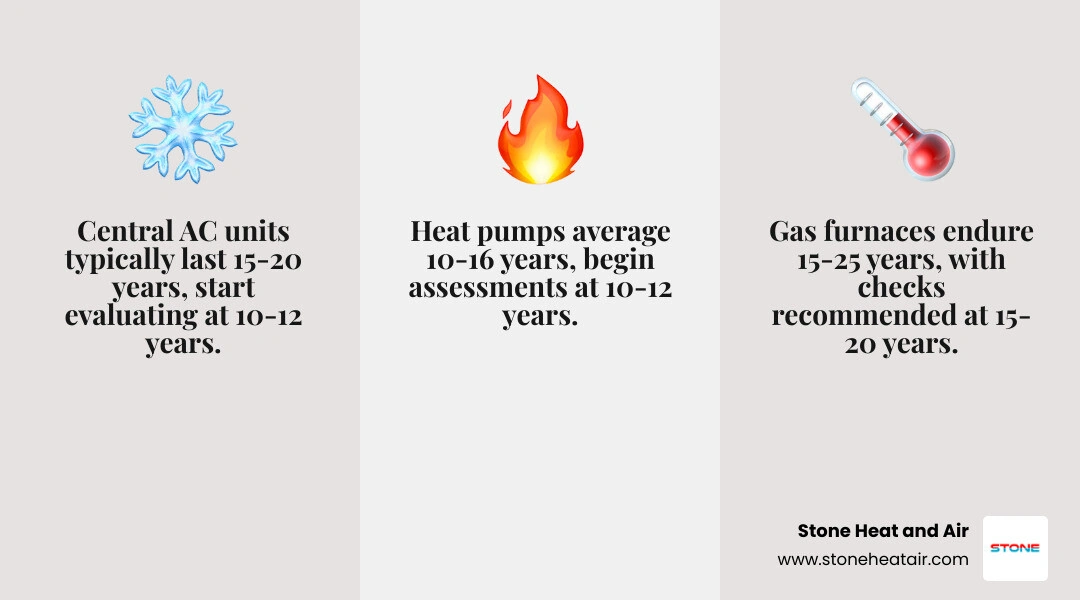
• Central Air Conditioner — Typical Lifespan: 15-20 years — Start Evaluating At: 10-12 years
• Gas Furnace — Typical Lifespan: 15-25 years — Start Evaluating At: 15-20 years
• Heat Pump — Typical Lifespan: 10-16 years — Start Evaluating At: 10-12 years
• Boiler — Typical Lifespan: 20-35 years — Start Evaluating At: 15-20 years
• Ductless Mini-Split — Typical Lifespan: 15-20 years — Start Evaluating At: 12-15 years
The 15-to-20-year mark is the general rule of thumb, but the honest answer is more nuanced than that. A system's age, maintenance history, climate, and repair track record all play a role. A well-maintained furnace in a mild climate may still run strong at 22 years. An AC unit in a hot, smoky, or coastal environment that has not been serviced regularly may be struggling much sooner.
Many homeowners deal with a major HVAC breakdown before their system reaches the upper end of its expected lifespan. That is exactly why understanding the warning signs early matters so much.
This guide walks you through what to know before your system fails: how long each system type typically lasts, what warning signs to watch for, when repairs stop making sense, and how to figure out exactly how old your system is right now.
For more guidance on replacement timing, visit When to Repair vs Replace Your HVAC System.
How Old Is Too Old for an HVAC System?
For most homeowners, the short answer is this: once your system reaches about 15 to 20 years old, it is officially in the danger zone for reliability, efficiency, and repair risk. But there is also an important earlier checkpoint.
Around year 10 to 12, many systems start showing what we think of as the "warning age." They may still run, but they often begin losing efficiency, breaking down more often, and struggling to keep temperatures even. Older systems commonly operate less efficiently than they did when new by that point.
That means a 12-year-old system is not automatically "too old," but it is old enough that every repair, maintenance record, and comfort complaint starts mattering more.
The average lifespan of each type of HVAC system
Different equipment ages at different rates. Heat pumps usually wear out faster because they work year-round. Furnaces often last longer because they are seasonal. Boilers are the marathon runners of the group.
• Central AC — Average Lifespan: 15-20 years — When to Start Planning: 10-12 years
• Gas furnace — Average Lifespan: 15-25 years — When to Start Planning: 15 years
• Heat pump — Average Lifespan: 10-16 years — When to Start Planning: 10-12 years
• Boiler — Average Lifespan: 20-35 years — When to Start Planning: 15-20 years
• Ductless mini-split — Average Lifespan: 15-20 years — When to Start Planning: 12-15 years
• Packaged unit — Average Lifespan: 10-15 years — When to Start Planning: 10 years
If you want deeper system-specific reading, these guides are helpful:
• Lifespan Of A Carrier Air Conditioner
• The Life Expectancy Of Commercial Hvac Systems
Why age alone does not tell the whole story
Two systems installed the same year can age very differently. One may still hum along. The other may sound like it has opinions.
Here is what changes the timeline most:
• Maintenance history
• Installation quality
• How often the system runs
• Ductwork condition
• Filter changes
• Refrigerant charge
• Indoor air quality
• Outdoor exposure to debris, salt, or smoke
A properly installed and regularly serviced system can often last longer than a neglected one. On the flip side, dirt, poor airflow, oversized equipment, and leaky ducts can shorten life dramatically.
How old is too old for an HVAC system in harsh climates?
In Southern Oregon, local conditions matter more than many homeowners realize.
In Central Point, the Rogue Valley, Roseburg, Brookings, and Klamath Falls, we see several stressors that can age equipment faster:
• Hot summer stretches that push cooling systems harder
• Winter heating demand that keeps furnaces and heat pumps busy
• Wildfire smoke that clogs filters and coats coils
• Coastal salt exposure in Brookings that can corrode outdoor units faster
• Humidity swings that make systems work harder to control indoor comfort
Coastal and high-moisture conditions can cut AC lifespan significantly. Outdoor units near salt air may corrode well before the average replacement window. If your home is in Brookings or another coastal environment, your condenser may age faster than the same model installed farther inland.

The warning signs your HVAC system is past its prime
Age gives us a clue. Symptoms tell us the story.
When an HVAC system is getting too old, homeowners usually notice the same warning signs:
• More frequent breakdowns
• Energy bills rising without a lifestyle change
• Rooms that never seem comfortable
• Weak airflow
• Strange noises like banging, squealing, or rattling
• AC that runs longer than it used to
• Humidity problems or a clammy indoor feel
• More dust than usual
• Thermostat battles from room to room
If your system is over 12 years old and checking several of these boxes, it is usually time for a serious replacement conversation.
How old is too old for an HVAC system if it still runs?
This is one of the most common homeowner questions, and the answer is: running is not the same thing as running well.
An older unit may still turn on every day while quietly causing problems like:
• Higher operating costs from lost efficiency
• Short cycling
• Poor humidity control
• Hot and cold spots
• Longer run times
• Increased stress on aging parts
• More surprise failures after the warranty expires
A central AC over 10 to 12 years old often performs well below its original rating. By year 12, some systems have lost 20% to 30% of their efficiency. So yes, a system can still "work" and still be too old to keep.
Safety risks of keeping an old furnace or AC
Old HVAC equipment is not just a comfort problem. Sometimes it becomes a safety problem.
The biggest risks include:
• Cracked furnace heat exchangers, which can create carbon monoxide danger
• Electrical corrosion or worn wiring
• Refrigerant leaks
• Emergency shutdowns during extreme weather
• Blower or motor failure that leaves the home without heating or cooling
A cracked heat exchanger is especially serious. That is not a "maybe later" issue. If a furnace has that problem, replacement is generally the safe path.
Performance clues homeowners notice first
Before a full breakdown, your house usually starts dropping hints:
• One bedroom is freezing while another feels stuffy
• The thermostat says one thing, your living room says another
• The unit starts with a loud clunk or groan
• The air feels damp in summer
• The house smells dusty or musty when the system starts
• The AC runs forever on warm days and still never quite catches up
These comfort problems often show up before a major part fails.
What makes one HVAC system last longer than another?
The biggest difference between a 10-year system and a 20-year system is usually not luck. It is maintenance, airflow, and how hard the equipment has been forced to work.
How regular maintenance affects HVAC lifespan
Preventive maintenance is one of the most powerful ways to extend system life.
Annual service helps us catch small issues before they become expensive failures. For heat pumps, which run in both heating and cooling mode, twice-yearly service is even better. Regular maintenance supports:
• Cleaner coils
• Better airflow
• Proper refrigerant charge
• Safer electrical connections
• Less strain on motors and compressors
• Better efficiency retention over time
Well-maintained systems often last 20% to 30% longer than neglected ones.
For more on furnace longevity, see How Long Can A Furnace Last.
The biggest factors that shorten system life
These are the biggest life-shorteners we see:
• Poor installation
• Incorrect sizing
• Dirty filters
• Leaky ducts
• Neglected coils
• Low refrigerant charge
• Blocked vents
• Debris around the outdoor unit
• Skipped tune-ups
Oversized systems short cycle. Undersized systems run endlessly. Neither one is happy. Neither one ages gracefully.
Dirty ducts and airflow restrictions also matter more than many homeowners think. If conditioned air is leaking into an attic or crawlspace, the equipment has to work much harder than it should.
Climate and location factors that change replacement timing
Here in Southern Oregon, replacement timing can vary by location:
• Central Point and Rogue Valley homes often see heavy summer cooling demand
• Klamath Falls homes may put more stress on heating equipment in winter
• Brookings homes can face accelerated corrosion from coastal air
• Wildfire seasons can load systems with smoke particles and reduce airflow if filters are not changed promptly
That means a system in one town may age differently than the same system in another. Climate is not just background scenery - it is part of your HVAC system's life story.
Repair or replace? How to make the smartest call
This is where age and math meet.
A repair still makes sense sometimes. But on an older system, not every fix is worth making. Two common rules of thumb can help guide the decision:
• 50% rule: if a repair approaches half the value of replacement, replacement is usually the smarter long-term move
• Rule of 5000: multiply the system age by the repair amount; if the result is over 5000, replacement deserves serious consideration
These are not perfect formulas, but they are useful reality checks.
When a repair still makes sense
Repair is often reasonable when:
• The system is relatively young
• The issue is a minor wear item
• The unit has a strong maintenance history
• This is the first meaningful repair
• Performance has otherwise been stable
A failed capacitor or contactor on a newer system is a very different situation than a major compressor failure on a 14-year-old AC.
When replacement is the better long-term move
Replacement usually makes more sense when:
• The system is 12 to 15+ years old
• Repairs are becoming regular instead of occasional
• A major component fails
• Your furnace has a cracked heat exchanger
• The refrigerant is obsolete or difficult to source
• Comfort and efficiency keep getting worse
• You are out of warranty and the system is entering the slow-bleed stage of repeated repairs
If this is the decision you are facing now, read When To Repair Vs Replace Your Hvac System.
Refrigerant type and why it changes the decision
Refrigerant matters a lot on older AC and heat pump systems.
If your system uses R-22, that is a major red flag in 2026. R-22 was phased out in the U.S. years ago, and systems that still use it are often very expensive and impractical to keep repairing.
R-410A systems are more modern, but the industry is now moving toward lower-GWP refrigerants such as R-32 and R-454B. That does not mean every R-410A unit needs replacing right away, but it does mean refrigerant-related repairs on aging equipment deserve extra scrutiny.
In plain English: if your old system has a refrigerant leak, the age of the system and the refrigerant type may push replacement higher on the list.
Efficiency upgrades homeowners get with a new system
New systems are not just replacements. They are upgrades.
Depending on what you are replacing, modern equipment may offer:
• Higher SEER2 cooling efficiency
• Better AFUE furnace efficiency
• Variable-speed operation
• More even temperatures
• Better humidity control
• Quieter performance
• Improved air filtration options
• Smart thermostat compatibility
Replacing a unit over 10 years old with an ENERGY STAR model can reduce annual cooling costs by up to 20%, and in some cases modern systems can cut energy use by 20% to 40% compared to much older equipment.
If your AC is struggling, Is It Time To Replace My Air Conditioning is a good next read.
How to find your HVAC system’s age and plan your next step
If you are not sure how old your equipment is, do not guess. HVAC systems are notorious for looking either older or younger than they really are. Kind of like house paint and pickup trucks.
How to determine system age using the serial number
Look for the manufacturer data plate on:
• The outdoor condenser
• The indoor air handler
• The furnace cabinet
• The side or back panel of a mini-split
The serial number often includes the manufacture date. Many brands use a year-week format. For example, a serial number beginning with 1422 may indicate the 22nd week of 2014.
Important note: every manufacturer uses its own format, so if the date is not obvious, we recommend having a pro decode it during an inspection.
Also check both indoor and outdoor units. It is common for one component to be newer than the other.
A simple replacement planning checklist for homeowners
Use this list to decide whether your system is nearing the end:
• Is the system over 10 to 12 years old?
• Has it needed more than one significant repair recently?
• Are energy bills climbing?
• Do you have uneven temperatures or weak airflow?
• Does the system run longer than it used to?
• Is maintenance history spotty or unknown?
• Is the refrigerant R-22?
• Has the warranty expired?
• Would a breakdown during peak summer or winter create a major problem for your household?
If you answered yes to several of these, now is the right time to plan instead of waiting for an emergency.
Rebates, tax credits, and upgrade incentives to look for in 2026
In 2026, many homeowners can still reduce upgrade costs through:
• Federal tax credits for qualifying high-efficiency equipment
• Incentives for heat pumps
• Local utility rebates where available
• Manufacturer promotions in some seasons
Tax incentives can change, and eligibility depends on the exact equipment installed, so it is smart to verify program details before making a final decision. We also recommend saving all product documentation and installation paperwork in case it is needed for rebate or tax-credit claims.
Frequently Asked Questions About How Old Is Too Old for an HVAC System
Can an HVAC system last more than 20 years?
Yes, some can. Furnaces and boilers are the most likely to make it past 20 years, especially in homes with regular maintenance and favorable operating conditions. But central ACs and heat pumps are less likely to age that gracefully because outdoor exposure and seasonal demand wear them down faster.
A 22-year-old furnace that is safe, well-maintained, and heating reliably is not impossible. A 22-year-old heat pump is much rarer.
Is a 12-year-old HVAC system too old?
Not necessarily - but it is no longer young.
We consider 12 years old the point where homeowners should start paying close attention. Efficiency is often slipping. Parts may begin failing more often. The warranty is usually gone. This is the age where minor repairs may still be reasonable, but major repairs deserve a hard look.
How much can a newer system improve energy efficiency?
Quite a bit, especially if you are replacing equipment that is more than a decade old.
A newer ENERGY STAR system may reduce cooling costs by up to 20%, and modern high-efficiency systems can lower energy use even more when matched with good ductwork, proper sizing, and smart controls. If your current system has leaky ducts, poor airflow, or old single-stage operation, the improvement in comfort may feel just as important as the utility savings.
Conclusion
So, how old is too old for an HVAC system? In most homes, the answer starts around 15 to 20 years, with a serious checkpoint around year 10 to 12. If your system is aging, losing efficiency, needing repeated repairs, or creating comfort and safety concerns, it may be time to move from "keep it going" to "let's make a plan."
At Stone Heat Air, we believe replacement decisions should be proactive, honest, and based on the full picture - not panic during a breakdown. If you want peace of mind before the next heat wave or cold snap, learn more about heating replacement.
And if you want year-round support, routine maintenance, and fewer surprise failures, ask us about our Stone Comfort Membership Club. It is one of the easiest ways to help your system stay gold a little longer - or know exactly when it is time not to.