

Why Pacific Northwest Weather Is Quietly Shortening Your HVAC System's Life
Understanding how Pacific Northwest weather affects HVAC lifespan is one of the most important things a homeowner in this region can do — because the damage happens slowly, invisibly, and often long before your system ever stops working.
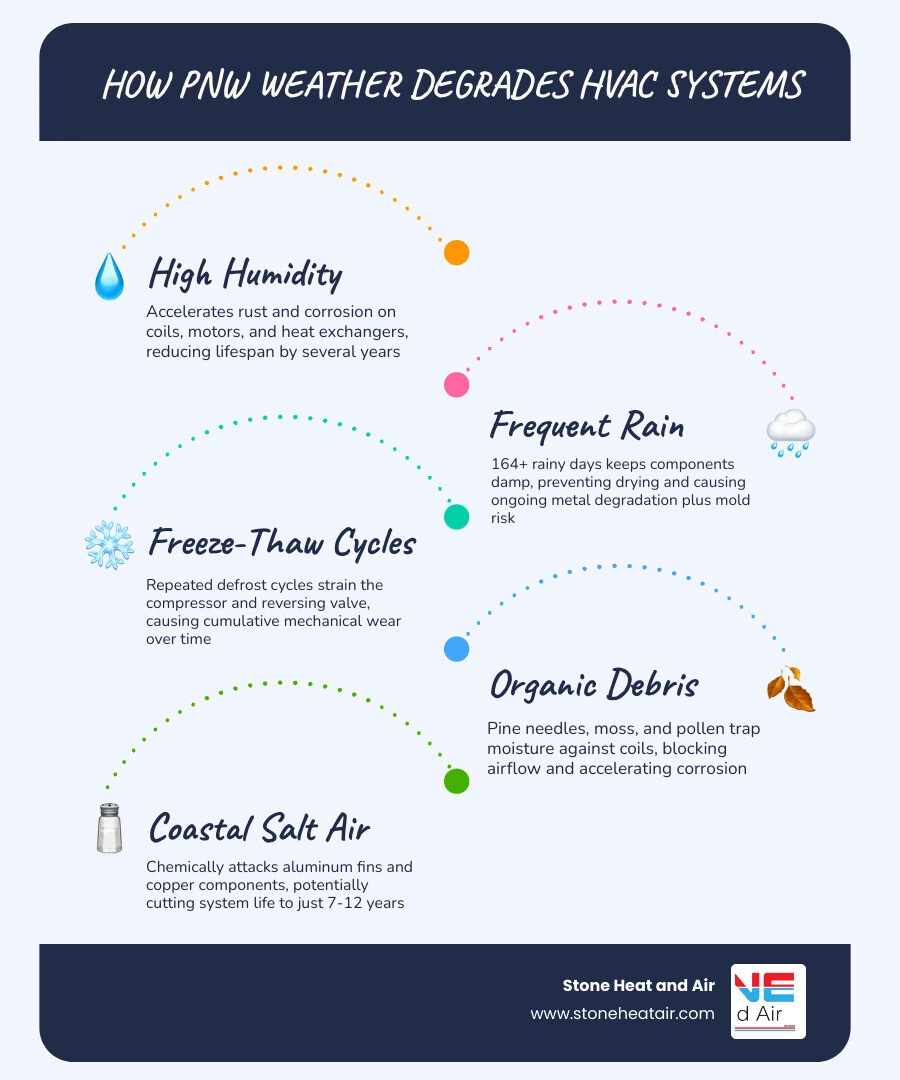
Here is a quick summary of the key ways PNW weather degrades HVAC systems:
• High humidity (75%+) — Impact on HVAC System: Accelerates rust and corrosion on coils, motors, and heat exchangers — Lifespan Effect: Reduces lifespan by several years without protection
• 164+ rainy days per year — Impact on HVAC System: Keeps components perpetually damp, preventing normal drying — Lifespan Effect: Ongoing metal degradation and mold risk
• Freeze-thaw cycles — Impact on HVAC System: Forces repeated defrost cycles, straining the compressor and reversing valve — Lifespan Effect: Mechanical wear adds up over time
• Organic debris (pine needles, moss, pollen) — Impact on HVAC System: Traps moisture against coils like a wet blanket — Lifespan Effect: Blocks airflow and accelerates corrosion
• Coastal salt air — Impact on HVAC System: Chemically attacks aluminum fins and copper components — Lifespan Effect: Can cut system life to just 7-12 years
• Wildfire smoke events — Impact on HVAC System: Clogs filters rapidly, forces system to overwork — Lifespan Effect: Reduces efficiency and strains internal components
Most people in the Rogue Valley and broader Pacific Northwest assume their HVAC system is fine because the weather never feels extreme. It rarely hits brutal cold snaps or scorching desert heat. But that mild reputation is misleading. Persistent dampness, long heating seasons, and frequent temperature swings between morning and afternoon create a kind of slow, grinding stress on HVAC equipment that drier climates simply do not produce.
A heat pump in a dry inland climate might coast along for 18 to 20 years with basic care. That same system installed in a high-humidity, heavily forested, or coastal PNW location faces a fundamentally different environment — one where neglected systems can see efficiency losses of 15 to 20 percent during the wettest months, and where coastal units without protective treatment can fail in as few as 7 years.
The good news is that most of this degradation is preventable. But only if you understand what is actually happening to your equipment.
How Pacific Northwest Weather Affects HVAC Lifespan
When we talk about the Pacific Northwest, we are looking at a collection of distinct microclimates. From the rain-soaked coastline of Brookings OR to the damp valleys of Roseburg OR and the Rogue Valley (including Central Point), all the way over to the higher, colder elevations of Klamath Falls OR, our weather is highly diverse. Yet, they all share environmental factors that directly influence your heating and cooling equipment.
To understand how Pacific Northwest weather affects HVAC lifespan, we first have to look at Marine Zone 4C—the official climate classification for much of our region. This zone is characterized by cool, wet winters and mild, relatively dry summers. While this sounds pleasant, it presents a serious challenge for mechanical systems.
Moisture is the primary vehicle for HVAC degradation. When outdoor humidity levels consistently hover above 75% for months on end, your outdoor condenser unit never truly has a chance to dry out. This constant state of dampness triggers chemical reactions on metal surfaces.
Copper refrigerant lines and aluminum heat-dissipating fins are highly sensitive to galvanic corrosion when moisture acts as an electrolyte. Over time, this corrosion creates microscopic pits in the coils, leading to refrigerant leaks. Once a system begins losing refrigerant, the compressor must work significantly harder and run hotter to achieve the same level of temperature control, drastically shortening its operational life.
Furthermore, we must consider how the unique geography of Southern Oregon shapes these wear patterns. To dive deeper into these regional differences, you can read our detailed guide on How Southern Oregon Climate Affects Your HVAC System.
Without routine maintenance to clean and protect these delicate components, the average lifespan of a heat pump in our region can drop significantly. While a well-cared-for system can reach up to 20 years, a neglected unit subjected to constant moisture and temperature swings may begin failing around the 10-to-12-year mark. For a complete breakdown of expected equipment longevity in our area, explore our resource on How Long Does an HVAC System Last in Southern Oregon.
The Double Whammy of High Humidity and Freeze-Thaw Cycles
In Southern Oregon, our winters are characterized by a relentless cycle: daytime temperatures hovering in the low-to-mid 40s with high humidity, followed by nighttime drops below freezing. This persistent freeze-thaw dynamic is incredibly demanding on heat pumps.
High humidity means the air is saturated with water vapor. When a heat pump extracts heat from this damp outdoor air, the moisture immediately condenses onto the cold outdoor coils. When the temperature drops, this condensation rapidly freezes into frost or solid ice.
This brings us to a fundamental concept of thermodynamics: latent heat. Because humid air holds a massive amount of water vapor, the system must work up to 25% harder to extract warmth from moisture-laden air when temperatures are between 40°F and 50°F with high humidity. To understand the physics behind this energy drain, check out our article on How Humidity Affects HVAC Energy Efficiency.
Conversely, you might wonder why winter air feels different indoors. When cold outdoor air is heated, its relative humidity drops significantly, which is why we often experience dry indoor air during the coldest months. To learn more about this seasonal shift, read our piece on Why Is Winter Air Drier.
Defrost Cycle Stress and How Pacific Northwest Weather Affects HVAC Lifespan
To prevent the outdoor unit from turning into a solid block of ice, heat pumps utilize an automatic defrost cycle. During this cycle, the system temporarily reverses its operation: it switches into cooling mode, redirecting hot refrigerant back to the outdoor coils to melt the ice.
While this process is entirely normal, the sheer volume of moisture in our climate forces systems to enter defrost mode far more frequently than they would in drier, colder regions like the Mountain West. Every time the system shifts into defrost mode, the reversing valve must physically slide to reroute the refrigerant, and the compressor experiences a sudden spike in pressure.
This constant mechanical shifting and pressure cycling acts like stop-and-go city driving on a car engine. The mechanical wear and tear accumulates rapidly, eventually leading to premature reversing valve failure or compressor burnout—often the most expensive repairs an HVAC system can face.
Winter Storms, Ice, and How Pacific Northwest Weather Affects HVAC Lifespan
When winter storms roll through places like Klamath Falls or the higher elevations of the Rogue Valley, they bring heavy snow, freezing rain, and ice accumulation. If an outdoor unit is not properly prepared or elevated, these winter elements can cause catastrophic physical damage.
Falling icicles from gutters can bend fan grilles or puncture coils, while heavy snow accumulation can choke off the system's airflow entirely. When airflow is restricted, the heat pump is forced to run continuously to meet the thermostat's demands, causing severe thermal stress on the fan motor and compressor.
To protect your system from these sudden weather events, it is essential to understand the risks and take proactive steps. Read our guides on How Snow & Ice Can Damage Your HVAC System and Common Types of Winter Storm Damage to HVAC Systems to learn what to watch out for.
Additionally, taking the time to winterize your system before the cold weather hits can save you from unexpected breakdowns. Learn how to safeguard your equipment by reading Why You Should Winterize Your HVAC System.
Environmental Stressors: From Coastal Salt Air to Wildfire Smoke
Our beautiful geographic diversity also brings localized environmental hazards that can degrade an HVAC system much faster than normal wear and tear.
For residents in coastal communities like Brookings OR, salt air corrosion is a constant battle. Saltwater mist is carried inland by coastal winds, settling directly onto the aluminum fins and copper tubes of outdoor condensers. The sodium chloride chemically attacks the aluminum, causing it to oxidize and disintegrate—a process often called "white rust."
In these coastal environments, a standard, unprotected HVAC system can see its service life cut to just 7 to 12 years. To combat this, we recommend specialized coastal coil coatings and sacrificial anodes to protect these vital components.
On the flip side, inland areas like Central Point, Roseburg, and the Rogue Valley have faced increasingly severe wildfire seasons over the last several years. Wildfire smoke is not just a health hazard for your family; it is incredibly destructive to your HVAC system.
Wildfire smoke is packed with fine particulate matter (PM2.5), sticky ash, and corrosive chemical compounds. When your system runs during a smoke event, these particulates are pulled directly into your return vents. Within days, your air filters can become completely choked with ash and soot.
When a filter is clogged, the blower motor must work twice as hard to pull air through the system, causing it to overheat and significantly shortening its lifespan. Furthermore, fine ash that slips past cheap filters can settle onto the indoor evaporator coils, mixing with normal condensation to form a sticky, acidic paste that corrodes the coils and fosters mold growth.
To understand how to navigate these summer challenges, read our expert advice on How Wildfire Season Affects Your HVAC and Air Quality and discover how to manage your system's filtration needs during these events in our article on How Wildfire Smoke Impacts HVAC Maintenance Needs.
Organic Debris and Rainwater Accumulation
With over 160 rainy days a year in many parts of the Northwest, our lush forests produce an abundance of organic debris. Pine needles, maple seeds, pollen, and moss are constantly falling from our beautiful trees.
When these organic materials land on or inside your outdoor unit, they don't just block airflow—they act like a wet blanket. Pine needles and organic matter trap moisture directly against the metal coils, preventing them from drying out even during brief sunny spells. This trapped moisture creates a micro-environment that accelerates rust and encourages the growth of moss and algae directly on the heat-transfer fins.
Regularly clearing a two-foot perimeter around your outdoor unit and washing away trapped debris is a simple but critical practice to prevent this localized corrosion.
Mitigating Degradation: Sizing, Maintenance, and System Selection
Because of our unique Marine Zone 4C climate, choosing and maintaining the right system is absolutely crucial for maximizing efficiency and equipment lifespan.
• Air-Source Heat Pump — PNW Suitability: Excellent (Gold Standard) — Key Strengths in Our Climate: Highly efficient down to 35°F; provides both heating and cooling — Vulnerabilities to Watch: Frequent defrost cycles in humid weather; requires elevation
• Ductless Mini-Split — PNW Suitability: Outstanding — Key Strengths in Our Climate: No duct loss (saves 20-30% energy); exceptional zone control and moisture removal — Vulnerabilities to Watch: Requires regular filter cleaning; outdoor head unit placement is critical
• Gas Furnace — PNW Suitability: Great for colder pockets — Key Strengths in Our Climate: Provides rapid, high-temperature heat during winter cold snaps — Vulnerabilities to Watch: Long heating seasons run the system for months, accelerating wear
Proper system sizing is another critical factor. In our humid climate, an oversized system is actually worse than an undersized one. If a system is too large for your home, it will quickly heat or cool the air and shut off. This is known as "short-cycling."
Because the system runs in short bursts, it never runs long enough to dehumidify the air. This leaves your home feeling damp and clammy while subjecting the compressor to constant startup wear—which consumes 8 to 12 percent more energy and drastically shortens its lifespan.
To ensure your system is ready to handle these seasonal transitions smoothly, check out our practical Tips for Preparing Your HVAC for Winter.
Additionally, investing in systems with variable-speed blowers or inverter technology is highly recommended for our region. These systems run continuously at lower, highly efficient speeds, providing superior humidity control and reducing the mechanical stress of constant starting and stopping.
Frequently Asked Questions about PNW HVAC Lifespan
Why does my heat pump run defrost cycles so often in the winter?
In the Pacific Northwest, high humidity combined with temperatures between 35°F and 45°F creates the perfect environment for frost to accumulate on your outdoor coils. Because the air is saturated with moisture, your heat pump must work harder to extract heat, causing the coils to drop below freezing and collect ice. The system automatically switches to defrost mode to melt this buildup, which is normal. However, if your unit is constantly in defrost mode or covered in thick, solid ice, it may indicate a failing defrost board or low refrigerant, which requires professional attention.
How often should I change my HVAC filters in the Pacific Northwest?
While standard advice suggests changing filters every 90 days, the damp conditions and seasonal challenges of our region dictate a more frequent schedule. We recommend checking your filters every 30 days. High indoor humidity can make airborne dust heavier and stickier, clogging filters faster. During summer wildfire seasons or high-pollen spring months, filters should be replaced every 30 to 45 days to prevent airflow restriction and protect your blower motor from overworking.
Does coastal salt air really cut my HVAC system's lifespan in half?
Yes, in coastal areas like Brookings OR, unprotected HVAC units frequently fail in just 7 to 12 years compared to the 15 to 20 years enjoyed by inland systems. The salt in the air chemically attacks aluminum and copper, causing rapid galvanic corrosion. Homeowners in these areas should invest in units with specialized anti-corrosive coil coatings, install protective physical barriers to block direct ocean winds, and schedule semi-annual coil washes to rinse away salt deposits.
Conclusion
The Pacific Northwest climate is incredibly beautiful, but its persistent dampness, high humidity, and seasonal temperature swings present a unique set of challenges for your home's heating and cooling systems. From the coastal breezes of Brookings to the snowy winters of Klamath Falls and the damp valleys of Roseburg and the Rogue Valley, your HVAC system works hard year-round to keep you comfortable.
At Stone Heating & Air, we are proud to serve our local communities across Southern Oregon with honest, fair dealings and meticulous attention to detail. We treat your home just like ours, providing the expert maintenance and Carrier-certified installations you need to protect your investment.
By joining our exclusive Stone Comfort Membership Club, you gain ultimate peace of mind with regular, professional tune-ups that can cut your heating and cooling costs by up to 30% and extend your system's lifespan well past the 20-year mark. Plus, with our 24/7 emergency service, we are always here for you when you need us most.
Don't let the damp Northwest weather quietly wear down your system. Schedule your seasonal HVAC maintenance with Stone Heating & Air today and ensure your home remains a cozy, efficient sanctuary all year long!