

When the Sky Turns Orange: How Wildfire Season Affects Your HVAC and Air Quality
How wildfire season affects your HVAC and air quality is something every Rogue Valley homeowner needs to understand — because the damage happens fast, often before you even realize there's a problem.
Wildfire smoke doesn't just make the air outside smell bad. It infiltrates your home, loads up your HVAC filter, coats your ductwork in soot, and pushes fine particles deep into the air your family breathes every day. And with fire season in Southern Oregon starting earlier and lasting longer each year, the stakes are higher than ever.
Here's a quick look at the main ways wildfire smoke impacts your HVAC system and indoor air:
• Clogged filters - Fine smoke particles (PM2.5) accumulate rapidly, restricting airflow and forcing your system to work harder
• Ductwork contamination - Soot and ash settle inside ducts, recirculating pollutants long after the smoke clears
• Component damage - Corrosive particles can harm sensitive electronic parts, coils, and other internal components
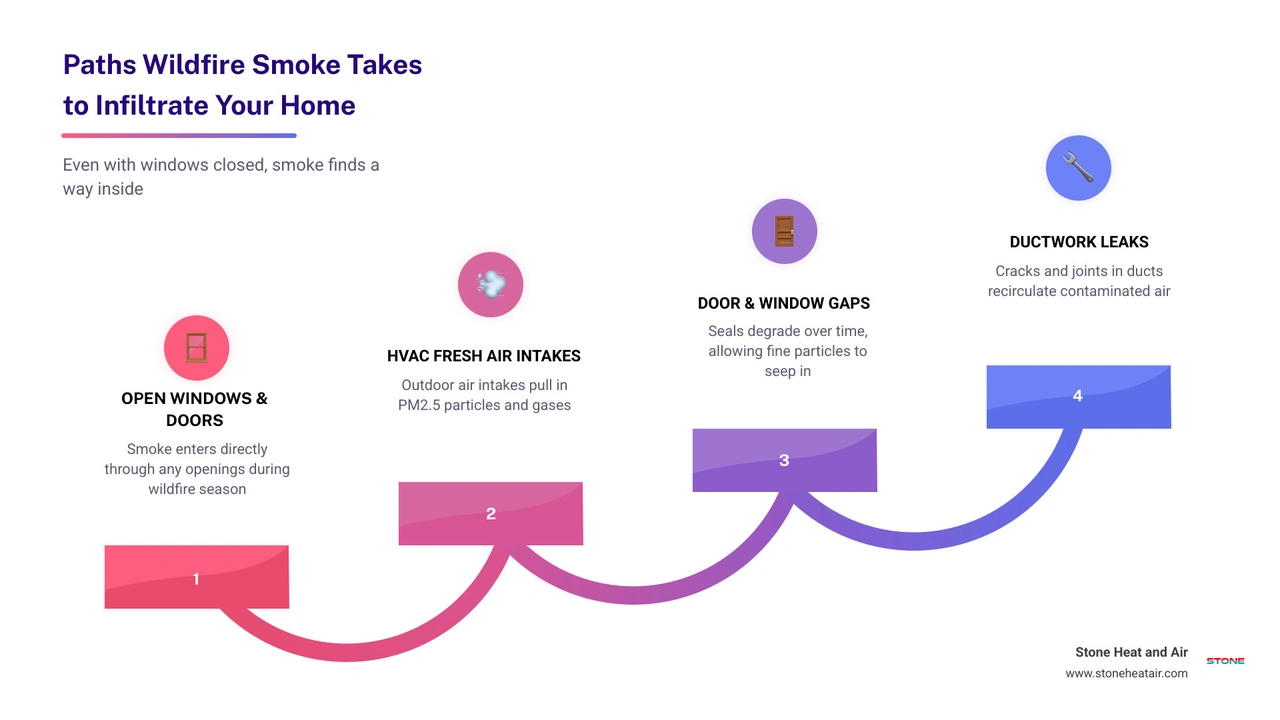
• Poor indoor air quality - Even with windows closed, nearly half of outdoor smoke can still make its way inside
• Higher energy bills - A smoke-clogged system loses efficiency, driving up utility costs
• Health risks - PM2.5 particles are small enough to enter the bloodstream directly through the lungs, posing real risks to respiratory and cardiovascular health
The good news is that with the right HVAC settings, filtration upgrades, and a bit of preparation, you can protect both your system and your family. This guide walks you through everything you need to know — before, during, and after wildfire season.
Understanding the Impact: How Wildfire Season Affects Your HVAC and Air Quality
In May 2026, we are already seeing the "resilience window" for spring maintenance closing as the summer heat approaches. Understanding how wildfire season affects your HVAC and air quality starts with a microscopic look at what is actually in that smoke. Wildfire smoke is a complex cocktail of fine particulate matter, gases, and chemicals.
The primary culprit is PM2.5—particulate matter that is 2.5 microns or smaller in diameter. To put that in perspective, a single human hair is about 70 microns thick. These particles are roughly 30 times smaller than a hair, making them small enough to bypass your body’s natural defenses and enter your bloodstream directly through the lungs.
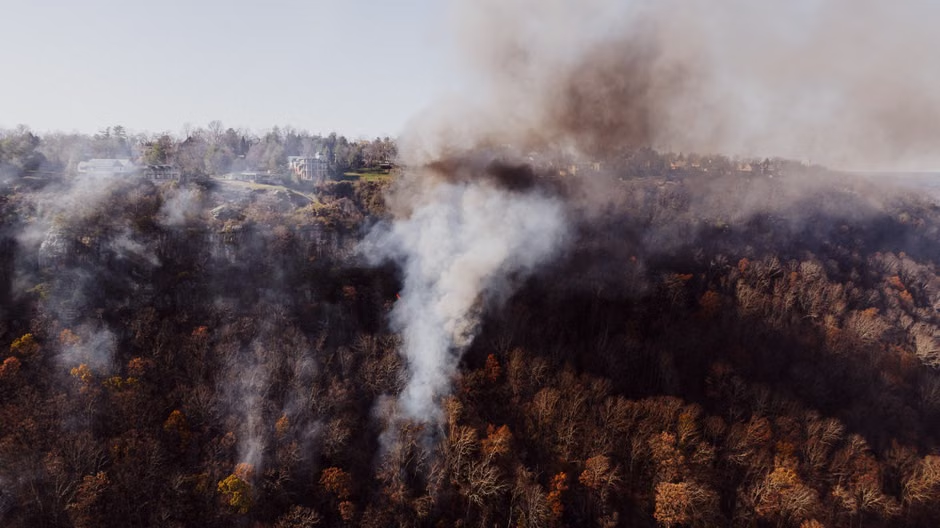
Beyond just wood ash, this smoke often contains Volatile Organic Compounds (VOCs), carbon monoxide, and even toxic chemicals from burned plastics or building materials. When these pollutants infiltrate your home, they don't just "go away." Without active filtration, they can linger for days. Clean Indoor Air Contributes To Better Health by reducing the risk of respiratory irritation, asthma flare-ups, and cardiovascular strain that occurs when your body is forced to process these toxins.
How wildfire season affects your HVAC and air quality through filter accumulation
Your HVAC filter is the front line of defense, but during a heavy smoke event, it becomes a victim of its own success. Wildfire smoke causes a rapid accumulation of fine particles that can clog a standard filter in a matter of days rather than months.
When the filter is packed with soot and ash, your system experiences restricted airflow. This forces the blower motor to work significantly harder to pull air through the blockage. As we've discussed in our guide on How Wildfire Smoke Impacts Hvac Maintenance Needs, this leads to a spike in energy consumption and higher utility costs. If left unaddressed, the strain can even lead to a complete system breakdown right when you need the cooling most.
The Hidden Toll of Smoke on Your Heating and Cooling System
While the filter takes the brunt of the damage, the rest of your system isn't immune. Smoke and ash are naturally corrosive. When fine soot passes through a low-quality filter, it settles on the evaporator coils and inside the ductwork.
This residue acts as an insulator on your coils, preventing them from effectively cooling the air. Furthermore, if you notice 6 Signs Of Poor Air Quality Inside Your Home, such as visible dust settling quickly after cleaning or a lingering campfire smell, your ducts may already be contaminated. This soot can eventually corrode sensitive electronic components, leading to expensive repairs that could have been avoided with proactive care.
Optimizing settings: How wildfire season affects your HVAC and air quality management
One of the most effective ways to manage air quality during a smoke event is knowing which buttons to push on your thermostat. Most modern systems in the Rogue Valley are designed to recirculate indoor air, but some have "fresh air intakes" that pull in outdoor air to meet ventilation standards.
During a wildfire, you want to close those fresh air dampers. Setting your HVAC to Recirculate Mode ensures you aren't inviting the smoke inside. Additionally, consider your fan settings. While "Auto" is great for energy saving, switching the fan to "On" provides continuous filtration. This keeps the air moving through your high-efficiency filter even when the AC isn't actively cooling. Following these 5 Things You Can Do To Improve Indoor Air Quality can reduce the infiltration factor of smoke by nearly half.
Advanced Filtration and Purification Strategies for Rogue Valley Homes
Standard fiberglass filters (usually rated MERV 1-4) are designed to protect the equipment from large dust bunnies, not to protect your lungs from smoke. To effectively capture wildfire particles, you need to upgrade.
We generally recommend MERV 13 filters for most residential systems during smoke season. These are capable of capturing up to 85% of PM2.5 particles. However, because they are denser, they create more "static pressure." It is vital to have a professional ensure your system's blower can handle the higher resistance.
• MERV 8 — Smoke Capture Efficiency (PM2.5): ~20% — Best Use Case: Standard dust/pollen (Not for smoke)
• MERV 11 — Smoke Capture Efficiency (PM2.5): ~65% — Best Use Case: Better residential protection
• MERV 13 — Smoke Capture Efficiency (PM2.5): ~85% — Best Use Case: Recommended for wildfire smoke
• HEPA — Smoke Capture Efficiency (PM2.5): 99.97% — Best Use Case: Hospital-grade (Requires specialized housing)
For those with severe allergies or respiratory issues, Why An Air Purifier Is Worth Investing In This Allergy Season applies equally to smoke season. Portable HEPA units can supplement your central system, especially in "clean air rooms" like bedrooms.
Enhancing protection with whole-home solutions
If you want the ultimate "set it and forget it" protection, whole-home air purification systems are the gold standard. These systems are installed directly into your ductwork and work in tandem with your HVAC.
There are 4 Ways An Air Purifier Improves Indoor Air Quality, including molecular purification that breaks down odors and VOCs that filters alone can't catch. Systems like the Lennox PureAir™ use a combination of carbon-clean filters and UV-C lights to remove over 99% of smoke particles and even neutralize viruses and bacteria. Understanding Indoor Air Quality How Improving It Can Keep You Healthy is about more than just comfort; it's about creating a sanctuary where the outside environment can't reach you.
Post-Season Recovery and HVAC Remediation
Once the skies finally clear and the rain returns to Southern Oregon, your work isn't quite done. The ash that settled during the summer doesn't disappear; it sits in your ducts and on your outdoor condenser coils.
A professional Guide To Duct Cleaning is often the best first step after a particularly bad fire season. This removes the "memory" of the smoke from your home. Additionally, your outdoor unit (the condenser) likely has a layer of ash on its fins. This ash can mix with moisture to create a corrosive paste that eats away at the metal.
The Importance Of Regular Hvac Maintenance cannot be overstated here. A post-season inspection should include a deep coil cleaning and a check of all electrical connections that may have been stressed by high heat and restricted airflow. This remediation ensures your system is ready for the winter heating season without carrying over the pollutants of the summer.
Frequently Asked Questions about Wildfire Smoke and HVAC
Should I run my air conditioner when it is smoky outside?
Yes, you should run your air conditioner, but with a few caveats. Ensure it is set to "recirculate" so you aren't pulling in smoky air. Running the AC helps dehumidify the air and, more importantly, filters the air through your HVAC filter. If you have a high-efficiency MERV 13 filter, running the AC is actually one of the best ways to clean your indoor air.
How often should I change my HVAC filter during active wildfires?
During heavy smoke events (AQI over 150), you should check your filter every 2 weeks. If the smoke is particularly dense, you might even need to change it every week. A good rule of thumb: if the filter looks grey or black, it’s time for a new one. Replacing it immediately after the smoke clears is also essential.
Can wildfire smoke damage my outdoor AC unit?
The smoke itself (the gas) won't damage the outdoor unit, but the ash and soot will. Ash can clog the delicate fins of the condenser coil, causing the unit to overheat. In the Rogue Valley, it's common for ash to accumulate heavily. We recommend a professional coil cleaning after every major fire season to prevent long-term corrosion and efficiency loss.
Conclusion
Living in the Rogue Valley means accepting that fire season is a part of our lives, but it doesn't mean you have to accept poor air quality inside your home. By understanding how wildfire season affects your HVAC and air quality, you can take proactive steps to protect your investment and your family’s health.
At Stone Heat and Air, we take pride in being the Rogue Valley’s comfort experts. Whether you are in Central Point, Medford, or anywhere in Southern Oregon, our Carrier-certified team is ready to help. From installing advanced filtration systems to providing 24/7 emergency service when the smoke gets too tough for your system to handle, we’ll treat your home like ours.
For the ultimate peace of mind, consider joining our Stone Comfort Membership Club. You’ll get the meticulous attention to detail and honest recommendations we are known for, ensuring your system is always ready for whatever the Oregon skies throw at us.
Don't wait for the smoke to arrive. If you're concerned about your home's breathability, explore our services for Indoor Air Quality Central Point OR and let us help you breathe easier today.