

Identifying a True Crisis: What Constitutes an HVAC Emergency?
Knowing what to expect during an emergency HVAC call can make a genuinely stressful situation feel a lot more manageable. Whether your furnace went silent at 2 a.m. or your AC quit during a Rogue Valley heat spike, most homeowners have no idea what actually happens once they pick up the phone — and that uncertainty makes everything worse.
Here is a quick overview of what the process looks like from start to finish:
1. You call the emergency line — A dispatcher answers 24/7, asks about your symptoms, and triages your call by urgency.
2. Safety guidance is given over the phone — If there is a gas smell, burning odor, or electrical issue, you will be told exactly what to do before the technician arrives.
3. A technician is dispatched — Response priority is based on safety risk, outdoor temperatures, and whether vulnerable residents are in the home.
4. On-site assessment begins — The technician checks for safety hazards first, then moves to a full system diagnosis.
5. Repair or temporary stabilization happens — Many repairs are completed on the same visit. If a part is unavailable, the technician will stabilize your system and return.
6. Final testing is performed — Before leaving, the technician runs a full system cycle to confirm safe, proper operation.
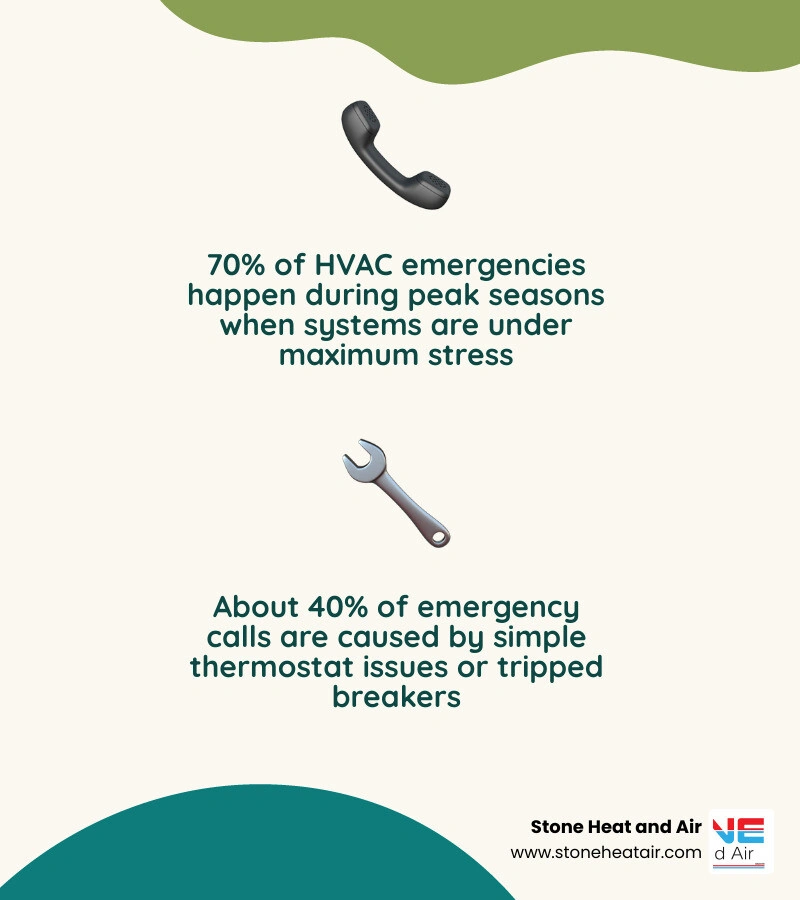
It is worth knowing that about 70% of homeowners experience an HVAC breakdown during peak seasons — exactly when systems are under the most stress and technicians are busiest. And roughly 40% of those emergency calls trace back to something as simple as a thermostat malfunction or a tripped breaker. That does not make the situation less stressful, but it does mean that fast, knowledgeable help can often resolve things quicker than you might expect.
At Stone Heat and Air, our team serves the Rogue Valley with 24/7 emergency response, showing up ready to diagnose, repair, and restore your comfort — treating your home with the same care we would want for our own.
Quick look at what to expect during an emergency hvac call:
• how 24 7 emergency service protects your family
• how to prevent hvac emergencies with maintenance
• signs you need immediate hvac help
When your heating or cooling system acts up, it is natural to want it resolved immediately. However, to ensure that critical safety issues are handled first, we must distinguish between standard repair needs and true, immediate crises. Understanding What Constitutes an HVAC Emergency helps protect your family and property during extreme Southern Oregon weather.
A true emergency is defined by risks to health, life safety, or property integrity. Here are the primary situations that qualify for immediate, 24/7 response:
• Critical Safety Hazards: This includes natural gas leaks (indicated by a distinct "rotten eggs" smell from added mercaptan), active carbon monoxide alarms, visible smoke, sparks, or a persistent burning plastic odor from your equipment.
• Extreme Temperatures: In our region, seasonal weather can be unforgiving. If outdoor temperatures drop below freezing in winter or climb past 90°F in summer, a complete system failure ceases to be a mere inconvenience. It becomes a health hazard, particularly for households with infants, elderly family members, or individuals with chronic medical conditions.
• Property Damage Risks: A severely clogged condensate line can back up and dump gallons of water into your drywall, ceilings, or flooring. Similarly, a total furnace failure during a winter freeze can cause your water pipes to burst, leading to catastrophic water damage.
When you understand What Causes HVAC Emergencies, it is easier to spot these warning signs early. Our dispatchers use these guidelines to triage incoming calls. This ensures that a family shivering in freezing temperatures or a home facing a major electrical hazard receives priority dispatch over a household experiencing minor, uneven cooling in one bedroom.
• Emergency Service — Typical Response Window: Immediate Dispatch (24/7) — Common Scenarios: Gas leaks, sparking wires, complete failure in extreme weather (<35°F or >90°F), active water leaks. — Priority Level: High (Life-Safety & Property Risk)
• Standard Repair — Typical Response Window: Scheduled Business Hours — Common Scenarios: Squeaking noises, minor airflow issues, system short-cycling in mild weather. — Priority Level: Medium (Comfort-Related)
• Routine Maintenance — Typical Response Window: Pre-Scheduled Appointment — Common Scenarios: Seasonal tune-ups, filter changes, system efficiency checks. — Priority Level: Standard (Preventative Care)
Immediate Safety and Preparation Steps Before the Technician Arrives
Once you have made the call and your emergency technician is on the way, there are several steps you can take to keep your home safe and speed up the repair process.

First and foremost, prioritize safety. If you smell gas, see smoke, or notice sparks coming from your indoor or outdoor unit, shut down the system at the thermostat and the main circuit breaker immediately. If a natural gas leak is suspected, evacuate everyone from the home immediately and call emergency services from a safe distance before calling us.
If there are no immediate safety hazards, you can perform a few basic troubleshooting checks. About 40% of HVAC emergencies actually start with thermostat malfunctions or power issues. Check to see if your thermostat display is blank—if so, replacing the batteries might solve the problem instantly. Next, inspect your electrical panel to see if a circuit breaker has tripped. If it has, reset it once. If it trips again immediately, do not attempt to reset it a second time, as this indicates a serious electrical fault that requires our attention.
While waiting, you can prepare the workspace to help our technician get straight to work:
• Clear the Access Paths: Ensure there is at least a three-foot clearance around your indoor air handler, furnace, and outdoor condenser unit. Clear away stored boxes, clutter, or overgrown brush.
• Secure Your Pets: Emergency repairs can involve open electrical panels and moving parts. Keep your dogs or cats in a secure, quiet room so they stay safe and our technician can work without distraction.
• Gather System Information: If possible, write down the make, model, and approximate age of your system, along with any previous maintenance records.
• Document the Symptoms: Note down exactly when the system stopped working and whether you heard any unusual noises—such as grinding, screeching, or banging—before the failure.
If your system goes out during a hot summer afternoon, you can find practical advice on keeping your household safe and comfortable by reading Staying Cool in an HVAC Emergency: Tips and Tricks.
What to Expect During an Emergency HVAC Call: The Step-by-Step Process
When our technician arrives at your home, you can expect a structured, professional process designed to restore safety and comfort as quickly as possible. We treat your home like our own, which means our technicians will present identification, wear protective shoe covers, and use drop cloths to protect your floors.
Every emergency visit follows a precise sequence:
1. Initial Safety Assessment: Before looking at the mechanical components, the technician performs a sweep for immediate hazards, such as gas leaks, carbon monoxide levels, or unsafe electrical wiring.
2. Diagnostic Troubleshooting: Using specialized testing equipment, the technician isolates the root cause of the failure.
3. Transparent Communication: Once the problem is identified, we will explain the issue in clear, everyday language, presenting your options so you can make an informed decision.
4. Repair or Stabilization: Depending on the issue and parts availability, we will either complete a permanent repair or safely stabilize your system.
5. Quality Assurance and Testing: We run the system through a full operating cycle to verify that all safety controls, airflow parameters, and electrical draws are within manufacturer specifications.
This meticulous approach is part of How 24/7 Emergency Service Protects Your Family, ensuring that we never leave your home with a system that poses a hidden safety risk.
The Diagnostic Phase: What to Expect During an Emergency HVAC Call
The diagnostic phase typically takes between 30 and 90 minutes. During this window, the technician does not just look at the part that stopped working; they look at the system as a whole to identify any cascading failures.
To find the exact issue, the technician will perform:
• An Electrical Inspection: Using a digital multimeter, they test voltage, inspect wiring connections, and check the health of capacitors, contactors, and relays.
• Refrigerant Level Measurements: For air conditioners and heat pumps, pressure gauges are connected to check for leaks or restrictions in the refrigerant lines.
• Airflow and Static Pressure Testing: Blocked airflow can cause evaporator coils to freeze or furnaces to overheat and shut down. Technicians check blower motors, fan belts, and filter conditions.
• Combustion and Flue Analysis: On gas furnaces, we use specialized detectors to ensure the heat exchanger is not cracked and that combustion gases are venting safely outside.
Repair Timelines: What to Expect During an Emergency HVAC Call on Your Property
Once the diagnosis is complete, the actual repair timeline depends on the complexity of the issue. Most emergency repairs are successfully completed within 1 to 3 hours of the technician's arrival.
Simple component failures—such as a bad capacitor, a blown fuse, a failed ignitor, or a faulty thermostat—can usually be fixed on the spot. Our service vehicles are stocked as "rolling warehouses" with a wide inventory of common replacement parts to maximize the chances of a single-visit repair.
However, if your system has suffered a major failure—such as a burnt-out compressor, a cracked heat exchanger, or a failed blower motor that requires a specialized manufacturer part—a same-day permanent fix may not be possible. In these scenarios, our priority shifts to temporary stabilization. We will secure the equipment to ensure it is completely safe, and we will work to provide temporary heating or cooling solutions to keep your household safe until we can return with the necessary parts.
Preventing Future Breakdowns with Proactive Maintenance
While knowing what to expect during an emergency hvac call keeps you prepared, the best emergency is the one that never happens. Investing in regular, preventative maintenance is the single most effective way to keep your home comfortable year-round. In fact, homeowners who prioritize regular maintenance are 50% less likely to experience a sudden emergency breakdown.
Furthermore, a well-maintained heating and cooling system can easily last 15 to 20 years, whereas a neglected unit under constant strain may suffer a catastrophic failure in as little as 8 to 10 years. Routine checkups catch minor issues—like a weakening capacitor or a slightly dirty sensor—before they escalate into expensive, middle-of-the-night system failures.
To make preventative care effortless, we offer our exclusive Stone Comfort Membership Club. Members receive pre-scheduled seasonal tune-ups, priority emergency response, and the peace of mind that comes with knowing your system is running at peak efficiency.
Here is a quick checklist of the essential preventative maintenance tasks that keep your system healthy:
• Change Air Filters Regularly: Replace your filters every 1 to 3 months to prevent airflow restrictions that strain your compressor and blower motor.
• Keep Outdoor Units Clear: Maintain at least a two-foot clearance around your outdoor condenser unit, keeping it free of grass clippings, leaves, and weeds.
• Schedule Bi-Annual Tune-ups: Have a professional inspect your cooling system in the spring and your heating system in the fall.
• Monitor System Noises: Never ignore new or unusual sounds. Squealing, scraping, or rattling are early warning signs that a component is wearing out.
Frequently Asked Questions about Emergency HVAC Services
What should I do if I smell gas or burning odors near my system?
If you smell natural gas (a rotten egg odor) or see smoke coming from your system, evacuate your home immediately. Do not flip any light switches, use your phone, or start your car in the garage, as a single spark could ignite the gas. Once you are a safe distance away from the property, call 911 and your gas utility provider. After the utility company has declared the site safe, contact us to perform a thorough safety inspection and repair of your heating system.
Can I stay in my home while waiting for the emergency technician?
In most cases, yes, provided there are no active safety hazards like gas leaks or carbon monoxide risks. While you wait, keep your home comfortable by closing your blinds and using ceiling fans during summer outages. In winter, gather your family in a central room, close the doors to unused spaces to retain heat, and wear layers. However, if indoor temperatures reach extreme levels (above 95°F or below 50°F) and you have vulnerable residents in the house, consider waiting at a neighbor's home or a local community center.
How does commercial emergency service differ from residential?
Commercial systems operate on a much larger scale and often utilize complex multi-zone configurations. When a commercial system fails, it affects more than just personal comfort—it can threaten business continuity, lead to lost productivity, or risk spoiling valuable inventory. If you manage a local business, understanding How to Handle Your Commercial HVAC Emergency is vital to protecting your operations and getting your facility back up and running with minimal disruption.
Conclusion
A sudden heating or cooling failure can be incredibly stressful, but knowing what to expect during an emergency hvac call puts you back in control. From the moment you contact our dispatch team to the final safety testing before our technician leaves, our goal is to resolve your crisis with speed, transparency, and expert craftsmanship.
We are proud to serve communities throughout Southern Oregon and the Rogue Valley, providing reliable support when you need it most. If your system is acting up or has failed completely, don't wait in discomfort. Reach out to our team of dedicated professionals for rapid, 24/7 support:
• Emergency HVAC Service Medford OR
• Emergency HVAC Service Central Point OR
• Emergency HVAC Service Grants Pass OR
• Emergency HVAC Service Ashland OR
• Emergency HVAC Service Rogue River OR
For immediate assistance or to learn more about how we can protect your home's year-round comfort, Contact Stone Heat and Air for 24/7 Emergency Service today.