

Why Knowing When Should You Get Your Air Ducts Cleaned Could Save Your Home's Air Quality
Most homeowners in the Rogue Valley don't think about their air ducts until something goes wrong — dust that keeps coming back no matter how often you clean, a musty smell when the heat kicks on, or allergy symptoms that seem worse indoors than outside. The truth is, your ductwork quietly circulates nearly all the air your family breathes, and over time it collects dust, pollen, pet dander, mold spores, and more.
Here's a quick answer to help you decide right now:
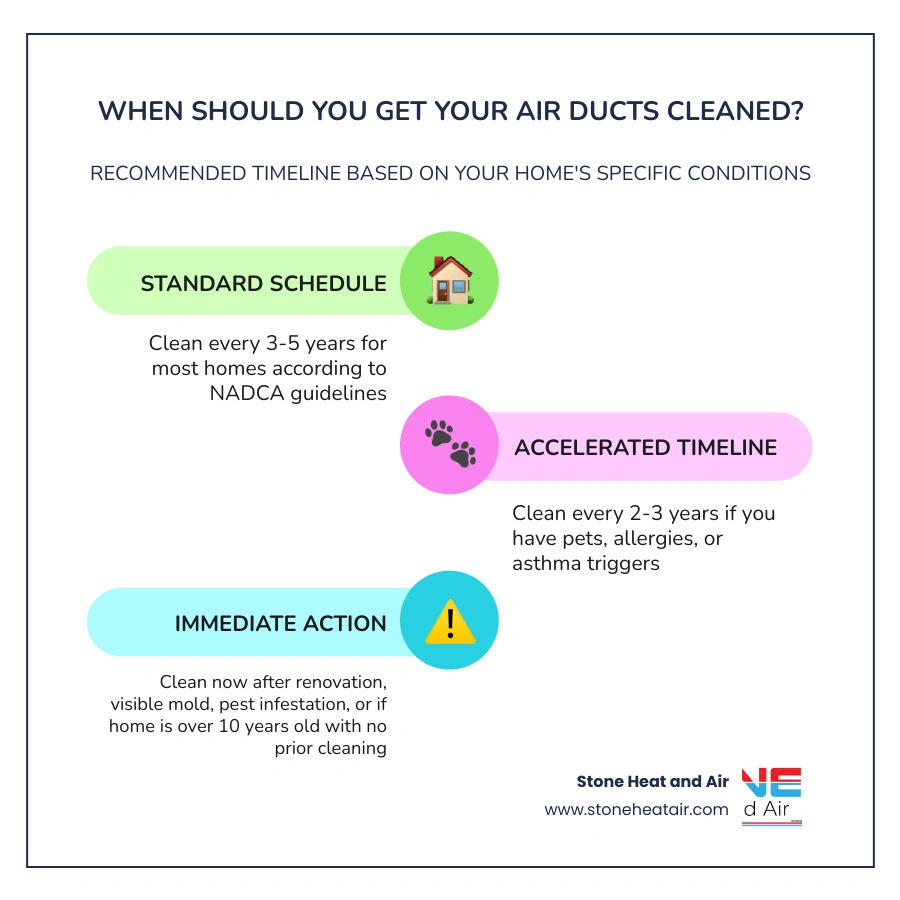
When to get your air ducts cleaned:
• Every 3 to 5 years — standard recommendation for most homes (NADCA guideline)
• Every 2 to 3 years — if you have pets, allergies, or asthma
• Immediately — after a renovation, if you see visible mold, notice a pest infestation, or have never had your ducts cleaned and your home is over 10 years old
• As soon as possible — if dust is puffing from registers, musty odors appear when the system runs, or your energy bills have spiked without explanation
Those are the core triggers. But the right timing for your home depends on a few important factors — and getting it wrong in either direction has real consequences, from poor indoor air quality to an overworked HVAC system.
According to the EPA, indoor pollutant concentrations can run 2 to 5 times higher than outdoor levels. And with one in four U.S. buildings classified as "sick" due to poor indoor air quality, what's happening inside your ductwork matters more than most people realize.
When should you get your air ducts cleaned terms you need:
• dryer vent lint buildup dangers explained
• how dirty ducts affect your hvac efficiency
• how duct and dryer vent cleaning improve your home
When Should You Get Your Air Ducts Cleaned? The Standard Timeline
If your home has standard heating and cooling needs, you don't need to have your ducts cleaned every single year. In fact, doing so is rarely necessary unless you have unique environmental triggers. Instead, industry experts and authoritative bodies have established a reliable baseline for the average household.
The National Air Duct Cleaners Association (NADCA) recommends that homeowners have their air ducts professionally cleaned every three to five years. This standard timeline is designed to prevent the gradual accumulation of everyday household dust, dead skin cells, hair, and outdoor particulates that naturally settle in your ductwork over time.
However, many HVAC specialists advise narrowing that window to every two to three years if you live in an area with high seasonal pollen, experience long heating and cooling seasons, or share your home with shedding pets. For a deeper dive into how these general timelines apply to different households, check out our guide on How Often Should You Have Your Air Ducts Cleaned.
It is also important to consider the age of your property. If you have lived in your home for more than five years and have no record of a prior duct cleaning, your system is likely overdue. Over a decade or more, several pounds of dust and debris can settle inside the return and supply lines, creating a thick layer of grime that standard air filters cannot catch. To help you evaluate your home's current status, you can read more about identifying your specific maintenance needs in our article on When Should I Clean My Air Ducts.
Key Warning Signs Your Home Needs Immediate Duct Cleaning
Waiting for a specific date on the calendar isn't always the safest approach. Sometimes, your HVAC system will send clear physical signals that it is struggling with heavy contamination. Ignoring these signs can lead to degraded indoor air quality and unnecessary wear and tear on your heating and cooling equipment.
Keep an eye out for these primary warning signs that indicate your home requires prompt professional attention:
• Visible Dust Clouds: If you notice a small puff of dust exiting your supply registers every time your furnace or air conditioner kicks on, your ducts are holding a substantial amount of loose debris.
• Thick Grime on Registers: Take a look at your vent covers and return air grilles. If they are coated in a fuzzy, dark layer of dust and pet hair, it is a strong indicator that the internal ductwork looks even worse.
• Musty or Stale Odors: A persistent musty, earthy, or damp smell coming from your vents when the air is blowing usually points to mold or mildew growth within the system.
• Pest Infestations: If rodents or insects have made their way into your ductwork, they leave behind droppings, nesting materials, and unpleasant odors. Duct cleaning should always be scheduled immediately after pest control has successfully resolved the active infestation.
• Uneven Airflow: When certain rooms feel drafty or receive significantly less airflow than others, it could mean that thick blocks of debris or restricted dampers are clogging specific branches of your duct system.
Identifying these issues early can save you from more complex system failures down the road. For a comprehensive breakdown of what to look for, read our guide on Signs You Need to Schedule Professional Duct Cleaning.
Worsening Allergies and When Should You Get Your Air Ducts Cleaned
For residents living in the Rogue Valley, seasonal allergies are a familiar struggle. Between high local pollen counts, dense tree cover, and dry summer winds, our outdoor air is filled with irritants. When these particles enter your home, they settle directly into your carpets, furniture, and eventually, your ductwork.
If you or your family members suffer from asthma, chronic allergies, or other respiratory sensitivities, the standard three-to-five-year cleaning timeline may not be sufficient. In these households, experts recommend scheduling a professional cleaning every two years.
When your HVAC system runs, it recirculates indoor air multiple times a day. If your ducts are coated with pet dander, mold spores, and pollen, your heating and cooling system essentially acts as an allergen distributor, continuously stirring up the very particles you are trying to avoid. Removing this accumulated buildup provides a clean baseline for your indoor air, helping to reduce daily symptoms and make your living spaces far more comfortable. If you are looking to restore the air quality in your home, you can learn more about our local solutions by visiting our Air Duct Cleaning Services Rogue Valley page.
Post-Renovation Dust and When Should You Get Your Air Ducts Cleaned
A major home remodel is exciting, but it is also incredibly messy. Activities like sanding drywall, cutting tile, grinding concrete, or installing new flooring generate massive quantities of ultra-fine dust.
Even if you are diligent about closing off doors and covering furniture, this microscopic construction dust inevitably gets pulled into your return vents. Once inside, it can bypass standard fiberglass filters and coat the internal surfaces of your ductwork, the furnace blower motor, and the sensitive air conditioning coils.
Drywall dust is particularly problematic because it contains chemically processed gypsum and binders that can severely irritate your lungs and restrict airflow within your system. If you have recently completed any major structural updates, you should schedule a professional duct cleaning immediately after the construction work wraps up. To protect your investment and prevent renovation dust from causing premature system wear, read our advice on how to Protect Your HVAC System from Dust and Dirt.
How Dirty Ducts Impact Your HVAC Efficiency and Air Quality
Many homeowners view duct cleaning purely as a cosmetic task to reduce household dust. While a cleaner home is certainly a fantastic benefit, the mechanical impact on your heating and cooling system is even more significant.
When dirt, pet hair, and debris accumulate inside your ductwork, they create physical friction and restrict the smooth flow of air. Your system has to work much harder and run for longer periods to push conditioned air into your living spaces. This constant strain accelerates the wear and tear on your blower motor, heat exchanger, and compressor, which can dramatically shorten the overall lifespan of your expensive HVAC equipment.
Furthermore, when dust settles on your air conditioner's indoor evaporator coil, it forms an insulating barrier. This barrier prevents efficient heat transfer, which can reduce the cooling efficiency of your system by up to 30%. In other words, you end up paying significantly more on your monthly utility bills for a system that is struggling to keep you comfortable.
To understand how clean ductwork keeps your utility bills in check, read our detailed article on How Dirty Ducts Affect Your HVAC Efficiency. Additionally, if your ducts are physically damaged or leaking, they can pull in dirty air from crawlspaces or attics, compounding your air quality issues. You can find out more about this dynamic by reading Why Are Ductwork Leaks Bad for Indoor Air Quality.
Below is a quick comparison of how clean versus dirty ductwork affects your home's comfort and system performance:
• Airflow Resistance — Clean Ductwork: Low; air moves freely and quietly — Dirty Ductwork: High; restricted airflow strains the blower
• HVAC System Lifespan — Clean Ductwork: Maximized; minimal mechanical strain — Dirty Ductwork: Reduced; components wear out prematurely
• Energy Consumption — Clean Ductwork: Optimal; runs on standard, efficient cycles — Dirty Ductwork: Elevated; system runs longer to reach target temps
• Indoor Air Quality — Clean Ductwork: High; minimal airborne dust and allergens — Dirty Ductwork: Poor; continuous recirculation of contaminants
• AC Coil Heat Transfer — Clean Ductwork: Excellent; prevents ice buildup and short-cycling — Dirty Ductwork: Degraded; can lower cooling efficiency by up to 30%
How to Maintain Clean Air Ducts Over Time
Once your air ducts have been professionally cleaned, you will want to keep them in peak condition for as long as possible. Fortunately, a few simple, routine habits can significantly extend the time between professional cleanings and keep your indoor air fresh.
Here are the most effective ways to maintain clean ductwork:
• Change Your Air Filters Regularly: This is the single most important step you can take. Check your filter once a month and replace it at least every 90 days — or every 30 to 60 days if you have shedding pets.
• Upgrade Your Filter Quality: Switch from cheap, flat fiberglass filters to high-quality pleated filters with a MERV (Minimum Efficiency Reporting Value) rating between 8 and 11. These filters are highly effective at capturing fine dust, pet dander, and pollen before they can enter your duct system.
• Keep a Clean Home: Vacuum your carpets weekly using a vacuum equipped with a HEPA filter, and dust hard surfaces regularly. The less dust and hair floating around your living spaces, the less your HVAC system will pull into the return vents.
• Manage Indoor Humidity: Keep your home's relative humidity between 30% and 50%. This range is comfortable for humans but discourages the growth of mold and dust mites inside your ductwork.
• Schedule Annual HVAC Maintenance: Having a professional inspect and tune up your heating and cooling system before the summer and winter seasons ensures that all components, including the blower motor and coils, stay clean and operate reliably.
By taking these preventative steps, you can protect your indoor air quality year-round. For more practical tips, explore our guide on How to Keep Your HVAC Ducts Cleaner for Longer.
Frequently Asked Questions About Duct Cleaning
Can I clean my air ducts myself?
While there are plenty of household maintenance tasks you can handle on your own, thorough duct cleaning is not one of them. Standard household vacuum cleaners and shop vacs simply do not have the suction power or the hose length required to reach deep into your ductwork. In fact, attempting to clean your ducts with improper tools can actually do more harm than good by stirring up settled dust and releasing it directly into your living spaces, or by accidentally tearing flexible ducting.
Professional duct cleaning requires specialized, high-powered negative pressure vacuum systems and mechanical agitation tools. These commercial-grade machines safely draw all dislodged dust and debris directly out of your home without allowing any of it to escape into your rooms. To learn more about how a professional, whole-system clean is performed, read our comprehensive Guide to Duct Cleaning.
How do I know if my ducts are leaking instead of just dirty?
Dirty ducts and leaking ducts can share similar symptoms, such as rapid dust accumulation and uneven heating or cooling. However, leaking ducts present a unique set of hazards. When seams, joints, or connections in your ductwork pull apart, they draw unconditioned, dusty air from your attic, crawlspace, or wall cavities directly into your breathing air.
Key signs of a duct leak include a sudden, unexplained spike in your energy bills, rooms that never seem to reach the temperature set on your thermostat, or a whistling or popping sound coming from your walls when the system runs. If you suspect your system is losing air, you can learn how to spot the signs by reading our guide on How to Tell If You Have an Air Duct Leak.
Does duct cleaning really reduce dust in the house?
Yes, a professional duct cleaning can noticeably reduce the amount of dust that settles on your furniture, shelves, and floors. When your ducts are heavily contaminated, every cycle of your furnace or air conditioner sends fine particles back into your living spaces. Once the supply and return lines, blower motor, and registers are thoroughly cleared of debris, your HVAC system stops recirculating that old dust, making your weekly cleaning routine much easier and keeping your home smelling fresher.
Conclusion
Understanding when should you get your air ducts cleaned is essential to keeping your home comfortable, healthy, and energy-efficient. Whether you are keeping up with the standard three-to-five-year maintenance window, addressing seasonal allergy triggers, or clearing out fine drywall dust after a beautiful home remodel, keeping your ductwork clean is a smart investment in your property and your family's health.
At Stone Heating & Air, we are proud to serve homeowners throughout Central Point, the Rogue Valley, and Southern Oregon. We approach every job with honest recommendations, meticulous attention to detail, and a simple promise: we will treat your home just like ours.
If you want to ensure your heating and cooling system is running at peak efficiency with clean, fresh air, we are here to help. You can easily request an honest assessment or set up an appointment by visiting our Schedule Professional Duct Services page.