

Why Dirty Ducts Are Quietly Draining Your HVAC System
Understanding how dirty ducts affect your HVAC efficiency is one of the most important — and most overlooked — parts of keeping your home comfortable and your energy bills under control.
Here's a quick answer if you're short on time:
How dirty ducts affect HVAC efficiency — at a glance:
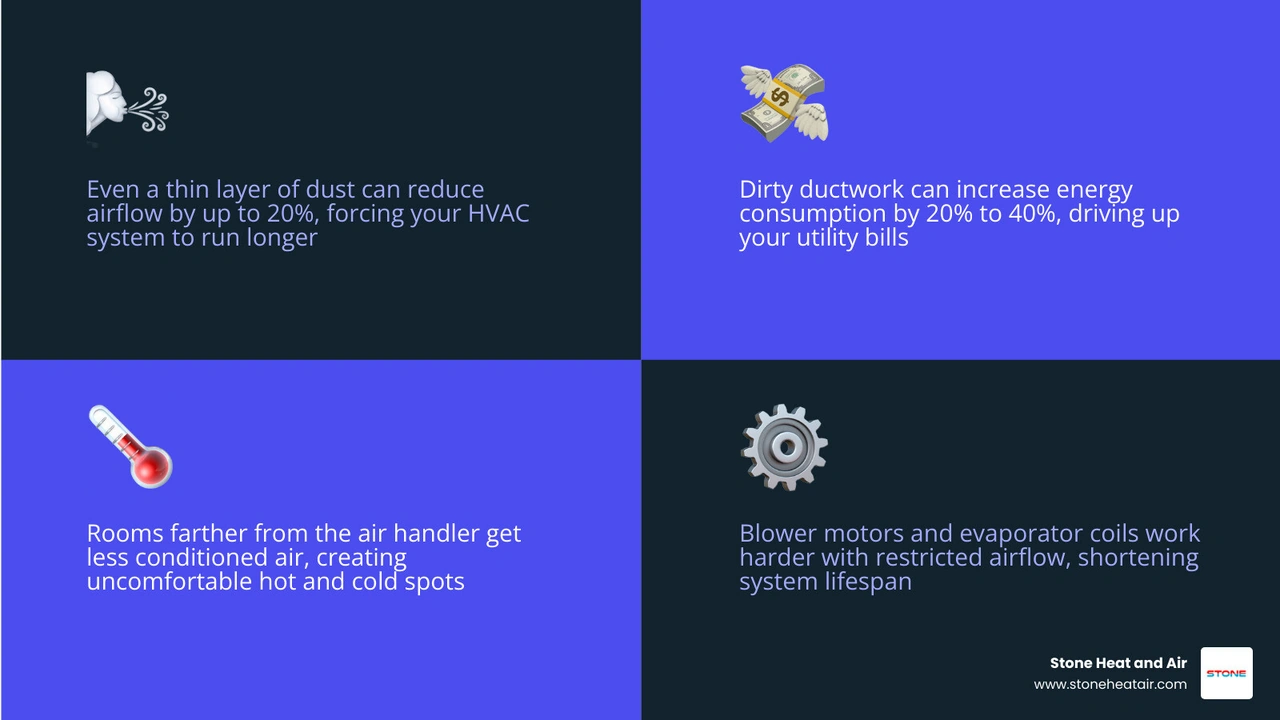
• Restricted airflow: Even a thin layer of dust can reduce airflow by up to 20%, forcing your system to run longer to reach your target temperature
• Higher energy bills: Dirty ductwork can increase energy consumption by 20% to 40%
• Uneven comfort: Rooms farther from the air handler get less conditioned air, creating hot and cold spots
• Premature wear: Components like the blower motor and evaporator coil work harder, shortening system lifespan
• Poor indoor air quality: Dust, mold spores, pet dander, and other contaminants recirculate through your living spaces every time the system runs
Most homeowners never think about their ductwork — until the energy bills creep up with no obvious explanation, or one room just never feels right no matter how they adjust the thermostat. The truth is, your ducts are the delivery system for every dollar you spend on heating and cooling. When they're dirty, that investment leaks away — literally.
For Rogue Valley homeowners, where both heating and cooling seasons put real demands on HVAC systems, keeping ducts clean isn't optional maintenance. It's the foundation of an efficient, reliable home comfort system.
The Science of Airflow: How Dirty Ducts Affect Your HVAC Efficiency
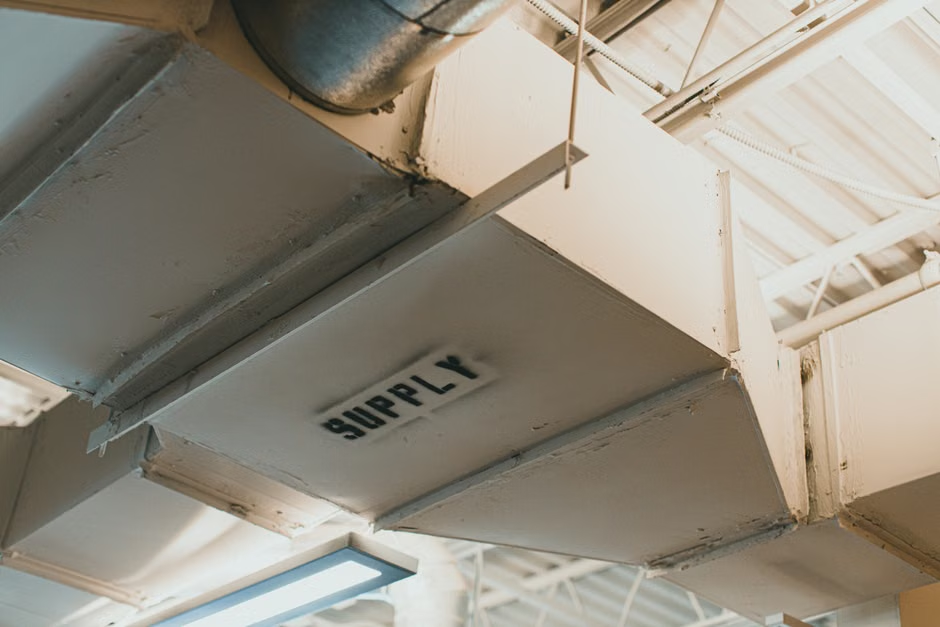
To understand how dirty ducts affect your HVAC efficiency, it helps to look at your heating and cooling system as a closed loop. Your furnace or heat pump is designed to move a very specific volume of air throughout your home. This volume is measured in Cubic Feet per Minute (CFM).
When everything is clean, air glides smoothly through your ductwork, meets minimal resistance, and returns to the system to be conditioned again. However, when dust, pet hair, construction debris, and wildfire ash accumulate inside the metal or fiberglass channels, they create a textured, rough surface.
This rough surface acts like microscopic sandpaper, creating friction. In the HVAC world, this friction increases what we call "static pressure"—the technical term for the resistance your blower motor must overcome to push air through the vents. When static pressure rises because of clogged pathways, your blower motor has to work overtime, drawing significantly more electrical current and driving up your monthly utility bills.
Over time, this continuous strain degrades the overall performance of your entire system. This is why The Importance of Having Ductwork Inspected by HVAC Pros cannot be overstated; catching static pressure issues early prevents a cascade of mechanical failures.
Understanding How Dirty Ducts Affect Your HVAC Efficiency and Airflow
When dust sweaters build up inside your ductwork, they create a literal physical bottleneck. Studies show that even a thin, barely visible layer of dust inside your ducts can reduce overall airflow by up to 20%.
This airflow reduction triggers a classic "bottleneck effect." Because the system cannot push the designed amount of hot or cold air into your living spaces, the rooms furthest from your air handler suffer the most. You might notice that while your living room feels perfectly fine, a back bedroom or upstairs office feels like a sauna in July or an icebox in January.
Before you start closing registers to force air to those distant rooms, be careful. Closing too many vents actually worsens static pressure and can damage your system. Instead, check out these Simple Tips for Redirecting Your Air Vents Properly to optimize the airflow you do have.
The Financial Impact: How Dirty Ducts Affect Your HVAC Efficiency and Energy Bills
The mechanical strain of dirty ducts translates directly into financial losses on your monthly utility bills. When airflow is restricted, your HVAC system has to run much longer cycles to satisfy your thermostat settings. If a typical cooling cycle should take 15 minutes, a system choked by dirty ducts might run for 25 to 30 minutes to achieve the exact same temperature drop.
According to research from the National Air Duct Cleaners Association (NADCA) and the U.S. Department of Energy, dirty ductwork can increase your system's energy consumption by 20% to 40%. For the average household, this translates to hundreds of dollars in wasted energy every single season.
To put this in perspective, look at how dust levels correlate with system performance metrics:
• Clean — Average Airflow (per Ton of AC): ~400 CFM — Energy Consumption Increase: Baseline (0% increase) — Typical Filter Life: 60–90 days
• Moderate Dust — Average Airflow (per Ton of AC): ~300 CFM — Energy Consumption Increase: 10% to 15% increase — Typical Filter Life: 30–45 days
• Severe Accumulation — Average Airflow (per Ton of AC): <250 CFM — Energy Consumption Increase: 20% to 40% increase — Typical Filter Life: Less than 20 days
Compounding this issue is the fact that many homes with dirty ducts also suffer from physical leaks. The average home loses 20% to 30% of its conditioned air through gaps and tears in the ductwork. When you combine dirty, restricted ducts with physical leaks, your system is practically throwing money away into your attic or crawlspace. Learning How to Tell if You Have an Air Duct Leak is a crucial step in stopping this double-whammy of energy waste.
Key Signs Your Rogue Valley Home Needs Duct Cleaning
Because ductwork is hidden behind drywall, under floorboards, and in attics, it is easy to ignore. However, your home will drop several clear hints when it is time to address the buildup inside.
Here are the most common warning signs that your ducts are overdue for a professional cleaning:
• Visible Dust Around Vents: If you notice dark, dusty rings or "cobwebs" clinging to your supply registers, or if a fine layer of dust settles on your furniture within 24 hours of cleaning, your ducts are likely full of circulating debris.
• Musty Odors or "Dirty Sock Syndrome": When your system kicks on, do you notice a stale, damp, or musty smell? This is often caused by moisture mixing with organic dust inside the dark environment of your ducts, creating a breeding ground for mold and bacteria.
• Unexplained Spikes in Utility Bills: If your local utility rates haven't changed but your monthly bills are climbing compared to the same month last year, your system is working harder to overcome airflow restrictions.
• Worsening Allergy or Respiratory Symptoms: If family members experience increased sneezing, coughing, watery eyes, or asthma flare-ups specifically when they are resting indoors, the HVAC system is likely recirculating concentrated allergens.
Recognizing these symptoms early can save you from both high energy bills and unnecessary discomfort. If you are experiencing any of these issues, it is highly recommended to read through our detailed checklist of Signs You Need to Schedule Professional Duct Cleaning.
The Hidden Toll on HVAC Equipment Lifespan and Components
While the immediate impact of dirty ducts is felt in your wallet through higher energy bills, the long-term threat is to the expensive mechanical components of your heating and cooling system.
When your ducts are heavily contaminated, that dust doesn't stay put. It migrates backward and forward, settling directly onto critical internal parts:
1. The Evaporator Coil: Your air conditioner or heat pump relies on the evaporator coil to absorb heat from your indoor air. When a blanket of dust settles on this coil, it acts as an insulating barrier. The system can no longer transfer heat efficiently, which often causes the coil to freeze over into a solid block of ice, completely shutting down your system during a hot summer afternoon.
2. The Blower Motor: Forced to pull air through a restricted system, the blower motor runs hotter and draws more amperage. This extra heat breaks down the motor’s internal lubrication, leading to premature bearing failure and burned-out motors.
3. The Heat Exchanger: In a gas furnace, restricted airflow prevents heat from being swept away from the heat exchanger quickly enough. This causes the metal to overheat, expand, and contract excessively, which can eventually lead to cracks. A cracked heat exchanger is a severe safety hazard that can leak dangerous carbon monoxide into your home.
Additionally, poor airflow combined with humidity can lead to condensation pooling in areas it shouldn't. Understanding the relationship between moisture and airflow is key to protecting your equipment; learn more about this by reading Sweating it Out: Condensation in Air Ducts and How to Prevent It.
Frequently Asked Questions About Duct Maintenance
How often should I have my air ducts professionally cleaned?
For most residential properties in Southern Oregon, having your air ducts professionally cleaned every 3 to 5 years is the industry standard. However, you should consider moving up this timeline if you have shedding pets, family members with severe allergies or asthma, or if you have recently completed a major home renovation project that generated high amounts of drywall dust.
To help plan your home maintenance schedule, explore our guides on How Often Should You Have Your Air Ducts Cleaned and When is the Best Time to Have Your Air Ducts Cleaned.
What specific contaminants accumulate inside dirty ductwork?
Ductwork acts as a collection basin for anything that floats through your indoor air. Over the years, this includes:
• Pollen tracked in from outdoors
• Pet dander and hair
• Dead skin cells (the primary component of household dust)
• Mold and mildew spores
• Volatile Organic Compounds (VOCs) from household cleaners, paints, and new furniture
• Fine particulate matter from local wildfire smoke
When your duct system has leaks, it can pull even worse contaminants from your crawlspace or attic—such as insulation fibers or pest droppings—directly into your breathing air. This is why addressing leaks is so critical; find out more in our article on Why Are Ductwork Leaks Bad for Indoor Air Quality.
How can I prevent future duct contamination?
While you cannot stop dust from existing, you can dramatically slow down how quickly it builds up in your system:
• Upgrade Your Air Filters: Use high-quality pleated filters with an appropriate MERV rating (typically MERV 8 to 11 for standard homes) to capture smaller particles before they enter the ductwork.
• Change Filters Regularly: Replace your filters every 60 to 90 days, or monthly if you have multiple pets.
• Seal Your Ducts: Professional duct sealing prevents dirty unconditioned air from being sucked into your system through gaps.
• Practice Good Housekeeping: Regular vacuuming with a HEPA-filter vacuum and keeping your return registers clean prevents dust from entering the system in the first place.
For a complete list of proactive strategies, check out our guide on How to Keep Your HVAC Ducts Cleaner for Longer.
Conclusion
Your ductwork is the unsung hero of your home comfort system. When it is clean and sealed, your HVAC system runs beautifully, your energy bills stay low, and your indoor air remains fresh and healthy. When it is ignored, dirty ducts act as a quiet drain on your system's efficiency, driving up your monthly utility costs and putting your expensive equipment at risk of premature failure.
At Stone Heating & Air, we are dedicated to helping our neighbors throughout Central Point, the Rogue Valley, and Southern Oregon enjoy reliable, energy-efficient comfort all year long. Our experienced technicians use professional-grade source-removal equipment to thoroughly clean your entire air distribution system without releasing dust back into your living spaces.
Ready to restore your system's performance and lower your energy bills? Read our comprehensive Guide to Duct Cleaning to learn exactly what to expect, or Schedule professional duct services today with the trusted team at Stone Heating & Air. We will treat your home just like ours!