

Safe Homeowner Checks Before Calling for Service
Knowing when to call a professional for AC problems can mean the difference between a quick, affordable fix and a full system breakdown on the hottest day of the year. Most homeowners don't think about their air conditioner until it stops working — and by then, a small issue may have turned into a costly repair.
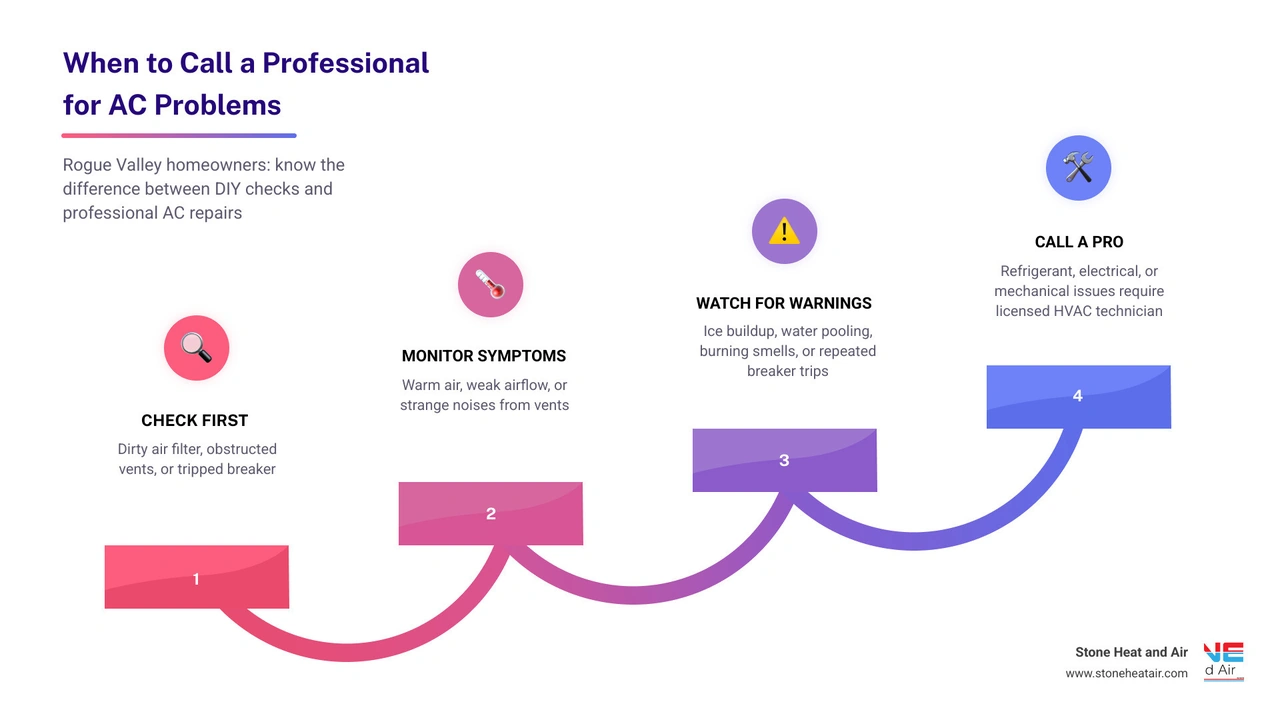
Call a professional for AC problems if you notice any of the following:
• Warm air blowing from vents despite correct thermostat settings
• Ice forming on refrigerant lines or the evaporator coil
• Water pooling around the indoor unit
• Burning smells or electrical odors coming from the system
• Loud grinding, squealing, or clanging noises
• The system short cycles (turns on and off every few minutes)
• Your circuit breaker trips repeatedly when the AC runs
• Energy bills spike with no clear explanation
Some issues — like a dirty filter or a tripped breaker — are safe to check yourself before picking up the phone. But problems involving refrigerant, electrical components, or mechanical failures always need a licensed technician.
Here in Southern Oregon, summer heat in the Rogue Valley can push AC systems hard. A struggling unit that gets ignored rarely fixes itself. The good news is that understanding the difference between a simple homeowner check and a serious repair can save you time, money, and a lot of discomfort.
Similar topics to when to call a professional for ac problems:
• I need a quote for a heat pump repair in Rogue River, OR.
• ac not cooling properly what to check first
Before you pick up the phone to schedule an emergency visit, it is always a good idea to perform a few basic, safe checks. Sometimes, what feels like a total system failure is actually a minor oversight that you can resolve in a few minutes.
We always recommend starting with the easiest solutions first. Checking these simple components can save you the time of waiting for a service call and help you narrow down the exact issue if you do end up needing our help. For a detailed guide on what to inspect first, take a look at our article on AC Not Cooling Properly: What to Check First.
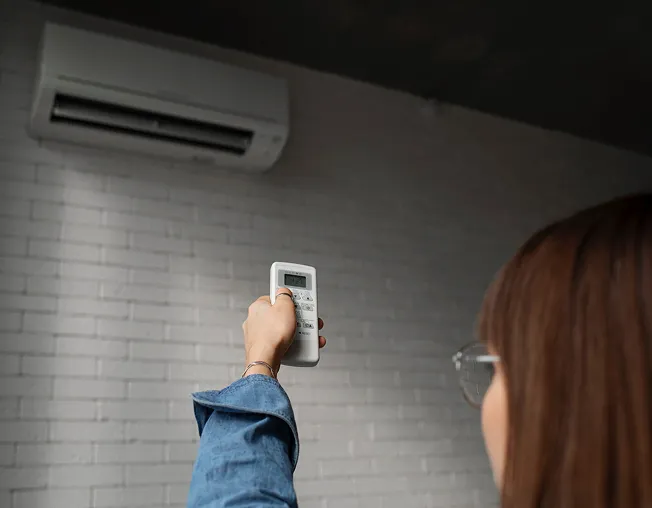
Checking the Air Filter and Vents
It might surprise you to learn that a clogged air filter is responsible for a massive number of service calls. In fact, standard industry data shows that basic troubleshooting—centered largely around the air filter—resolves problems in 20 to 30 percent of cases without any professional help.
When an air filter is caked in dust, pet hair, and Rogue Valley pollen, it restricts airflow. This restriction forces your system to work twice as hard for half the results. Over time, restricted airflow can cause the indoor evaporator coil to drop below freezing, leading to a layer of ice that completely blocks your cooling.
Before calling us, turn off your system and pull out the filter. If it looks like a dusty dryer lint trap, replace it. While you are at it, walk through your home and check the supply vents and return grilles. Ensure that furniture, heavy drapes, or stray toys are not blocking the air vents. For more insights on how airflow restrictions impact your comfort, check out our guide on the Possible Reasons Your Air Conditioner Isn't Cooling Your Home Properly.
Verifying Power and Thermostat Settings
Another common culprit behind a "dead" AC is a simple loss of power or a misconfigured thermostat.
First, look at your thermostat screen. Is it blank? It might just need a fresh set of batteries. If the screen is active, verify that the system is set to "COOL" and the fan is set to "AUTO" (not "ON," which runs the fan continuously even when the AC isn't cooling). Make sure the set temperature is at least a few degrees lower than the current room temperature.
Next, head over to your home’s electrical panel. Your air conditioning system relies on two separate breakers: one for the indoor air handler/furnace and another for the outdoor condensing unit. If a breaker has tripped to the middle position, switch it completely to "OFF" and then back to "ON."
A quick word of warning: If the breaker trips again immediately or within a short period, do not reset it a second time. Repeatedly resetting a tripping breaker can cause severe electrical damage or even a house fire. This is a clear indicator of an underlying electrical short or a failing compressor, and it is exactly when to call a professional for AC problems.
When to Call a Professional for AC Problems
Once you have verified that your filters are clean, your vents are open, and your breakers are on, any remaining issues should be left to the experts. Modern air conditioners are highly complex machines. They rely on pressurized refrigerant, high-voltage electrical circuits, and delicate electronic controls to keep your home comfortable.
If your system is showing signs of mechanical failure, trying to diagnose it yourself can lead to further damage. For a comprehensive look at the warning signs, read our Signs Your AC Needs Repair Guide 2026.
To help you decide whether to grab a fresh filter or grab the phone, we have put together this handy comparison table:
• No Airflow / Weak Airflow — Safe Homeowner Check: Check and replace dirty air filter; open closed registers. — When to Call a Professional: Blower motor failure; ductwork leaks; failing compressor.
• AC Blowing Warm Air — Safe Homeowner Check: Verify thermostat is set to "COOL" and "AUTO." — When to Call a Professional: Refrigerant leak; failed capacitor; compressor issues.
• Water Around the Unit — Safe Homeowner Check: Check for obvious external drain line blockages. — When to Call a Professional: Clogged internal condensate line; damaged drain pan; refrigerant leaks.
• Strange Noises — Safe Homeowner Check: Clear visible leaves/debris from the outdoor unit. — When to Call a Professional: Squealing fan belt; grinding bearings; high-pressure compressor issues.
• System Won't Turn On — Safe Homeowner Check: Replace thermostat batteries; reset circuit breaker once. — When to Call a Professional: Burnt electrical wiring; failed capacitor; control board failure.
• Tripped Breaker — Safe Homeowner Check: Reset the breaker once. — When to Call a Professional: Breaker trips repeatedly; electrical short circuit.
Warm Air and Weak Airflow
If your vents are blowing warm air or the airflow feels like a gentle whisper rather than a cool breeze, your system is crying out for professional attention.
Warm air is often a sign of a failing compressor or a refrigerant imbalance. The compressor is the heart of your air conditioner; if it cannot pump refrigerant through the system, no heat can be removed from your indoor air. Weak airflow, on the other hand, often points to a failing blower motor or severe ductwork issues.
Did you know that leaky ducts can lose 20 to 30 percent of conditioned air before it ever reaches your living spaces? That means you are paying to cool your attic or crawlspace. If you notice uneven temperatures across your home, it is time to schedule an inspection. You can learn more about these warning signs in our article, Signs Your AC Needs a Tune-Up.
Moisture Pooling and Frozen Coils
Water and ice are two of the most common reasons homeowners contact us. In fact, industry statistics show that almost 90% of central air service calls are related to water leaks around the unit.
Your air conditioner doesn't just cool the air; it also dehumidifies it. The moisture removed from the air collects on the indoor evaporator coil, drips into a condensate pan, and flows out of your home through a drain line. In our humid Southern Oregon summers, algae and slime can quickly clog this drain line. When that happens, water backs up and overflows, which can damage your drywall, ceilings, and flooring.
If you notice water pooling around your indoor furnace or air handler, or if you spot ice forming on the copper refrigerant lines outside, shut the system down immediately and call us. Running an AC with a frozen coil or a major leak can destroy the compressor. For step-by-step guidance on handling water issues, read What to Do If Your AC Is Leaking.
The Risks of Delaying Repairs or Attempting Complex Fixes
It is tempting to look up a quick video tutorial and attempt a DIY fix to save a bit of money. However, air conditioning systems are not designed for amateur repairs. Attempting to fix complex mechanical or electrical issues yourself carries significant safety risks, and delaying professional repairs almost always turns a minor issue into a major financial headache.
Why You Must Avoid DIY Refrigerant and Electrical Work
There are two areas where homeowners should never attempt DIY repairs: refrigerant handling and electrical components.
First, refrigerant is not like engine oil—it does not get consumed by the system. If your AC is low on refrigerant, it means you have a leak. Simply adding more refrigerant without finding and sealing the leak is illegal under federal law and can permanently damage your compressor. Handling refrigerant requires specialized tools, precise calculations, and an EPA Section 608 certification.
Second, your AC unit utilizes high-voltage electricity. Components like the capacitor store large amounts of electrical energy even when the power to the unit is completely shut off. Touching the wrong terminal can result in severe electrical shock, burns, or worse. Improper wiring is also a leading cause of HVAC-related house fires.
Furthermore, almost all major HVAC manufacturers require that repairs be performed by a licensed contractor to keep the equipment warranty valid. A DIY mistake can instantly void your warranty, leaving you financially responsible for the entire cost of a system replacement.
Recognizing When to Call a Professional for AC Problems Involving Water or Ice
Water leaks and frozen coils are progressive problems. If you ignore a small water leak, it won't just go away—it will eventually lead to extensive water damage and structural mold growth in your home. Mold spores thrive in damp, dark environments, and once they get into your ductwork, they can spread throughout your entire house, affecting your family's health.
Similarly, a frozen evaporator coil places massive strain on your compressor. If the coil is encased in ice, the refrigerant cannot absorb heat, which can cause liquid refrigerant to flood back into the compressor. Compressors are designed to pump gas, not liquid; liquid slugging will destroy the compressor instantly. If you see ice or water, turn off the system and review our guide on Signs You Need Immediate HVAC Help.
Identifying an Emergency and When to Call a Professional for AC Problems
While some AC issues can wait for a standard weekday appointment, certain situations demand immediate action. You should treat the following scenarios as true emergencies:
• Burning Smells or Smoke: If you detect a burning plastic smell, sulfur, or see visible smoke coming from your vents or the outdoor unit, shut off the system at your home's breaker panel immediately and call us. This indicates an active electrical short or overheating components.
• Extreme Heat Waves: If your AC fails during a severe Rogue Valley heat wave and you have vulnerable family members at home—such as infants, elderly relatives, or pets—a lack of cooling is a health hazard.
• Squealing or Shrieking Noises: A loud, high-pitched screeching sound can indicate that the compressor is operating at dangerously high pressure levels. Turn the system off immediately to prevent a catastrophic mechanical failure.
If you are facing any of these issues, consult our articles on When to Call for Emergency HVAC Services and What Constitutes an HVAC Emergency to understand your next steps.
Deciding to Repair vs. Replace Your Rogue Valley AC System
Even the most reliable air conditioners eventually reach the end of their service life. If you are facing recurring breakdowns, you have to decide whether it makes more sense to keep repairing your old unit or invest in a new, high-efficiency system.
Here are the primary factors we help our customers evaluate:
• The 15-Year Rule: Central air conditioners typically last between 10 to 15 years. If your unit is over 12 years old and requires a major repair, replacement is usually the more cost-effective long-term choice.
• The 50% Rule: If the cost of a single repair exceeds 50% of the value of a brand-new system, we highly recommend replacing it.
• The $5,000 Rule: A helpful industry formula is to multiply the age of your system by the cost of the repair. If the result is greater than $5,000, replacement is generally the smarter investment. (For example, an 11-year-old system needing a $500 repair equals $5,500—indicating replacement is worth considering).
• Phased-Out Refrigerants: If your older AC uses R-22 refrigerant, you should plan for a replacement. R-22 has been phased out by the EPA. Sourcing this refrigerant for repairs is incredibly difficult and expensive, making even minor leaks highly impractical to fix.
• Energy Efficiency: Modern systems use advanced variable-speed technology and must meet strict SEER2 energy efficiency standards. Upgrading an old SEER 10 unit to a modern SEER2 system can reduce your cooling energy usage by 20 to 40 percent, leading to immediate savings on your monthly utility bills.
To help weigh your options, read our detailed guides on When to Repair vs. Replace Your HVAC System and Is It Time to Replace My Air Conditioning.
Frequently Asked Questions About Rogue Valley AC Repairs
Why is my air conditioner blowing warm air despite the settings?
If your thermostat settings are correct but your vents are blowing warm air, the issue is typically a failed compressor, a broken outdoor fan motor, or a refrigerant leak. When the outdoor unit cannot release heat or lacks the refrigerant to absorb it from indoors, the indoor fan simply circulates uncooled air. You will need a professional technician to diagnose the electrical and refrigerant components to find the root cause.
Can I run my AC if it is leaking water or freezing up?
No, you should not run your air conditioner if it is leaking water or freezing up. Running a frozen system puts extreme strain on the compressor, which can lead to permanent damage and a much more expensive replacement. Additionally, a leaking system can cause severe water damage and mold growth inside your home. Turn the system off, set the fan to "ON" or "FAN ONLY" to help melt the ice, and call a professional.
How often should I schedule professional AC maintenance?
We recommend scheduling professional AC maintenance at least once a year, ideally in the spring before the summer heat hits the Rogue Valley. Regular HVAC maintenance can prevent nearly 80% of common repair issues, keep your system running at peak efficiency, and prolong its overall lifespan.
Conclusion
When summer temperatures climb in Central Point, Roseburg, Klamath Falls, or anywhere across the Rogue Valley, a reliable air conditioner is essential to your home's comfort. Knowing when to call a professional for AC problems keeps small issues from escalating into major system failures, protecting your home, your family, and your wallet.
At Stone Heat & Air, we believe in honest dealings, fair recommendations, and exceptional craftsmanship. Our certified technicians are experts in diagnosing and repairing all makes and models of cooling systems. To enjoy uninterrupted comfort and complete peace of mind all year round, consider joining our exclusive Stone Comfort Membership Club, which includes regular preventative maintenance, priority scheduling, and peace of mind.
Don't wait for your system to break down completely in the middle of a heat wave. Schedule professional air conditioning services in Central Point with the trusted team at Stone Heat & Air today, and let us treat your home like ours!