

Why Recognizing the Signs Your HVAC Is Reaching End of Life Can Save You Money
The signs your HVAC is reaching end of life are easy to miss — until your system quits on the hottest day of summer or the coldest night of a Rogue Valley winter. Most systems don't fail overnight. They give you plenty of warning first.
Here's a quick look at the most common signs your HVAC is nearing the end:
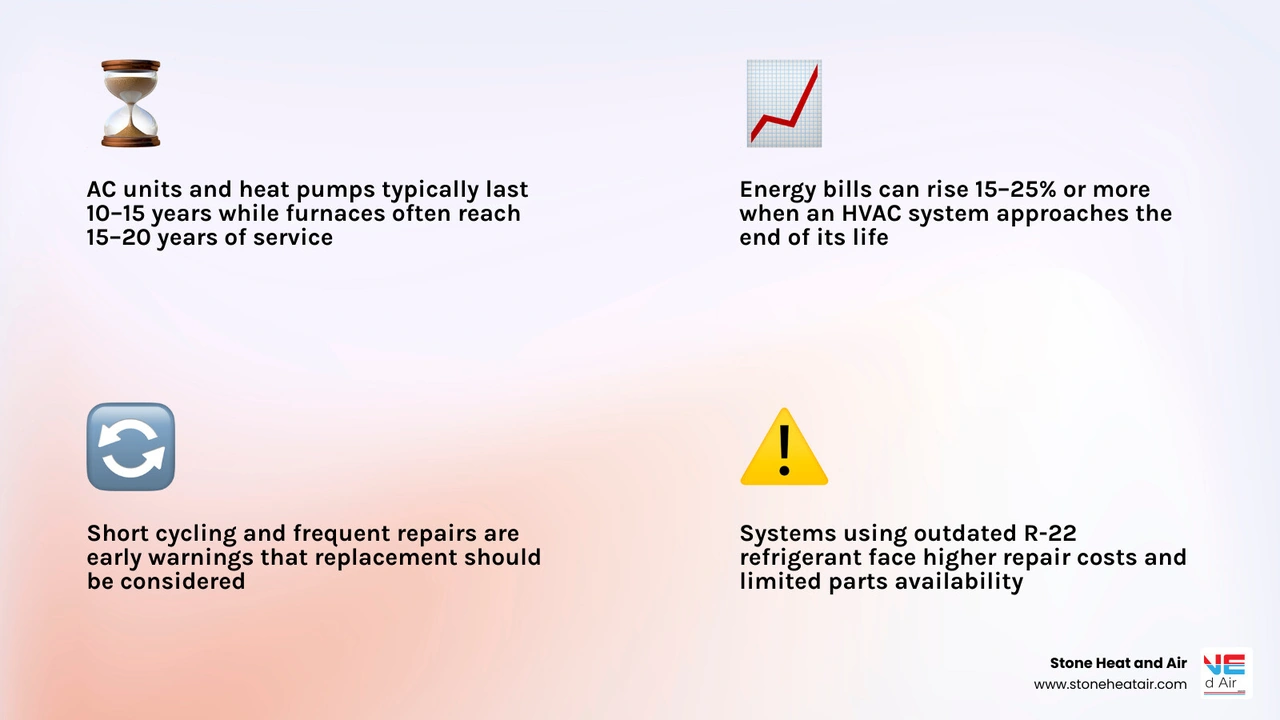
• System age — AC units and heat pumps typically last 10–15 years; furnaces 15–20 years
• Rising energy bills — unexplained increases of 15–25% or more year over year
• Frequent repairs — multiple service calls in a single season
• Uneven temperatures — some rooms too hot, others too cold
• Strange noises — banging, screeching, grinding, or clicking
• Unusual odors — burning smells, sulfur, or musty air from vents
• Short cycling — the system turns on and off too frequently
• R-22 refrigerant — systems using this banned refrigerant face high repair costs and limited support
Most homeowners don't think about their HVAC until something goes wrong. That reactive approach almost always costs more — in emergency service fees, rushed decisions, and avoidable discomfort. Knowing what to watch for puts you back in control.
This guide walks you through every major warning sign, the math behind repair versus replacement decisions, and how regular maintenance fits into the picture.
Signs your hvac is reaching end of life further reading:
• how long does an hvac system last in southern oregon
• how to extend the life of your hvac system
Understanding HVAC Lifespans in Southern Oregon
To understand when your heating and cooling equipment is on its last legs, we first have to look at the calendar. Every piece of machinery has an expiration date, and HVAC systems are no exception. However, determining How Old Is Too Old for an HVAC System depends largely on the specific type of equipment you have running in your home or business.
In Southern Oregon, our climate puts unique demands on our home comfort systems. From the dry, scorching summer afternoons in Klamath Falls and Central Point to the damp, chilly winters in Roseburg and the coastal winds of Brookings, our systems work hard year-round.
Here is what you can generally expect regarding the service life of different heating and cooling systems:
• Air Conditioners: A standard central air conditioning unit typically has a lifespan of 12 to 15 years. If you are assessing the Lifespan of a Carrier Air Conditioner, they often lean toward the upper end of that range due to premium engineering, but environmental wear still takes its toll over time.
• Furnaces: Burning fuel to create heat is a heavy-duty process. Fortunately, gas and oil furnaces are built to last. When asking How Long Can a Furnace Last, the answer is generally 15 to 20 years, provided it receives annual maintenance to protect the heat exchanger from cracks.
• Heat Pumps: Because heat pumps provide both heating in the winter and cooling in the summer, they run almost continuously throughout the year. This double duty means they experience faster mechanical wear, typically resulting in a lifespan of 10 to 15 years.
• Commercial HVAC Systems: If you manage a commercial property in the Rogue Valley, you are likely dealing with larger rooftop units (RTUs) or split systems. According to The Life Expectancy of Commercial HVAC Systems, these heavy-duty units generally last between 15 and 20 years with rigorous commercial maintenance.
There are always 5 Factors That Can Affect Your Air Conditioners Lifespan, including installation quality, local climate, sizing, usage habits, and how diligently the system has been maintained.
• Central Air Conditioner — Average Lifespan (Years): 12 – 15 — Primary Wear Factors in Southern Oregon: High summer heatwaves, dust, and lack of coil cleaning
• Gas Furnace — Average Lifespan (Years): 15 – 20 — Primary Wear Factors in Southern Oregon: Heat exchanger stress, cycling frequency, and filter clogs
• Heat Pump — Average Lifespan (Years): 10 – 15 — Primary Wear Factors in Southern Oregon: Year-round operation, defrost cycle wear, and coastal salt (near Brookings)
• Commercial RTU — Average Lifespan (Years): 15 – 20 — Primary Wear Factors in Southern Oregon: Constant building loads, ventilation demands, and weather exposure
Key Signs Your HVAC is Reaching End of Life
Recognizing the signs your hvac is reaching end of life before a total system failure occurs can save you from a middle-of-the-night heating or cooling emergency. Over time, internal components naturally degrade, causing a slow decline in overall performance.
One of the first red flags is a noticeable drop in home comfort. You might start noticing uneven temperatures throughout your home—perhaps your living room in Central Point feels icy cold, while the upstairs bedrooms remain stuffy and warm. This is often a sign that your system's blower motor or compressor is struggling to distribute air effectively.
Another common performance red flag is short cycling, which occurs when your air conditioner or furnace turns on, runs for a brief couple of minutes, shuts off, and then repeats the cycle rapidly. This constant starting and stopping places immense electrical and mechanical strain on the compressor and fan motors.
If you are noticing these comfort issues, it might be time to ask: Is It Time to Replace My Air Conditioning or is it Time to Get a New Furnace?
Rising Energy Bills as Signs Your HVAC is Reaching End of Life
Have you noticed your monthly utility bills creeping upward, even though your family’s heating and cooling habits haven't changed? This is one of the most reliable signs your hvac is reaching end of life.
As heating and cooling systems age, they lose operational efficiency. Internal parts wear down, motors draw more electrical current to perform the same amount of work, and coils accumulate stubborn grime that restricts heat transfer. Older units built over a decade ago were manufactured to lower SEER (Seasonal Energy Efficiency Ratio) standards. Over 15 years of continuous operation, a system originally rated at 14 SEER can degrade to an effective rating of 8 or 9 SEER.
This dramatic drop in efficiency means your system has to run much longer and work significantly harder to maintain your desired indoor temperature, leading to a steady, unexplained rise in your monthly energy bills.
Strange Noises and Odors as Signs Your HVAC is Reaching End of Life
While no heating or cooling system is completely silent, it should never sound like a construction site. If your system starts making unusual sounds, it is trying to tell you something important:
• Screeching or Squealing: This typically points to a failing blower motor bearing or a slipping fan belt.
• Banging or Clanking: This often indicates that a major internal component, such as a fan blade or connecting rod, has come loose and is striking other parts.
• Grinding: This is a classic sign of worn-out motor bearings scraping against metal.
• Clicking: If you hear rapid clicking from your outdoor unit without the system turning on, you are likely dealing with a failing electrical contactor or control board.
In addition to strange noises, never ignore unusual odors coming from your vents. A musty, dusty smell often points to mold growth within your ductwork or evaporator coil, which severely degrades indoor air quality.
More critically, a burning electrical odor—reminiscent of melting plastic or hot metal—signals that wires are overheating or a motor is burning out. If you smell a rotten egg or sulfur odor near a gas furnace, this is a sign of a potential gas leak or a cracked heat exchanger. In any of these situations, turn the system off immediately at the thermostat or breaker panel and contact a professional.
The Financial Decision: Repair vs. Replace
When an older system breaks down, homeowners face a tough choice: do you patch it up one more time, or is it wiser to invest in a complete replacement? Navigating this crossroad requires looking at both the immediate repair costs and the long-term operational expenses.
To make an objective, unemotional decision, we recommend using two popular industry benchmarks outlined in our HVAC Repair or Replace Guide 2026 and our comprehensive guide on When to Repair vs Replace Your HVAC System:
1. The 50% Rule: If the cost of a single repair exceeds 50% of the cost of an entirely new system, replacement is almost always the smarter financial choice. Paying for a massive repair on a system with aged, degraded components only buys you a little more time before the next part fails.
2. The $5,000 Rule: Multiply the age of your HVAC system by the cost of the proposed repair. If the resulting number is greater than $5,000, you should strongly consider replacing the system. For example, a minor repair on a 4-year-old system makes perfect sense. But a significant repair on a 14-year-old system easily crosses that $5,000 threshold, signaling that you are throwing good money after bad.
Another critical financial factor is the type of refrigerant your air conditioner or heat pump uses. If your system was manufactured before 2010, there is a very high probability that it runs on R-22 refrigerant (commonly known as Freon).
Due to environmental regulations and the EPA phase-out of ozone-depleting substances, the production and import of R-22 was completely banned in 2020. Today, only limited, recycled supplies of R-22 exist. Consequently, repairing a refrigerant leak on an old R-22 system has become incredibly expensive. If your older air conditioner develops a refrigerant leak, replacing the unit with a modern, eco-friendly system is almost always the most cost-effective path forward.
How Maintenance Impacts System Longevity
Just like changing the oil in your car, scheduling annual preventative maintenance is the single most effective way to protect your heating and cooling investment. Regular tune-ups keep your system running at peak efficiency, catch minor issues before they spiral into catastrophic failures, and directly extend the usable lifespan of your equipment.
During a professional maintenance visit, our experienced technicians perform several vital tasks:
• Clean dirt and debris from the outdoor condenser and indoor evaporator coils to maximize heat transfer
• Lubricate moving parts to eliminate friction and reduce mechanical wear
• Inspect electrical connections, contactors, and capacitors to prevent sudden system failures
• Verify correct refrigerant levels to protect the compressor from overheating
• Check and calibrate the thermostat for accurate temperature control
• Thoroughly inspect the furnace heat exchanger for dangerous stress cracks or rust
If you want to maximize your system's lifespan and enjoy year-round peace of mind, we recommend reading our guide on How to Extend the Life of Your HVAC System.
For the ultimate hassle-free comfort, we offer our exclusive Stone Comfort Membership Club. Members receive regular, precision tune-ups, priority scheduling, and discounts on repairs, ensuring your system remains reliable through every season in Southern Oregon. However, keep in mind that while maintenance works wonders for a system in its prime, it cannot reverse decades of mechanical wear. Once a system has reached the end of its natural life, even the most meticulous maintenance can no longer prevent aging parts from failing.
Frequently Asked Questions About Aging HVAC Systems
How do I know if my system uses outdated R-22 refrigerant?
To determine what type of refrigerant your air conditioner or heat pump uses, locate the manufacturer’s data plate on the side of your outdoor condenser unit. Look for a section labeled "Refrigerant" or "Refrig." If your system uses R-22, it will be clearly printed there (it may also be listed as HCFC-22).
As a general rule of thumb, if your system was manufactured before 2010, it likely uses R-22. If you cannot find the label or are unsure how to read it, any licensed HVAC technician can easily identify the refrigerant type during a routine service visit.
What is the 50% rule for HVAC replacement?
The 50% rule is a simple financial guideline used by HVAC professionals and homeowners to decide whether to repair or replace a failing system. The rule states that if the cost of a necessary repair is 50% or more of the cost of installing a brand-new, modern system, you should opt for replacement.
Investing a significant sum into an older, out-of-warranty system rarely makes financial sense because the remaining, unrepaired components are still prone to failing shortly down the road.
Can regular maintenance extend the life of an older system?
Yes, regular maintenance is highly effective at extending the lifespan of an older system, but only up to a certain point. Routine service reduces strain on aging motors, keeps coils clean for better heat transfer, and ensures electrical components are operating safely.
However, maintenance cannot replace worn-out metal or restore a failing compressor. Once your system crosses the 15-year mark and major components begin to break down, replacement becomes the most practical and energy-efficient solution.
Conclusion
Your home's comfort and safety depend on a reliable heating and cooling system. Recognizing the signs your hvac is reaching end of life—whether it is an aging system, rising utility bills, uneven temperatures, or frequent breakdowns—allows you to plan a replacement on your own terms rather than dealing with an expensive emergency in the dead of winter or peak of summer.
At Stone Heating & Air, we are proud to serve families and businesses throughout Central Point, the Rogue Valley, Roseburg, Brookings, and Klamath Falls. Our team is dedicated to providing honest, straightforward recommendations, meticulous workmanship, and the absolute best in home comfort solutions. We treat your home just like we would treat our own.
If you suspect your heating or cooling system is nearing the end of its useful life, don't wait for a total breakdown. Schedule your professional HVAC evaluation with Stone Heating & Air today, and let our experienced team help you find the perfect, high-efficiency solution for your home and budget.