

Why the Standard Efficiency vs High Efficiency HVAC Comparison Matters for Rogue Valley Homeowners
The standard efficiency vs high efficiency HVAC comparison is one of the most important decisions you'll make for your home's comfort and energy costs. In the Rogue Valley, where winters can be cold and summers genuinely hot, the system you choose affects every utility bill for the next 15 to 20 years.
Here's a quick side-by-side to answer the core question:
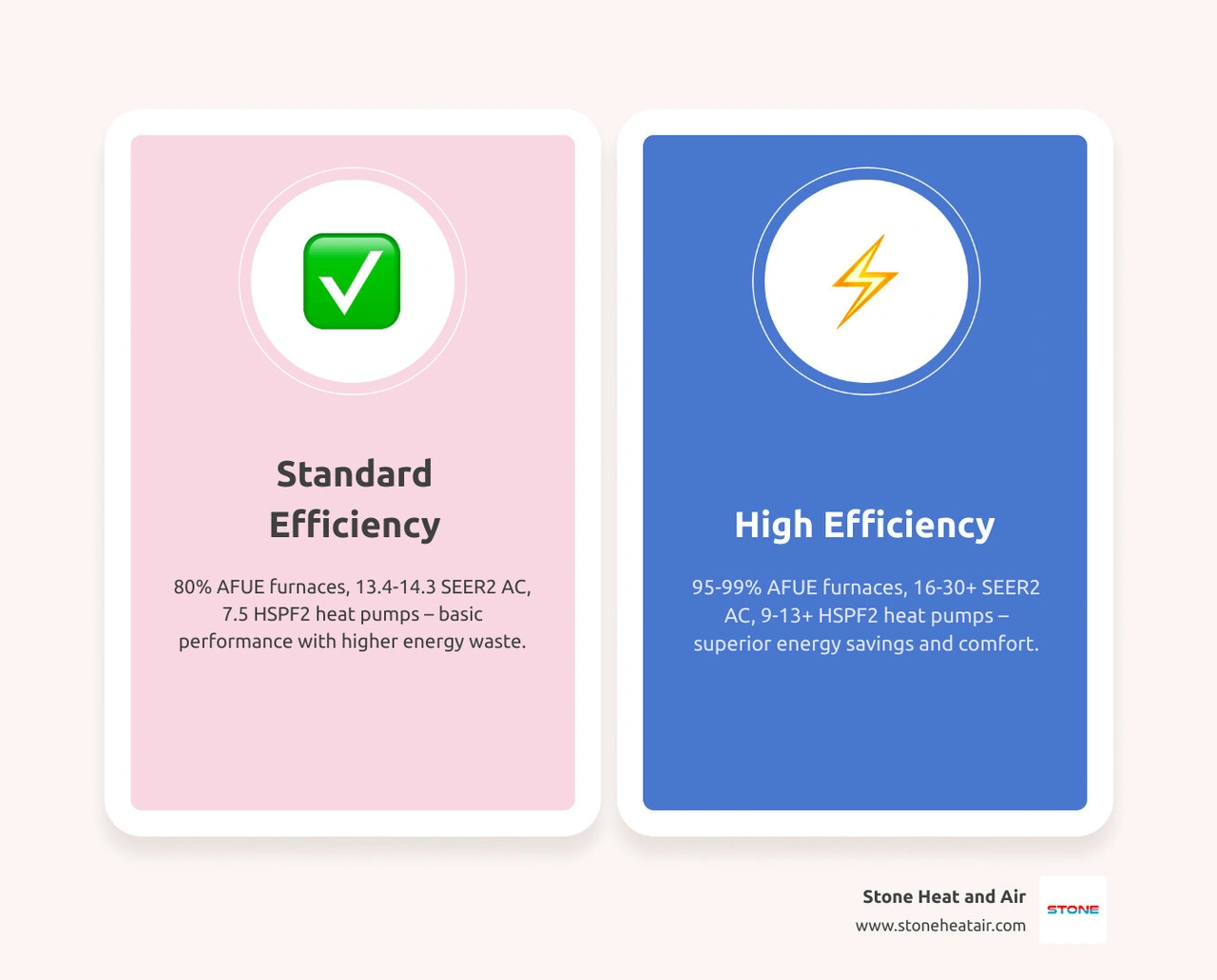
• Furnace AFUE — Standard Efficiency: ~80% — High Efficiency: 95–99%
• AC Efficiency (SEER2) — Standard Efficiency: 13.4–14.3 — High Efficiency: 16–30+
• Heat Pump (HSPF2) — Standard Efficiency: ~7.5 — High Efficiency: 9–13+
• Venting — Standard Efficiency: Metal flue — High Efficiency: PVC pipes
• Combustion — Standard Efficiency: Open (indoor air) — High Efficiency: Sealed (outdoor air)
• Heat Exchangers — Standard Efficiency: Single — High Efficiency: Dual
• Blower Motor — Standard Efficiency: Single-speed — High Efficiency: Variable-speed
• Annual Energy Savings — Standard Efficiency: Baseline — High Efficiency: $150–$500+ vs. standard
• Upfront Cost — Standard Efficiency: Lower — High Efficiency: Higher by $1,000–$3,000
• Payback Period — Standard Efficiency: N/A — High Efficiency: 5–10 years (cold climates)
• Best For — Standard Efficiency: Mild climates, short-term owners, tight budgets — High Efficiency: Cold climates, long-term owners, high energy costs
The short answer: high-efficiency systems cost more upfront but can save hundreds of dollars per year on energy bills — and in a cold-climate region like the Rogue Valley, that math often works in your favor. That said, standard-efficiency systems aren't a bad choice in every situation. Your climate, home size, insulation, and how long you plan to stay in the home all play a role.
This guide breaks down exactly what sets these systems apart, when each one makes sense, and how to make a confident decision for your specific home.
Understanding the Metrics: AFUE, SEER2, and HSPF2
When we talk about a standard efficiency vs high efficiency hvac comparison, we first have to sort through what some call the "alphabet soup" of HVAC ratings. These numbers aren't just technical jargon; they represent exactly how much of your money is being turned into comfort and how much is going out the exhaust pipe.
AFUE: For the Winter Chill
AFUE stands for Annual Fuel Utilization Efficiency. It is the metric for gas and oil furnaces. A standard-efficiency furnace typically has an 80% AFUE. This means that for every dollar you spend on gas, 80 cents heat your home, while 20 cents are lost as exhaust. In contrast, high-efficiency furnaces reach 95% to 99% AFUE. Essentially, they waste almost nothing. You can dive deeper into this in our guide on Understanding HVAC System Efficiency Ratings.
SEER2: Staying Cool in the Rogue Valley
For air conditioning, we use the Seasonal Energy Efficiency Ratio (SEER2). This measures how much cooling the system puts out for every watt of electricity it uses over an entire season. As of May 2026, the Department of Energy has strict minimums. In our region, the minimum for a split system is typically 13.4 SEER2. High-efficiency models can go well beyond 20 or even 30 SEER2. Think of SEER2 like the "miles per gallon" for your AC. For more on how these rules changed recently, see our post on 2023 Minimum Efficiency Standards.
HSPF2: The Heat Pump Factor
If you use a heat pump, you’ll also want to look at HSPF2 (Heating Seasonal Performance Factor). This measures heating efficiency specifically for heat pumps. Standard units hover around 7.5 HSPF2, while high-efficiency versions can reach 10 or higher. Because heat pumps move heat rather than creating it, they can reduce energy usage by up to 50% compared to traditional electric heating.
Standard Efficiency vs High Efficiency HVAC Comparison: Key Differences
The differences between these systems go far beyond just a number on a sticker. They are built differently from the inside out. When we perform a standard efficiency vs high efficiency hvac comparison for a neighbor in Central Point or Klamath Falls, we look at three main areas: the heat exchangers, the combustion process, and the airflow.
Heat Exchangers: The Heart of the System
A standard furnace has one heat exchanger. The gas burns, the metal gets hot, and the air blows over it. In a high-efficiency system, we add a secondary heat exchanger. This second component captures the heat from the exhaust gases that a standard furnace would just throw away. By the time the exhaust leaves a high-efficiency furnace, it’s so cool that it turns into water (condensate), which is why these are often called "condensing furnaces." You can learn more about how different fuels play into this in our Comparison of Gas and Electric Furnaces.
Combustion Types
Standard furnaces usually use "open combustion," meaning they pull air from the room they are sitting in to burn the gas. High-efficiency units use "sealed combustion." They pull fresh air from outside through a dedicated pipe. This is safer and more efficient because it doesn't use the air you’ve already paid to heat just to keep the fire going.
Mechanical Design in a Standard Efficiency vs High Efficiency HVAC Comparison
The mechanical "brains" of the system also differ.
• Single-Stage Operation: Most standard units are either "on" or "off." When they kick on, they run at 100% capacity. This can lead to the "thump and whoosh" sound and temperature swings.
• Variable-Speed Blowers: High-efficiency systems often feature variable-speed motors. Instead of full blast or nothing, they can ramp up and down slowly. This keeps the temperature steady and is much quieter.
• Modulating Burners: While a standard furnace is like a light switch, a high-efficiency modulating furnace is like a dimmer switch. It can adjust the flame size to provide exactly the amount of heat needed, sometimes running at just 40% capacity on a mild day to save energy.
This level of control is also a hallmark of ductless systems. If you're curious how they compare to traditional setups, check out our Central AC vs Ductless Mini-Split Comparison.
Venting and Installation in a Standard Efficiency vs High Efficiency HVAC Comparison
One of the biggest physical differences you’ll notice is the venting. Because standard furnaces have very hot exhaust, they require a metal flue that goes up through the roof.
High-efficiency systems extract so much heat that the exhaust is actually quite cool—usually cool enough to touch. Because of this, we use PVC piping for the vents. These pipes can often be routed out the side of the house, which is sometimes easier but does require new holes to be drilled.
Additionally, because high-efficiency units "condense" the exhaust, they produce water. This means we have to install a condensate drain line. If the furnace is in a basement or a spot without a nearby floor drain, we might need to install a small pump to move that water away.
Comfort and Performance Benefits of High-Efficiency Systems
While the energy savings get all the headlines, the comfort benefits are often what our customers in the Rogue Valley love most.
Superior Humidity Control
In the summer, your AC doesn't just cool the air; it removes moisture. Standard units that cycle on and off frequently often don't run long enough to properly dehumidify the home, leading to that "sticky" feeling. High-efficiency units with variable-speed compressors run for longer cycles at lower speeds, which is much better at pulling moisture out of the air. You can read more about this in our article on How Humidity Affects HVAC Energy Efficiency.
Whisper-Quiet Operation
Because high-efficiency systems ramp up and down slowly rather than slamming on at full power, they are significantly quieter. Many homeowners find that they don't even notice when the system is running. This reduction in noise can actually make a home environment feel more peaceful and productive. For business owners, this is a key reason why HVAC Maintenance Increases Productivity through better comfort.
Better Air Quality and Filtration
Variable-speed blowers don't just regulate temperature; they keep air moving through your filters more consistently. This means your air is being cleaned more often. High-efficiency systems are also better equipped to handle high-MERV filters that trap smaller particles like pollen and smoke—a major plus for our Southern Oregon summers.
When to Choose Standard Efficiency for Your Rogue Valley Home
With all the benefits of high efficiency, you might wonder why anyone chooses a standard system. There are actually several scenarios where "simple is smart."
1. Short-Term Homeownership: If you plan on moving in the next two or three years, you likely won't be in the home long enough to see the energy savings pay back the higher upfront cost.
2. Budget Constraints: If your old system dies unexpectedly and the budget is tight, a standard-efficiency unit is a reliable, affordable way to get your home comfortable again immediately.
3. Mild Usage: If you are installing a unit in a guest house, a finished basement that is rarely used, or a vacation cabin, the lower usage means the "payback period" for high efficiency could take decades.
4. Difficult Venting Situations: In some older homes in places like Roseburg or Brookings, rerouting vents for PVC or installing condensate drains can be extremely expensive due to the home's construction. In these cases, a standard 80% unit that fits the existing metal flue might be the most practical choice.
Maximizing Your Investment with Incentives and Maintenance
If you decide that high efficiency is the way to go, there are ways to make the transition easier on your wallet.
Tax Credits and Rebates
In 2026, there are still significant incentives available. Federal tax credits through programs like the Inflation Reduction Act can cover a portion of the cost of high-efficiency heat pumps and furnaces. Additionally, local utility providers in Southern Oregon often offer "instant rebates" that can range from a few hundred to over two thousand dollars. We always recommend checking the Energy Star labels to ensure the model you pick qualifies.
The Role of Maintenance
Regardless of which system you choose, it will only hit its rated efficiency if it is maintained. A high-efficiency unit with a dirty coil or a clogged filter can quickly perform like a standard unit—but with higher repair costs. We offer the Stone Comfort Membership Club to take the guesswork out of this, providing regular tune-ups that ensure your system lasts its full 15-20 year lifespan.
Proper maintenance is especially important during seasonal transitions. Check out our tips on How to Run Your HVAC Efficiently in the Fall to keep your bills low as the weather turns.
Frequently Asked Questions about HVAC Efficiency
What is the main difference between 80% and 95% AFUE furnaces?
The main difference is how they handle exhaust. An 80% furnace loses 20% of its heat through a metal chimney. A 95% furnace uses a second heat exchanger to catch that escaping heat, cooling the exhaust so much that it can be vented through a plastic PVC pipe.
How much can I save annually by upgrading to a high-efficiency system?
While it depends on your home's insulation and local fuel prices, most homeowners in the Rogue Valley see savings between $150 and $500 per year. If you are switching from an old, failing unit to a modern high-efficiency model, the savings can be even higher.
Do high-efficiency units require more maintenance than standard models?
The basic maintenance (filters and cleanings) is the same. However, high-efficiency units have a few extra parts, like condensate drains and secondary heat exchangers, that need to be checked to prevent clogs or corrosion.
Conclusion
Choosing between standard and high efficiency doesn't have to be a guessing game. At Stone Heat and Air, we pride ourselves on giving honest, fair recommendations based on your specific home and goals. Whether you need a quick, affordable replacement or you want to invest in the "Cadillac" of high-efficiency systems to slash your utility bills, we are here to help.
We serve the entire Rogue Valley, from Central Point to Klamath Falls, with 24/7 emergency service and Carrier-certified expertise. We treat your home like ours, ensuring every installation is meticulous and every recommendation is one we’d give to our own families.
Ready to see which system fits your home and budget? Schedule your high-efficiency HVAC consultation with Stone Heat and Air today.