

The Great Chill Debate: Which Cooling System Is Right for Your Rogue Valley Home?
The central ac vs ductless mini split comparison comes down to a few key factors: whether your home already has ductwork, how many rooms you need to cool, and how much control you want over your comfort zone. Here's a quick breakdown:
• Requires ductwork — Central AC: Yes — Ductless Mini-Split: No
• Best for — Central AC: Whole-home, existing ducts — Ductless Mini-Split: Zoned areas, no ducts
• Efficiency (max SEER2) — Central AC: Up to 26 SEER — Ductless Mini-Split: Up to 38+ SEER2
• Energy loss — Central AC: Up to 30% via ducts — Ductless Mini-Split: Near zero
• Zoning — Central AC: Add-on (extra cost) — Ductless Mini-Split: Built-in
• Heating capability — Central AC: Paired furnace/heat pump — Ductless Mini-Split: Built-in heat pump
• Lifespan — Central AC: 15-20 years — Ductless Mini-Split: 15-20 years
• Aesthetics — Central AC: Hidden vents — Ductless Mini-Split: Visible wall units
Choosing the wrong cooling system for your home is the kind of mistake that follows you for the next 15 to 20 years — on your utility bills, in your comfort, and in your wallet. Yet most homeowners in Southern Oregon's Rogue Valley face exactly this crossroads at some point: stick with traditional central air conditioning, or make the switch to a ductless mini-split system?
There's no single right answer. The best choice depends on your home's layout, your existing infrastructure, and how you actually live in your space. Southern Oregon's climate — with its warm, dry summers and cool winters — adds another layer to the decision. A system that performs brilliantly in a humid coastal climate may not be the ideal fit for the Rogue Valley's unique seasonal swings.
In this guide, we'll walk you through everything you need to know to make a confident, informed choice in 2026.
Understanding the Core Differences: Central AC vs Ductless Mini Split Comparison
When we sit down with families in Central Point or Medford to discuss their cooling options, the first question is usually: "What is the actual difference?" At its simplest, the central ac vs ductless mini split comparison is a choice between a "whole-house" philosophy and a "surgical precision" philosophy.
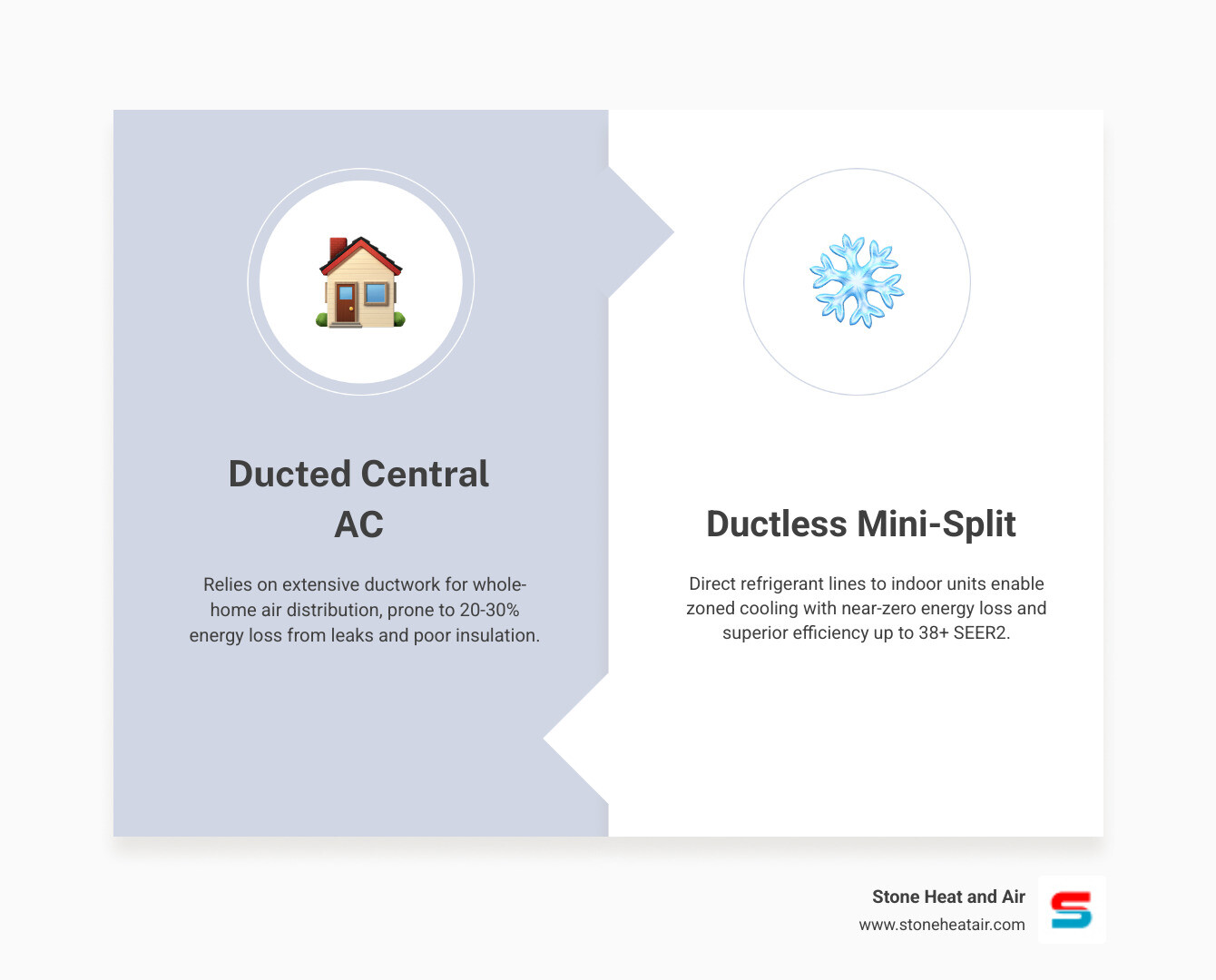
A Central Air Vs Forced Air Systems Which Is The Better Choice often depends on what is already behind your walls. Central AC relies on a massive network of hidden ducts to push air into every corner of the home simultaneously. Conversely, a Ductless Mini Split bypasses the need for those bulky metal pipes entirely. Instead, it uses thin refrigerant lines to connect an outdoor compressor directly to individual indoor air handlers.
Deciding between an Air Conditioner Or Ductless System requires looking at your home's footprint. Central systems are essentially invisible, tucked away in attics or crawlspaces, while ductless systems feature sleek, modern units mounted directly on your walls or ceilings.
Defining Traditional Central Air Systems
Traditional central air is the "classic" American cooling method. It functions as a closed-loop system where an indoor evaporator coil strips heat and humidity from your air, and an outdoor condenser releases that heat into the Southern Oregon breeze. The cooled air is then forced through a network of ducts and out through supply registers. Because it is controlled by a single thermostat, it aims for a uniform temperature across the entire house.
Exploring Ductless Mini-Split Technology
If central AC is a broad brush, a ductless system is a fine-tipped pen. These systems utilize advanced inverter technology, which allows the compressor to speed up or slow down smoothly rather than just clicking "on" or "off." This variable-speed capability is one of the many Ductless Air Conditioners And Their Features that provide superior comfort. With multi-zone capability, you can have a separate indoor unit in the kitchen, the master bedroom, and the home office—each with its own independent remote.
Operational Mechanics: How Ducted and Ductless Systems Work
Both systems operate on the same scientific principle: they don't actually "create" cold; they move heat from one place to another. However, the way they distribute that comfort differs significantly.
In a Carrier Ductless Hvac System, the heat transfer happens right in the room where the unit is located. In a central system, the air has to travel a long distance before it reaches you. This travel time introduces variables like noise and air quality. While central systems offer robust whole-home filtration, ductless units are famous for their whisper-quiet operation, often running at decibel levels lower than a library whisper (around 19–26 dB).
The Role of Ductwork in Whole-Home Comfort
Ductwork is the circulatory system of a central AC. It involves supply registers that blow cold air in and return vents that suck warm air out. For this to work efficiently, your attic insulation must be top-notch, and you need professional duct sealing to prevent air from escaping into unconditioned spaces. When balanced correctly, central air provides a seamless, hidden aesthetic that many homeowners prefer for their main living areas.
The Precision of Zoned Cooling
Finding the Ideal Spots For A Ductless Mini Split Air Conditioner is key to its success. Because these units provide targeted comfort, they are perfect for "problem rooms" that stay too hot in the summer. Whether you choose wall-mounted units, recessed ceiling cassettes, or floor-mounted models, you gain the ability to integrate your cooling with smart home technology, allowing you to adjust the temperature of a specific room from your phone before you even walk through the door.
Efficiency and Performance: Navigating the 2026 Standards
As we move through 2026, efficiency standards have become more stringent. The Department of Energy now uses SEER2 (Seasonal Energy Efficiency Ratio 2) and HSPF2 (Heating Seasonal Performance Factor 2) to measure how much cooling or heating you get for every watt of power used.
Understanding How Can A Ductless Hvac System Help You Save Money starts with looking at these ratings. While high-end central AC units can reach an impressive 26 SEER, ductless systems are the undisputed champions of energy conservation, with some units soaring past 38+ SEER2.
Efficiency and Energy Savings in a Central AC vs Ductless Mini Split Comparison
The biggest "thief" of efficiency in a central system is duct leakage. The Department of Energy estimates that the typical home loses 20% to 30% of its conditioned air through leaks, cracks, and poor insulation in the ductwork. Imagine buying a gallon of milk and having 30% of it leak out of the bag before you get home! Ductless systems avoid this "thermal loss" entirely because there are no ducts to leak. For Rogue Valley residents, this translates to significant utility savings, especially during those scorching July afternoons.
Year-Round Versatility with Heat Pump Technology
In Southern Oregon, we don't just worry about the heat; we need reliable warmth for our winters in Klamath Falls and Roseburg. Most modern mini-splits are actually heat pumps equipped with reversing valves. This means they can pull heat from the outdoor air—even when it's chilly—and move it inside. These systems offer incredible electric efficiency and are often a better choice than old baseboard heaters or wood stoves. For those who want the best of both worlds, dual-fuel options (combining an electric heat pump with a gas furnace) remain a popular choice for our region's coldest nights.
Application Scenarios: Which System Suits Your Home Layout?
Your home's architecture is often the deciding factor in the central ac vs ductless mini split comparison.
If you are living in a historic home near downtown Roseburg or a vintage property in the Rogue Valley, tearing open plaster walls to install bulky ductwork is often a nightmare. This is where ductless shines. It's also the go-to solution for home additions, garage conversions, or "bonus rooms" that were never connected to the main HVAC system.
Making the Final Call: Your Central AC vs Ductless Mini Split Comparison
If your home already has healthy, well-sized ductwork, replacing an old central AC with a new high-efficiency model is often the most straightforward path. It maintains your home's architectural integrity and provides uniform cooling for large, open-concept floor plans.
However, if you struggle with "hot upstairs syndrome"—where the bedrooms are sweltering while the living room is a fridge—a ductless system might be the better call. It caters to your specific lifestyle habits, allowing you to cool only the rooms you are actually using.
Hybrid Solutions for Maximum Flexibility
You don't always have to choose just one! Many of our Southern Oregon neighbors opt for a hybrid approach. We might install a high-efficiency central system for the main floor and use a single-zone mini-split for a master suite or an attic guest room. This customized HVAC design solves those specific comfort gaps without overtaxing your main unit.
Maintenance, Longevity, and Frequently Asked Questions
Both systems are built to last between 15 and 20 years, but that longevity depends entirely on how well they are cared for. At Stone Heat Air, we take meticulous pride in our workmanship and recommend annual professional tune-ups to keep your warranty valid and your system running at peak performance.
For a ductless system, maintenance is a bit more "hands-on" for the homeowner. You'll need to rinse the reusable filters every few weeks to ensure proper airflow. Central systems require a filter change every 1 to 3 months, depending on your home's pet and dust levels.
Can mini-splits provide effective heating in Southern Oregon?
Absolutely. Modern "cold-climate" mini-splits are designed to provide efficient heat even when temperatures drop significantly. They are far more efficient than traditional electric resistance heating and can keep your Rogue Valley home cozy all winter long.
How do noise levels differ between the two systems?
Central AC isn't necessarily "loud," but you will hear the "whoosh" of air through the vents when the fan kicks on. Ductless mini-splits are designed for near-silent operation. Because the noisy compressor is outside and the indoor fan is tiny and sophisticated, you might actually forget the unit is even running.
Is it possible to integrate air purification with both options?
Yes! Central AC systems excel here because they can accommodate thick, high-MERV filters or whole-home UV air purifiers. Ductless units have smaller filters, but they can still be paired with specialized air scrubbers to keep your indoor air fresh and healthy.
Conclusion
Choosing between central air and a ductless system is a big decision, but you don't have to make it alone. At Stone Heat Air, we provide honest recommendations based on your specific home and comfort goals. Whether you need 24/7 emergency service or you want the peace of mind that comes with our exclusive "Stone Comfort Membership Club," we treat your home like ours.
From the Rogue Valley to Klamath Falls, our team is ready to help you find the perfect chill. Schedule your consultation for a ductless system today and let us show you why Southern Oregon trusts us for all their heating and cooling needs.