

Is It Time to Replace Your AC and Furnace Together?
Are you staring at a blank thermostat, sweating through the heat, and wondering about replacing your AC and furnace together vs. doing it separately? At Stone Heating and Air, we know firsthand that a late-summer August AC breakdown is incredibly frustrating, especially when you just want the house cool again as quickly as possible before the kids head back to school. The immediate priority is obvious: fix the cooling issue so your family can sleep comfortably. However, a sudden air conditioning failure often forces a much larger conversation about the overall health of your home's climate control equipment.
If you are relying on a 10-15 year old existing furnace, simply swapping out the broken air conditioner might only be half the solution. This creates a common dilemma for homeowners. Do you address the immediate emergency and replace the cooling unit alone, or do you take a proactive approach and upgrade the aging heating system at the exact same time? To make the best choice for your home, you need to understand the relationship between your entire HVAC system and your options for an AC replacement.
Making this choice requires a comprehensive look at the mechanical overlap between your units, the logistical benefits of a consolidated installation, and the upfront investment required. In our years serving Central Point, we've found there is no single right answer for every home. The best decision depends entirely on the specific age, condition, and maintenance history of your current equipment. This guide will break down the financial and mechanical realities of a dual installation, providing the objective information you need to make a confident, well-informed choice.
Understanding the Mechanics: How Your Cooling and Heating Systems Overlap
To understand why our technicians often recommend a dual upgrade, you first need to look inside the equipment. Many homeowners assume that the air conditioner and the furnace operate completely independently of one another. In reality, they are deeply interconnected parts of a single, unified system that shares critical components to keep your home comfortable year-round.
Here is a breakdown of how these systems overlap and why their mechanical relationship matters:
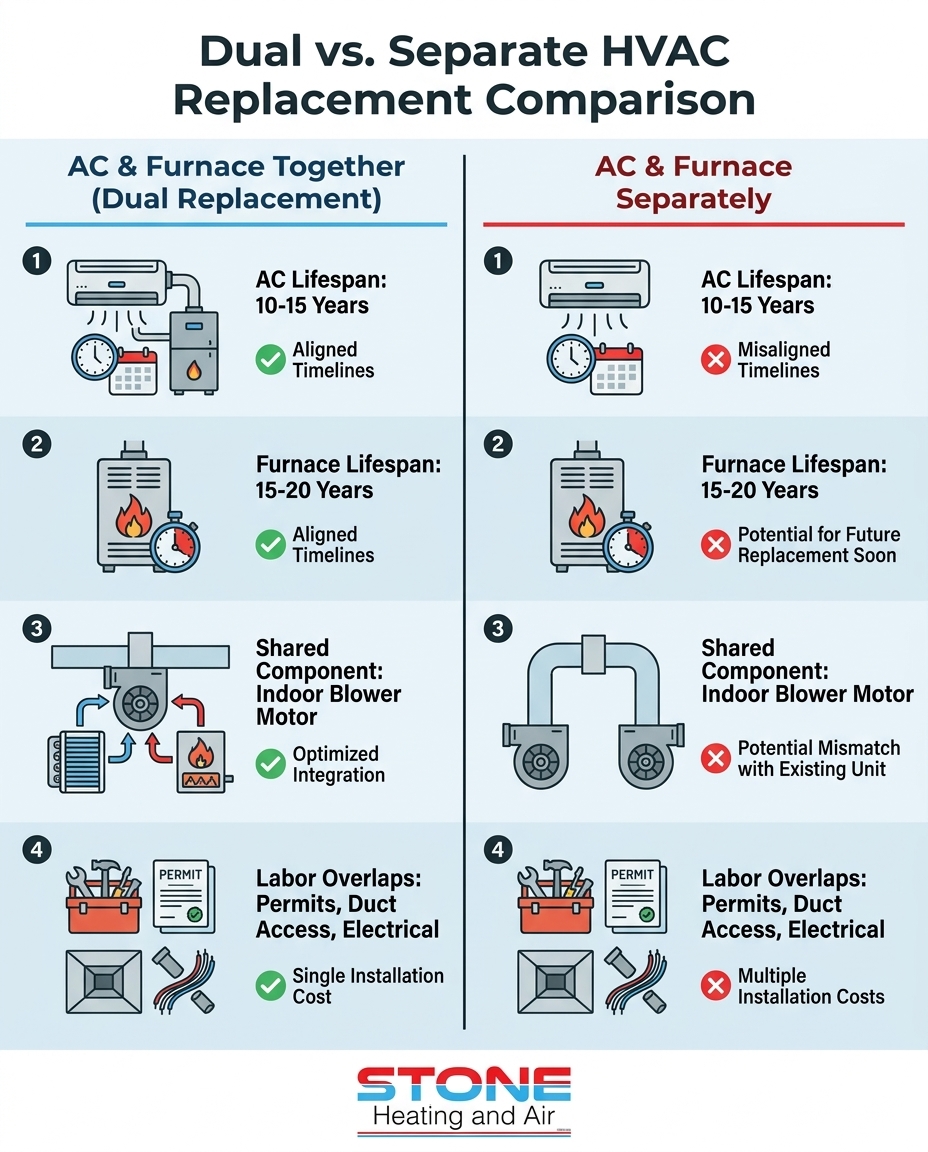
1. The shared indoor blower motor: Your air conditioner does not have its own fan to push cold air through your home. Instead, it relies entirely on the indoor blower motor located inside your furnace. Whether you are blasting cold air in July or warm air in December, that exact same furnace blower is doing the heavy lifting to circulate the treated air through your ductwork.
2. Matched efficiency ratings: Achieving optimal ENERGY STAR SEER2 (for cooling) and AFUE (for heating) efficiency ratings requires a perfectly matched system. Manufacturers design modern air conditioners and furnaces to communicate and operate seamlessly together. If you mix a brand-new, ultra-efficient air conditioner with older, outdated heating technology, you will likely never achieve the maximum energy efficiency advertised on the new unit's box.
3. The performance bottleneck: Pairing a high-efficiency AC with a 10-15 year old existing furnace often creates a severe performance bottleneck. An older blower motor might lack the variable-speed capabilities needed to properly distribute the cooling output of a modern air conditioner. This mismatch can lead to short-cycling, uneven cooling, elevated utility bills, and unnecessary wear and tear on your brand-new compressor.
4. Appliance lifespan disparities: The Department of Energy outlines different expected lifespans for these appliances. Air conditioners typically last 10 to 15 years, while furnaces often last 15 to 20 years. Because they age at slightly different rates, our team frequently sees AC units fail while the furnace still technically functions, creating the exact replacement dilemma you are facing.
Evaluating these mechanical overlaps is a crucial step when deciding whether to repair or replace your HVAC equipment. A mismatched system forces new technology to rely on old, deteriorating parts, which compromises overall performance.
The Advantages of a Dual HVAC Replacement
Choosing to replace both units simultaneously offers significant logistical and long-term benefits. While the initial investment is higher than swapping out a single unit, the consolidated process provides built-in efficiencies that are impossible to achieve when splitting the jobs years apart. We often remind our customers that doing the job right the first time saves considerable hassle down the road.
Labor and Logistical Savings
The most compelling reason to tackle both systems at once is the sheer reduction in redundant labor. Installing an HVAC system is a complex, multi-step process. When our team replaces an air conditioner, we must pull local permits, safely evacuate old refrigerants, disconnect high-voltage electrical wiring, open the sheet metal plenum, and calibrate the thermostat.
If you replace the furnace a few years later, an installation crew has to repeat nearly all of those exact same steps. They have to pull new permits, tear into the ductwork again, disconnect the wiring again, and recalibrate the system again. A dual installation consolidates all of these overlapping tasks into a single day, streamlining ductwork modifications and requiring only one electrical integration.
• Labor Efficiency — Replacing Together (Dual Installation): Consolidates overlapping tasks; requires opening the plenum and wiring the system only once. — Replacing Separately (Staggered): Duplicates labor; technicians must repeat permitting, electrical work, and duct access later.
• System Warranties — Replacing Together (Dual Installation): Perfectly matched warranties that start and end on the exact same timeline for easy tracking. — Replacing Separately (Staggered): Staggered warranties with different expiration dates, complicating future service claims.
• Home Disruption — Replacing Together (Dual Installation): A single installation event, meaning your home is only a construction zone for one day. — Replacing Separately (Staggered): Multiple installation days spread out over years, requiring you to take time off work twice.
• Performance — Replacing Together (Dual Installation): Guaranteed compatibility, allowing both units to reach their maximum rated energy efficiency. — Replacing Separately (Staggered): Potential bottlenecks if an old blower motor cannot support a new, high-efficiency AC.
Beyond the mechanical and labor advantages, a dual replacement provides long-term peace of mind. Upgrading both systems simultaneously resets the clock on your entire home comfort setup. You eliminate the lingering anxiety of waiting for the other shoe to drop, completely avoiding a secondary HVAC emergency in the near future. Additionally, generally applicable energy rebates or federal tax credits may apply to qualifying high-efficiency installations, so we always advise readers to verify current programs with their utility provider or a tax professional.
The Hidden Risk of Waiting: Winter Furnace Failure
When dealing with a late-summer August AC breakdown, it is easy to develop tunnel vision. The house is sweltering, and the only thing on your mind is getting the cold air flowing again. However, ignoring the heating side of the equation carries a significant hidden risk, especially given the demands of our local Central Point OR climate.
With 90-degree summers and freezing winters, the weather in our region puts equal, heavy wear on both halves of your climate control system. Because the indoor blower motor is a shared component, it runs almost year-round to combat these intense seasonal temperature swings. If your air conditioner has just died from old age and exhaustion, the furnace that has been working right alongside it is likely in a similar state of deterioration.
If you defer a heating system upgrade now, that aging furnace is highly susceptible to failing during the first major cold snap of the year. The transition from summer to winter places immense stress on older heat exchangers and blower motors. The last thing you want is to endure a stressful, rushed air conditioning replacement in August, only to face a freezing house and a mid-winter heating emergency in December.
Proactively replacing the furnace alongside the broken AC removes this risk entirely. Heading into the colder months with a fully vetted, reliable, and perfectly matched heating setup allows you to enjoy the changing seasons without worrying about whether your equipment will survive the next freeze.
When to Replace Separately: Honest Advice for Homeowners
While a dual installation offers undeniable benefits, it is not universally the right answer for every single home. At Stone Heating and Air, transparent financial guidance and honest logistical advice are vital to how we operate. A trustworthy professional will never use high-pressure tactics to force a dual installation if it doesn't genuinely serve your best interests.
There are several valid, practical scenarios where replacing the units separately makes perfect sense:
• The existing furnace is relatively new: If your furnace is less than 10 years old, has been well-maintained, and has a strong service history, it likely has plenty of life left. In this case, discarding a perfectly good heating unit just to match a new AC is an unnecessary expense.
• Premature or localized AC failure: Sometimes, an air conditioner dies long before its time due to a specific manufacturer defect, severe storm damage, or localized electrical surges. If the AC failure is premature and not related to old age, the furnace does not automatically need to be replaced.
• Budgetary considerations: A dual replacement requires a larger upfront investment. If your budget requires prioritizing the immediate cooling need to keep your family safe and comfortable, replacing the AC alone is a completely valid and necessary choice.
• Full mechanical compatibility: If your home's ductwork and the current furnace blower motor are fully compatible with the new AC unit's efficiency standards, you won't suffer the performance bottlenecks that plague mismatched systems.
Our goal is always to help you find the solution that best balances your immediate comfort needs with your long-term financial goals. Evaluating a 10-15 year old existing furnace requires a careful look at its maintenance history, not just its manufacturing date.
Real-World Replacements: Navigating Aging Systems
Dealing with very old HVAC equipment often requires comprehensive, rather than piecemeal, solutions. When multiple components are deteriorating simultaneously, a band-aid fix usually leads to repeated breakdowns and endless frustration. Assessing the entire system at once allows our technicians to offer replacement options that resolve underlying airflow, efficiency, and comfort problems permanently.
One local homeowner reached out to us late last summer when they needed a new HVAC unit installed to replace a deeply aging system. Rather than just swapping out a single box, our team came out to take detailed measurements and provide comprehensive recommendations for the whole home. Within 24 hours, the homeowner had a clear estimate outlining their options. By choosing a planned, dual installation, they had their new system scheduled and installed within a week.
This kind of proactive approach gets the home back to optimal comfort quickly and efficiently. Instead of waiting for a total system failure during extreme weather, taking control of the replacement timeline ensures complete satisfaction and long-term system reliability. Following up after the installation guarantees that the matched equipment is delivering the precise airflow and temperature control it was designed to provide.
Frequently Asked Questions
Should I replace my 15-year-old furnace when my AC dies?
Yes, we generally highly recommend replacing a 15-year-old furnace if you are already replacing a dead air conditioner. At 15 years old, a furnace is nearing the end of its expected lifespan and is at a higher risk for breakdowns. Replacing them together ensures system compatibility, maximizes your new AC's efficiency, and prevents a secondary heating emergency in the near future.
What are the labor benefits of replacing an AC and furnace together?
A dual replacement consolidates overlapping installation tasks into a single day. Our technicians only have to pull permits once, open the sheet metal plenum once, and integrate the electrical wiring and thermostat once. This streamlined process eliminates the redundant labor required if you were to split the installations years apart, minimizing disruption to your home.
Do my AC and furnace need to match for optimal efficiency?
Yes, an air conditioner and furnace must be properly matched to achieve the manufacturer's maximum efficiency ratings. Modern cooling systems rely on the furnace's indoor blower motor to circulate air. If you pair a new, high-efficiency AC with an old, standard-efficiency furnace motor, the older component will bottleneck the system and reduce overall performance.
How long does a furnace last compared to an AC?
Furnaces generally outlast air conditioners by a few years. According to typical appliance guidelines and what we see in the field, an air conditioner usually lasts between 10 and 15 years, primarily because it sits outside exposed to the elements. A furnace, housed safely indoors, typically lasts between 15 and 20 years with proper routine maintenance.
Is it cheaper in the long run to replace the AC and furnace at the same time?
Over the long term, replacing both units simultaneously is often more cost-effective due to consolidated labor and improved energy efficiency. While the initial upfront investment is higher, you save on the duplicated labor costs of a second installation day down the road. Additionally, a perfectly matched system operates more efficiently, which can help lower your monthly utility usage.
Will a new high-efficiency AC work properly with an old furnace blower motor?
A new high-efficiency AC will function with an older blower motor, but it will not operate at its peak potential. Older motors often lack the variable-speed technology required to distribute the cooling output of modern air conditioners effectively. This mismatch can lead to uneven cooling, shorter equipment lifespans, and higher energy consumption.
Ultimately, deciding on replacing your AC and furnace together vs. doing it separately comes down to the age of your current equipment and your long-term comfort goals. If your heating system is aging rapidly, a dual upgrade provides unmatched reliability and efficiency. When you are ready to evaluate your home's needs, scheduling a professional AC replacement consultation with the Stone Heating and Air team will give you the clear, objective answers you need to restore your comfort with absolute confidence.