


Preparing for the October Temperature Drop
October is arriving in Central Point, bringing a sudden chill to the morning air that pushes home maintenance tips and troubleshooting to the top of every homeowner's priority list. After months of running your cooling system to combat the intense summer heat, the sudden shift in weather prompts a critical transition period for your home's climate control. Turning on the heating system for the first time in nearly half a year often brings a mix of relief and anxiety. You want your home to be warm and comfortable, but you also want to be absolutely certain that the equipment is operating safely.
During this initial October temperature drop, a typical pattern we see is homeowners noticing unexpected quirks—strange smells, unfamiliar clicking noises, or uneven airflow—and wondering if they are facing a major mechanical failure. The anxiety over these initial startup symptoms is entirely understandable. Your heating equipment involves combustible materials, high-voltage electricity, and complex moving parts. Distinguishing between normal seasonal quirks, like a brief period of burning dust, and actual safety hazards is the first step in a successful seasonal transition.
However, focusing solely on the heater only addresses half of the equation. A proper seasonal transition requires a dual approach: securing the heating system for the freezing temperatures ahead while properly shutting down the cooling system that just worked overtime. Neglecting the cooling side of your equipment can lead to compounding issues that remain hidden until the spring. By taking a comprehensive approach to your air conditioning services and heating startup procedures, you set your entire home up for reliable performance throughout the harsh winter months.
As the leaves change and the mornings grow frostier, taking the time to understand the mechanical realities of your HVAC system pays significant dividends. The transition from cooling to heating is not as simple as flipping a switch on the thermostat; it is a mechanical handoff that requires attention, observation, and proactive care to ensure safety and efficiency.
The Hidden Toll of Summer Heat and Wildfire Smoke on Your AC
It is tempting to simply turn the thermostat to "Heat" and completely forget about the air conditioning unit sitting outside. However, Southern Oregon's hot, dusty summers take a severe toll on cooling equipment, and leaving that wear and tear unaddressed over the winter is a recipe for premature failure. The cumulative damage sustained over months of continuous operation requires specific attention before the system goes dormant.
The environmental factors unique to the Rogue Valley add an extra layer of complexity to this shutdown process. Wildfire smoke, in particular, introduces microscopic particulate matter (PM2.5) into the air, which interacts poorly with HVAC components. When you understand the mechanics of this damage, the need for professional Medford AC maintenance at the end of the season becomes clear.
1. Microscopic Filter Saturation: Prolonged high temperatures force AC units to work overtime, pulling massive volumes of air through the system. During wildfire season, this air is thick with PM2.5 particulates. These microscopic ash and smoke particles bypass standard fiberglass filters and rapidly saturate high-efficiency pleated filters, choking off the system's airflow long before the typical 90-day replacement window.
2. Evaporator Coil Coating: When filters become overwhelmed by smoke and summer dust, those particulates travel further into the system and settle directly onto the indoor evaporator coil. The coil relies on condensation to remove humidity from the air. When dust and ash mix with this condensation, it forms an insulating layer of grime over the metal fins, severely restricting the coil's ability to absorb heat from your home.
3. Compressor Strain and Overheating: A clogged filter and a dirty evaporator coil create a chain reaction of mechanical stress. Because the system cannot effectively transfer heat, the outdoor compressor must run for longer cycles to achieve the desired indoor temperature. This continuous operation accelerates wear on the compressor's internal bearings and electrical components, pushing the unit closer to a breakdown.
4. Drainage System Blockages: The grime that washes off the evaporator coil eventually flows into the condensate drain pan and drain line. Ash and heavy summer dust can quickly turn into a thick sludge that clogs these narrow PVC pipes. If left sitting over the winter, this sludge hardens, practically guaranteeing a severe water backup when you turn the AC back on in the spring.
Addressing this wear and tear immediately after the cooling season ends is the only way to prevent compounding damage. Allowing ash, dust, and biological growth to sit on sensitive components for six months leads to corrosion, rust, and significantly degraded efficiency.
Why End-of-Season AC Maintenance Prevents Spring Surprises
Transitioning from the damage caused by summer heat to a proactive solution involves a dedicated end-of-season check-up. Abandoning a dirty, overworked cooling system until the first heatwave of the following year is a common misstep that often results in emergency service calls. An end-of-season check-up systematically reverses the toll of the summer, ensuring the equipment is safely put to rest.
A typical pattern we see involves homeowners assuming that because the AC was working on the last hot day of September, it will perfectly resume operation in May. One local homeowner experienced the downside of this firsthand when their AC unit stopped working properly after a long workday during a late-summer heatwave. A technician arrived late in the day, repaired the overworked system, and demonstrated how proper seasonal upkeep prevents such sudden failures. Catching these hidden issues requires a specific set of shutdown procedures.
• Deep cleaning the condenser and evaporator coils: Removing the baked-on dust and smoke residue prevents galvanic corrosion from eating away at the delicate copper and aluminum fins while the system sits idle.
• Verifying refrigerant levels and pressures: Identifying a microscopic leak now prevents the compressor from running dry and burning out during its first cycle next spring.
• Clearing organic debris from the outdoor cabinet: Removing fallen leaves, twigs, and dirt from the exterior unit prevents moisture retention, which can lead to rust and provide a winter nesting ground for rodents.
• Flushing and treating the condensate drain line: Clearing out the summer's accumulation of sludge ensures the line is completely dry and free of blockages before freezing temperatures arrive.
• Inspecting electrical contacts and capacitors: Tightening loose electrical connections and testing capacitors ensures the electrical system hasn't been compromised by the heavy summer workload.
Leaving dust and smoke residue on components over the winter provides the perfect environment for mold growth and metal degradation. By investing in comprehensive AC maintenance in Central Point before the snow flies, you secure the overall lifespan of the equipment. The cost-benefit of catching minor wear and tear now, rather than facing an emergency breakdown during next year's first major heatwave, heavily favors proactive action.
Normal Fall Heating Startup Symptoms vs. Warning Signs
When you finally switch the thermostat to heat, the system's first run cycle will likely produce a few noticeable symptoms. For a homeowner preparing for winter, evaluating these symptoms can be stressful. Providing a clear, non-alarmist troubleshooting guide helps you evaluate whether the system is simply shaking off the summer dust or signaling a critical safety failure.
The key to peace of mind is knowing exactly what to expect and knowing the precise threshold for when to turn the system off and wait for an expert. The following breakdown delineates normal seasonal quirks from red-flag warning signs.
What to Expect During the First 30 Minutes
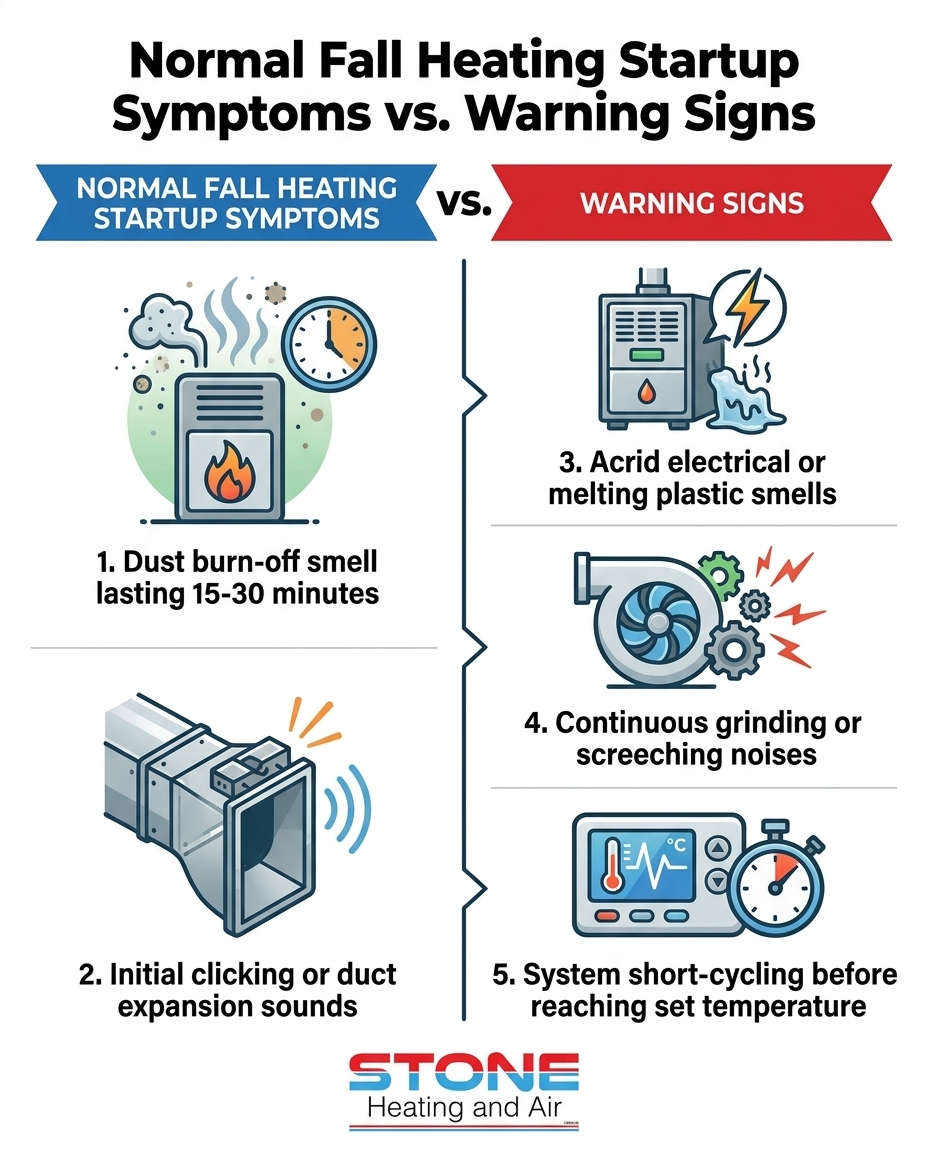
The most common and alarming symptom of a first-time heating startup is a distinct burning dust smell. Over the summer, dust, pet dander, and microscopic particulates settle directly onto the heat exchanger or heating elements. When these components reach operating temperature for the first time, this settled dust immediately burns off. This odor typically dissipates entirely within 15 to 30 minutes. You may also notice initial airflow stabilization as the blower motor ramps up, pushing out the stagnant air sitting in the ductwork. Finally, thermostat calibration can take a few cycles; the system might run slightly past the set temperature on its very first cycle as the sensors adjust to the new ambient conditions.
When to Turn Off the Unit Immediately
While dust burn-off is normal, an acrid smell of melting plastic or electrical burning is an immediate red flag. This indicates failing wiring, a seized blower motor, or a compromised electrical component. Loud grinding, metal-on-metal screeching, or continuous banging noises indicate serious mechanical failure, such as a broken blower wheel or failing bearings. Another critical warning sign is frequent short-cycling, where the system turns on for just a minute or two and then shuts down before reaching the set temperature. This is often the system's internal safety limit switches tripping to prevent a catastrophic overheat or a cracked heat exchanger.
• Brief smell of burning dust — Normal or Warning Sign?: Normal — Recommended Action: Open a window; wait 15-30 minutes for the odor to dissipate naturally.
• Initial clicking or minor duct popping — Normal or Warning Sign?: Normal — Recommended Action: Monitor the system. Metal ducts naturally expand as warm air hits them.
• Acrid electrical or melting plastic smell — Normal or Warning Sign?: Warning Sign — Recommended Action: Turn off the system immediately at the thermostat and call a professional.
• Continuous grinding or screeching noises — Normal or Warning Sign?: Warning Sign — Recommended Action: Turn off the system immediately to prevent further damage to the blower motor.
• System runs for 60 seconds then shuts off — Normal or Warning Sign?: Warning Sign — Recommended Action: Turn off the system. This indicates a tripped safety sensor or flame rollout issue.
Troubleshooting Airflow and Thermostat Issues
Before calling a professional for a suspected heating failure, there are several non-technical troubleshooting steps you can safely perform. Often, what appears to be a major mechanical breakdown is actually a simple airflow restriction or a misconfigured control setting. By walking through these basic checks, you can rule out the most common, easily solvable problems.
Thermostat Configuration: The first step is to verify that the thermostat settings are correctly switched from "Cool" to "Heat." This sounds overly simple, but a surprising number of early-season service calls are resolved by simply toggling the system mode. Additionally, ensure the fan setting is on "Auto" rather than "On," which prevents the system from blowing cold unconditioned air between heating cycles. If you have a programmable or smart thermostat, verify that the schedule hasn't reverted to a summer cooling profile during a recent power fluctuation.
Airflow Obstruction: Next, check that all vents and registers are open and unobstructed. Over the summer, it is common to rearrange furniture, place rugs, or set up fall decorations directly over floor registers or in front of return vents. Blocking these pathways starves the system of air, causing the heat exchanger to rapidly overheat and trip the safety limit switch. Walk through every room and ensure there is at least two feet of clearance around every vent.
Filter Saturation: Inspect the air filter immediately. As discussed earlier, summer smoke and dust likely took a massive toll on your filter. Running a heating system with a filter that is already clogged from wildfire season severely restricts airflow, reducing heating efficiency and straining the blower motor. Replacing the filter before the first heating cycle is one of the most effective ways of navigating AC maintenance and fall heating transitions.
While these basic checks are safe for any homeowner, we must remind readers never to attempt internal mechanical or electrical repairs themselves. Opening the furnace cabinet exposes you to high-voltage components and combustible gases. If the thermostat is set correctly, the vents are clear, and the filter is clean, but the system still fails to operate, it is time to call a licensed technician.
Creating a Seamless Seasonal Transition Plan
Managing the shutdown of an air conditioner and the startup of a furnace simultaneously can feel overwhelming. However, introducing the value of professional ongoing maintenance simplifies this process entirely. A structured transition plan shifts the burden of equipment care from the homeowner to a certified professional, ensuring nothing is overlooked during the critical October weather shift.
The efficiency of having a technician address both systems in a single seasonal visit cannot be overstated. Instead of scheduling an AC tune-up in the spring and a heating inspection in the fall, a comprehensive approach tackles the entire climate control ecosystem at once. During a routine fall service call, one customer needed guidance on the correct maintenance steps to keep their system working properly. Technicians arrived to perform the service call, completed a thorough inspection of the equipment, and explained the ongoing maintenance steps, ensuring the system was ready to operate at peak performance all winter long.
Beyond immediate performance, routine professional oversight keeps manufacturer warranties valid. Most HVAC manufacturers require proof of annual professional maintenance to honor parts warranties. If a blower motor fails in January and the system hasn't been inspected, the claim may be denied. Routine oversight ensures you remain compliant with these terms.
Furthermore, comprehensive maintenance plans protect against sudden breakdowns during the region's extreme temperature swings, saving money over time. When the weather in the Rogue Valley drops from a mild afternoon to a freezing night, the sudden demand on the heating system exposes any underlying weaknesses. Knowing the heating system has been safety-checked—with the heat exchanger inspected for cracks, the burners cleaned, and the electrical connections secured—provides profound peace of mind. The long-term reliability gained through a structured preventative maintenance plan transforms HVAC care from a stressful seasonal chore into a predictable, manageable process.
Secure Your Comfort Before Winter Arrives
The window between the first October chill and the deep freezes of winter is narrow. Waiting until the first major frost to test your heating system or address the summer wear on your air conditioner leaves your home vulnerable to uncomfortable and disruptive breakdowns. Acting proactively ensures your equipment is ready to handle whatever the season brings to Central Point.
Do not let the seasonal transition catch you off guard. Secure your home's comfort and safety by scheduling your dual-purpose seasonal check-up today. Taking action now guarantees that your cooling system is properly protected against winter damage and your heating system is primed to deliver safe, reliable warmth all season long.
Frequently Asked Questions
Why does my heater smell like burning dust when I turn it on?
This is a completely normal symptom of the first heating cycle of the season. Over the summer, dust, pet dander, and microscopic debris settle on the cold heat exchanger and heating elements. When the system heats up for the first time in months, this accumulated dust safely burns off. The odor should dissipate entirely within 15 to 30 minutes of continuous operation.
What is normal when turning on a furnace for the first time?
A brief burning dust smell, minor clicking noises from the thermostat, and the sound of metal ductwork expanding (popping or ticking) are all normal. You may also notice it takes a few moments for the airflow to stabilize as the blower motor ramps up. As long as the system achieves the set temperature without shutting down prematurely or producing electrical odors, it is likely operating normally.
How do I prepare my AC for winter after a smoky summer?
Preparing your AC requires a deep cleaning of the condenser and evaporator coils to remove corrosive wildfire ash and heavy summer dust. The condensate drain line must be flushed to prevent sludge from hardening over the winter, and the outdoor cabinet should be cleared of organic debris. Because this process involves handling sensitive fins and checking electrical components, it is best handled through a professional end-of-season tune-up.
When should I schedule fall HVAC maintenance?
The ideal time to schedule fall maintenance is during the transitional weeks of late September or October, just before the first major temperature drop. Scheduling early ensures your system is inspected and safety-checked before you desperately need it. It also allows technicians to properly shut down your cooling equipment before freezing temperatures risk damaging components that still hold moisture.
How do I know if my furnace is safe to run?
A furnace is generally safe to run if it ignites smoothly, runs consistently until the thermostat set point is reached, and produces no acrid smells or grinding noises. However, the only way to be absolutely certain it is safe—particularly concerning invisible threats like carbon monoxide leaks from a cracked heat exchanger—is to have a licensed professional perform a pre-winter safety inspection.
Can a dirty AC filter affect my heating system?
Yes, absolutely. Most homes use a central air handler and ductwork system shared by both the air conditioner and the furnace. If your filter is clogged from summer wildfire smoke, it will severely restrict the airflow to your heating system. This restriction forces the furnace to overheat, which can trip internal safety switches and cause the system to short-cycle or shut down entirely.