


The First October Startup: Addressing That Burning Dust Smell
That unmistakable burning dust smell fills the hallway just minutes after you switch your thermostat from cooling to heating for the first time this season. It is a stressful moment for any homeowner. You expect warm, comfortable air, but instead, you get a concerning odor and a system that might even start short-cycling. When relying on local service expertise and area tips, a mid-fall heating startup requires knowing the exact difference between a harmless seasonal quirk and a serious mechanical issue. This is exactly why scheduling a thorough ac check up is so critical before the freezing weather settles in permanently.
For more details on keeping your entire system running safely year-round, explore professional air conditioning services.
When the crisp autumn air finally arrives, the last thing anyone wants to deal with is a malfunctioning heating and cooling system. That initial burning odor is incredibly common, yet it often triggers immediate panic. Homeowners frequently wonder if their equipment is overheating, if there is an electrical fire hazard, or if the blower motor has simply given out after a long summer. Acknowledging this immediate concern is the first step toward resolving it safely. The transition from summer cooling to winter heating places a unique stress on dual-season equipment like heat pumps and traditional furnaces.
Understanding the root cause of these startup symptoms is essential. A system that sits idle in heating mode for months will naturally behave differently during its first active cycle. However, dismissing every strange noise or smell as a "normal" part of the mid-fall heating startup can lead to significant safety risks. The key decision point for any homeowner is determining whether that odor is simply harmless dust burning off the internal components, or if it indicates a failing electrical connection that requires immediate professional attention. Approaching this transition with a safety-first mindset ensures that minor seasonal adjustments do not turn into major winter emergencies.
Understanding the Transition: From Summer Cooling to Winter Heating
The Problem: After months of operating strictly in cooling mode, your heating components have been sitting entirely dormant. When you finally call for heat, the system suddenly produces a sharp, burning odor that circulates through every vent in the house.
The Cause: During the long summer months, airborne particulates, pet dander, and household dust bypass the air filter and gradually settle onto the cold heat exchangers or dormant heat pump coils. Because these heating elements remain inactive, the dust simply accumulates layer by layer. When the mid-fall heating startup finally occurs, these components rapidly heat up to extreme temperatures. The physical process of the first ignition literally incinerates that accumulated dust layer all at once, creating the distinct burning smell.
The Solution: The most effective way to manage this transition is through professional preparation. Scheduling comprehensive AC maintenance in Central Point ensures that excessive debris is cleared away before the system is forced to ignite. While a minor smell is normal, a professional cleaning significantly reduces the volume of dust that burns off, keeping your indoor air quality high and your equipment safe.
The Science of Dust Burn-Off
Seasonal dormancy creates the perfect environment for particulates to gather. Even in homes with excellent air quality, microscopic dust particles continuously circulate. When a furnace or air handler sits unused from May to October, the internal heating elements act like a magnet for these settling particles. Once the thermostat triggers the heating cycle, the heat exchanger rapidly climbs to temperatures exceeding 140 degrees Fahrenheit. This temperature threshold is more than enough to scorch the settled dust.
Proper filtration mitigates this issue but does not entirely prevent it. High-quality pleated filters capture a significant portion of airborne debris, but no filter is 100% effective. A small amount of dust will always reach the internal components over a six-month period. Typically, this normal burn-off smell should last for a single heating cycle—usually dissipating within one to two hours. If the odor persists beyond that initial window, it is no longer a simple dust issue and signals a deeper mechanical or electrical problem.
The Toll of Intense Summer Heatwaves on Your Equipment
The transition into fall is not just about turning on the heat; it is about assessing the damage left behind by the summer. The intense, dry 90-plus degree summer heatwaves in the Rogue Valley force cooling systems to work at maximum capacity for weeks on end. This relentless demand takes a severe toll on every moving part within the unit. When a system runs continuously to combat triple-digit heat, the internal components experience significant thermal stress and mechanical wear.
One of the most impacted areas is the coil system. Dirty evaporator and condenser coils are a direct result of moving massive volumes of summer air. As these coils accumulate dirt, pollen, and outdoor debris, their ability to transfer heat drops dramatically. Unmaintained systems operating with fouled coils can suffer an efficiency reduction of up to 40%. This means the equipment had to work nearly twice as hard just to maintain a baseline temperature during July and August, accelerating the degradation of critical parts.
Furthermore, the extreme heat places immense strain on the electrical framework of the system. Capacitors and contactors endure thousands of high-voltage cycles during a typical Central Point summer. The constant expansion and contraction caused by temperature fluctuations can loosen electrical connections and degrade wire insulation. Before relying on these exact same dual-season heat pumps or air handlers for winter heating, these summer-worn components must be thoroughly inspected. A post-summer check up is essential to ensure that a unit exhausted by the Rogue Valley heat is actually structurally sound enough to handle freezing winter temperatures safely.
What Actually Happens During a Fall AC Check Up?
Many homeowners assume that preparing for winter simply means swapping out the air filter and adjusting the thermostat. In reality, a professional mid-fall heating startup inspection is a highly technical process focused on safety and mechanical integrity. Understanding exactly what an HVAC maintenance visit includes helps clarify why these appointments are so crucial for extending the life of the equipment. Expert local technicians focus on deep safety checks rather than just applying quick fixes.
1. Comprehensive System Diagnostics: The technician begins by testing the thermostat calibration and running the system through a full heating and cooling cycle to listen for abnormal noises and observe the ignition sequence.
2. Airflow and Ductwork Assessment: Static pressure is measured to ensure the blower motor is pushing the correct volume of air without excessive resistance, which can cause overheating.
3. Refrigerant Level Verification: For heat pumps, the exact volume of refrigerant is checked. Improper levels not only ruin efficiency but can permanently damage the compressor during cold weather operation.
4. Condensate Drain Clearing: The drain lines, often clogged with summer algae and dust, are flushed to prevent water damage and biological growth inside the air handler.
It is critical to maintain a strict "no DIY" stance when it comes to electrical testing and refrigerant handling. These are high-voltage, highly pressurized systems that require specialized gauges, meters, and EPA certifications to service safely.
Coil and Blower Motor Inspections
During the visit, removing summer debris from the coils is a top priority to ensure proper airflow. If the coil is blocked, the system cannot exchange heat effectively, leading to longer run times and higher utility bills. The technician will also check the blower motor's amp draw. A motor pulling too many amps is a clear indicator that it is struggling against resistance or failing internally. Catching a high amp draw in October prevents a complete motor failure in the middle of a January freeze.
Safety Controls and Electrical Testing
The most vital portion of the check up involves verifying that all safety limit switches operate correctly. These switches are designed to shut the system down if it overheats or if the exhaust venting fails. If a limit switch is compromised, the system could run in a dangerous state. Technicians also spend time tightening electrical connections that have been loosened by months of summer vibrations, ensuring that voltage flows cleanly and safely to all major components.
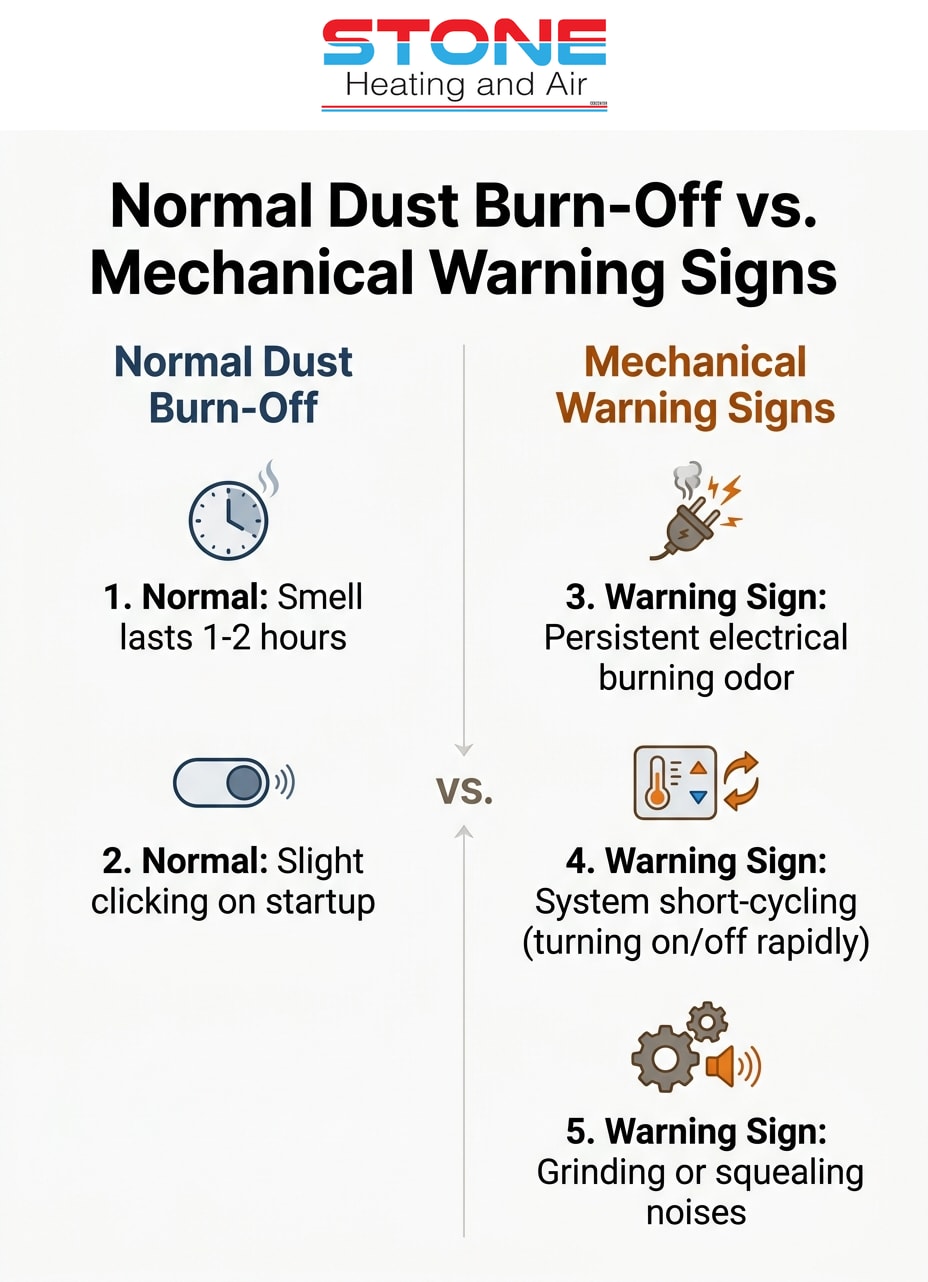
Normal Seasonal Quirks vs. Signs You Need AC Repair
Knowing exactly when to call for professional help can save thousands of dollars in catastrophic equipment failure. During a mid-fall heating startup, the system will exhibit some behaviors that are entirely harmless, while other symptoms are massive red flags. If your equipment displays any of the warning signs, shutting the system down immediately at the thermostat and scheduling professional AC repair is the only safe next step.
• Startup Odors — Normal Seasonal Quirk: Brief burning dust smell lasting 1 to 2 hours during the very first cycle. — Warning Sign (Requires Repair): Persistent electrical burning, melting plastic, or acrid smells that do not fade.
• System Noises — Normal Seasonal Quirk: Minor clicking from the thermostat or ductwork expanding as it warms up. — Warning Sign (Requires Repair): Loud grinding, metal-on-metal squealing, or violent banging from the cabinet.
• Cycle Length — Normal Seasonal Quirk: Initial brief sluggishness as the system pressurizes and reaches the set temperature. — Warning Sign (Requires Repair): Short-cycling: turning on and off rapidly every few minutes without heating the room.
• Airflow Quality — Normal Seasonal Quirk: Slightly cool air for the first 60 seconds before the heat exchanger fully warms up. — Warning Sign (Requires Repair): Weak, barely noticeable airflow or persistently cold air blowing from the vents.
Unexpected breakdowns rarely happen without warning. They are almost always preceded by one of the warning signs listed above. A grinding noise usually indicates a failing motor bearing, while short-cycling often points to an overheating safety switch tripping repeatedly. Catching these signs early and relying on a qualified technician prevents a minor repair from turning into a full system replacement.
Extending Equipment Life Through Preventative Maintenance
Shifting the focus from reactive repairs to proactive care is the secret to getting the maximum lifespan out of your heating and cooling equipment. Preventative maintenance is not just a recommendation; it is a mechanical necessity for modern, high-efficiency systems. Industry data consistently shows that routine, professional attention can prevent up to 95% of unexpected breakdowns. By addressing minor wear and tear before it cascades into major component failure, homeowners save significantly on emergency service costs and utility bills over the life of the unit.
One critical factor often overlooked is warranty compliance. Most major HVAC manufacturers require documented proof of annual maintenance by a licensed professional to keep the factory warranty valid. If a compressor or heat exchanger fails prematurely and the system has not been serviced, the manufacturer can—and often will—deny the warranty claim, leaving the homeowner fully responsible for the replacement costs. Enrolling in a routine maintenance plan guarantees that this documentation is always up to date and that the equipment remains protected.
The tangible benefits of these visits are clear in everyday operation. One Central Point homeowner scheduled a routine service call last fall specifically to get guidance on keeping their system running at peak performance. The responding technicians thoroughly explained the necessary maintenance procedures and performed a deep clean of the equipment. The outcome was a system optimized to run highly efficiently, fully prepared for the upcoming temperature drops. This level of routine service ensures that systems are always ready for the next season, providing the ultimate peace of mind that comes from knowing the equipment has been thoroughly vetted by a local expert.
Frequently Asked Questions About Fall HVAC Check Ups
Why does my heater smell like burning dust when I turn it on?
That burning smell is caused by the incineration of dust and debris that settled on the internal heating components during the summer months. When the system is dormant, particulates naturally gather on the heat exchanger or heat pump coils. Upon the mid-fall heating startup, these components reach high temperatures rapidly, burning off the accumulated layer. This is a normal process that should completely dissipate within one to two hours of operation.
What is included in a fall HVAC check up?
A comprehensive fall check up goes far beyond a simple filter change, focusing heavily on safety and efficiency. A licensed technician will clean the evaporator and condenser coils, measure the amp draw on the blower motor, and verify correct refrigerant levels. Most importantly, they conduct rigorous safety testing on all electrical connections and limit switches to ensure the system will not overheat or pose a fire risk during heavy winter use.
Is an annual AC check up really necessary?
Yes, annual maintenance is absolutely critical for both the longevity and efficiency of the equipment. Systems that skip maintenance can lose up to 40% of their operational efficiency due to dirty coils, clogged blowers, and uncalibrated thermostats. Regular professional check ups prevent up to 95% of unexpected breakdowns by catching small mechanical issues before they turn into complete system failures in the middle of a harsh season.
Is a burning smell normal for a heat pump in the fall?
A brief burning dust smell is normal for a heat pump during its first few heating cycles in the fall, but an electrical or plastic burning smell is never normal. If the odor smells like melting wires or ozone, or if the dust smell persists for days, it indicates a serious problem. In these cases, it is vital to turn the system off immediately and call a professional to inspect the wiring and internal components.
What happens if you don't service your AC before winter?
Failing to service your equipment before winter means carrying all the intense wear and tear from the summer directly into the harsh heating season. Loose electrical connections, degraded capacitors, and dirty coils will force the system to work much harder to warm your home. This neglect drastically increases the likelihood of a mid-winter breakdown, higher monthly energy bills, and a shortened overall lifespan for your HVAC system.
Securing Peace of Mind for the Coming Winter
Navigating the transition from summer cooling to winter heating does not have to be a source of anxiety. While a brief burning dust smell during your first October startup is a normal part of the seasonal shift, understanding the line between harmless quirks and persistent mechanical issues is crucial. Ignoring warning signs like short-cycling, grinding noises, or electrical odors can turn a minor adjustment into a major winter emergency in Central Point.
Reiterating the value of a professional check up is about more than just efficiency; it is about preventing mid-winter breakdowns when you need your heat the most. By allowing an expert to inspect, clean, and calibrate your system, you eliminate the guesswork and ensure your equipment is operating safely. As temperatures begin to drop, prioritize your family's comfort and safety by scheduling an ac check up to secure total peace of mind for the freezing months ahead.