

The Silent Hazard Lurking in Dormant Furnaces
If you are preparing to turn on your heating system for the first time this year without a prior inspection, understanding the carbon monoxide risks of a neglected furnace is the most critical step you can take for your home's safety. That strange metallic odor or faint rattling sound from your utility closet isn't just a sign of aging equipment; it can be an indicator of severe mechanical stress that has developed out of sight. A dormant heating system sits unused for months, accumulating dust, suffering from subtle metal fatigue, and potentially hiding hazards that only reveal themselves when the burners ignite.
At Stone Heating and Air, we see homeowners in Central Point OR face a distinct decision point every autumn. You can simply walk over to the thermostat, switch it from cooling to heating, and hope for the best, or you can actively choose to verify the system's safety before the freezing weather arrives. Choosing the latter is vital because carbon monoxide (CO) is completely invisible, tasteless, and odorless. It does not announce its presence until physical symptoms begin to manifest in your household.
Because this dangerous byproduct requires highly specific testing to detect, comprehensive heating services are designed to do much more than just make sure your vents blow warm air. Proactive system care is fundamentally about life safety, ensuring that every combustion process happening inside your equipment is contained, controlled, and venting safely to the outside of your home.
The Mechanics of Incomplete Combustion and CO Generation
To understand why a neglected furnace becomes dangerous, we have to look closely at the science of combustion. Inside a standard gas furnace, natural gas or propane mixes with oxygen from the surrounding air. When ignited, this mixture produces heat, water vapor, and carbon dioxide. In a perfectly tuned, clean system, this process is known as complete combustion. The exhaust gases are safely carried away through the flue, and the heat is transferred into your home.
However, when a system is neglected, the delicate fuel-to-air ratio is disrupted. Blocked flues, compromised intake pipes, or restricted airflow can choke the system of the oxygen it needs. When the flame is starved of oxygen, the chemical reaction changes. Instead of producing relatively harmless carbon dioxide, the combustion process begins to produce elevated levels of carbon monoxide. This is known as incomplete combustion, and it happens entirely out of sight within the sealed combustion chamber.
During the early fall pre-heating season (September), our technicians consistently find that this mechanical degradation is often at its worst, as the system has been sitting idle, gathering dust and debris that further disrupt the burners.
Why Dirty Burners Compromise the Flame
The visual characteristics of your furnace flame tell a detailed story about the health of the combustion process. A clean, well-maintained burner produces a crisp, steady blue flame. This blue color indicates that the gas is burning at its maximum temperature and that the fuel-to-air ratio is perfectly balanced.
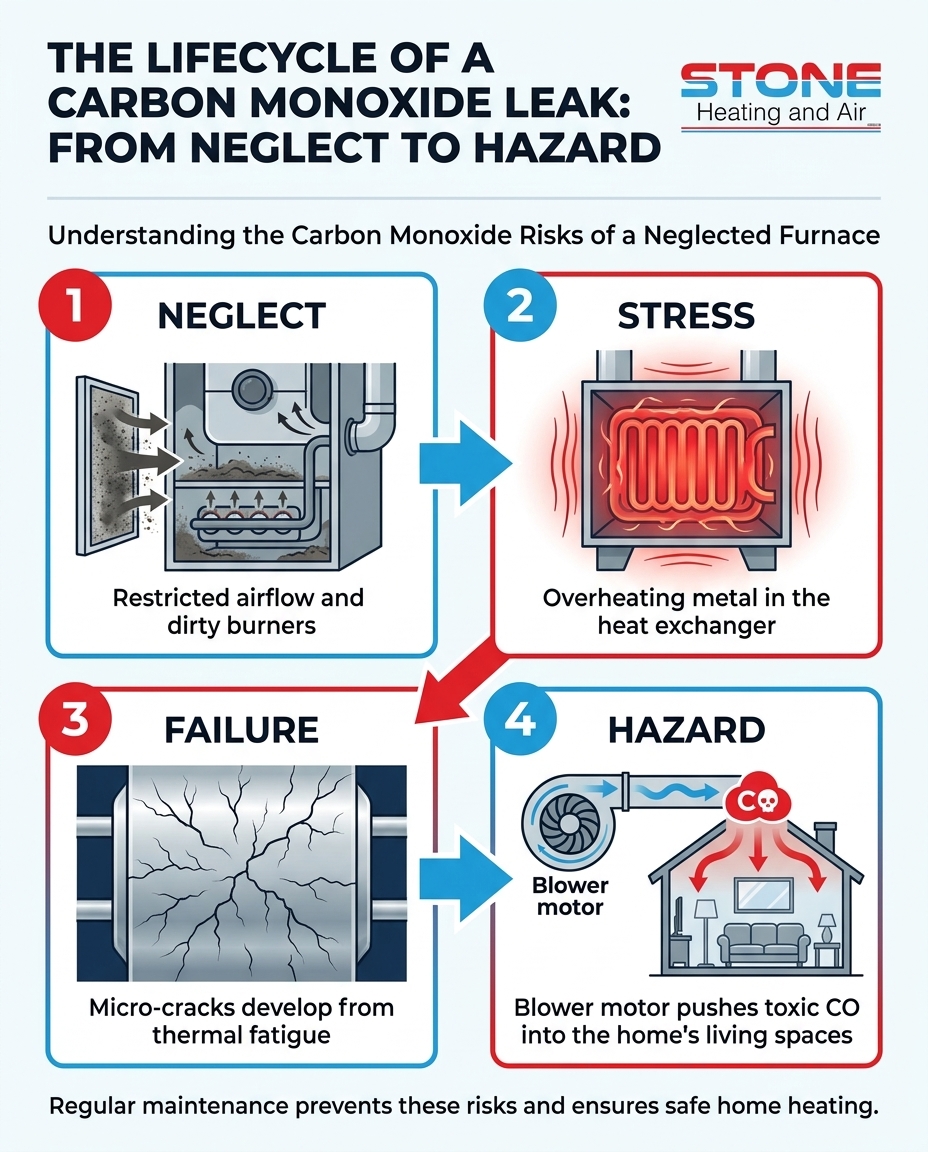
When soot, dust, and rust build up on the burner assembly over years of neglect, they physically alter how the gas flows and mixes with the air. The flame temperature drops, and the color shifts from blue to a lazy, flickering yellow or orange. That yellow flame is a visual confirmation of incomplete combustion. The soot buildup physically restricts the burner ports, causing the gas to burn inefficiently and generating significantly higher concentrations of toxic exhaust gases right at the source.
How a Cracked Heat Exchanger Becomes a Silent Threat
The problem: Even if your furnace is producing carbon monoxide due to incomplete combustion, that toxic gas is supposed to remain safely contained and vented outdoors. The danger arises when the primary physical barrier inside your furnace fails. This barrier is the heat exchanger, a series of metal coils or tubes that act as the only wall between the toxic exhaust gases and the breathable air circulating through your home.
The cause: Over years of continuous operation, the heat exchanger undergoes massive temperature swings. Every time the furnace kicks on, the metal heats up and expands. When the cycle ends, the metal cools and contracts. This endless expansion and contraction eventually causes metal fatigue. This process is drastically accelerated by restricted airflow. If you have a neglected, clogged air filter, the blower motor cannot move enough cool air over the heat exchanger. The metal overheats, pushing it past its design limits, and microscopic cracks begin to form. In our years of servicing local HVAC systems, we've found these cracks often develop entirely unnoticed during the early fall pre-heating season (September).
The solution: Once a crack forms, the system becomes an active hazard. When the blower fan turns on to distribute warm air, it creates pressure changes that force air over the cracked metal, effectively pushing carbon monoxide directly out of the combustion chamber and into your living spaces. The only solution is professional intervention. In our professional experience, a cracked heat exchanger cannot be patched or taped; it requires a complete component replacement or, in many cases with older units, a full system replacement to restore safety.
The Amplified Danger During the First Fall Cold Snap
The timing of furnace failures plays a massive role in how dangerous they become. The transition from mild weather to freezing temperatures is the period of highest risk for residential CO exposure. Working in this region, our team knows firsthand that Central Point's rapid temperature drops into the 40s and 30s prompt immediate, heavy furnace usage in homes that have been closed up tightly for the season.
This creates what safety experts call the "enclosed environment" effect. During the summer, windows are often cracked, doors are opened frequently, and homes breathe. But when the first major cold snap hits, windows are shut tight, weatherstripping is sealed, and fresh air ventilation drops to near zero. Modern homes, in particular, are built to be highly energy-efficient and airtight, which is great for retaining heat but terrible for dispersing airborne toxins.
A minor carbon monoxide leak that might dissipate harmlessly in a drafty summer house will quickly accumulate to dangerous levels in a sealed, winterized home. Because the furnace is running longer cycles to combat the sudden cold, it is pumping a continuous stream of exhaust into an airtight box. If you suspect any issues with your system during this critical transition period, reaching out for emergency HVAC service is a necessary step to protect your household from rapid gas accumulation.
Home CO Alarms vs. Professional Combustion Analyzers
Most homeowners rely entirely on ceiling-mounted or plug-in carbon monoxide alarms to keep them safe. While these devices are an absolute necessity for preventing acute poisoning, they have significant limitations that every family should understand.
Standard home CO alarms are designed to prevent immediate, life-threatening emergencies. According to standard manufacturing regulations, they often only trigger at high thresholds—such as 70+ parts per million (PPM) sustained over several hours, or 400 PPM sustained for a few minutes. They are generally not designed to alert you to low-level, chronic CO exposure (e.g., 15 to 30 PPM), which can still cause headaches, nausea, and long-term health impacts over weeks of exposure.
• Primary Purpose — Standard Home CO Alarm: Alerts to acute, life-threatening emergencies. — Professional Combustion Analyzer: Diagnoses trace mechanical leaks before they escalate.
• Detection Threshold — Standard Home CO Alarm: High (typically 70+ PPM over extended time). — Professional Combustion Analyzer: Extremely precise (detects 1 PPM in real-time).
• Location of Measurement — Standard Home CO Alarm: Ambient air in hallways and bedrooms. — Professional Combustion Analyzer: Directly inside the furnace exhaust flue.
• Response Time — Standard Home CO Alarm: Delayed (requires sustained exposure). — Professional Combustion Analyzer: Instantaneous reading of exhaust gases.
By contrast, a professional combustion analyzer is a highly sensitive diagnostic tool that reads real-time exhaust composition directly at the source. When our professionals at Stone Heating and Air test a system, we aren't waiting for the ambient air in the home to become dangerous. We measure the exact chemical makeup of the exhaust inside the flue. Finding trace amounts of CO early prevents chronic exposure entirely. Relying solely on a home alarm means you won't know there is a problem until the air you are already breathing has reached a critical toxicity level.
Inside Our Professional Early-Season Safety Methodology
Catching mechanical failures before they threaten your home requires a rigorous, methodical approach to HVAC system care. At Stone Heating and Air, our early-season inspections don't just look at the equipment; our technicians actively measure its performance against strict safety baselines.
When we test a heat exchanger, the process involves several critical steps:
1. Visual and Camera Inspection: We begin by examining the exterior of the heat exchanger for obvious signs of rust, soot, or thermal stress. We then use specialized inspection cameras to look deep into the clamshell or tubular cells, searching for hairline cracks that are invisible to the naked eye.
2. Burner and Flame Analysis: We evaluate the burner assembly, cleaning away debris that disrupts the gas flow, and we verify that the flame is burning a crisp, efficient blue.
3. Active Combustion Testing: The most crucial step involves running the system while actively monitoring the exhaust with a combustion analyzer. We place the probe directly into the flue to read the exact chemical output. If we detect dangerous parts-per-million (PPM) CO levels on a combustion analyzer, we immediately shut the system down and lock it out to prevent accidental usage.
4. Homeowner Education: We walk you through our findings, showing you exactly how your system is functioning and what steps are necessary to maintain a safe environment.
Sometimes, this methodology reveals that a system is simply too compromised to operate safely. For instance, one homeowner reached out when they needed a new heating and cooling system during a period of extensive supply chain problems. They had done extensive research on system safety and knew their old unit was a risk. Our team worked hard to earn their business, providing constant updates on equipment availability and ensuring the final installation was flawlessly executed and rigorously tested for safety.
Physical and System Warning Signs You Should Never Ignore
While professional tools are required to definitively diagnose a CO leak, your neglected furnace will often display secondary symptoms when the combustion process is failing. If you notice any of the following warning signs in your Central Point OR home, you should schedule an immediate evaluation with our team.
• Soot or brown staining: Look closely around the furnace registers, the exterior venting, or the front panel of the unit. Black or brown streaks indicate that incomplete combustion is producing heavy soot, which is spilling out of the combustion chamber.
• A yellow or orange burner flame: As discussed, a healthy gas flame should be blue. A lazy, flickering yellow flame means the fuel is not burning efficiently, and toxic gases are being generated at a high rate.
• Excessive window condensation: Water vapor is a natural byproduct of combustion. If the heat exchanger is cracked or the venting is blocked, that excess moisture will be pushed into your home, often appearing as heavy condensation on the inside of your windows.
• Unusual rattling or clicking noises: A grinding or rattling sound when the blower turns on can indicate a cracked heat exchanger expanding and contracting as it heats up and cools down.
Paying attention to these physical indicators is a crucial part of home safety, which is why our technicians consider checking the heat exchanger during fall maintenance a non-negotiable step for responsible homeowners.
Prioritizing Life Safety Before the Heavy Heating Season
Carbon monoxide risks are entirely preventable through proactive, professional oversight. The dangers posed by incomplete combustion and cracked heat exchangers do not develop overnight; they are the direct result of long-term neglect and unchecked mechanical stress. A pre-season inspection is a critical life-safety measure, not just a minor performance tweak to make your vents blow a little warmer.
Before the heavy cold sets in permanently, make the choice to verify your system's integrity. By scheduling a comprehensive evaluation during the early fall pre-heating season (September), you ensure that your equipment is clean, structurally sound, and venting properly. Protect your household by securing a spot on a professional HVAC maintenance plan today.
Frequently Asked Questions
Can a dirty or neglected furnace cause carbon monoxide leaks?
Yes, a neglected furnace is a primary cause of carbon monoxide generation. When burners become caked with dust and soot, the delicate fuel-to-air ratio is disrupted, leading to incomplete combustion. This inefficient burning process produces high levels of carbon monoxide instead of safe carbon dioxide. If the system also suffers from a cracked heat exchanger due to poor airflow, that toxic gas is pushed directly into your home.
How do professionals test a furnace for carbon monoxide?
Professionals use highly sensitive diagnostic tools called combustion analyzers to test for carbon monoxide. A technician inserts the analyzer's probe directly into the furnace's exhaust flue while the system is running. This device provides a real-time, exact measurement of the chemical makeup of the exhaust, allowing the technician to detect trace parts-per-million of CO long before it ever leaks into the ambient air of your home.
What are the signs of a cracked heat exchanger?
The most common signs of a cracked heat exchanger include unusual rattling or clicking noises as the metal expands and contracts during a heating cycle. You may also notice strong, unpleasant metallic odors coming from your vents, or excessive condensation building up on your windows due to exhaust moisture entering the living space. Additionally, a flame that dances or flickers when the blower motor turns on is a strong visual indicator that air is pushing through a crack in the metal.
Will a standard carbon monoxide detector go off if the furnace is leaking?
A standard detector will go off if the carbon monoxide levels reach a high, acute threshold, but it may miss low-level leaks. Most home alarms are calibrated to avoid nuisance tripping, meaning they often require sustained exposure to 70+ PPM before sounding the alarm. If your furnace is leaking a steady, low amount of CO (e.g., 20 PPM), you may experience chronic physical symptoms like headaches and nausea without the alarm ever triggering.
Why is a yellow burner flame dangerous in a gas furnace?
A yellow burner flame is dangerous because it visually confirms that the furnace is experiencing incomplete combustion. A healthy gas flame should always be a crisp, steady blue, indicating that the gas is burning at the correct temperature with adequate oxygen. A yellow or orange flame means the burners are choked with debris or starved of air, which drastically increases the amount of carbon monoxide being produced in the combustion chamber.
How often should combustion analysis be performed on a residential heating system?
Combustion analysis should be performed at least once a year, ideally during your early fall pre-season tune-up. Because heat exchangers endure massive thermal stress every winter, a system that tested perfectly safe last year could easily develop a micro-crack over the course of a single heavy heating season. Annual testing ensures that any mechanical degradation is caught and addressed before the system is run continuously during the winter.