

Why Understanding How Wildfire Smoke Affects Your HVAC Performance Could Save Your System
How wildfire smoke affects your HVAC performance is something every Rogue Valley homeowner needs to understand — especially as wildfire seasons grow longer and more intense each year. When smoke fills the air outside, your HVAC system becomes your home's primary defense. But that same system can quickly become overwhelmed, damaged, and far less effective without the right preparation.
Here is a quick summary of the key ways wildfire smoke impacts your HVAC system:
• Clogs filters rapidly — A filter that normally lasts three months can become packed with thick, black soot within days during a heavy smoke event
• Restricts airflow — Clogged filters force your blower motor to work harder, increasing energy use and wear
• Contaminates ductwork — Fine particles settle inside ducts, reducing air quality long after smoke clears
• Damages coils — Soot and ash coat evaporator and condenser coils, reducing efficiency and shortening system lifespan
• Degrades indoor air quality — PM2.5 particles, which are roughly 30 times smaller than a human hair, can circulate through your home even when windows are closed
• Triggers false alarms — Smoke can activate automatic safety shutdowns in some systems, interrupting cooling or heating when you need it most
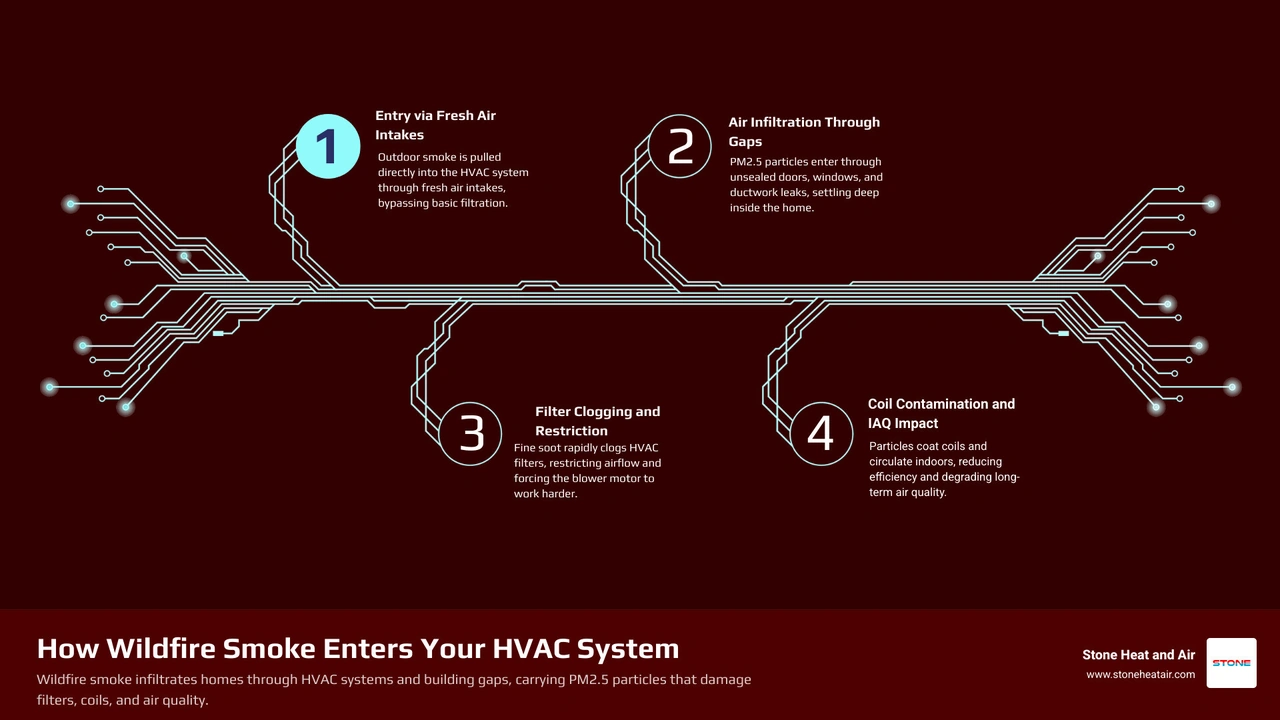
Wildfire smoke is not just an outdoor problem. It enters homes through HVAC fresh air intakes, gaps around doors and windows, and general air infiltration — even in tightly sealed homes. In the Rogue Valley, where smoke events can last days or even weeks, the strain on your HVAC system adds up fast. In May 2026, this remains one of the most pressing indoor air quality challenges for local homeowners and businesses alike.
How Wildfire Smoke Affects Your HVAC Performance and Efficiency
When the skies turn that eerie shade of orange we’ve come to know all too well in Southern Oregon, your air conditioner or furnace isn't just moving air; it’s acting as a giant vacuum cleaner for the neighborhood’s woodsmoke, ash, and chemicals.
The primary culprit in smoke is PM2.5 — particulate matter that is 2.5 micrometers or smaller. To give you some perspective, a single human hair is about 70 micrometers wide. These microscopic particles are small enough to bypass standard fiberglass filters and lodge themselves deep into the mechanical "lungs" of your home.
As these particles accumulate, the first thing you’ll notice is a drop in airflow. When a filter becomes "impacted" (a fancy word for completely stuffed with soot), your HVAC system has to work twice as hard to pull air through it. This creates a massive amount of strain on the blower motor. If you’ve ever tried to breathe through a thick wool blanket, you know exactly how your HVAC feels during a wildfire event. This extra effort translates directly to higher utility bills and a higher risk of a system breakdown right when you need cooling the most. For a deeper dive into these mechanical challenges, check out our guide on How Wildfire Smoke Impacts HVAC Maintenance Needs.
Impact on Internal Components and System Lifespan
It’s not just the filter that suffers. How wildfire smoke affects your HVAC performance extends to the very heart of the machinery. Fine ash and soot can pass through low-quality filters and coat the evaporator coils (the part inside your home that gets cold).
When these coils are covered in a layer of grime, they can’t effectively absorb heat from your indoor air. This leads to longer run times and can even cause the coils to freeze over. On the outside of your home, the condenser unit is also at risk. Ash can settle between the delicate fins of the condenser, acting as an insulating blanket that prevents the unit from releasing heat. Over time, the corrosive nature of smoke residue — which can contain chemicals from burned plastics and building materials — can actually eat away at sensitive electronic components and metal parts. You can learn more about shielding your unit in our article on how to Protect Your HVAC System from Dust and Dirt.
How Humidity Affects HVAC Energy Efficiency During Smoke Events
You might not think about humidity when the world is on fire, but it plays a silent role in how smoke behaves. High humidity can actually cause smoke particles to clump together and settle faster. However, in the dry heat of a Southern Oregon summer, these particles stay airborne longer, making them easier for your HVAC to "inhale."
If your home’s humidity levels aren't balanced (ideally between 40% and 60%), your system might struggle even more. Dry air makes the particulate matter more "staticky," causing it to cling to duct walls and sensitive sensors. Properly calibrated humidity levels help your system maintain peak efficiency even when the air quality is poor. We’ve detailed this relationship in our post on How Humidity Affects HVAC Energy Efficiency.
Protecting Your Indoor Air Quality During Active Smoke Events
During a wildfire, your home should be a sanctuary. Unfortunately, research shows that over 1.5 million deaths globally each year are attributed to harmful exposure caused by wildfires. The health risks are real, particularly for the most vulnerable members of our families. PM2.5 particles are small enough to enter the bloodstream, causing respiratory irritation, heart palpitations, and worsening asthma.
We often get asked about the best ways to protect the little ones. Babies and toddlers breathe more air relative to their body weight than adults do, making clean indoor air a top priority for parents in Brookings or Klamath Falls. For specific tips on nursery air safety, read How to Improve Indoor Air Quality for Babies.
Optimizing How Wildfire Smoke Affects Your HVAC Performance with MERV 13 Filters
One of the single most effective upgrades you can make is switching to a MERV 13 filter. MERV stands for Minimum Efficiency Reporting Value. Most "standard" filters are MERV 8, which are great for dust bunnies but useless against smoke. A MERV 13 filter can capture up to 90% of those pesky PM2.5 particles.
• MERV 8 — Particle Capture (PM2.5): < 20% — Best For: Large dust, lint, pollen
• MERV 11 — Particle Capture (PM2.5): 60% - 80% — Best For: Pet dander, some smoke
• MERV 13 — Particle Capture (PM2.5): > 90% — Best For: Wildfire smoke, bacteria, viruses
Note: Before upgrading, ensure your system can handle the increased resistance of a thicker filter. Some older blowers may struggle with MERV 13, which is why a professional inspection is always a good idea.
Adjusting System Settings for Maximum Protection
When the smoke is thick, you need to change how you interact with your thermostat. Here are the "Golden Rules" for smoke-event HVAC operation:
1. Switch to Recirculate: If your system has a "fresh air" intake or an economizer, shut it down. You want to stop pulling in outside air immediately.
2. Fan to "ON" instead of "AUTO": Usually, we suggest "Auto" to save energy. But during a smoke event, you want the air to pass through your high-efficiency filter constantly. Running the fan 24/7 ensures that any smoke that sneaks in through a door or window is quickly caught by the filter.
3. Pressure is Your Friend: For our commercial clients in Roseburg or Central Point, maintaining positive air pressure inside the building can help push smoke out of cracks and gaps rather than letting it seep in. For more on business-specific settings, see How to Maximize Your Commercial HVAC's Performance.
Essential Maintenance Steps Before and After Wildfire Season
In the Rogue Valley, we don't wonder if it will get smoky; we wonder when. Preparation is the key to ensuring how wildfire smoke affects your HVAC performance doesn't end in a total system failure.
Before the season starts, we recommend a "smoke-ready" audit. This includes checking for ductwork leaks. If your ducts have holes or disconnected joints in the attic or crawlspace, they can suck in smoke and ash from those unconditioned spaces and blow it directly into your bedrooms. This bypasses your filter entirely! Learn why this is a major issue here: Why Are Ductwork Leaks Bad for Indoor Air Quality.
Post-Smoke Recovery and Cleaning Practices
Once the blue skies return, your work isn't quite done. Think of your HVAC system like a sponge that has soaked up weeks of pollution.
• Duct Cleaning: If you can smell "campfire" in your home even after the smoke is gone, it’s likely that soot and ash have settled in your ductwork. Professional cleaning is the only way to remove these allergens effectively.
• Coil Rinsing: Gently rinse your outdoor condenser unit with a garden hose (never a pressure washer!) to remove ash buildup.
• Deep Filter Change: Even if you changed the filter during the fire, put in a fresh one once the air clears to ensure your system isn't struggling against residual soot.
For more tips on maintaining a pristine system, read How to Keep Your HVAC Ducts Cleaner for Longer.
Long-Term Strategies for How Wildfire Smoke Affects Your HVAC Performance
If you’re tired of the annual "smoke scramble," consider permanent upgrades. Modern smart IAQ (Indoor Air Quality) sensors can monitor PM2.5 levels in real-time and automatically kick your fan into high gear when levels rise.
Another excellent option is an Energy Recovery Ventilator (ERV). These systems allow for fresh air exchange without bringing in the pollutants, using a specialized core to filter and temper the air. And don't forget the basics — keeping your system clear of debris also prevents secondary issues like drainage problems. See How to Prevent Your AC Drain Line from Clogging for more maintenance advice.
Frequently Asked Questions about Wildfire Smoke and HVAC
Are DIY air cleaners effective supplements to HVAC filtration?
Yes! A popular DIY solution is the "Corsi-Rosenthal Box," which uses a standard box fan and four MERV 13 filters taped together. Research from the EPA shows these can be surprisingly effective at reducing indoor PM2.5 levels. They are great for supplementing your central HVAC, especially in bedrooms. Just make sure your box fan is a newer model (post-2012) with safety certifications to prevent overheating.
How often should I change my filter during a smoke event?
During heavy smoke, you should inspect your filter every 2 to 3 days. While we normally suggest quarterly changes, a wildfire can compact a filter with black soot in less than a week. If the filter looks dark gray or black, or if you notice the air coming out of your vents feels weaker than usual, change it immediately.
Can wildfire smoke damage my outdoor condenser unit?
While smoke itself is a gas and won't "break" the metal, the ash and soot it carries are physical debris. If this debris clogs the condenser coils, your system will overheat. In extreme cases, the compressor can burn out from the strain. After a major event, it is always wise to have a professional technician perform a deep clean of the outdoor unit to ensure it hasn't lost its efficiency.
Conclusion
Understanding how wildfire smoke affects your HVAC performance is a vital part of living in Southern Oregon. Your heating and cooling system is more than just a luxury; during fire season, it is your most important health tool. By upgrading to MERV 13 filters, adjusting your settings, and staying on top of post-fire maintenance, you can protect both your equipment and your family’s lungs.
At Stone Heat and Air, we’ve spent years helping our neighbors in Central Point, the Rogue Valley, and across Southern Oregon breathe easier. Whether you need an emergency filter replacement or a full system "smoke-detox," we’re here to help. For the ultimate peace of mind, consider joining our Stone Comfort Membership Club, which offers priority service and regular maintenance so you’re never caught off guard by fire season.
Schedule your professional HVAC inspection today and let us treat your home like ours. Stay safe, stay cool, and breathe easy!