

Why Wildfire Smoke Is a Serious Threat to Your HVAC and Indoor Air Quality
Knowing how to keep your HVAC running during smoky days can make the difference between clean, breathable air inside your home and dangerous levels of fine particulate matter building up where you sleep, eat, and breathe. Here are the key steps to protect your system and your family right now:
Quick Answer: How to Keep Your HVAC Running During Smoky Days
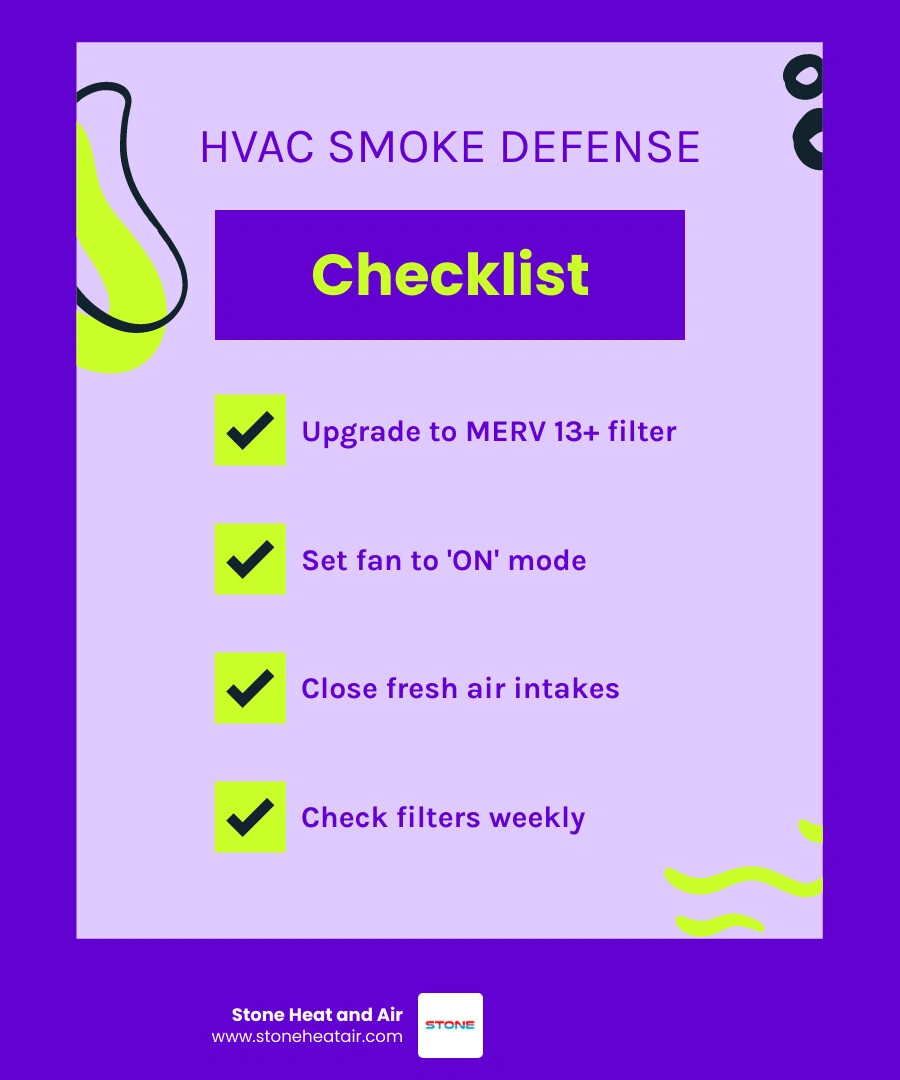
1. Upgrade your filter to MERV 13 or higher to capture fine smoke particles
2. Close all fresh air intakes and set your system to recirculate indoor air only
3. Switch the fan to "On" (not "Auto") for continuous filtration
4. Check and replace filters more often — every few days to weeks during heavy smoke
5. Seal gaps around doors, windows, and ductwork to block smoke infiltration
6. Add a portable HEPA purifier in bedrooms or high-use rooms
7. Avoid evaporative (swamp) coolers — they pull smoky outdoor air directly inside
8. Schedule a professional inspection before and after peak smoke season
Wildfire smoke isn't just an outdoor problem. By the time you can smell smoke inside your home, harmful fine particles known as PM2.5 may already be at dangerous concentrations. These particles — averaging just 0.4 to 0.7 microns in size — are small enough to slip right through standard HVAC filters and deep into your lungs.
The health stakes are real. Chronic exposure to PM2.5 from wildfire smoke contributes to an estimated 11,415 non-accidental deaths per year in the United States. A 10-year study of over 1.25 million adults found that people with repeated high smoke exposure faced a 7% higher risk of death — and that risk persisted for years after the air cleared.
Here in the Rogue Valley, wildfire season is no longer a brief annual inconvenience. It's a recurring health event that puts your HVAC system on the front line. Your heating and cooling system becomes your home's primary defense — but only if it's set up correctly and maintained through the smoke.
This guide walks you through exactly what to do, from filter upgrades and system settings to sealing your home and protecting your equipment for the long term.
How to Keep Your HVAC Running During Smoky Days with Proper Filtration
When the sky turns that eerie shade of orange in Southern Oregon, your first move should be to look at your air filter. Most homeowners use standard filters designed to catch dust bunnies and pet hair, but wildfire smoke is a different beast entirely. Smoke particles are microscopic—often between 0.4 and 0.7 microns—which means they can sail right through a basic filter and back into your living room.

To effectively scrub the air, you need to understand The Different Types Of Hvac Air Filters. Standard fiberglass filters (MERV 1–4) or even basic pleated filters (MERV 8) simply aren't dense enough to stop PM2.5 particles. During a smoke event, your HVAC system needs a "shield" that can catch these tiny invaders without suffocating the blower motor.
Upgrading to MERV 13 for Wildfire Smoke
The industry gold standard for wildfire protection is a MERV 13 rating or higher. Filters in the MERV 13–16 range are designed with specialized electrostatic layers that attract and trap 0.3 to 1-micron particles. This is crucial because it addresses the specific size of wildfire soot and ash.
When you're looking for Which Air Filters Are Best For Allergies or smoke, MERV 13 is the "sweet spot." It provides hospital-grade filtration that can significantly reduce the particulate load in your home. However, high-MERV filters are thicker and create more "static pressure" (resistance to airflow). Before you make the jump, it’s a good idea to have a professional from Stone Heat and Air ensure your system's motor can handle the extra work. Reducing Dust With Air Filters is a great side benefit, but during May 2026, our priority is keeping that hazardous smoke out of your lungs.
Frequency of Filter Changes During Smoke Events
In normal conditions, you might change your filter every three months. During a heavy smoke event in the Rogue Valley, that schedule goes out the window. Smoke and ash can clog a high-efficiency filter in a matter of days.
A clogged filter doesn't just stop cleaning the air; it forces your HVAC system to work overtime, leading to potential overheating and motor failure. We recommend performing weekly inspections during active fire periods. If the filter looks grey, dark, or covered in visible ash, it's time for a swap. Knowing when to Change My Hvac Air Filters is the simplest way to prevent a mid-summer system breakdown.
Optimizing System Settings for Maximum Protection
Your thermostat is more than just a temperature dial; it’s the control center for your home’s air pressure. During smoky days, how you configure these settings determines whether you’re pulling smoke in or pushing it out.
One of the biggest mistakes homeowners make is leaving the "fresh air intake" open. Many modern systems are designed to pull in a percentage of outdoor air to keep the home from feeling "stuffy." In May 2026, that "fresh" air is actually toxic. You must locate your outdoor intake dampers and close them, or set your system to "Recirculate" mode. This ensures the system only treats the air already inside your home. This is a key part of how we How To Address Common Air Quality Problems In Autumn and during the peak of summer smoke.
Why You Should Run Your HVAC Fan Continuously During Smoky Days
If you want to know how to keep your HVAC running during smoky days effectively, the secret is the "Fan" setting. Usually, we keep this on "Auto," meaning the fan only blows when the AC is cooling. However, during a wildfire, the smoke doesn't stop just because your house reached 72 degrees.
By switching your fan to the "On" position, you ensure that air is continuously being pulled through your high-efficiency MERV 13 filter. This constant filtration helps remove particles that may have snuck in through open doors or window gaps. Just be sure you aren't making Are You Guilty Of These 3 Hvac Filter Mistakes, such as running the fan with an old, dirty filter, which can actually spread dust and odors more quickly.
Managing Window Units and Evaporative Coolers
If you live in places like Klamath Falls or Central Point and rely on window ACs or evaporative (swamp) coolers, you face a unique challenge.
• Window ACs: Most have a "vent" or "fresh air" lever. Ensure this is closed tightly. Use weatherstripping or even blue painter's tape to seal the gaps between the unit and the window frame.
• Evaporative Coolers: These are unfortunately the worst option during a fire. They work by pulling large volumes of outdoor air through wet pads. During a smoke event, they act like a vacuum, sucking smoke directly into your home. If the air quality is hazardous, it is best to turn off the swamp cooler entirely and use floor fans or a "clean room" strategy instead.
Sealing Your Home and Creating a Clean Room Sanctuary
Even with the best HVAC settings, smoke is persistent. It finds its way through tiny cracks in door frames, attic hatches, and even electrical outlets. Sealing these leaks is essential to prevent your HVAC system from being overwhelmed.
Start by checking your weatherstripping and door sweeps. If you can see light under a door, smoke can get in. For a more permanent solution, using mastic duct sealant on exposed ductwork in your attic or crawlspace can prevent smoky air from being sucked into your ventilation system before it even reaches the filter. This proactive approach is exactly Why An Air Purifier Is Worth Investing In This Allergy Season and beyond—it keeps your indoor environment controlled.
Setting Up a Clean Room for High-Risk Individuals
If someone in your home has asthma, heart disease, or is elderly, you should designate a "clean room"—usually a bedroom with the fewest windows and doors.
1. Keep the door and windows of this room closed at all times.
2. Run a portable HEPA air purifier in this room 24/7.
3. Avoid activities in this room that create particles, like smoking, burning candles, or vacuuming (unless you have a HEPA vacuum).
Understanding the 4 Ways An Air Purifier Improves Indoor Air Quality can help you set up this sanctuary effectively, providing a safe space for recovery when outdoor levels are dangerous.
Supplementary Air Purification Options
While your central HVAC does the heavy lifting, supplementary tools can provide an extra layer of defense:
• In-Duct Air Scrubbers: These are professionally installed units that use UV light or ionization to neutralize odors and kill pathogens.
• UV Light Systems: These help keep your coils clean from the biological growth that can occur when ash and moisture mix.
• DIY Box Fan Filters: If you can't find a portable purifier (they often sell out in Roseburg and Medford during fire season), you can tape a MERV 13 furnace filter to the back of a 20-inch box fan. Research shows these DIY units perform surprisingly well at reducing PM2.5 levels.
Preventing Long-Term Damage to Your HVAC Components
Wildfire smoke doesn't just hurt your lungs; it’s physically abrasive and chemically corrosive to your HVAC equipment. Ash is essentially tiny bits of burnt organic material and minerals. When this settles on your outdoor condenser coils, it acts like a blanket, trapping heat and forcing the compressor to run hotter and longer.
Over time, this leads to increased motor strain and can even corrode sensitive electronic circuit boards within the unit. This is why How Wildfire Smoke Impacts Hvac Maintenance Needs is such a critical topic for Southern Oregon residents. Ignoring the buildup can shorten the lifespan of your system by years.
Post-Smoke Maintenance and Professional Inspections
Once the air clears, your work isn't done. The "residue" of the fire season is still inside your system.
• Evaporator Coils: Fine soot can bypass filters and settle on the wet indoor coils, leading to "dirty sock syndrome" (bad odors) or mold growth.
• Condensate Drains: Ash can mix with the water in your drain line, creating a sludge that causes backups and water damage.
Scheduling a post-season tune-up ensures these components are cleaned properly. We emphasize The Importance Of Regular Hvac Maintenance because a professional cleaning is far cheaper than replacing a burnt-out blower motor.
Frequently Asked Questions about HVAC Operation in Smoke
Can wildfire smoke damage my HVAC system permanently?
Yes, if left unaddressed. The primary risks are premature motor failure due to restricted airflow (from clogged filters) and the corrosive nature of soot on electrical components. Regular filter changes and professional coil cleaning after the season are your best defenses.
Is it safe to run my AC if I smell smoke inside?
If you smell smoke, it means your filtration is being bypassed or is insufficient. First, check that your system is on "Recirculate" and that all windows are closed. If the smell persists, your filters may be saturated or your ductwork may have leaks. It is generally safe to run the AC, but you should prioritize upgrading to a MERV 13 filter and using a portable HEPA unit to scrub the air.
How to keep your hvac running during smoky days without a high-MERV filter?
If you can't get a MERV 13 filter immediately, you can use a standard filter but you must change it much more frequently—perhaps every 1–2 weeks. Supplement this by sealing every possible air leak in your home with towels or tape and using portable air purifiers in the rooms you use most.
Conclusion
Living in the Rogue Valley means being "smoke-ready" is part of being a homeowner. By upgrading your filtration, optimizing your thermostat settings, and being proactive about maintenance, you can turn your home into a true refuge from the outdoor elements.
At Stone Heat and Air, we treat your home like ours. Whether you need an emergency filter delivery, a professional duct sealing, or a post-smoke system cleaning in Central Point or Brookings, our team is here for you 24/7. Don't let the smoke compromise your comfort or your health.
Breathe easier with professional indoor air quality services in Central Point and across Southern Oregon. Join our Stone Comfort Membership Club today for peace of mind all year round, no matter what the horizon looks like.