

Why How Dryer Usage Affects Vent Cleaning Schedule Matters for Your Home
how dryer usage affects vent cleaning schedule is something most homeowners never think about — until their dryer stops working efficiently or, worse, becomes a fire hazard. The truth is simple: the more you run your dryer, the faster lint builds up inside your vent system, and the sooner that vent needs to be cleaned.
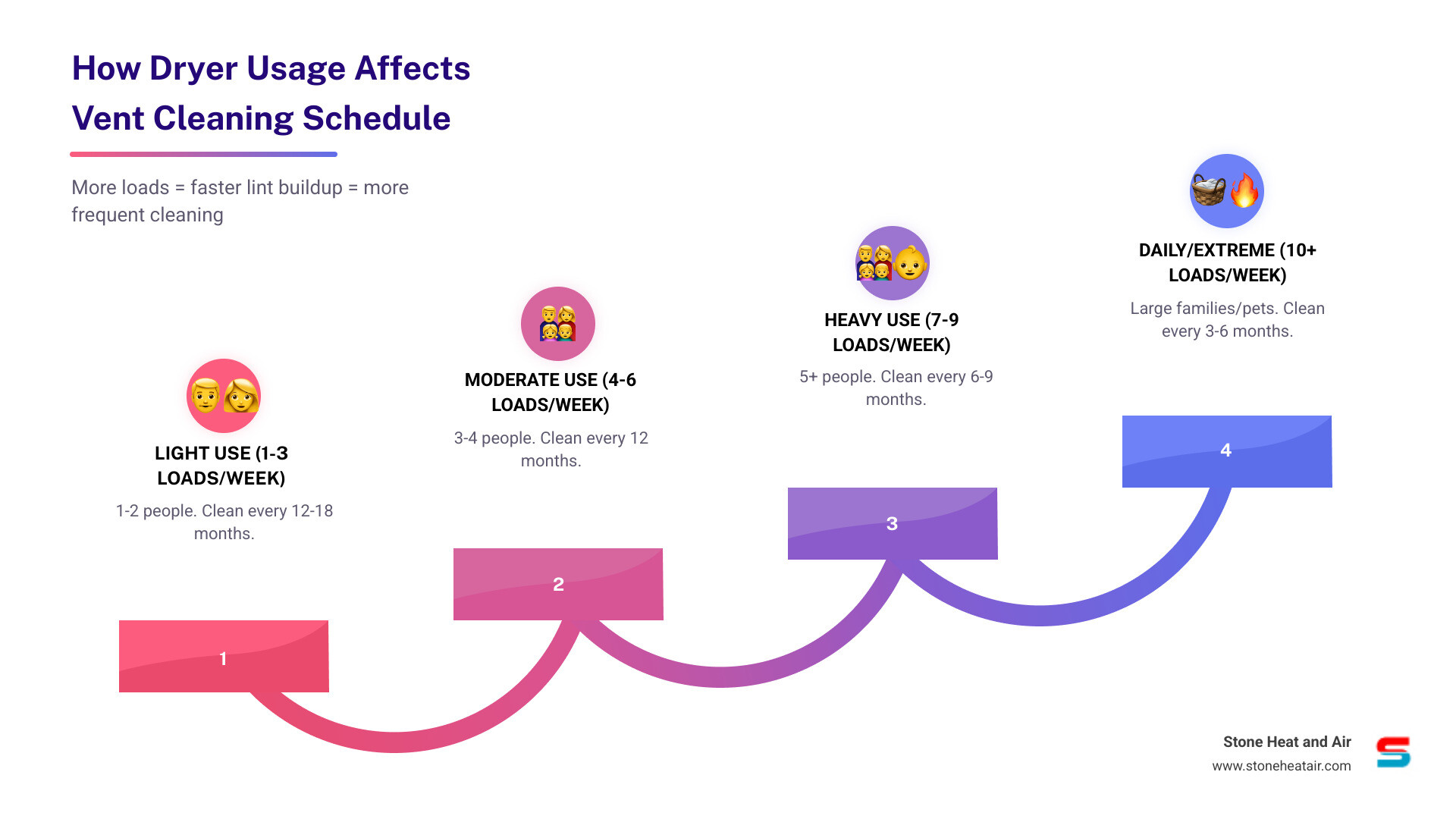
Here is a quick breakdown of recommended cleaning intervals based on how often you use your dryer:
• 1-2 people, light use — Estimated Loads Per Week: 1-3 loads — Recommended Cleaning Interval: Every 12-18 months
• 3-4 people, moderate use — Estimated Loads Per Week: 4-6 loads — Recommended Cleaning Interval: Every 12 months
• 5+ people, heavy use — Estimated Loads Per Week: 7-9 loads — Recommended Cleaning Interval: Every 6-9 months
• Large family or daily loads — Estimated Loads Per Week: 10+ loads — Recommended Cleaning Interval: Every 6 months
• Pet owners or heavy fabrics — Estimated Loads Per Week: Any — Recommended Cleaning Interval: Every 3-6 months
• Commercial settings — Estimated Loads Per Week: High volume — Recommended Cleaning Interval: Every 1-3 months
According to the National Fire Protection Association, dryer fires account for nearly 16,000 house fires each year in the U.S., and failure to clean the vent is the leading cause. That risk goes up fast when a dryer runs multiple cycles every day.
Your lint trap catches most of the lint — roughly 90 to 95 percent — but the rest travels into your vent system and sticks to the walls of the duct. Over time, that buildup restricts airflow, forces your dryer to work harder, and creates the conditions for overheating or fire.
For Rogue Valley homeowners in April 2026, understanding how your laundry habits connect to your vent maintenance schedule is one of the simplest ways to protect your home, lower your energy bills, and extend the life of your appliance.
Understanding How Dryer Usage Affects Vent Cleaning Schedule
When we talk about how dryer usage affects vent cleaning schedule, we are really talking about the physics of airflow and debris. Your dryer works by blowing hot air through a tumbling drum of wet clothes. This air picks up moisture and tiny fibers (lint). While the lint screen is your first line of defense, it isn't a perfect seal.
As we move through April 2026, many of us in Southern Oregon are finding ourselves doing more laundry than ever. Whether it’s athletic gear from weekend hikes or the endless cycle of school uniforms, each load sends a small amount of lint past the trap and into the ductwork. Over dozens of loads, this "bypass" lint begins to coat the interior of your vent pipe.
This creates a snowball effect known as exhaust back-pressure. As the lint layer thickens, the diameter of the vent narrows. This restricts airflow, meaning the dryer has to run hotter and longer to push the moist air out. This thermal stress doesn't just wear out your appliance; it creates a dangerous environment where highly flammable lint is exposed to extreme heat. If you’ve noticed your laundry room feeling like a sauna lately, it might be time to look into Dryer Vent Cleaning to restore proper balance.
Furthermore, this back-pressure puts a strain on your entire home’s Duct Service ecosystem. A dryer that can’t breathe effectively releases excess heat and humidity into your home, forcing your air conditioner to work overtime during our warm Rogue Valley summers.
How dryer usage affects vent cleaning schedule for large families
For families with five or more members, the laundry room is often the busiest part of the house. We frequently see households in Central Point and Roseburg running 10 or more loads a week. At this volume, the standard "once a year" cleaning advice simply doesn't apply.
When you are running multiple loads daily, the sheer volume of lint being produced is staggering. Research shows that high-volume households should shift to a six-month cleaning interval. Waiting a full year can lead to a vent that is almost entirely obstructed. This isn't just a matter of efficiency; it's about safety. Large families often dry heavy items like jeans and towels back-to-back, which keeps the dryer at peak operating temperatures for hours. Without clear airflow, the risk of a lint fire increases exponentially.
If you're managing a large household, reading a Guide to Duct Cleaning can help you understand how all the air pathways in your home—including your dryer vent—interact to keep your family safe.
How dryer usage affects vent cleaning schedule for pet owners
We love our pets in Southern Oregon, but our furry friends contribute significantly to lint buildup. Pet hair is heavier and more "sticky" than standard clothing fibers. When you wash pet bedding or clothes covered in fur, that hair often bypasses the lint screen entirely because it is so fine.
Once inside the vent, pet hair acts like a web, catching other lint particles and creating thick, felt-like clogs. If you have multiple shedding pets, your vent may need professional attention every six months, regardless of how many loads you do. Static cling also plays a role here; pet hair tends to bond to the interior walls of flexible transition hoses more easily than cotton fibers. If your dryer vent has suffered from a heavy clog, you might even require Duct Repair to fix crushed or disconnected sections caused by the weight of the debris.
Household Factors That Accelerate Lint Accumulation
It isn't just about how often you dry; it's about what you dry. Different fabrics shed at different rates, and this has a direct impact on how dryer usage affects vent cleaning schedule.
Heavy fabrics are the primary culprits. Think about the last time you dried a load of brand-new fluffy towels. The lint trap was likely overflowing after just one cycle. Now imagine how much of that escaped into the vent. Cotton is a high-shed fabric, while synthetic materials like polyester shed less but can create "pills" that catch on any rough edges inside your ductwork.
• New Towels & Blankets — Lint Production Level: Very High — Impact on Cleaning Schedule: Requires 3-6 month check-ins
• Cotton Bedding — Lint Production Level: High — Impact on Cleaning Schedule: Shortens interval by 2-3 months
• Fleece & Flannel — Lint Production Level: Moderate-High — Impact on Cleaning Schedule: Increases buildup in winter months
• Work Uniforms (Denim/Canvas) — Lint Production Level: Moderate — Impact on Cleaning Schedule: Standard annual cleaning
• Synthetics (Activewear) — Lint Production Level: Low — Impact on Cleaning Schedule: Extends time between cleanings
If your household dries a lot of "high-lint" items, you should consider our Duct Cleaning Services Rogue Valley more frequently than a household that mostly wears synthetic athletic gear. Work uniforms, especially those used in construction or agriculture around Klamath Falls, can also introduce dirt and grit into the vent, which weights down the lint and makes it harder for the dryer's fan to blow it out.
Recommended Maintenance Intervals Based on Laundry Volume
To keep things simple, we recommend tailoring your schedule to your specific household size. While April 2026 brings new energy-efficient dryer models to the market, the venting requirements remain largely the same.
• Light Usage (1-2 people): If you are a couple or a single resident doing 1-3 loads a week, you can typically wait 12-18 months. However, you should still perform a visual check of your exterior vent hood every few months to ensure no birds have nested there.
• Moderate Usage (3-4 people): This is the "standard" household. For 4-6 loads a week, a 12-month cleaning cycle is the gold standard. This ensures that any buildup from the previous year is cleared before it becomes a hazard.
• Heavy Usage (5+ people): For those running 7 or more loads a week, we recommend a 6-month rule. This is particularly important for homes with children, where the dryer might run every single day.
If you’re wondering, "When Should I Clean My Air Ducts," remember that your dryer vent is a separate system that often needs more frequent attention than your HVAC ducts due to the high flammability of lint.
The Hidden Dangers of Neglecting High-Usage Vents
The risks of ignoring how dryer usage affects vent cleaning schedule go far beyond just having damp clothes. The most immediate danger is fire. Lint is essentially tinder; it takes very little to ignite it when the dryer's heating element is forced to stay on for extended periods due to poor airflow.
For those with gas dryers, there is an added risk: carbon monoxide. If the vent is blocked, the combustion byproducts from the gas burner cannot escape the home. This can lead to a dangerous buildup of odorless, colorless gas that can be fatal.
Beyond safety, there is the financial impact. A clogged vent can increase your energy usage by up to 30%. In April 2026, with energy prices being a concern for many in Brookings and the Rogue Valley, that’s money literally being blown away. Furthermore, the excess heat causes the dryer’s internal components—like the thermal fuse, heating element, and motor—to fail prematurely. Keeping your vents clear is a key part of How to Keep Your HVAC Ducts Cleaner for Longer and maintaining overall home efficiency.
Warning Signs Your Rogue Valley Home Needs Immediate Service
Sometimes, you don't need a calendar to tell you it's time for a cleaning. Your dryer will tell you. If you notice any of the following Signs You Need to Schedule Professional Duct Cleaning or vent service, don't wait for your scheduled six-month mark:
1. Longer Drying Times: If a load that used to take 45 minutes now takes two cycles, your vent is likely restricted.
2. Excessive Heat: If the top of the dryer is hot to the touch or your clothes come out with metal zippers that burn your fingers, the heat isn't escaping.
3. Burning Odors: This is an emergency. If you smell something scorching, turn off the dryer immediately.
4. Visible Debris: If you see lint sticking out of the exterior vent flap, or if the flap doesn't open when the dryer is running, the system is backed up.
5. Humidity Buildup: If your laundry room feels unusually damp or you see condensation on the windows, the moist air is backing up into the house.
Frequently Asked Questions
Does vent length change the cleaning schedule for heavy users?
Absolutely. The longer the vent, the more surface area there is for lint to cling to. If your dryer is in the center of your home and vents through the roof or a long side-wall run (exceeding 25-35 feet), you face more friction loss. Multiple bends or elbows in the duct also create "trap points." For heavy users with long or complex vent runs, we often recommend cleaning every 3-6 months to prevent a total blockage. In some cases, a booster fan might be necessary to help push the air through, which is a service we can evaluate during a Duct Service call.
Should commercial users follow a different schedule than homeowners?
Yes. Businesses like salons, pet groomers, and laundromats operate their equipment almost constantly. Because they are drying high-lint items like towels or pet blankets all day, their vents accumulate lint at a rate ten times faster than a residential home. Commercial users should have their vents inspected monthly and professionally cleaned every 1-3 months. This is a core part of our Dryer Vent Cleaning specialty services.
Can simple habits extend the time between professional cleanings?
While they don't replace the need for professional service, good habits help. Always clean the lint screen after every load. Once a month, wash the lint screen with warm soapy water to remove the invisible film left by dryer sheets. You can also vacuum out the lint trap housing with a narrow attachment. Keeping the area behind the dryer clean and ensuring the transition hose isn't kinked or crushed are also vital. For more tips, check out our Guide to Duct Cleaning.
Conclusion
At Stone Heat and Air, we want our Rogue Valley neighbors to enjoy a home that is safe, efficient, and comfortable. Understanding how dryer usage affects vent cleaning schedule is a major part of that mission. Whether you’re in Central Point, Klamath Falls, or anywhere in Southern Oregon, your laundry habits dictate your maintenance needs.
Don't wait for a warning sign or a spike in your energy bill. Our team provides honest recommendations and meticulous attention to detail, treating your home like ours. With our 24/7 emergency service and professional expertise, we can ensure your dryer vents are clear and your home is protected.
Schedule your professional dryer vent cleaning today and breathe easier knowing your home is in expert hands.