

When Your Commercial Cooler Goes Down, Every Minute Counts
Common commercial refrigeration issues and solutions are something every Rogue Valley business owner needs to understand — because when a cooler or freezer fails, the consequences hit fast. Spoiled inventory, food safety violations, and unhappy customers can follow within hours.
The USDA estimates that foodborne illness linked to improper refrigeration costs the nation more than $161 billion every year. The FDA requires perishable foods to be held at 41°F or below — and anything stored above that threshold for more than two hours may no longer be safe to serve.
Here's a quick look at the most common problems and what causes them:
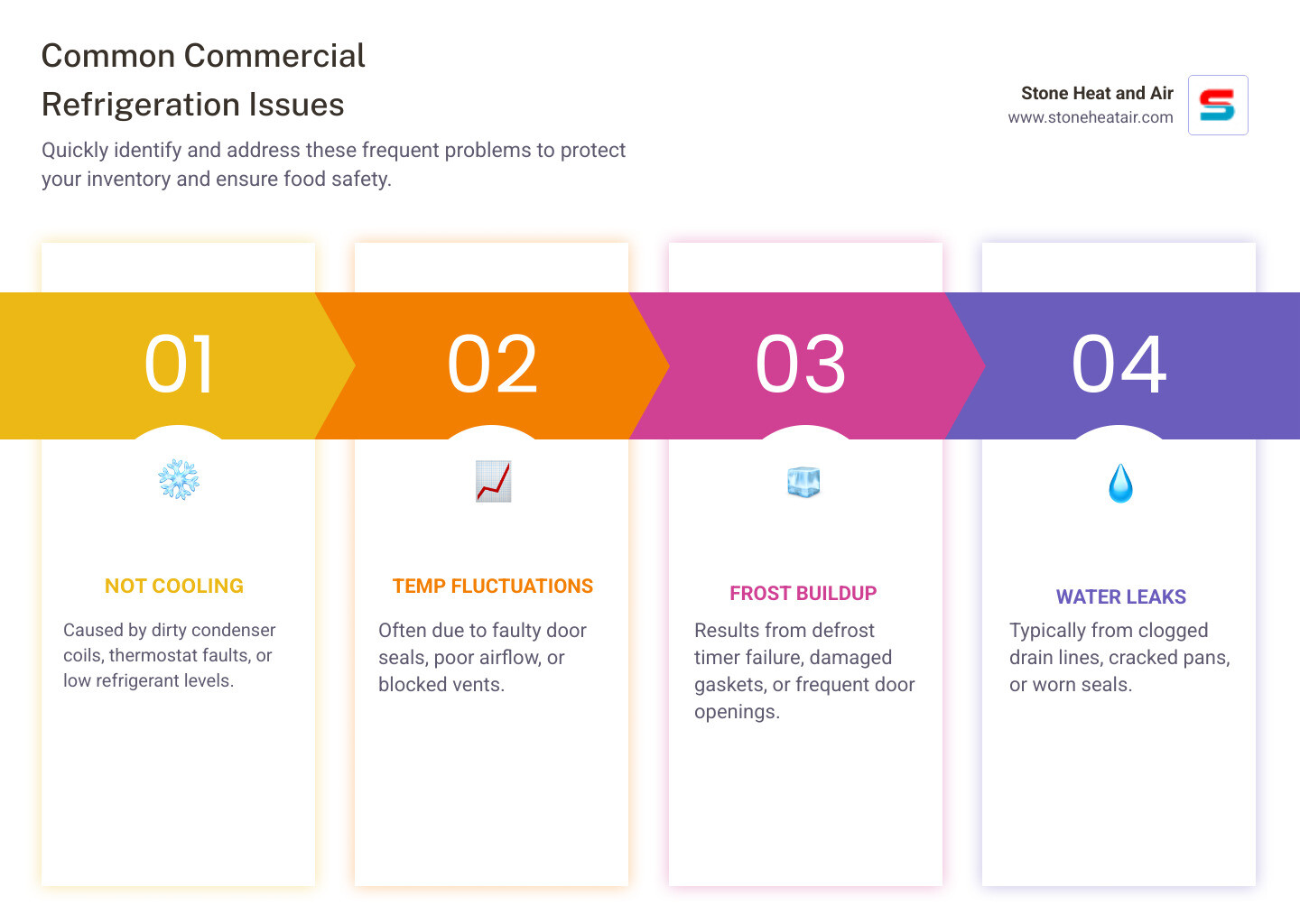
• Unit not cooling — Common Cause: Dirty condenser coils, thermostat fault, low refrigerant
• Temperature fluctuations — Common Cause: Faulty door seals, poor airflow, blocked vents
• Excessive frost or ice buildup — Common Cause: Defrost timer failure, damaged door gaskets, frequent door openings
• Water leaks and condensation — Common Cause: Clogged drain lines, cracked drain pan, worn door seals
• Unusual noises — Common Cause: Loose components, failing fan bearings, compressor issues
• Rising energy bills — Common Cause: Dirty coils, refrigerant leak, failing motor
• Unit won't power on — Common Cause: Tripped breaker, blown fuse, faulty start relay
Most of these problems don't appear overnight. They build slowly — coils get dusty, gaskets crack, drain lines clog. By the time a unit fails completely, the warning signs were usually there for weeks. Knowing what to look for makes it much easier to catch problems early and keep your operation running safely.
What are the most common commercial refrigeration issues and solutions?
In our experience serving businesses from Central Point to Roseburg, the most frequent headache for kitchen managers is temperature fluctuation. When a unit can't hold a steady temp, your inventory is at risk. Maintaining that strict 41°F safety threshold isn't just a suggestion; it’s a requirement for foodborne illness prevention. One in six Americans gets sick from foodborne illness yearly, and improper cold storage is a leading factor.
If you are noticing your milk is a little too warm or your produce is wilting faster than usual, you might be looking at Commercial Refrigeration Medford OR experts to help stabilize the environment. Beyond food safety, these fluctuations lead to massive energy consumption spikes. A malfunctioning refrigeration system can increase your electricity usage by up to 30% until it’s fixed. Considering that commercial Refrigeration can account for nearly 40% of a supermarket’s or large restaurant's total electricity bill, those spikes hurt your bottom line quickly.
Poorly maintained systems are notorious for wasting 15–25% more energy than necessary. If you’re operating in the Rogue Valley and notice your bills creeping up, it’s often a sign that your equipment is fighting a losing battle against dust, wear, or failing seals. For businesses needing Commercial Refrigeration Grants Pass OR support, we often find that a simple calibration or cleaning can stop that 30% efficiency loss in its tracks.
Why is my commercial fridge not cooling properly?
The "heart" of your system is the compressor, but the "lungs" are the condenser coils. When these coils get coated in grease and dust—which happens quickly in a busy Rogue Valley kitchen—they can’t release heat. This causes the entire system to work overtime, leading to a unit that stays stubbornly warm.
Condenser vs. Evaporator: Knowing the Difference
It helps to know which part of the system is acting up. Use this table to help identify where the trouble might be:
• Unit is warm, compressor is hot to the touch — Likely Culprit: Dirty Condenser Coils — Location: Exterior/Bottom of unit
• Ice forming on the internal coils — Likely Culprit: Frozen Evaporator — Location: Inside the cabinet
• Constant running with no cooling — Likely Culprit: Low Refrigerant/Leak — Location: Sealed system
• Clicking sounds but no startup — Likely Culprit: Faulty Start Relay — Location: Near the compressor
Airflow obstruction is another major player. We often see units pushed too close to the wall or vents blocked by boxes. This lack of "breathing room" creates ambient temperature stress. If your kitchen is particularly hot or humid—common during our Southern Oregon summers—your fridge has to work even harder. If you’re struggling with these issues, professional Commercial Refrigeration Jacksonville OR services can ensure your thermostat is calibrated correctly and your unit is positioned for maximum heat rejection.
And don't forget the ice! If your cooling issues extend to your beverage service, you may need Ice Machine Repair Medford OR to address scale buildup or sensor failures that mimic general refrigeration problems.
Troubleshooting common commercial refrigeration issues and solutions for airflow
Proper airflow is the lifeblood of a cold cooler. Without it, you get "hot spots" where food spoils despite the thermostat saying everything is fine.
• Vent Clearance: Ensure there is at least 4 to 6 inches of space between the unit and the wall.
• Fan Motor Inspection: Listen for the hum of the evaporator fan. If it’s silent or making a grinding noise, the air isn't moving.
• Internal Loading Patterns: Do not overstack shelves. Air must be able to circulate around every container.
• Evaporator Coil Icing: If air can't move, moisture freezes on the coils, creating a wall of ice that blocks cooling entirely.
For businesses in the northern part of our service area, Commercial Refrigeration Eagle Point OR specialists can help evaluate if your loading patterns are the cause of your icing issues or if there’s a deeper mechanical failure at play.
Addressing frost buildup and water leaks in the Rogue Valley
Excessive frost is more than just an eyesore; it’s a sign that warm, moist air is invading your cold zone. This is almost always due to damaged door gaskets or a defrost timer failure. In the Rogue Valley, where humidity can fluctuate, a tight seal is your first line of defense.
When gaskets fail, they allow humid air in, which instantly condenses and freezes. This leads to ice buildup that can eventually bend fan blades or block drain lines. Speaking of drains, a clogged line will result in water pooling at the bottom of your unit or leaking onto the floor. This isn't just a maintenance issue; it’s a major safety concern. Slips, trips, and falls account for over 25% of workplace injuries.
If you notice water pooling, it’s time to check the drain pan for cracks or debris. For those in the Grants Pass area, Ice Machine Repair Grants Pass OR and general refrigeration maintenance can clear these lines before they cause mold growth or health code violations. Similarly, Ice Machine Repair Ashland OR services often find that the same humidity issues affecting fridges also cause "slime" or mold in ice harvesters.
Preventing common commercial refrigeration issues and solutions through maintenance
We believe that preventive maintenance prevents 90% of breakdowns before they occur. It is much easier to clean a coil than it is to replace a seized compressor.
1. Weekly Coil Cleaning: Cleaning condenser coils weekly can reduce energy use by a staggering 30%. Use a soft brush or vacuum to remove dust.
2. Gasket Integrity Checks: Wipe down your door seals daily. Grease and crumbs can degrade the rubber, leading to leaks.
3. 90-Day Compressor Service: Have a professional check the "heart" of your system every three months. This includes checking the start relay and amp draw.
4. Stay Current: As we move through April 2026, efficiency standards are stricter than ever. Modern upgrades can reduce your costs by 20–40% compared to older, struggling units.
For our neighbors needing Commercial Refrigeration Phoenix OR support, implementing a simple 90-day checklist can extend the life of your equipment by years.
When to call a professional for compressor or electrical failure
There are some common commercial refrigeration issues and solutions that you simply shouldn't tackle yourself. Anything involving the refrigerant or the high-voltage electrical system requires a certified pro.
If you hear unusual noises, pay attention to the "dialect" of the machine:
• Grinding or Squealing: This usually indicates failing fan bearings or motor mounts.
• Clicking or Humming: This often points to a defective start relay or a compressor that is trying to start but can't.
• Hissing or Bubbling: This is a classic sign of a refrigerant leak.
Refrigerant leaks are serious. Not only do they stop the cooling process, but they are also environmental hazards that require specialized tools like UV dye testing or electronic "sniffers" to locate. If your unit has power but the compressor isn't running, it could be a tripped circuit breaker or a blown fuse. However, if the breaker keeps tripping, there is a short circuit or a grounded component that needs immediate Commercial Refrigeration Medford OR expertise.
Attempting to "top off" refrigerant without fixing the leak is a temporary patch that can lead to liquid slugging—essentially destroying your compressor. We always recommend a permanent fix to ensure your 2026 operations remain profitable and safe.
Frequently Asked Questions about Commercial Refrigeration
What is the safe temperature for commercial food storage?
To prevent rapid bacteria growth, the FDA guidelines state that refrigerated foods must be held at 41°F (5°C) or below. If perishable foods spend more than two hours above this limit, they enter the "danger zone" and may become unsafe to serve. We recommend keeping your thermostats set between 35°F and 38°F to provide a safety buffer for when doors are frequently opened.
How often should I clean my commercial condenser coils?
For maximum efficiency, you should perform a basic cleaning of your condenser coils weekly. This simple task can lead to a 30% reduction in energy consumption. A more thorough, professional deep clean should be scheduled every 90 days to remove grease and deeply embedded dust that a standard vacuum might miss.
Why is there ice on my evaporator coils?
Ice on the internal evaporator coils is usually caused by one of three things: restricted airflow (blocked vents or a dead fan), low refrigerant levels, or a malfunction in the defrost cycle (such as a bad timer or heater). In the Rogue Valley, high humidity can accelerate this buildup if door gaskets are leaky, allowing moisture to settle on the cold coils.
Conclusion
At Stone Heat and Air, we know that your commercial refrigeration is the backbone of your business. Whether you are running a restaurant in Central Point or a medical facility in Roseburg, you can't afford downtime. We pride ourselves on honest and fair dealings, providing the Rogue Valley with reliable 24/7 emergency service when things go wrong.
To stay ahead of the curve, consider joining our exclusive Stone Comfort Membership Club. It’s the best way to ensure your 90-day maintenance is never forgotten, giving you uninterrupted comfort and peace of mind. From Commercial Refrigeration Phoenix OR to the furthest reaches of the Rogue Valley, we’ll treat your business’s equipment with the same care we’d give our own. Don’t wait for a breakdown—let’s keep things cool today.