

Why Commercial Refrigeration Basics for Business Owners Can Make or Break Your Operation
Understanding commercial refrigeration basics for business owners is one of the most important things you can do to protect your inventory, stay compliant with food safety laws, and keep your business running without costly interruptions.
Here is a quick overview of what you need to know:
• What it does — Key Point: Removes heat from a space to keep food, medicine, or other perishables safe
• Safe temperature range — Key Point: 34°F to 40°F for coolers; 0°F or below for freezers
• Core components — Key Point: Compressor, condenser, evaporator, metering device, refrigerant
• Common equipment types — Key Point: Reach-in coolers, walk-in freezers, prep tables, display cases
• Typical lifespan — Key Point: 10 to 15 years with proper maintenance
• Biggest energy drain — Key Point: Up to 40% of total energy use in grocery and food service businesses
• Maintenance frequency — Key Point: Professional service 2 to 4 times per year
For Rogue Valley businesses — from restaurants in Medford to grocery stores in Grants Pass — reliable cold storage is not optional. A single equipment failure can mean spoiled inventory, failed health inspections, and lost revenue. The summer heat in Southern Oregon only adds to the pressure your refrigeration equipment faces.
In this guide, we break down everything from how the refrigeration cycle works to when it is time to repair or replace your equipment — so you can make smart decisions and keep your business running smoothly.
What are the commercial refrigeration basics for business owners in the Rogue Valley?
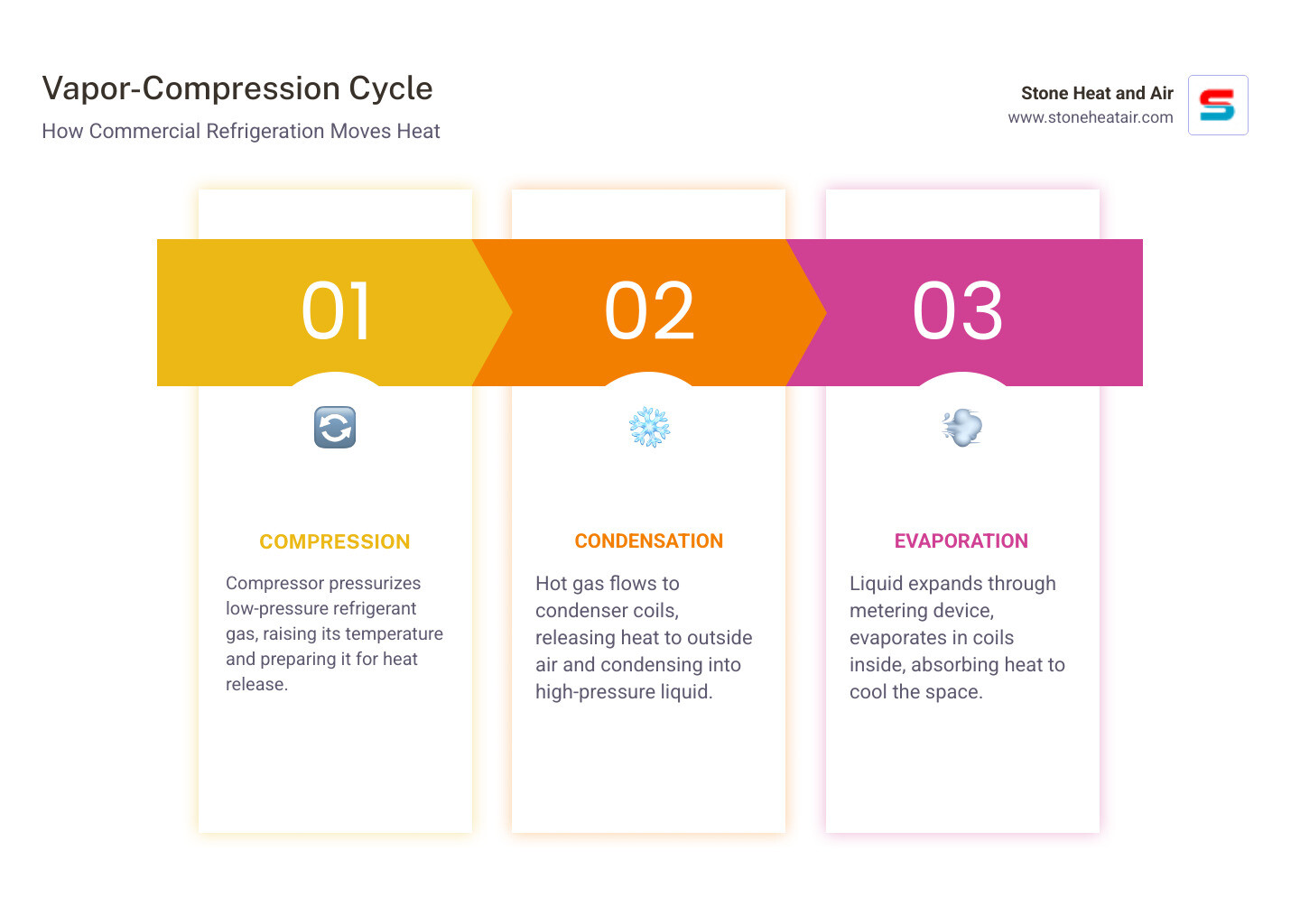
When we talk about commercial refrigeration basics for business owners, the first thing to understand is that these systems don't actually "create" cold. Instead, they operate on the Second Law of Thermodynamics, which states that heat naturally moves from a warmer object to a cooler one. Your refrigeration system is essentially a heat-moving machine. It pulls heat out of the insulated cabinet and dumps it outside.
In the Rogue Valley, where July and August temperatures can soar, your system has to work much harder to move that heat. This process is known as the vapor-compression cycle. It uses a specialized fluid called refrigerant that changes states from liquid to gas and back again, absorbing and releasing heat as it goes.
Many new business owners ask us how these units differ from the fridge they have at home. While the scientific principles are the same, the execution is worlds apart. Commercial units are built for:
• Heavy-Duty Usage: They are designed to be opened dozens or even hundreds of times a day.
• Rapid Temperature Recovery: After the door is closed, a commercial motor is powerful enough to pull the internal temperature back down to the safe zone quickly.
• Durability: Most units feature stainless steel construction and high-output compressors meant to run 24/7 for years.
If your system isn't recovering quickly enough after a busy lunch rush, it might be time to look into professional Refrigeration services to ensure your equipment is sized correctly for your Southern Oregon climate.
Understanding the commercial refrigeration basics for business owners regarding system components
To manage your equipment effectively, you should be familiar with the "Big Five" components that make the cooling possible:
1. The Compressor: Often called the "heart" of the system, it squeezes the refrigerant, raising its pressure and temperature.
2. The Condenser: Usually located on the back or bottom (or sometimes on the roof), this is where the hot refrigerant releases its heat to the outside air and turns back into a liquid.
3. The Metering Device (Expansion Valve): This acts like a nozzle, dropping the pressure of the liquid refrigerant so it can cool down rapidly.
4. The Evaporator: Located inside the unit, this coil absorbs heat from your food or products, turning the refrigerant back into a gas.
5. Refrigerant: The specialized chemical "courier" that carries the heat through the pipes.
In places like Medford, dust and pollen can coat your condenser coils, making it nearly impossible for the heat to escape. If you notice your unit running constantly, you may need Commercial Refrigeration Medford OR expertise to clean and calibrate these sensitive parts.
Why commercial refrigeration basics for business owners are essential for food safety
Food safety isn't just a suggestion; it's a legal requirement. According to the FDA Food Code, "Time/Temperature Control for Safety" (TCS) foods must generally be held at 41°F or below. Bacteria thrive in the "Danger Zone" between 40°F and 140°F, where they can double in number every 20 minutes.
By mastering commercial refrigeration basics for business owners, you protect your customers from foodborne illnesses and protect your bottom line from inventory loss. A single walk-in freezer failure can result in thousands of dollars of wasted product. Maintaining consistent temperatures in Commercial Refrigeration Central Point OR ensures that your business stays compliant with local health department inspections and keeps your reputation spotless.
Which refrigeration systems are best for my Medford or Grants Pass business?
Choosing the right equipment depends on your volume, your menu, and your physical space. Here is a breakdown of the most common types:
• Reach-in Coolers — Best For: Fast access on the line — Capacity Range: 20 – 80 cubic feet
• Walk-in Freezers — Best For: Bulk storage and long-term holding — Capacity Range: 200 – 2,000+ cubic feet
• Prep Tables — Best For: Sandwiches, salads, and pizza prep — Capacity Range: Varies by pan count
• Display Cases — Best For: Bakeries and grab-and-go retail — Capacity Range: High visibility, lower efficiency
For smaller cafes in Grants Pass, a few reach-in units might suffice. However, larger grocery stores or high-volume restaurants often rely on Rack Systems, which use multiple compressors connected in parallel to handle massive cooling loads efficiently. If you are struggling with space, you might consider Commercial Refrigeration Grants Pass OR consultations to see if a walk-in or a remote condensing unit (where the noisy, hot compressor is located outside) is right for you.
Selecting equipment based on your industry
• Restaurants: Need high-durability units with fast temperature recovery.
• Grocery Stores: Rely heavily on display cases and large walk-in rack systems.
• Medical Facilities: Require "medical-grade" units that maintain incredibly tight temperature tolerances (within ±1°C) for vaccines and lab samples.
• Florists: Need high-humidity environments to keep flowers from wilting.
• Hospitality: Often require high-volume ice production. If your hotel or bar is struggling to keep up with demand, specialized Ice Machine Repair Grants Pass OR can keep the drinks cold and the customers happy.
How can I keep my commercial cooling system running efficiently in April 2026?
As of April 2026, energy efficiency is more important than ever. Commercial refrigerators can account for up to 40% of the total energy bill for supermarkets and convenience stores. With new EPA efficiency regulations and DOE standards coming into play, modern systems are now roughly 30% more efficient than models from a decade ago.
One of the biggest shifts we've seen in the Rogue Valley is the rise of IoT monitoring. Smart sensors can now alert you on your phone if a door is left open or if the internal temperature rises above a certain threshold. These digital controls don't just save food; they save money by optimizing defrost cycles and reducing compressor wear. If you’re looking to modernize, our team provides Commercial Refrigeration Phoenix OR services to help you integrate these smart technologies.
A maintenance checklist for Rogue Valley business owners
Proactive maintenance is the only way to avoid an $800 emergency service call on a Saturday night. Use this checklist to keep your system in top shape:
• Monthly: Inspect door gaskets for tears or gaps. A leaky seal is like throwing money out the window.
• Monthly: Clean the interior and exterior with mild soap and water to prevent mold.
• Quarterly: Deep clean the condenser coils. In Southern Oregon, dust and grease can build up quickly.
• Quarterly: Check the "Dollar Bill Test" on all doors. If you can easily pull a dollar bill out of a closed door, your seal is failing.
• Bi-Annually: Clear the drain lines to prevent water backup and icing.
• Bi-Annually: Have a pro calibrate the thermostat and check refrigerant levels.
Regularly scheduled maintenance, like the kind offered through Ice Machine Repair Medford OR, can extend the life of your equipment by years.
Is it time to repair or replace my business's refrigeration equipment?
A well-maintained commercial refrigerator typically lasts between 10 to 15 years. However, age isn't the only factor. We recommend using the 50% Rule: if the cost of a single repair is more than 50% of the price of a brand-new, energy-efficient unit, it’s time to replace it.
Watch for these warning signs:
• Frequent Breakdowns: If you know your repair technician's first name because they're there every month, it's time for an upgrade.
• Excessive Condensation or Frost: This indicates your system is struggling to manage humidity or has a major seal failure.
• Rising Utility Bills: Older units lose efficiency, causing the motor to run longer to maintain the same temperature.
• Food Spoilage: If milk is souring before its expiration date, your unit isn't holding a steady 38°F.
If you are seeing these issues in Ashland, getting a professional evaluation for Ice Machine Repair Ashland OR or general refrigeration can help you decide if a repair will buy you another three years or if you're just throwing good money after bad.
Frequently Asked Questions about Commercial Refrigeration
What is the ideal temperature for a commercial refrigerator?
For most food service applications, the "sweet spot" is between 34°F and 38°F. You never want it to rise above 40°F, as that enters the bacterial danger zone. Freezers should be kept at 0°F or below to ensure quality preservation and safety.
How often should I clean my condenser coils?
In a standard office environment, twice a year is usually enough. However, for a busy Rogue Valley restaurant with flour, grease, and high foot traffic, you should clean them quarterly. Dirty coils can reduce cooling capacity by 5% with just a tiny bit of buildup, forcing the compressor to work harder and fail sooner.
Why is my walk-in cooler leaking water?
The most common culprit is a clogged drain line. Dust and "slime" can build up in the condensate pan, causing water to overflow. Other causes include failing door gaskets that allow humid air to enter and condense, or evaporator coils that have iced over due to poor airflow.
Conclusion
At Stone Heat Air, we understand that your refrigeration system is the lifeblood of your business. Whether you are running a boutique vineyard in Jacksonville or a high-volume diner in Central Point, we are here to ensure your "cold chain" never breaks. We pride ourselves on honest, fair dealings and 24/7 emergency service because we know that refrigeration emergencies don't wait for business hours.
Our team serves the entire Rogue Valley, providing the skilled workmanship you need to protect your inventory and your peace of mind. From routine maintenance to Carrier-certified installations, we treat your business like it’s our own.
If you're noticing strange noises from your compressor or temperatures that just won't stay steady, don't wait for a total system failure. We provide expert Commercial Refrigeration Jacksonville OR services to catch small problems before they become big headaches.