

Why Commercial HVAC Maintenance Requirements Matter for Your Bottom Line
Commercial HVAC maintenance requirements include a structured schedule of inspections, cleaning, testing, and component servicing designed to keep your system running safely, efficiently, and in compliance with regulatory standards.
Here is a quick overview of the core requirements:
• Daily — Key Tasks: Visual inspections, thermostat checks, unusual noise or odor monitoring
• Monthly — Key Tasks: Air filter inspection and replacement, condensate drain check
• Quarterly — Key Tasks: Belt and pulley inspection, electrical connection checks, refrigerant pressure verification
• Semi-Annual — Key Tasks: Coil cleaning, bearing lubrication, safety control testing
• Annual — Key Tasks: Full system calibration, refrigerant leak check per EPA Section 608, heat exchanger inspection, BAS sensor calibration
• Regulatory — Key Tasks: ASHRAE Standard 180-2018 compliance, EPA 608 refrigerant handling, IMC code adherence
If your commercial building's HVAC system stopped working tomorrow, how long could you keep operating? For most businesses in the Rogue Valley, the honest answer is: not long.
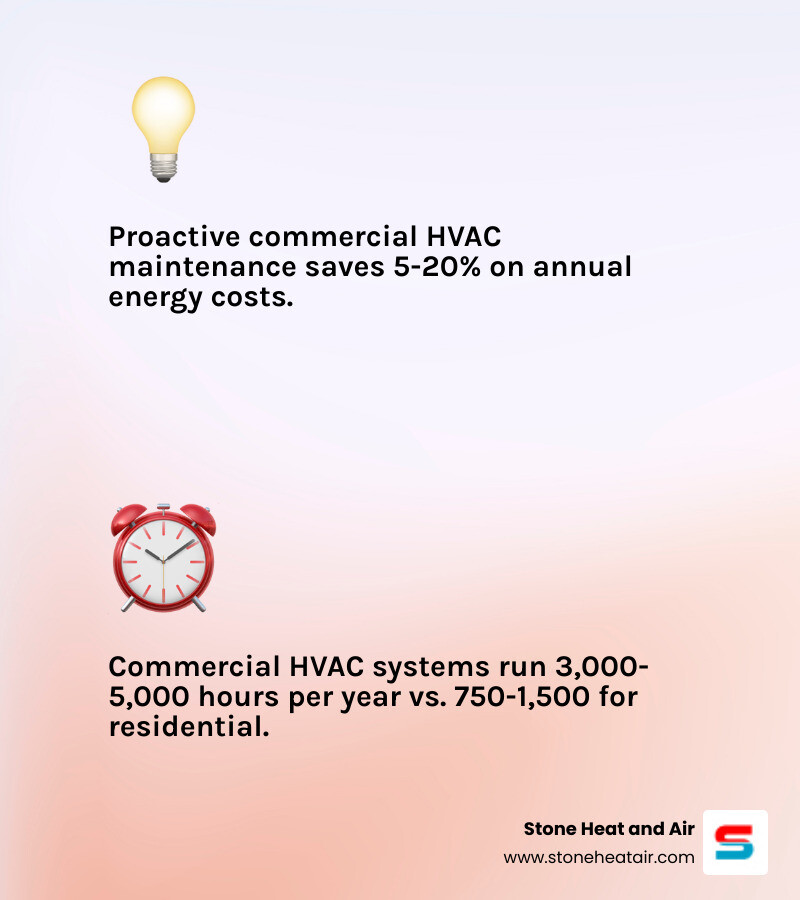
A well-run HVAC system is easy to take for granted. It quietly keeps employees productive, customers comfortable, and equipment within safe temperature ranges. But commercial systems are under enormous strain. Unlike a home system that runs roughly 750 to 1,500 hours per year, a commercial unit typically logs 3,000 to 5,000 operating hours annually. That kind of workload means wear accumulates fast, and small problems escalate quickly when maintenance is skipped.
The good news is that proactive operations and maintenance practices can save businesses anywhere from 5 to 20 percent on annual energy costs, according to U.S. Department of Energy estimates. That is not a minor adjustment. For a facility where HVAC accounts for a significant share of total energy spend, those savings are real and repeatable.
This guide walks you through everything you need to know to manage your commercial HVAC system with confidence, from daily checklists to regulatory compliance.
Understanding the Scale: Commercial vs. Residential HVAC Systems
When we talk about commercial hvac maintenance requirements, the first thing we have to acknowledge is the sheer scale of the equipment. If you’ve ever looked at the Commercial HVAC Lifespan, you know these systems are built to last 15 to 20 years, but they only reach that milestone through rigorous care.
Commercial systems differ from residential ones in kind, not just size. While a home AC might cool 2,000 square feet, a commercial system in a Rogue Valley office or retail center might serve 50,000 to 500,000 square feet. This requires massive air distribution networks, complex controls, and often, redundant systems to ensure that if one compressor fails, the whole building doesn't overheat.
Comparing the Specifications
To understand why maintenance is so much more intensive for businesses, look at the differences in operational demand:
• Annual Run Hours — Residential HVAC: 750 – 1,500 hours — Commercial HVAC: 3,000 – 5,000+ hours
• Complexity — Residential HVAC: Single-stage, simple ducting — Commercial HVAC: Multi-stage, VAV boxes, BAS integration
• Location — Residential HVAC: Ground level or crawlspace — Commercial HVAC: Rooftops (RTUs) or dedicated mechanical rooms
• Maintenance Needs — Residential HVAC: Twice a year (standard) — Commercial HVAC: Quarterly or Monthly (intensive)
• Redundancy — Residential HVAC: None (one unit fails, house gets hot) — Commercial HVAC: Built-in (staged compressors/chiller loops)
In our region, we see a wide variety of systems. Many Southern Oregon businesses rely on Rooftop Units (RTUs), which package the heating and cooling into one weatherized box. Larger facilities might use Chiller plants or Variable Refrigerant Flow (VRF) technology for precision control. Regardless of the type, the Commercial Design Build process ensures these systems are tailored to the building's specific occupancy loads.
Essential Commercial HVAC Maintenance Requirements for Rogue Valley Businesses
Why exactly does your system need so much attention? Why Commercial HVAC Needs Maintenance boils down to reliability and cost control. In a commercial setting, a breakdown isn't just an inconvenience; it can mean lost inventory, halted production, or a mass exodus of customers.
Neglect carries a heavy price tag. For example, a poorly maintained 20-ton rooftop unit typically fails after just 9 years. However, a well-maintained unit can easily reach its 14-year expected lifespan or beyond. To protect your investment, you need to Avoid Commercial HVAC Issues by staying ahead of the "silent killers" of HVAC equipment: dirt, vibration, and friction.
Common Signs of System Neglect
If you notice any of the following, your system is likely overdue for professional attention:
• Uneven Temperatures: Some offices are freezing while the conference room is a sauna.
• Rising Utility Bills: Your energy usage is climbing despite no change in building occupancy.
• Unusual Noises: Clanging, clicking, or squealing often points to frayed belts or failing bearings.
• Poor Air Quality: Increased dust or "musty" odors suggest clogged filters or dirty coils.
If these symptoms sound familiar, it's time to consult with Commercial HVAC Specialists Central Point to get your system back on track.
A Multi-Tiered Checklist: Daily, Monthly, and Seasonal Tasks
A successful maintenance program isn't a once-a-year event; it’s a tiered strategy. When we perform a Commercial HVAC Service Call, we look at everything from the smallest electrical connection to the overall system calibration.
Seasonal tuning is especially critical in the Rogue Valley. Our summers can be scorching and our winters surprisingly biting. Following Commercial HVAC Tips like cleaning condenser coils before the July heat hits can prevent high-pressure shutdowns. Similarly, ensuring Commercial Furnace Efficiency in the fall prevents emergency heating failures when temperatures drop.
Standard Commercial HVAC Maintenance Requirements by Frequency
To keep things organized, we recommend breaking your commercial hvac maintenance requirements into the following schedule:
Daily Tasks (In-House Team)
• Check the Building Automation System (BAS) or thermostats for error codes.
• Listen for unusual vibrations or noises near air handlers.
• Visually inspect outdoor units for debris or blockages.
Monthly and Quarterly Tasks
• Filter Changes: Commercial Air Filters should be inspected monthly. In high-traffic or dusty environments, they may need replacement every 30 to 90 days to maintain airflow.
• Belt Inspection: Check for cracking or fraying. A snapped belt can shut down an entire air handler instantly.
• Condensate Drains: Ensure lines are clear to prevent water damage or microbial growth.
Semi-Annual and Annual Tasks
• Coil Cleaning: Dirty coils force the compressor to work harder, skyrocketing energy bills.
• Boiler Care: Commercial Boilers require professional cleaning to remove scale and buildup that affects safety and heat transfer.
• Calibration: Test all sensors and thermostats to ensure the system is actually delivering the air it thinks it is. Understanding Commercial HVAC Maintenance frequency is the key to avoiding the "break-fix" cycle.
Regulatory Commercial HVAC Maintenance Requirements and EPA Compliance
Beyond keeping your staff comfortable, maintenance is a matter of law. Several regulatory bodies set the standards for how commercial systems must be handled:
1. ASHRAE Standard 180-2018: This is the industry "bible" for maintenance. It establishes the minimum inspection and maintenance requirements to preserve indoor air quality and energy efficiency.
2. EPA Section 608: If your system holds more than 50 pounds of refrigerant, the EPA has strict rules about leaks. You are required to repair leaks within 30 days if they exceed annual thresholds (currently 20% for comfort cooling and 30% for commercial refrigeration).
3. IMC (International Mechanical Code): Governs the safe installation and operation of mechanical systems.
4. Warranty Protection: Most manufacturers will not honor a warranty claim without documented proof of professional maintenance. Avoiding Commercial HVAC Mistakes like skipping these documented visits can save you thousands in parts costs later.
Implementing a High-Performance Maintenance Program
To truly Maximize Commercial HVAC Performance, forward-thinking facility managers are moving from preventive maintenance (fixing things on a schedule) to predictive maintenance (using data to fix things right before they break).
The Role of Technology
Many modern buildings use Computerized Maintenance Management System (CMMS) software. This tool allows us to:
• Track every asset (RTUs, chillers, VAV boxes) by age and service history.
• Automate work orders so a filter change is never forgotten.
• Monitor performance trends to spot a failing motor before it burns out.
Smart controls are another game-changer. Following Commercial Thermostat Tips like installing lockable, programmable thermostats or integrating them into a BAS can save 20-50% on energy.
Emergency Response Planning
Even with the best maintenance, emergencies can happen. Do you have an Emergency Playbook? This should include vendor contact info, a list of critical spare parts kept on-site, and a plan for temporary cooling if a major unit fails. Knowing how to handle a Commercial HVAC Emergency is the difference between a four-hour outage and a four-day shutdown.
Frequently Asked Questions about Commercial HVAC Maintenance
What are the most common signs that a commercial HVAC system needs immediate maintenance?
The most urgent signs are "tripped" circuit breakers, the smell of burning plastic or ozone (electrical issues), ice forming on the coils even in warm weather, or a sudden, unexplained spike in your utility bill. If your system is "short-cycling" (turning on and off every few minutes), it's putting immense strain on the compressor and needs a technician immediately.
How does the 2026 regulatory environment affect refrigerant handling for businesses?
As of April 2026, the industry is deep into the HFC refrigerant phasedown. This means older refrigerants are becoming more expensive and harder to source. Modern commercial hvac maintenance requirements now place a heavy emphasis on leak detection. Finding and sealing a small leak today prevents a very expensive "recharge" with high-priced refrigerant tomorrow.
Can a professional maintenance contract actually extend the life of a 20-ton RTU?
Absolutely. Statistics show that well-maintained commercial units last 5 to 7 years longer than neglected ones. By keeping coils clean, electrical connections tight, and moving parts lubricated, you reduce the heat and friction that cause metal fatigue and motor failure. It is the difference between replacing a $25,000 unit every 10 years or every 17 years.
Conclusion
Managing a business in the Rogue Valley is challenging enough without having to worry about your building’s climate control. At Stone Heat and Air, we specialize in taking that weight off your shoulders. We understand the specific commercial hvac maintenance requirements of Southern Oregon businesses, from Roseburg to Klamath Falls.
Whether you need a one-time tune-up or a comprehensive service agreement through our Stone Comfort Membership Club, we provide honest, fair, and expert service. We are available 24/7 for those middle-of-the-night emergencies, ensuring your business stays "open for business" no matter what the weather does.
Ready to protect your investment and lower your operating costs? Explore our full range of Commercial Services and let us treat your business like it's our own.