

Why Every Rogue Valley Business Owner Needs to Understand Commercial HVAC Basics
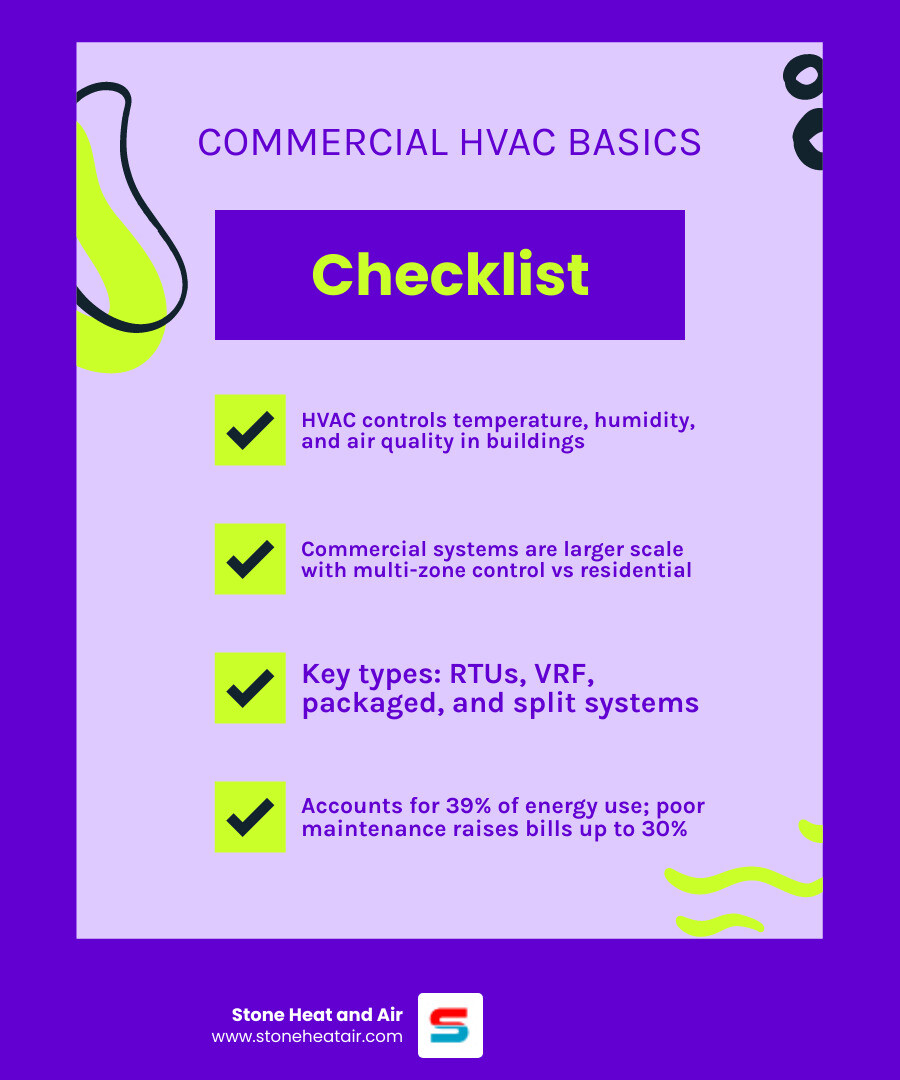
Commercial HVAC basics for business owners can be summarized in five core points:
1. What it is - A system that controls temperature, humidity, and air quality throughout your building
2. How it differs from residential - Larger scale, multi-zone control, greater complexity, and more frequent maintenance needs
3. Main system types - Rooftop units (RTUs), VRF systems, packaged units, and split systems
4. Why maintenance matters - HVAC accounts for roughly 39% of a commercial facility's energy use, and neglected systems can raise energy bills by up to 30%
5. When to call a pro - Refrigerant issues, electrical faults, unusual noises, or rising utility bills all warrant a licensed technician
Walk into any office, retail store, or warehouse in the Rogue Valley on a hot Southern Oregon summer day, and you instantly notice whether the HVAC is doing its job. But for most business owners, the system running quietly overhead — or sitting on the roof — remains a mystery until something goes wrong. And when it does go wrong, the consequences go beyond discomfort. Lost productivity, unhappy customers, and energy bills that quietly climb month after month can all trace back to a poorly understood or neglected climate control system.
The U.S. commercial HVAC market is worth over $17 billion and growing fast — a clear sign of just how central these systems are to the way modern businesses operate. Yet many owners only engage with their HVAC when there's a breakdown. That reactive approach is one of the most expensive habits in facilities management.
This guide is designed to change that. Whether you manage a small café in Central Point or a multi-floor office building in Medford, understanding how your system works — and what it needs — puts you in control of your building's comfort, air quality, and operating costs.
Commercial HVAC Basics for Business Owners: Key Differences from Residential Systems
When we talk about commercial hvac basics for business owners, the first thing to understand is that a commercial system isn't just a "big" version of the one in your home. While the goal is the same—keeping people comfortable—the engineering is worlds apart.
Residential systems are typically standalone units designed to heat or cool a single family dwelling. In contrast, Commercial HVAC Medford OR systems are modular, meaning they are built to be expanded or modified as your business grows. They handle much higher occupancy loads; while your home might have four or five people in it, a retail space or office could have dozens or hundreds, each generating body heat and requiring fresh, filtered air.
The drainage systems are also significantly more complex. Because commercial units remove massive amounts of moisture from the air, they require heavy-duty piping and specialized pans to prevent water damage to the building structure. Furthermore, commercial systems offer multi-zone control, allowing you to keep a server room at 65 degrees while the front lobby stays at a welcoming 72.
Understanding Commercial HVAC Basics for Business Owners: Rooftop Units (RTUs)
If you look at the skyline of any business district in Southern Oregon, you'll see boxes sitting on top of the buildings. These are Rooftop Units, or RTUs. These are "packaged" units, meaning all the components—the compressor, evaporator, and heating elements—are housed in one weatherized cabinet.
RTUs are the gold standard for Commercial Design Build projects because they save valuable indoor floor space. They are also easier for our technicians to service without disrupting your daily operations, as the work happens entirely outside and on the roof.
Modularity and Scalability in Business Environments
One of the most important commercial hvac basics for business owners to grasp is scalability. If you lease an extra 2,000 square feet next door, a commercial system can often be expanded by adding new modules rather than replacing the entire infrastructure. This modular design also provides redundancy. If one compressor in a large multi-stage system fails, the others can often "limp along" to provide partial cooling, preventing a total business shutdown while we arrive for a 24/7 emergency call.
Common System Types for Rogue Valley Commercial Properties
Choosing the right system for your property in the Rogue Valley depends on your building size, your budget, and how your space is used. Whether you're looking for Commercial HVAC Rogue River OR solutions or a system for a large warehouse, here are the primary options.
Variable Refrigerant Flow (VRF) and Heat Recovery
VRF systems are the high-tech choice for modern businesses. Originally developed in the 1980s, these systems are up to 30% more efficient than traditional ducted systems. They work by varying the flow of refrigerant to multiple indoor units.
The most impressive feature is "heat recovery." This allows the system to take heat removed from a room that needs cooling (like a kitchen) and move it to a room that needs heating (like a chilly office). This simultaneous heating and cooling makes them incredibly efficient for hotels and multi-use buildings.
• Installation — Rooftop Unit (RTU): Easier/Lower Upfront Cost — VRF System: Higher Upfront Cost
• Efficiency — Rooftop Unit (RTU): Standard — VRF System: High (up to 30% better)
• Control — Rooftop Unit (RTU): Single or Limited Zones — VRF System: Precise Multi-Zone
• Maintenance — Rooftop Unit (RTU): Routine — VRF System: Specialized
Packaged vs. Split Systems for Small Businesses
For smaller retail applications, such as those needing Commercial HVAC Phoenix OR services, a split system might be more appropriate. Similar to a residential setup, a split system has an indoor air handler and an outdoor condenser. However, they are built with commercial-grade components to withstand the 24/7 demands of a business environment. Packaged units, on the other hand, keep everything in one box, which is ideal for businesses with limited indoor utility space.
Improving Efficiency and Air Quality in Your Facility
Efficiency isn't just about saving the planet; it’s about your bottom line. Since HVAC accounts for about 39% of a facility's energy use, even small improvements can lead to major savings. One of the best starting points is Commercial Duct Cleaning. Over time, dust and debris in your ducts act like a "clogged artery," forcing your fans to work harder and driving up electricity costs.
Optimizing Commercial HVAC Basics for Business Owners: Controls and Automation
Modern Building Automation Systems (BAS) allow us to move beyond simple "on/off" thermostats. By using Find the Right Commercial Thermostat with These Tips, you can implement temperature setbacks during unoccupied hours, which can save between 5% and 20% on your energy bills. Demand Control Ventilation (DCV) is another smart upgrade; it uses CO2 sensors to adjust fresh air intake based on how many people are actually in the room, ensuring you aren't paying to heat or cool air for an empty conference room.
Indoor Air Quality (IAQ) and Regulatory Compliance
In April 2026, indoor air quality is more than just a comfort issue—it's a regulatory one. Following ASHRAE standards ensures that your building remains healthy for employees. This often involves high-efficiency HEPA filtration, which can remove 99.97% of particles. Proper humidity control (keeping it between 40% and 60%) prevents mold growth and protects your building's assets. For those in office settings, following Tips for Improving Airflow in Office Buildings can significantly reduce "sick building syndrome" and improve overall productivity.
Why Proactive Maintenance is Essential for Business Continuity
Many business owners view maintenance as an optional expense. However, data shows that routine maintenance can cut commercial HVAC energy costs by 10% to 40%. When you ignore your system, small issues like a $20 worn belt can snap, causing the motor to overheat and lead to a repair that costs thousands.
Beyond the money, Why Your Commercial HVAC System Needs Maintenance is about reliability. A breakdown in July doesn't just mean a hot office; it means lost revenue if customers leave or sensitive equipment fails.
A Comprehensive Checklist for Commercial HVAC Basics for Business Owners
While we recommend professional service, knowing what to look for is part of How Often Should Commercial HVAC Be Serviced. A standard professional checklist includes:
• Filter Replacement: Monthly or quarterly depending on the environment.
• Coil Cleaning: Dirty coils can drop cooling efficiency by 21% from just 0.042 inches of dirt.
• Refrigerant Levels: Checking for leaks to prevent compressor damage.
• Electrical Connections: Tightening terminals to prevent fire hazards and system failure.
• Lubrication: Ensuring all moving parts move freely to reduce friction and wear.
Benefits of Professional Preventive Maintenance Plans
When you sign up for a plan, like those we offer for Commercial HVAC Grants Pass OR, you aren't just buying a tune-up; you're buying peace of mind. Professional plans often include priority scheduling, meaning if your system goes down during a heatwave, you are at the front of the line. It also creates a paper trail of maintenance that can be vital for warranty claims or when you eventually decide to sell your property.
Recognizing When Your System Needs Professional Attention
Even the best systems eventually need expert help. Knowing the early warning signs can save you from a total system failure. Common indicators include unusual grinding or squealing noises, "short cycling" (where the system turns on and off rapidly), or a sudden, unexplained spike in your utility bills. We’ve identified 3 Things That Commonly Go Wrong with Commercial HVAC Systems that often start small but escalate quickly if ignored.
Signs It Is Time for a System Replacement
Commercial systems generally have a life expectancy of 15 to 20 years. If your system is over 10–15 years old and you find yourself calling for repairs more than twice a year, it may be time to consider a replacement. The Life Expectancy of Commercial HVAC Systems is heavily influenced by how well they were maintained. If your unit still uses outdated refrigerants like R-22, replacing it with a modern, high-efficiency unit can often pay for itself in energy savings within just a few years.
Choosing the Right Service Provider in the Rogue Valley
Not all HVAC companies are equipped to handle the complexities of commercial equipment. When choosing a partner, look for:
• Carrier-Certified Expertise: Ensures the technicians have the highest level of training.
• 24/7 Emergency Response: Because businesses don't just run from 9 to 5.
• Honest Recommendations: A provider who tells you when a repair is a smart move versus when a replacement is the better long-term investment.
Understanding What to Expect in a Commercial HVAC Service Call helps you prepare your facility and staff for the visit, ensuring a smooth process.
Frequently Asked Questions about Commercial HVAC
How often should commercial air filters be changed?
In most commercial settings, filters should be inspected monthly and changed every 1 to 3 months. However, if your business is in a high-dust industry (like manufacturing) or has high foot traffic (like a busy retail store), you may need to change them more frequently to maintain airflow and indoor air quality.
What is the difference between a chiller and an RTU?
An RTU (Rooftop Unit) uses air to cool the refrigerant and is generally used for smaller to medium-sized buildings. A chiller uses water to remove heat from the building and is typically found in very large facilities or industrial complexes. Chillers are more complex but can be more efficient for massive cooling loads.
How can smart technology reduce my building's energy bills?
Smart technology, such as Wi-Fi-enabled thermostats and building automation, allows for precise scheduling. It can automatically adjust temperatures based on occupancy sensors, outside weather conditions, and even peak energy pricing hours. This removes human error—like someone forgetting to turn down the heat on a Friday evening—and ensures the system only runs when it is actually needed.
Conclusion
Mastering the commercial hvac basics for business owners is one of the smartest investments you can make in your property. By moving from a reactive "fix it when it breaks" mindset to a proactive "maintain it to save" strategy, you protect your comfort, your employees, and your profits.
At Stone Heat and Air, we are proud to be the Rogue Valley’s trusted partner for all things Commercial. Based in Central Point, we serve businesses from Medford to Grants Pass and beyond with honest, fair dealings and meticulous attention to detail. Whether you need an emergency repair at 2 AM or are looking to join our Stone Comfort Membership Club for year-round peace of mind, we treat your business like it’s our own. Don't let your HVAC system be a mystery—let it be a reliable asset that helps your business thrive.