

Why Adding Cooling Without Ductwork Is a Real Challenge for Older Homes
Adding cooling without ductwork options compared is exactly what thousands of Rogue Valley homeowners need to think through before summer arrives. If your home was built before central air became standard, chances are it has no duct system at all — and retrofitting one can be executive, invasive, and sometimes simply not practical in an older structure.
Here's a quick look at your main options:
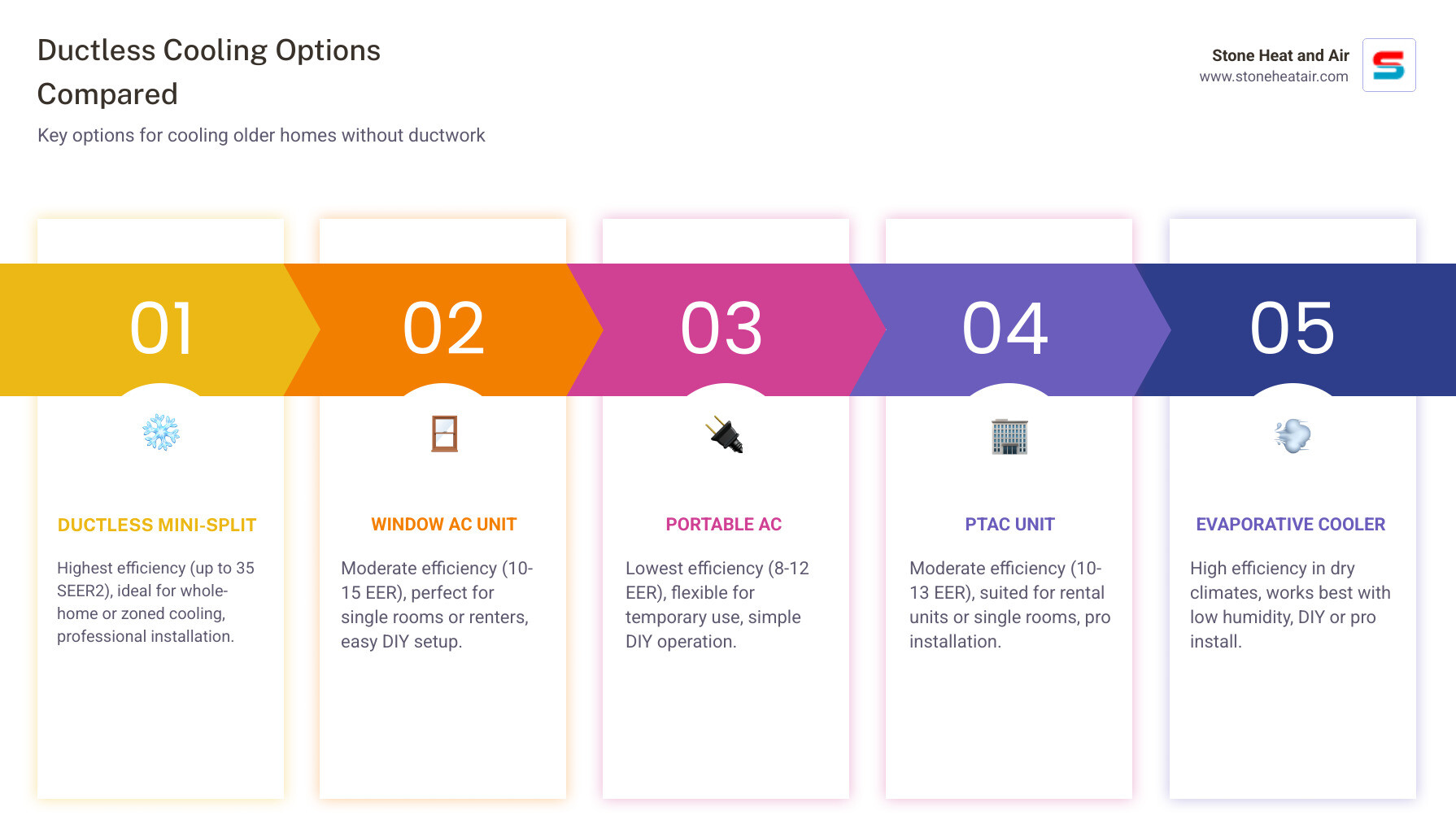
• Ductless mini-split — Best For: Whole-home or zoned cooling — Efficiency: Highest (up to 35 SEER2) — Installation: Professional
• Window AC unit — Best For: Single rooms, renters — Efficiency: Moderate (10-15 EER) — Installation: DIY
• Portable AC — Best For: Temporary, flexible use — Efficiency: Lowest (8-12 EER) — Installation: DIY
• PTAC unit — Best For: Rental units, single rooms — Efficiency: Moderate (10-13 EER) — Installation: Professional
• Evaporative cooler — Best For: Dry climates only — Efficiency: High in low humidity — Installation: DIY or Pro
• Whole house fan — Best For: Mild climates, cool nights — Efficiency: Very low energy use — Installation: Professional
The Rogue Valley's hot, dry summers and cool winters create a unique challenge. You need real cooling power, but you also want something that won't tear apart the character of your home. Traditional ductwork can eat up wall space, require major structural changes, and still lose up to 30-40% of its cooling energy through leaks and poor insulation.
The good news? There are several solid ductless options — and one of them is almost certainly the right fit for your home.
Adding Cooling Without Ductwork Options Compared: A Rogue Valley Guide
When we look at the landscape of cooling in 2026, the variety of choices can feel overwhelming. However, for those of us living in beautiful vintage homes in Central Point or Medford, the goal is clear: stay cool without destroying the architectural integrity of our houses. Understanding Ductless Air Conditioners and Their Features is the first step in making an informed choice.
Mini-Split Systems
Ductless mini-splits are the gold standard for permanent, non-ducted cooling. They consist of an outdoor condenser linked to one or more indoor air handlers via a small conduit. Because they don't rely on bulky ducts, they are incredibly versatile. You can cool a single "trouble" room or an entire multi-story home.
Window Units
Window ACs are the most common fallback. They are relatively inexpensive to buy and can be installed by most homeowners. However, they block your view, pose security risks, and are often noisy. In the Rogue Valley, where we love our natural light, losing a window to a plastic box isn't always ideal.
Portable ACs
These units stand on the floor and vent hot air through a flexible hose. While they offer mobility, they are generally the least efficient option. They often create "negative pressure," pulling warm outdoor air into the house through cracks and gaps, which forces the unit to work even harder.
PTAC Units (Packaged Terminal Air Conditioners)
You’ve likely seen these in hotels. They are through-the-wall units that provide both heating and cooling. While reliable, they require cutting a large, rectangular hole in your exterior wall, which can be a deal-breaker for historic preservation.
Evaporative Coolers
Also known as swamp coolers, these work by pulling air over water-saturated pads. They are energy-efficient but only work in very dry climates. While Southern Oregon is dry, our humidity can occasionally spike, rendering these units less effective than a refrigerant-based system.
Comparison Table: Mini-Splits vs. Window Units
• Energy Efficiency — Ductless Mini-Split: High (Up to 35 SEER2) — Window AC Unit: Low to Moderate (10-15 EER)
• Noise Level — Ductless Mini-Split: Near Silent (20-40 dB) — Window AC Unit: Loud (50-60+ dB)
• Security — Ductless Mini-Split: High (Small 3" wall hole) — Window AC Unit: Low (Window must remain unlocked)
• Lifespan — Ductless Mini-Split: 15–20 Years — Window AC Unit: 5–8 Years
• Aesthetics — Ductless Mini-Split: Sleek, high-wall or ceiling — Window AC Unit: Bulky, blocks window
• Zoning — Ductless Mini-Split: Individual room control — Window AC Unit: Single room only
Adding cooling without ductwork options compared for energy efficiency
Efficiency isn't just a buzzword; in the Rogue Valley, it's the difference between a manageable summer and a staggering utility bill. When adding cooling without ductwork options compared, energy efficiency is where the ductless mini-split truly shines.
Traditional ducted systems are notorious for "duct loss." Research shows that up to 30% of cooling energy can escape through leaks in the ductwork before it ever reaches your living space. In some older homes with uninsulated ducts in hot attics, that loss can climb to 40%. By delivering air directly into the room, ductless systems eliminate this waste entirely.
Understanding How Can a Ductless HVAC System Help You Save Money involves looking at SEER2 ratings. While a standard window unit might have an EER of 10, modern ENERGY STAR certified mini-splits can reach SEER2 ratings as high as 35. This means they use significantly less electricity to produce the same amount of cooling. For Rogue Valley residents facing 100-degree August afternoons, this efficiency translates to real-world savings.
Adding cooling without ductwork options compared for historic home preservation
For those of us in historic Central Point or the older neighborhoods of Roseburg, preserving the "soul" of the home is paramount. We don't want to drop ceilings to hide ducts or cut into original lath-and-plaster walls more than necessary.
Ductless systems offer a non-invasive installation. The connection between the indoor and outdoor units requires only a small, three-inch hole in the wall—easily patched if the system is ever removed. Furthermore, there are many Ideal Spots for a Ductless Mini-Split Air Conditioner that keep the unit out of your line of sight:
• Wall-Mounted Units: These are the most common and can be placed high on a wall where they are less noticeable.
• Ceiling Cassettes: These sit flush with the ceiling, showing only a discreet grille. They are perfect for open-concept areas.
• Floor-Mounted Units: These look similar to a traditional radiator and are ideal for rooms with slanted ceilings or limited wall space.
Why Ductless Mini-Splits Lead the Pack
If you are looking for a permanent solution, the Ductless Mini-Split is almost always the superior choice. The secret to their performance lies in inverter technology. Unlike traditional systems that are either "all on" or "all off," an inverter compressor can vary its speed. It slows down or speeds up to maintain a perfectly consistent temperature, much like the cruise control on your car.
Key Benefits of Going Ductless:
• Quiet Operation: The indoor units often operate at decibel levels lower than a whisper. You won't have to turn up the TV just because the AC kicked on.
• Zoned Comfort: Each indoor unit has its own thermostat. This means you can keep the bedroom icy cold for sleeping while keeping the guest room at a more energy-saving temperature.
• Speedy Installation: Because there is no ductwork to design and install, a single-zone system can often be up and running in a single day.
• No Window Blocking: You get to keep your views and your natural light.
When deciding between a traditional Air Conditioner or Ductless System, consider the "zoning" factor. In a vintage home, some rooms naturally stay cooler than others. A ductless system allows you to address only the rooms that need help, rather than forcing the whole house to adapt to one central thermostat.
Year-Round Comfort: Heating and Cooling Without Ducts
In the Rogue Valley, we don't just deal with heat. Our winters can be biting, and many older homes rely on expensive electric baseboard heat or outdated oil furnaces. This is where the Ductless system pulls double duty. Most modern mini-splits are actually heat pumps.
Converting to a Ductless Heat Pump allows you to move heat rather than create it. In the winter, the system extracts heat from the outdoor air (even when it's cold!) and moves it inside. In the summer, the process reverses.
For our local climate, a Carrier Ductless HVAC System is particularly effective. Many of these units are designed for "cold climate" performance, meaning they can provide reliable heat even when temperatures drop well below freezing. This transition doesn't just save you money; it also significantly reduces your home's greenhouse gas emissions. In fact, ENERGY STAR certified systems can avoid more than 4,500 lbs of greenhouse gas emissions over their lifespan compared to standard systems.
Frequently Asked Questions about Ductless Cooling
How do ductless systems improve indoor air quality?
Vintage homes can sometimes struggle with dust, pollen, and "old house" smells. Ductless units feature multi-stage filtration systems that capture particulates and allergens before they circulate. Because there are no ducts, you don't have to worry about dust, mold, or pet dander accumulating in hidden passages. Many Ductless Air Conditioners and Their Features include specialized filters that also help with humidity control, which is essential for preventing mold growth in our wetter months.
Can one outdoor unit cool my entire home?
Absolutely. While a single-zone system is great for a garage or a new addition, multi-zone systems are designed for whole-home coverage. A single, powerful outdoor Ductless Mini-Split condenser can support anywhere from two to six indoor air handlers. This allows you to have a unit in every bedroom and the main living area, all powered by one discreet outdoor component.
Are there tax credits available for these systems in 2026?
Yes! As of April 2026, there are several incentives available to help Rogue Valley homeowners make the switch. Federal tax credits under the Inflation Reduction Act can cover up to 30% of the project cost for qualifying heat pumps. Additionally, many local utility companies in Southern Oregon offer rebates for residents who replace inefficient electric resistance heat with high-efficiency ductless systems. Choosing an ENERGY STAR certified unit is often the key to unlocking these savings.
Conclusion
At Stone Heat Air, we understand that your home is your sanctuary. Whether you are in Central Point, Brookings, or Klamath Falls, you deserve a home that is comfortable 365 days a year. We specialize in helping Rogue Valley residents navigate the complexities of adding cooling without ductwork options compared, providing honest recommendations that respect both your budget and your home's history.
From our 24/7 emergency service to our exclusive Stone Comfort Membership Club, we are committed to your peace of mind. We don't just install equipment; we build long-term relationships based on trust and skilled workmanship.
Ready to reclaim your comfort? Schedule your ductless consultation with our expert team today, and let’s find the perfect cooling solution for your vintage home.