

What AC Making Strange Noises Actually Means (And What to Do)
If your AC is making strange noises, here's a quick breakdown of what each sound likely means:
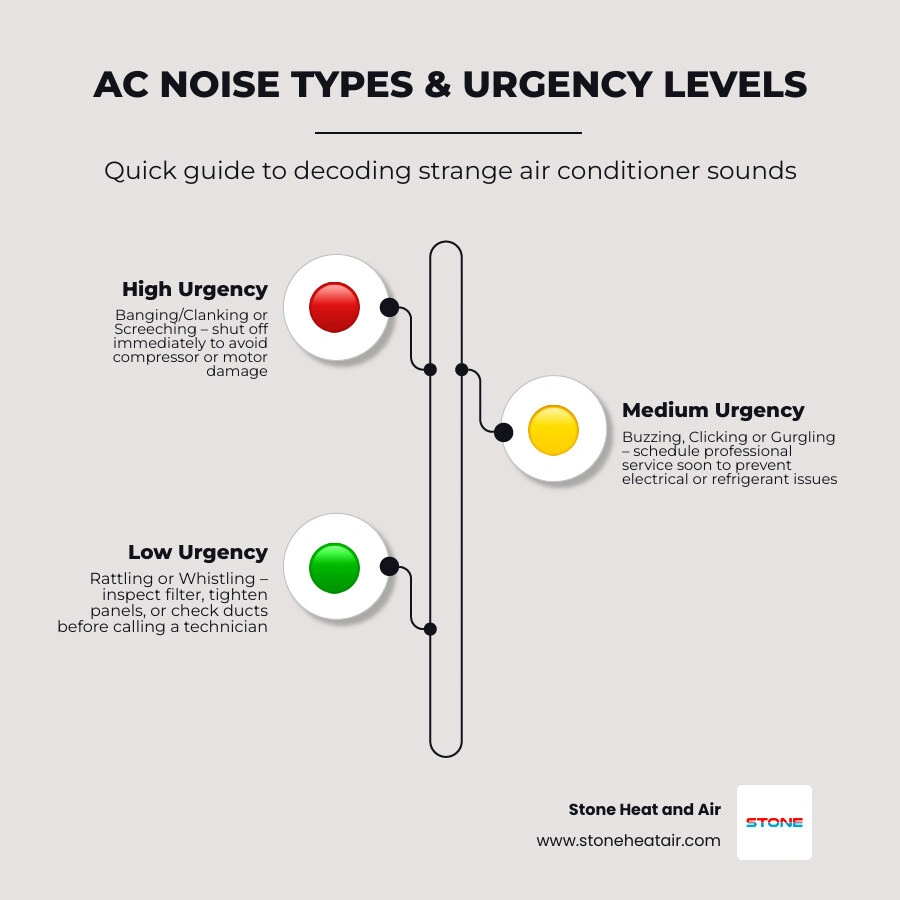
• Banging / Clanking — Most Likely Cause: Loose or broken internal part (compressor, fan blade) — Urgency: High - turn off immediately
• Hissing — Most Likely Cause: Refrigerant leak or high compressor pressure — Urgency: High - call a pro
• Buzzing — Most Likely Cause: Loose wiring, failing capacitor, or debris in fan — Urgency: Medium - schedule soon
• Clicking (repeated) — Most Likely Cause: Faulty relay, failing capacitor, or bad contactor — Urgency: Medium - don't ignore
• Screeching / Squealing — Most Likely Cause: Worn motor bearings or failing fan belt — Urgency: High - turn off immediately
• Rattling — Most Likely Cause: Loose panels, screws, or debris — Urgency: Low - inspect and monitor
• Gurgling / Bubbling — Most Likely Cause: Refrigerant issue or blocked condensate drain — Urgency: Medium - call a pro
• Whistling — Most Likely Cause: Clogged filter or air duct leak — Urgency: Low to medium - check filter first
Your air conditioner isn't supposed to be silent — but it should be predictable. When your system suddenly starts making sounds you've never heard before, it's usually trying to tell you something is wrong.
Modern AC units, especially variable-speed models, can run as quietly as 19 decibels indoors. That's softer than a whisper. So when an unfamiliar bang, hiss, or screech cuts through the background noise, it stands out — and for good reason.
Most strange AC noises point to one of three root causes: a mechanical part wearing out or breaking loose, an electrical component failing, or a refrigerant issue. Some noises are harmless. Others mean you should shut the system off right now before a small problem becomes a full system failure.
This guide walks through every major noise type, what's likely causing it, and what your next move should be.
Normal vs. Abnormal Air Conditioner Sounds
Before you panic over a new sound echoing through your Rogue Valley home, it helps to understand what a healthy, properly functioning air conditioner actually sounds like.
Every cooling system has moving parts, electrical circuits, and pressurized fluids. Because of this, some baseline noise is completely normal.
What Normal Operation Sounds Like
• A Gentle Whir or Whoosh: This is the sound of your indoor blower fan circulating cooled air through your home's ductwork.
• A Steady, Uniform Hum: Your outdoor condenser unit houses the compressor and a large fan. When running properly, it should emit a consistent, low-level hum.
• A Single, Soft Click: When your cooling cycle begins or ends, you will hear a single click. This is simply the thermostat communicating with the system and the electrical relays engaging to turn the unit on or off.
• Occasional Muffled Popping: In many Southern Oregon homes, metal ductwork expands and contracts as cold air starts and stops flowing. This temperature shift can cause harmless popping or creaking sounds within your walls.
• A Brief, Quiet Hiss (at Shutdown): When the system turns off, you might hear a very brief hissing sound lasting only a few seconds. This is the refrigerant pressure equalizing across the system and is entirely normal.
When to Worry: Normal vs. Abnormal Comparison
How do you tell the difference between these harmless sounds and a system cry for help? The table below highlights the key differences:
• Brief, single click at startup — Abnormal Warning Sound: Continuous, rapid clicking throughout the cycle — What the Abnormal Sound Signals: Electrical failure, dying thermostat, or contactor issues
• Steady, low-level outdoor hum — Abnormal Warning Sound: Loud, erratic buzzing or electrical vibration — What the Abnormal Sound Signals: Failing capacitor, loose wiring, or motor strain
• Gentle air whoosh from vents — Abnormal Warning Sound: High-pitched whistling or howling — What the Abnormal Sound Signals: Severe airflow restriction or ductwork leaks
• Brief pressure equalization hiss — Abnormal Warning Sound: Constant, loud hissing or bubbling — What the Abnormal Sound Signals: Active refrigerant leak or high compressor pressure
• Soft, consistent fan motor whir — Abnormal Warning Sound: Loud screeching, grinding, or metal-on-metal squealing — What the Abnormal Sound Signals: Failed bearings or a broken blower belt
If you are trying to understand the health of your cooling system, taking a few minutes to monitor these sounds can save you from unexpected breakdowns. For a deeper look into distinguishing normal startup sounds from mechanical failures, check out our guide on understanding the noises your air conditioner makes.
Decoding Your AC Making Strange Noises and What They Mean
When your air conditioner is struggling, it communicates through sound. Let's dive deep into the specific noises your system might make, what they indicate about your hardware, and how ignoring them can impact your home comfort.
If you notice your system acting up, it is crucial to address these warnings early to avoid major issues with your AC. Here is a breakdown of the most common strange noises and their root causes.
Banging and Clanking: Loose Internal Components
If your air conditioner sounds like a dryer filled with tennis balls, you are likely dealing with a banging or clanking noise. This is almost always a physical mechanical issue.
• The Compressor: Inside your outdoor unit, the compressor is the heart of the system. If internal components like the piston pin, connecting rod, or crankshaft break or come loose, they will violently rattle around inside the compressor housing.
• The Blower Fan: If you hear the banging coming from your indoor unit, a loose fan blade might be striking the surrounding metal housing.
• Broken Motor Mounts: The motors that spin your fans are held in place by mounts. If these mounts break, the motor will shift, causing the spinning fan blades to wobble and smash against other internal components.
Urgency: High. If you hear banging or clanking, turn your system off immediately. Running an AC with loose mechanical parts will cause severe, irreversible damage to surrounding components.
Hissing and Bubbling: What These AC Making Strange Noises Mean
Hissing and bubbling sounds are almost exclusively tied to your system's refrigerant loop or its condensate drainage.
• Refrigerant Leaks: A constant hissing sound coming from either your indoor evaporator coil or your outdoor condenser coil is a classic sign of a refrigerant leak. Because refrigerant is kept under high pressure, a tiny pinhole leak will sound like air escaping a tire. If you suspect this is the case, you should find out if your air conditioner need more refrigerant and learn what to do if your AC is leaking to prevent compressor failure.
• High Compressor Pressure: If you hear a loud, high-pitched hiss or shriek from the outdoor unit that lasts for 10 to 15 seconds at startup, your compressor may be operating under dangerously high pressure. Modern systems often have safety shut-offs for this, but older systems may keep running.
• Bubbling or Gurgling: If the sound is more of a bubbling or gurgling, it typically means air has entered your refrigerant lines, or your condensate drain line is clogged. When moisture wrung from your indoor air cannot drain properly, it pools in the drain pan and gurgles like water being sucked through a straw.
Buzzing and Clicking: AC Making Strange Noises and What They Mean for Your Electrical System
Electrical issues are notorious for causing buzzing and clicking sounds. Because electrical problems do not resolve themselves, these sounds require prompt attention.
• Contactor Relays and Capacitors: If your system clicks repeatedly but refuses to start, you are likely dealing with a failing contactor relay or a dead capacitor. If you want to know more, you can read about why is your HVAC system making a clicking sound and explore what causes an AC capacitor to fail to protect your system's electrical integrity.
• Loose Electrical Wiring: A constant buzzing sound from the outdoor unit often indicates electrical arcing, loose wiring connections, or a failing condenser fan motor.
• System Startup Failures: If these electrical issues are ignored, they will eventually prevent your unit from turning on entirely. Learn more about the 3 reasons why your air conditioning unit won't turn on to keep your home cool during the peak of summer.
Screeching and Grinding: Motor and Bearing Wear
A screeching or grinding noise is hard to ignore, and your ears are correct to find it alarming.
• Worn Motor Bearings: Your AC has motors in both the indoor blower fan and the outdoor condenser fan. Over time, the lubricating grease inside these motor bearings dries up. When this happens, metal grinds against metal, creating a harsh grinding or roaring sound.
• Failing Fan Belt: Older indoor blower units often use a belt-driven motor. If the belt becomes dry, cracked, or slips out of alignment, it will emit a high-pitched squeal or screech every time the system runs.
• Condenser Fan Obstructions: If a stick, pine needle, or piece of debris slips through the outdoor fan grate, the spinning blades will hit it, creating a rapid screeching or clicking sound.
Indoor vs. Outdoor Unit Noises: Mapping the Source
To properly diagnose an air conditioner, you have to play detective. The first step is figuring out exactly where the sound is coming from. Because central AC systems split their components between the inside and outside of your home, the location of the noise tells us exactly which parts are struggling.
Sounds Coming from the Indoor Unit
Your indoor cabinet houses the blower motor, the evaporator coil, the expansion valve, and various electronic sensors.
• Squealing or Chirping: Usually points to a failing blower motor or a slipping fan belt inside your furnace or air handler.
• Dripping or Splashing: Indicates a clogged condensate line or an overflowing drain pan.
• Clicking or Rattling: Often caused by a failing control board relay or a loose blower wheel. If your system's sensors are misreading temperatures due to electrical faults, it can trigger erratic system behavior. For troubleshooting help, read our guide on troubleshooting AC sensor issues signs and solutions.
Sounds Coming from the Outdoor Unit
Your outdoor condenser unit works under harsh weather conditions and houses the compressor and the condenser fan.
• Loud Buzzing: Often indicates electrical contactor failure, a failing capacitor, or a motor struggling to spin.
• Violent Banging: Points directly to loose internal compressor parts or a broken condenser fan blade.
• Continuous Hissing: Usually indicates a high-pressure refrigerant leak on the condenser coil or a faulty compressor valve.
When to Shut Off Your System and Call a Professional
Not every sound requires an emergency service call, but some noises are clear indicators that your system is in immediate danger of suffering catastrophic damage.
High-Urgency Noises: Turn Off Your AC Immediately If You Hear:
1. Loud Metal-on-Metal Screeching or Grinding: This means motor bearings have failed completely. Running the system will burn out the motor and could potentially cause an electrical fire.
2. Violent Banging or Clanking: Loose parts are flying around inside your compressor or fan housing. Keeping the system on will destroy surrounding components.
3. Constant, Loud Hissing: Pressurized refrigerant is escaping, or your compressor is operating under dangerous pressure levels.
Why You Shouldn't Ignore These Warnings
Ignoring these sounds can lead to a complete system breakdown, leaving your home hot and uncomfortable. If your unit is making unusual noises and failing to keep your home cool, it is time to look into the possible reasons your air conditioner isn't cooling your home properly and bring in a professional.
Frequently Asked Questions About AC Noises
Why does my AC make a clicking sound when starting up?
A single, distinct click when your system turns on is completely normal. This is the sound of your thermostat relay sending an electrical signal to the outdoor contactor to start the cooling cycle. However, if you hear rapid, continuous clicking that prevents the system from starting, it indicates an electrical issue, such as a failing capacitor, a worn-out contactor, or a faulty thermostat.
Can a dirty air filter cause my air conditioner to make noise?
Yes! A severely clogged air filter restricts the volume of air entering your system. This forces your blower motor to work much harder, which can cause a loud whistling, whistling-airflow, or howling sound as air is squeezed through tight gaps. Replacing your filter every 30 to 90 days resolves this noise and relieves strain on your system.
What should I do if my AC is making a loud screeching noise?
If you hear a loud, high-pitched screeching or grinding noise, you should turn off your air conditioner immediately at the thermostat or breaker. This sound is a clear warning that your motor bearings have failed or a fan belt is slipping. Running the system in this state can burn out the motor entirely. Call a professional HVAC technician to inspect and repair the motor.
Conclusion
When your ac making strange noises what they mean is usually a direct warning that your system needs professional attention. From minor panel rattles to high-pressure refrigerant leaks, catching these sounds early is the key to preventing complete system breakdowns and avoiding unnecessary stress.
At Stone Heating & Air, we are dedicated to keeping Rogue Valley families comfortable all year long. Whether you live in Central Point, Medford, or anywhere else in Southern Oregon, our team is here to help. We pride ourselves on honest recommendations, meticulous attention to detail, and treating your home just like our own.
To keep your system running quietly and efficiently, check out the signs your AC needs a tune-up or join our exclusive Stone Comfort Membership Club for year-round peace of mind.
If your air conditioner is making unusual sounds, don't wait for it to break down in the middle of a summer heatwave. Contact us today or visit our Stone Heating & Air Conditioning service page to schedule a professional diagnostic visit. We offer 24/7 emergency services to ensure your home stays cool, safe, and comfortable!