


Why Trying to Cool Specific Rooms Often Backfires
When facing climbing utility bills during the late-summer August heat, many homeowners want to know the truth about closing vents in unused rooms to save energy. Your air conditioner is running nonstop, yet the house still feels warm as the kids get ready to head back to school. In an attempt to force more cold air into the living room or master bedroom, you walk down the hall and shut the supply registers in the guest room, the office, and the spare bathroom. It seems like a logical, straightforward solution. However, this common household hack actually does the exact opposite of what you intend.
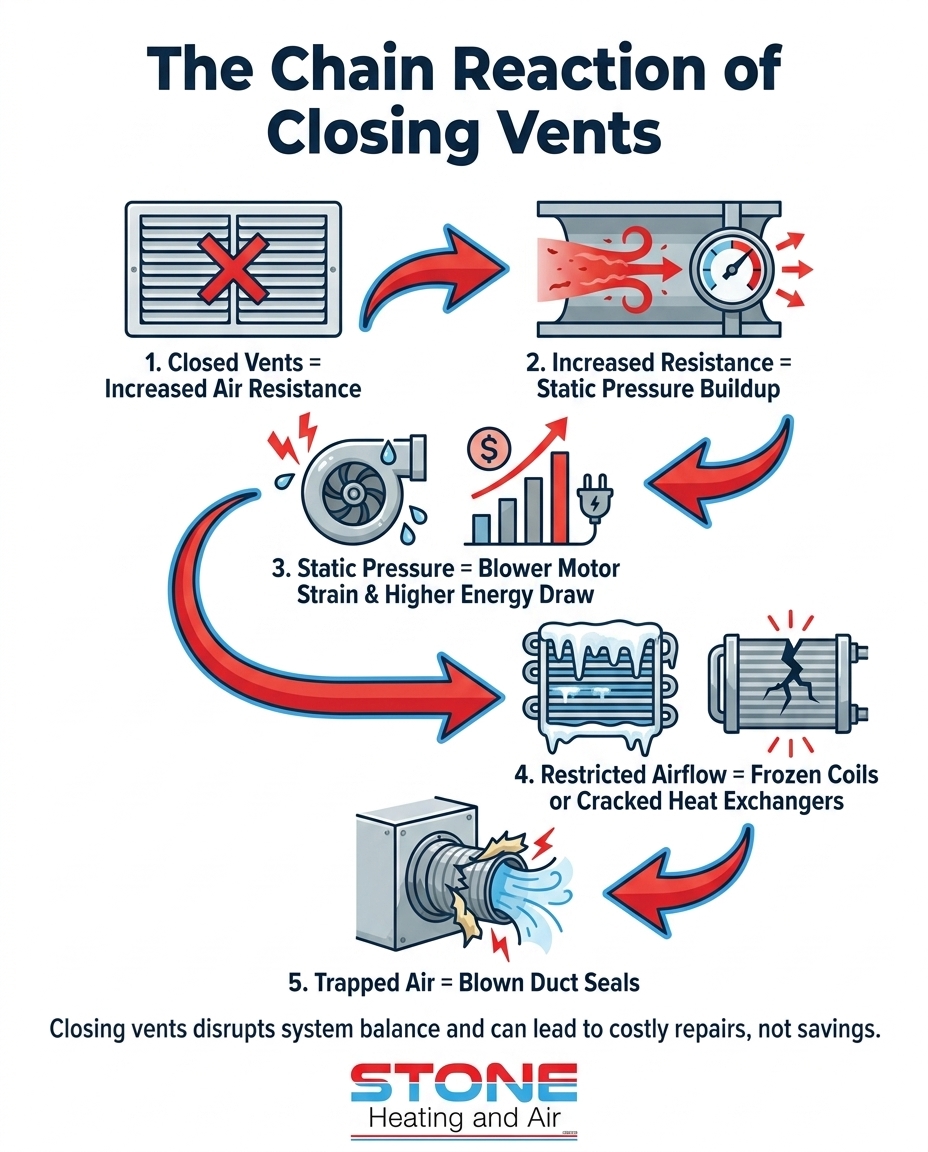
Rather than saving energy or redirecting cold air to where you want it, shutting your vents actively suffocates your HVAC system. Modern residential heating and cooling equipment is not designed to be compartmentalized by simply blocking off grilles. The entire network of ducts, fans, and coils is engineered to breathe as a single, balanced unit. When you disrupt that balance, you trigger a chain reaction of mechanical stress that can lead to catastrophic equipment failure, skyrocketing electrical consumption, and permanent damage to your ductwork.
To understand why this desperate measure backfires so spectacularly, we have to look past the vents themselves and examine the physics of how your home's central air system is actually designed to operate.
How Modern Systems Distribute Airflow
When a professional installs a central heating and cooling system, the equipment is meticulously sized based on the total volume of air inside your home. Technicians perform complex calculations—often referred to as a Manual J load calculation—to determine exactly how many cubic feet of air need to be conditioned to keep your specific square footage comfortable. Whether you live in a compact ranch or a sprawling two-story home in Central Point, OR, your equipment is matched to the whole house, not just the rooms you happen to be sitting in.
This system relies on a continuous, balanced loop. Your return vents pull unconditioned air from the house into the ductwork, the blower motor pushes it across the heating or cooling coils, and the supply vents distribute that newly conditioned air back into your rooms. The blower motor is calibrated to move a very specific volume of air per minute. Closing a supply vent does not communicate with the blower motor to tell it to produce less air. The motor will continue attempting to push the exact same volume of air through a suddenly restricted pathway.
The Myth of Redirected Air
The fundamental misunderstanding most homeowners have is treating forced air like water in a plumbing pipe. If you close a valve on a garden hose, the water pressure is cleanly redirected to another outlet. Airflow inside flexible residential ductwork does not behave this way.
While air does naturally seek the path of least resistance, blocking a vent does not create a neat, efficient redirection of cold air to the next room over. Instead, it creates massive systemic turbulence. The air crashes against the closed louver, backs up into the branch duct, and creates a localized pressure bottleneck. This turbulence disrupts the smooth, laminar flow of air throughout the entire trunk line, making the system work significantly harder just to maintain basic circulation.
System Dynamics Comparison: Open vs. Closed Vents
• All Vents Open — Airflow Distribution: Balanced and even throughout the entire home. — Blower Motor Workload: Normal operation; minimal resistance. — Energy Efficiency: High; system meets thermostat demands quickly.
• 1-2 Vents Closed — Airflow Distribution: Slight turbulence; minor pressure imbalance. — Blower Motor Workload: Elevated strain; motor works harder to push air. — Energy Efficiency: Reduced; energy consumption begins to climb.
• Multiple Vents Closed — Airflow Distribution: Severe bottlenecks; air forced through leaks. — Blower Motor Workload: Extreme strain; high risk of motor overheating. — Energy Efficiency: Very Low; system runs longer cycles with less effect.
The Physics of Restricted Airflow and Motor Strain
To truly understand the damage caused by closing vents, you have to understand a concept called static pressure. At Stone Heating and Air, our team typically sees static pressure buildup as the hidden culprit behind premature breakdowns during our daily service calls across Central Point. You can think of static pressure as the blood pressure of your HVAC system—it is the measurement of resistance against the air as it travels through the ducts.
When you close a vent, you artificially spike the static pressure inside the ductwork. Imagine trying to run a marathon while breathing through a cocktail straw. Your lungs would have to work incredibly hard to pull in and push out a tiny amount of air. This is exactly what happens to your blower motor when vents are shut.
What Happens Inside the Blower Compartment
Modern HVAC systems typically use one of two types of blower motors, and both suffer immensely under high static pressure:
• PSC (Permanent Split Capacitor) Motors: These are older, single-speed motors. When they encounter the high resistance of closed vents, they get bogged down. The RPMs drop, the motor draws more electrical current to try and keep spinning, and the internal components begin to overheat. Over time, this chronic overheating bakes the motor's windings and leads to total failure.
• ECM (Electronically Commutated Motors): These are modern, variable-speed motors designed for high efficiency. When an ECM senses an increase in static pressure, its programming tells it to ramp up its speed to overcome the resistance. If you close vents, the ECM will spin faster and faster, consuming massive amounts of electricity in a futile attempt to push air through a blocked duct.
In both scenarios, the homeowner's attempt to save energy results in the system consuming more electricity and drastically shortening the lifespan of an expensive mechanical component.
Why Closed Vents Lead to Air Conditioning Failure
The physics of restricted airflow don't just harm the blower motor; they directly threaten the refrigeration cycle that makes cooling possible. Your air conditioning system relies on a delicate balance of heat exchange. The indoor evaporator coil is filled with incredibly cold liquid refrigerant. In order for the system to work, a steady, high-volume stream of warm return air must blow across that coil. The refrigerant absorbs the heat from your home's air, turning into a gas and traveling outside to release that heat.
When you close vents and restrict airflow, there isn't enough warm air passing over the evaporator coil. Without that constant heat load, the temperature of the refrigerant drops below freezing. The natural condensation that forms on the coil (the humidity pulled from your home's air) suddenly turns to solid ice.
The Iced Evaporator Coil Domino Effect
1. Step 1: Reduced Airflow. Vents are closed, drastically reducing the total volume of air moving over the indoor indoor evaporator coil.
2. Step 2: Refrigerant Freezing. Because the refrigerant isn't absorbing enough heat, its temperature plummets below 32°F, turning normal condensation into a layer of frost.
3. Step 3: Total Blockage. The frost quickly builds into a thick block of solid ice. This ice acts as an insulator, blocking all remaining airflow through the coil fins.
4. Step 4: Compressor Threat. With the indoor coil frozen, liquid refrigerant can flow backward down the suction line into the outdoor compressor. Compressors are designed to pump gas, not liquid. If liquid hits the compressor (a condition called "slugging"), it can destroy the most expensive component of your entire AC system.
This sequence of events is incredibly common during periods of extreme weather. In fact, a pattern we see often at Stone Heating and Air is end-of-season cooling failures caused by restricted airflow. Just recently, as families were transitioning into back-to-school routines during a brutal late-summer August heat wave, a local homeowner reached out to us when their AC stopped working entirely on the hottest day of the year. Our technicians arrived for same-day service and found the system had completely frozen over into a block of ice. Once the ice was thawed and the closed vents were opened to restore proper airflow, the AC was repaired and able to provide reliable relief from the heat again.
The Year-Round Threat to Your Heating Equipment
While frozen coils are a late-summer nightmare, the dangers of restricted airflow are a year-round threat. As the back-to-school transition signals the eventual arrival of cooler weather, remember that your heating equipment requires the exact same unobstructed airflow to operate safely and efficiently. In fact, closing vents during the heating season carries even more severe safety risks.
Inside your furnace is a component called the heat exchanger. This is a series of metal tubes or clamshells that get incredibly hot as burners ignite gas inside them. The blower motor pushes cold return air over the outside of the heat exchanger, absorbing the heat and carrying it into your living spaces. This constant flow of air is what keeps the metal heat exchanger from overheating.
If you close vents and create static pressure buildup, the volume of air moving over the heat exchanger drops dramatically. The trapped heat causes the metal to expand beyond its design limits. Over time, this extreme thermal stress causes the metal to fatigue and crack. A cracked heat exchanger is not just an expensive repair—it is a critical safety hazard. The crack can allow carbon monoxide and other combustion exhaust gases to leak directly into the airstream being pushed into your home.
To prevent house fires and catastrophic overheating, modern furnaces are equipped with a high-limit switch. If the internal temperature gets too hot due to restricted airflow, this switch shuts the burners off. If you notice your furnace turning on, blowing warm air for only a few minutes, and shutting off repeatedly (a process called short-cycling), closed vents and high static pressure are very likely the cause.
How Artificial Pressure Damages Ductwork Seals
Beyond the mechanical components of your HVAC unit, closing vents wreaks havoc on the delivery system itself: your ductwork. Residential duct systems are assembled in sections, usually connected by slip drives, collars, and screws, and then sealed with mastic paste or foil tape. While these seals are strong, they are not designed to withstand high-pressure environments.
When you close supply registers, the excess static pressure buildup inside the ducts frantically searches for the weakest point of exit. Forced air will press against the seams, joints, and connections hidden in your attic, crawlspace, or walls. Over time, this relentless pressure will literally blow the seals apart, creating permanent leaks in your ductwork.
Losing Air to the Attic or Crawlspace
Once the duct seals are compromised, the consequences are both frustrating and expensive:
• Cooling the Great Outdoors: Up to 30% of your conditioned air can be lost to uninsulated spaces like the attic or crawlspace before it ever reaches your living areas.
• Permanent Efficiency Loss: Even if you realize your mistake and reopen all your vents, the duct seals are already broken. The air will continue to leak, meaning your system will permanently run less efficiently until the ducts are professionally repaired.
• Indoor Air Quality Issues: Leaky ducts don't just push air out; they can also pull air in. When the blower motor shuts off, the pressure changes, potentially drawing dust, insulation fibers, and crawlspace moisture into the ductwork and blowing it into your home.
Another homeowner recently needed our help after struggling with poor airflow and rooms that just wouldn't get comfortable. Our team at Stone Heating and Air assessed their ductwork and found significant pressure damage. We presented options, replaced the compromised sections, and optimized their ventilation configuration, working quietly and quickly to restore proper balance. If you suspect your ducts have been compromised by years of closed vents, professional duct repair and sealing is the only way to restore your system's integrity.
Safe Alternatives to Closing Vents in Unused Rooms
It is entirely understandable to want to manage the temperature in rooms you rarely use, especially in a climate like Central Point, OR, where weather extremes can drive up utility usage. Fortunately, there are safe, effective ways to control your home's climate without destroying your equipment.
The 75% Rule: If you absolutely must adjust a vent to reduce airflow in a specific room, never close it completely. Keep the louvers at least 75% open. This allows enough air to escape to prevent severe static pressure buildup while slightly reducing the volume entering the room.
Safe Temperature Management Strategies:
• Thermal Window Treatments: The vast majority of heat gain in the summer and heat loss in the winter occurs through windows. Installing blackout curtains, cellular shades, or UV-blocking window films in unused guest rooms prevents the room from becoming an oven, reducing the overall heat load on the house.
• Keep Interior Doors Open: HVAC systems rely on return vents to pull air back to the unit. Many homes only have one or two large return grilles in the main hallways. If you close a bedroom door, you trap supply air in that room, creating high pressure in the bedroom and low pressure in the hallway. Keeping doors open ensures free-flowing circulation.
• Utilize Ceiling Fans: Ceiling fans do not lower the temperature of a room, but they do create a wind-chill effect on your skin. Running fans in occupied rooms allows you to set the main thermostat a few degrees higher while maintaining the same level of comfort.
• Investigate HVAC Zoning: If you truly want room-by-room temperature control, the correct solution is a professionally installed zoning system. This involves installing motorized dampers inside the ductwork, paired with a specialized bypass duct or variable-speed equipment, controlled by multiple thermostats. A zoning system safely redirects air while managing static pressure automatically. Upgrading to qualifying high-efficiency equipment for zoning may even make you eligible for federal tax credits or local utility incentive programs, though you should always verify current offerings with a tax professional or your utility provider.
If you have tried these methods and certain rooms are still wildly uncomfortable, the issue is likely rooted in your duct design or insulation, not your vents. Exploring resources on diagnosing poor airflow in older homes can provide insight into the real structural issues causing your hot and cold spots.
Frequently Asked Questions About Home Airflow and Vents
Does closing vents in unused rooms save money?
No, closing vents does not save money and usually results in higher utility costs. Modern HVAC blowers push a set volume of air regardless of how many vents are open. When you close vents, the system has to work harder against increased resistance, which draws more electricity and forces the unit to run longer cycles to satisfy the thermostat.
Why is closing vents bad for the AC?
Closing vents restricts the warm return air flowing over the indoor evaporator coil. Without enough warm air to absorb, the refrigerant inside the coil drops below freezing, causing normal condensation to turn into solid ice. A frozen coil blocks all cooling capacity and can send liquid refrigerant back to the outdoor unit, potentially destroying the compressor.
What happens to static pressure when vents are closed?
Static pressure spikes significantly when you close supply vents. Because the blower motor is still trying to force the same amount of air through a smaller total opening, the air backs up, creating severe turbulence and resistance inside the ductwork. This pressure buildup strains the motor and can literally blow apart the seams of your ducts.
How many vents can I safely close in my house?
HVAC professionals strongly recommend keeping 100% of your supply and return vents fully open. If you must adjust airflow in a specific room for comfort reasons, you should never close a vent more than 25%. Closing even one or two vents completely can be enough to disrupt the system balance and trigger overheating or freezing issues.
Does closing basement vents help push cold air upstairs?
While it seems like closing basement vents would force cold air to the upper floors, it actually just creates a pressure bottleneck in the basement ductwork. Air takes the path of least resistance, but forcing it upward against gravity through restricted ducts usually just results in blown duct seals and a strained blower motor. True multi-level temperature control requires a professional zoning system.
Keep Your Vents Open and Your System Running Smoothly
The science is clear: a healthy HVAC system is one that can breathe freely. Keeping all your interior doors open and your supply vents unblocked is the simplest, most effective way to protect your equipment from unnecessary strain. Proper, unobstructed airflow ensures a long-lasting blower motor, prevents coils from freezing, and keeps your ductwork intact.
If you live in Central Point, OR, and suspect that years of closed vents have already taken a toll on your system's efficiency, the team at Stone Heating and Air is here to help. Reach out for a professional duct evaluation or system diagnostic to restore your home's airflow and secure true, lasting comfort.