

Why Regular Gas Furnace Maintenance in Eagle Point, OR Keeps Your Home Safe and Warm
Gas furnace maintenance in Eagle Point, OR is one of the smartest things you can do as a homeowner before winter sets in. Eagle Point winters can be cold and unforgiving, and your furnace works hard to keep your family comfortable through every frosty night.
The good news? Staying on top of routine maintenance means fewer surprises, lower energy bills, and a furnace that lasts longer. Most well-maintained furnaces last between 12 and 17 years. Neglected ones rarely make it that far.
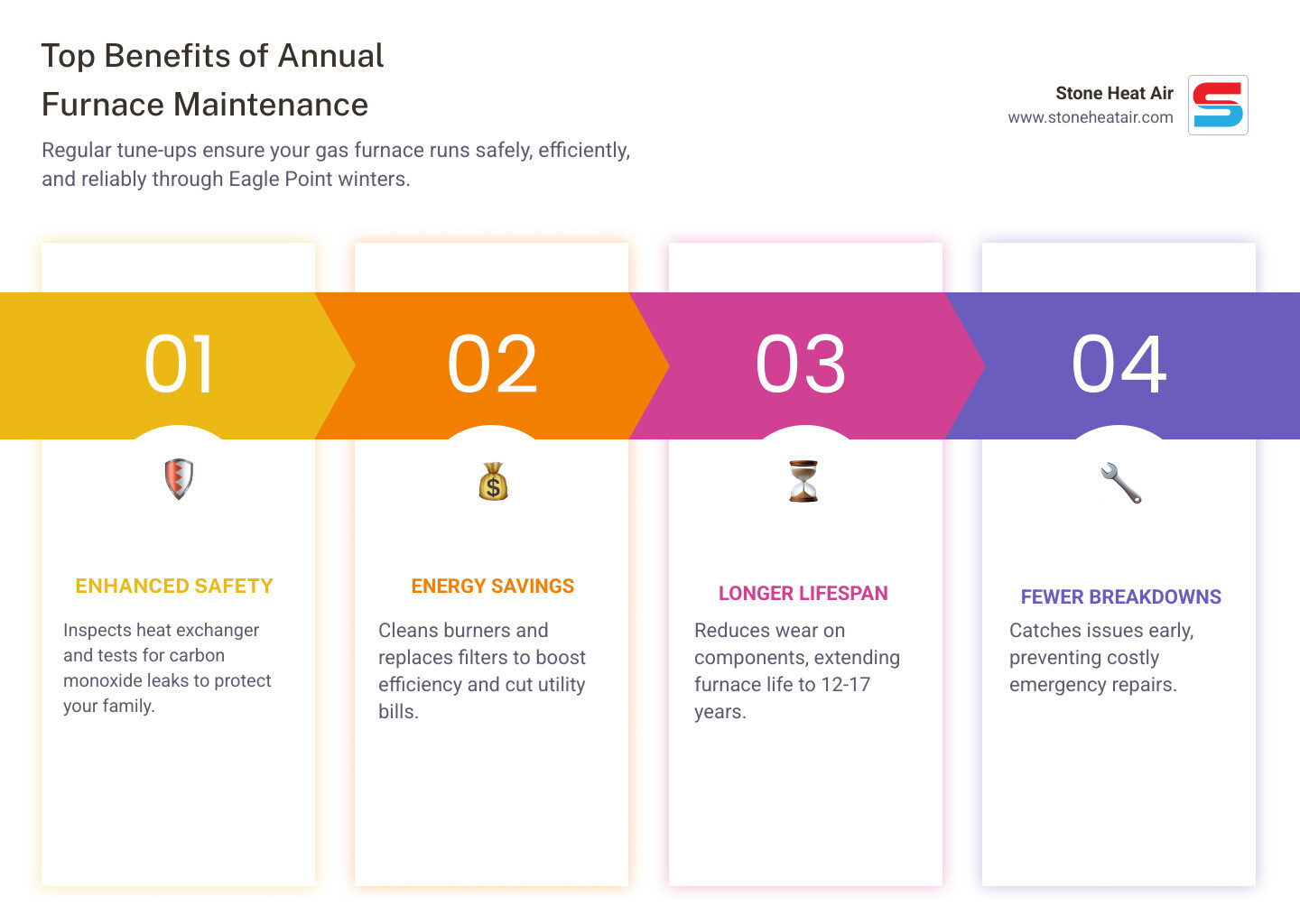
Here is a quick overview of what annual gas furnace maintenance covers and why it matters:
• Safety check - Inspect the heat exchanger and test for carbon monoxide leaks
• Burner cleaning - Remove buildup that reduces efficiency and causes uneven heating
• Flame sensor testing - Ensure the furnace ignites reliably every time
• Air filter replacement - Improve airflow and indoor air quality
• Blower motor inspection - Keep warm air moving evenly through your home
• Gas valve and electrical check - Confirm safe, accurate operation
• Overall tune-up - Catch small issues before they become costly repairs
Skipping annual maintenance puts your comfort, safety, and wallet at risk. A furnace that is not maintained regularly uses more energy, breaks down more often, and can even develop dangerous issues like carbon monoxide leaks.
The sections below walk you through everything you need to know about keeping your gas furnace in top shape in Eagle Point.
Why Gas Furnace Maintenance in Eagle Point, OR is Essential
Living in Eagle Point means we get to enjoy the beautiful Southern Oregon scenery, but it also means we deal with significant temperature swings. When the frost hits the Rogue Valley, your gas furnace isn't just a luxury—it’s a necessity for survival and home preservation.
Boosting Energy Efficiency
An unmaintained furnace is like a car that hasn't had an oil change in three years; it might still run, but it’s working way harder than it needs to. Dust and grime buildup on the burners and blower motor force the system to consume more gas and electricity to reach your desired temperature. By following gas-furnace-maintenance-medford-tips, you ensure that every therm of gas you pay for is actually being converted into heat for your living room.
Maximizing System Longevity
The average lifespan of a gas furnace is between 12 and 17 years. However, that range assumes the unit is being looked after. Without regular care, parts wear down prematurely, and the entire system can fail years before its time. Think of maintenance as an investment in the future—spending a little time on it now prevents the massive headache of a full system replacement later.
Safety and Carbon Monoxide Prevention
Safety is the most critical reason for gas furnace maintenance in Eagle Point, OR. Because these systems burn fuel, they produce carbon monoxide (CO). A cracked heat exchanger or a blocked flue can allow this odorless, colorless, and deadly gas to leak into your home. Professional inspections of your gas furnace include rigorous safety checks to ensure your heat exchanger is intact and your venting is clear, giving you true peace of mind while you sleep.
Lower Utility Bills
When your furnace runs at peak performance, it cycles less frequently and reaches the set temperature faster. This efficiency reflects directly on your monthly utility bills. Over the course of a single winter, the savings from a well-tuned furnace can often cover the cost of the maintenance visit itself.
• Average Lifespan — Maintained Furnace: 15–20 Years — Neglected Furnace: 10–12 Years
• Energy Efficiency — Maintained Furnace: High (Optimal AFUE) — Neglected Furnace: Low (Decreases 5-10% annually)
• Repair Frequency — Maintained Furnace: Rare / Minor — Neglected Furnace: Frequent / Emergency
• Safety Risk — Maintained Furnace: Minimal — Neglected Furnace: High (CO Leaks, Fire Hazards)
• Air Quality — Maintained Furnace: Clean / Filtered — Neglected Furnace: Dusty / Potential for Mold
Common Signs Your System Needs a Professional Tune-Up
Sometimes your furnace tries to tell you it’s struggling before it quits entirely. Being proactive and recognizing these red flags can save you from a "no-heat" emergency in the middle of a January night.
Strange Noises
If your furnace starts sounding like a percussion ensemble, something is wrong. Bangs, whistles, rattles, or squeals usually indicate loose belts, failing bearings, or ignition issues. These sounds are more than just annoying; they are the sounds of your system taking physical damage.
Unusual Odors
A slight "dusty" smell during the first startup of the year is normal. However, if you notice a persistent metallic, burning, or "rotten egg" smell, you need to act fast. A sulfur-like smell is often an additive in natural gas to alert you to a leak. If you experience this, or if you are wondering why your furnace smells, it is time to call in the experts.
The Yellow Pilot Light
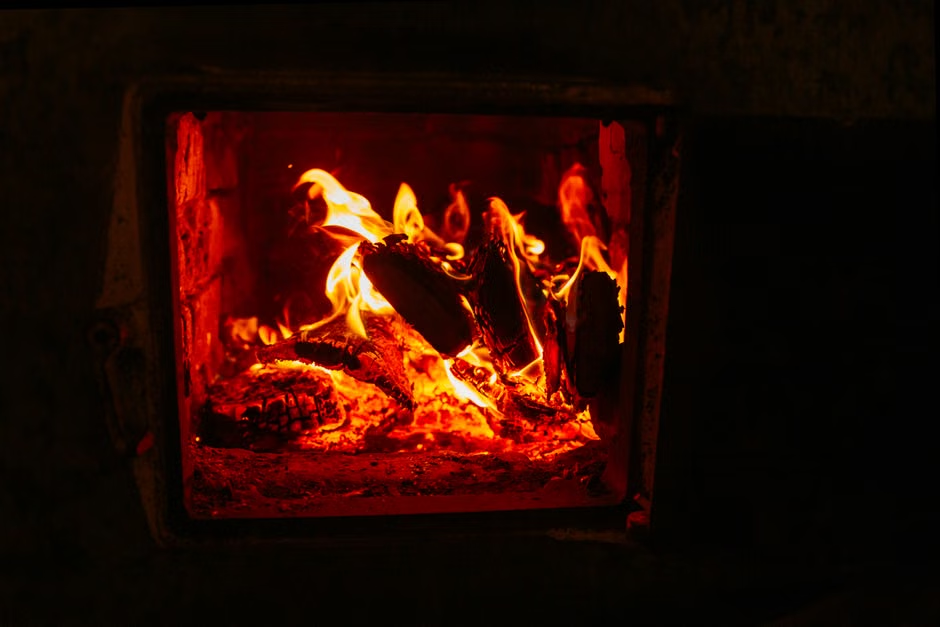
A healthy gas flame should be a crisp, steady blue. A yellow or flickering flame is a sign of incomplete combustion. This means the burner is dirty or the gas-to-air ratio is off, which significantly increases the risk of carbon monoxide production.
Frequent Cycling
Does your furnace turn on and off every few minutes? This is known as "short cycling." It’s often caused by an overheating heat exchanger or a faulty thermostat. Not only does this waste energy, but it also puts immense strain on the blower motor and igniter. If your system is struggling to stay on, there are several reasons why your furnace isn't turning on or staying on that require a professional diagnostic.
Uneven Heating and Rising Costs
If the kitchen is a sauna but the bedroom is an icebox, your furnace isn't distributing air correctly. This, combined with a sudden spike in your energy bills despite normal usage, indicates that the system is losing its battle against the cold.
Recognizing the Need for Gas Furnace Maintenance in Eagle Point, OR
Eagle Point's specific environment—with its mix of pollen, dust, and varying humidity—can lead to clogged airflows and dusty vents faster than you might expect. When airflow is restricted, the furnace has to work harder, leading to gas furnace repair in Medford, OR and surrounding areas like Eagle Point. Don't wait until the vents are covered in thick gray lint; schedule a check-up if you notice the air feels "stuffy" or your thermostat seems to be lying to you about the actual room temperature.
What to Expect During a Professional Maintenance Visit
When we come out for a maintenance visit, we don't just "look" at the furnace. We perform a comprehensive deep dive into the system's mechanics. A professional tune-up is a meticulous process designed to restore the unit to factory-spec performance.
The Heat Exchanger and Burners
We start by inspecting the heat exchanger for any signs of corrosion or hairline cracks. This is the "heart" of the furnace where the heat transfer happens. Next, we clean the burners. Over time, soot and dust can clog the burner ports, leading to uneven flames and poor efficiency. A clean burner ensures a clean burn.
Flame Sensor and Igniter
The flame sensor is a small but mighty safety device. If it gets coated in carbon (a common occurrence), it won't "see" the flame and will shut the furnace down for safety. We clean the sensor and test the igniter to ensure you won't be left in the cold because of a tiny bit of buildup. This process is a staple of any gas-furnace-maintenance-central-point-guide.
Moving Parts and Calibration
We lubricate the blower motor bearings to reduce friction and noise. We also check the gas valve to ensure the pressure is correct—too high and you're wasting fuel; too low and you aren't getting enough heat. Finally, we tighten all electrical connections, as the vibrations of the furnace can loosen wires over time, leading to shorts or failures. This level of detail is why gas-furnace-maintenance-in-talent-or and Eagle Point is best left to those with the right tools and training.
Critical Components of Gas Furnace Maintenance in Eagle Point, OR
Beyond the internal mechanics, we look at the "support systems" of your furnace:
• Air Filter Replacement: This is the simplest yet most vital task. A clogged filter is the #1 cause of furnace failure. We ensure you have a fresh, high-quality filter to keep your air clean and your blower motor happy.
• Condensate Drain Cleaning: High-efficiency furnaces produce water (condensate). If the drain line clogs with algae or debris, the furnace will shut down to prevent a flood. We clear these lines to keep things flowing.
• Ductwork Integrity: There is no point in making hot air if it leaks into your crawlspace. We do a visual check of your accessible ductwork to ensure your heat is actually reaching your rooms.
• Spring Preparation: Even as the weather warms up, furnace-spring-maintenance-tips are important to ensure the system is shut down correctly and ready for the next cycle.
• Electrical Safety: We test the limit switches and safety sensors. If the furnace ever gets too hot, these switches are what prevent a fire. We also check for electric furnace component failures that can overlap with gas system controls.
Frequently Asked Questions about Furnace Care
How often should I schedule maintenance in Eagle Point?
You should schedule gas furnace maintenance in Eagle Point, OR at least once a year. The best time is in the late summer or early autumn, before the first real cold snap hits. This ensures that if a part needs to be ordered, we can get it installed before you actually need the heat. If you have an older system (10+ years), some homeowners prefer a bi-annual check—once before the heating season and once after—to ensure those aging components are still holding up.
Can I perform gas furnace maintenance tasks myself?
Homeowners can and should handle two main tasks: changing the air filter every 1–3 months and keeping the area around the furnace clear of clutter (especially flammable items). You can also ensure your outdoor intake and exhaust pipes are free of bird nests or snow. However, anything involving the gas line, the heat exchanger, electrical wiring, or internal cleaning should be handled by a professional. Messing with gas valves or burners without the proper equipment can lead to dangerous gas leaks or fires.
How does proper maintenance extend my furnace's lifespan?
Think of it as "friction management." Maintenance removes the dirt that causes parts to grind together, lubricates the parts that spin, and ensures the "brain" (the control board) isn't getting overheated. When a system runs smoothly, it doesn't experience the extreme heat stress that causes metal to fatigue and crack. By preventing major breakdowns, you avoid the "domino effect" where one failing part (like a clogged filter) destroys a more expensive part (like the blower motor).
Conclusion
At Stone Heat Air, we take your comfort seriously. We know that a furnace failure in the middle of an Eagle Point winter is more than an inconvenience—it’s a disruption to your life. That’s why we offer comprehensive gas furnace maintenance in Eagle Point, OR designed to keep your home toasty and your mind at ease.
Our team brings decades of real-world experience to every job, ensuring honest and fair dealings every time. We don't believe in high-pressure upsells; we believe in fixing what’s broken and maintaining what’s working. For the ultimate peace of mind, we recommend our Stone Comfort Membership Club. Members enjoy priority scheduling, regular maintenance visits, and the security of knowing their home comfort is in expert hands.
Whether you need a routine tune-up or 24/7 emergency service, we are here for our neighbors in Eagle Point, Central Point, the Rogue Valley, and throughout Southern Oregon. Don't wait for the frost to bite—take control of your home comfort today.
Schedule your expert gas furnace maintenance in Eagle Point today