

Why HVAC Filter Upgrades for Wildfire Smoke Season Matter Right Now
HVAC filter upgrades for wildfire smoke season are one of the most important steps Rogue Valley homeowners can take to protect their families when the air outside turns hazardous. Wildfires across Southern Oregon and Northern California push fine particulate matter — known as PM2.5 — directly into your home through every gap, crack, and your HVAC system itself. Without the right filter in place, your HVAC can actually spread those particles throughout every room.
Here is what you need to know at a glance:
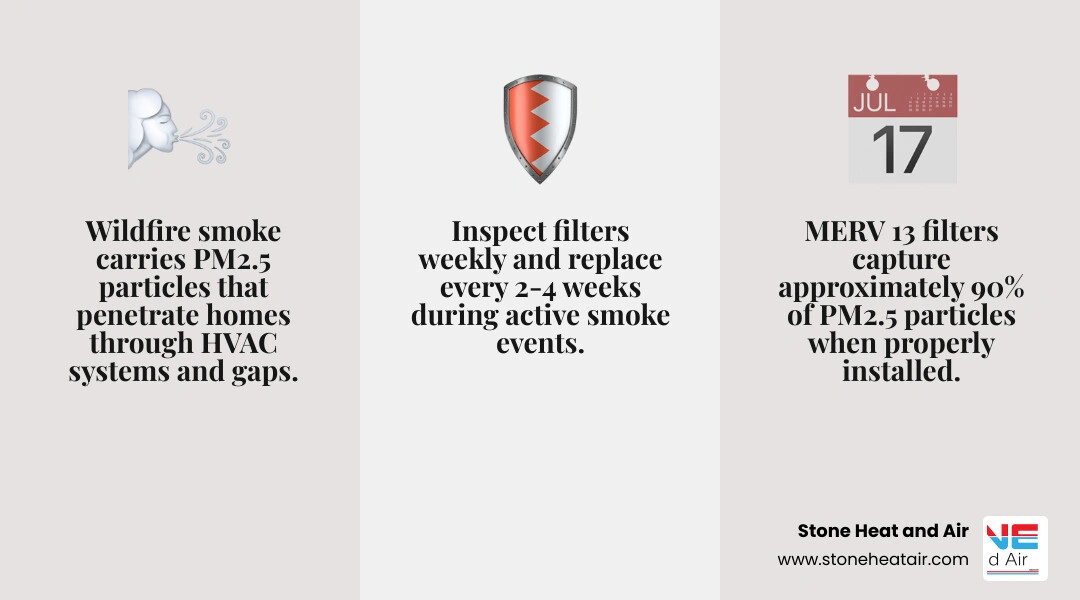
• Best filter rating: MERV 13 is the EPA's recommended minimum for wildfire smoke — it captures approximately 90% of PM2.5 particles
• Check frequency: Inspect your filter every week during active smoke events; replace every 2–4 weeks when smoke is heavy
• System compatibility: Most modern HVAC systems (under 10 years old with ECM motors) handle MERV 13 safely — older systems may need a professional evaluation first
• Not enough on its own: HVAC filtration reduces smoke indoors but does not remove gases or odors — a layered approach with duct sealing and portable air purifiers is recommended
• Act before smoke arrives: Filters, purifiers, and replacement supplies sell out fast once air quality advisories are issued
Wildfire smoke is no longer just a summer concern in the Rogue Valley. Seasons are longer, smoke events are more intense, and the health stakes are real — over 1.5 million deaths each year are linked to wildfire smoke exposure worldwide. The good news is that the right HVAC filter upgrades, combined with a few smart practices, can make a significant difference in the air your family breathes indoors.
This guide walks you through everything you need to know — from choosing the right MERV rating to protecting your HVAC system and setting up layered indoor air protection before the next smoke event arrives.
Hvac filter upgrades for wildfire smoke season terms explained:
• generator readiness during wildfire season outages
• how to keep your hvac running during smoky days
• how wildfire season affects your hvac and air quality
Why HVAC Filter Upgrades for Wildfire Smoke Season Are Essential for Rogue Valley Homes
Living in the Rogue Valley, from Central Point to Klamath Falls, means we get to enjoy some of the most beautiful landscapes in Southern Oregon. Unfortunately, it also means we are on the front lines of wildfire season. When the sky turns that all-too-familiar shade of apocalyptic orange, our homes should be our safe havens. However, without proactive hvac filter upgrades for wildfire smoke season, the air inside your living room can quickly become just as hazardous as the air on the street.
Many homeowners assume that keeping windows and doors shut is enough to keep the smoke out. In reality, standard fiberglass filters (the flimsy ones you can see right through) are only designed to catch large dust bunnies and protect your heating and cooling equipment from mechanical damage. They do absolutely nothing to stop microscopic smoke particles from recirculating through your home.
Upgrading to a high-efficiency pleated filter acts as a reliable shield, trapping these dangerous pollutants before they can settle into your carpets, furniture, and lungs. To understand how this works, we have to look closely at what wildfire smoke is actually made of and why it is so uniquely dangerous. For a deeper look at how these seasonal shifts impact your home, check out our guide on How Wildfire Season Affects Your HVAC and Air Quality.
Understanding PM2.5 and Wildfire Smoke Composition
Wildfire smoke is not just simple wood ash. It is a toxic soup of fine particulate matter, microscopic droplets, and volatile organic compounds (VOCs) produced by burning vegetation, soil, and building materials. The primary pollutant of concern during a wildfire is PM2.5 — particulate matter that is 2.5 microns in diameter or smaller. To put that in perspective, a single human hair is about 70 microns wide, meaning PM2.5 particles are roughly 30 times smaller than the width of a hair.
Because these particles are so incredibly small, they bypass your body’s natural defense mechanisms, like the hairs in your nose. When inhaled, PM2.5 travels deep into your lungs and can even enter your bloodstream. This exposure can trigger:
• Persistent coughing, wheezing, and shortness of breath
• Severe asthma attacks and bronchitis flare-ups
• Increased risk of heart attacks and cardiovascular complications
• Long-term respiratory issues, particularly in children, seniors, and those with pre-existing conditions
Using a high-efficiency filter to capture these particles is just as critical as managing seasonal pollen. You can learn more about managing everyday airborne irritants in our article on Which Air Filters Are Best for Allergies.
Selecting the Right MERV Rating for Your HVAC Filter Upgrades for Wildfire Smoke Season
To successfully trap PM2.5, you need to understand the MERV (Minimum Efficiency Reporting Value) rating system. MERV ratings range from 1 to 20, measuring a filter's ability to capture particles of various sizes. The higher the MERV rating, the tighter the filter weave, and the smaller the particles it can catch.
For effective protection against wildfire smoke, the U.S. Environmental Protection Agency (EPA) recommends a minimum of a MERV 13 filter. While lower-rated filters might keep your system clean under normal conditions, they simply lack the density required to trap microscopic smoke.
Here is a breakdown of how different MERV ratings perform when put to the test against wildfire smoke:
• MERV 1–4 — PM2.5 Particle Capture Efficiency: Less than 20% — Best Used For: Large lint, carpet fibers, heavy dust — Wildfire Smoke Protection Level: Extremely Poor (Allows almost all smoke to pass)
• MERV 8 — PM2.5 Particle Capture Efficiency: Approximately 20% — Best Used For: Pollen, mold spores, household dust — Wildfire Smoke Protection Level: Poor (Captures only the largest ash particles)
• MERV 11 — PM2.5 Particle Capture Efficiency: Approximately 65% — Best Used For: Pet dander, dust mites, mild smoke — Wildfire Smoke Protection Level: Moderate (Better, but still lets significant PM2.5 through)
• MERV 13 — PM2.5 Particle Capture Efficiency: Approximately 90% — Best Used For: Smoke, microscopic allergens, bacteria — Wildfire Smoke Protection Level: Excellent (The EPA-recommended minimum for smoke)
• HEPA (MERV 17+) — PM2.5 Particle Capture Efficiency: 99.97% (at 0.3 microns) — Best Used For: Microscopic viruses, ultra-fine smoke — Wildfire Smoke Protection Level: Outstanding (Requires dedicated or portable systems)
As you can see, making the jump to a MERV 13 filter is a game-changer. It captures the vast majority of smoke particles passing through your ductwork, providing a reliable baseline of clean air for your household.
System Compatibility and Safety Considerations for High-MERV Filters
Before you rush out to buy the thickest, highest-rated MERV 13 filter you can find, we need to talk about system compatibility. A common misconception is that high-efficiency filters are "plug-and-play." In reality, because MERV 13 filters are tightly woven to catch tiny particles, they also make it harder for air to push through.
Think of it like trying to breathe through a thick wool sweater versus a light cotton t-shirt. If your HVAC system's blower motor has to work too hard to pull air through a dense filter, it can create a series of problems. This is why understanding system compatibility is a vital safety step. To see how these factors impact your system's overall health, read about How Wildfire Smoke Impacts HVAC Maintenance Needs.

How Professional HVAC Filter Upgrades for Wildfire Smoke Season Protect Your System
To avoid accidentally damaging your heating and cooling system, it is highly recommended to have a professional HVAC technician evaluate your setup. When we perform an indoor air quality assessment, we measure your system’s static pressure — which is essentially the resistance to airflow within your ductwork.
If the static pressure drop across a new MERV 13 filter is too high, it can lead to:
• Reduced heating and cooling capacity (your home won't reach the thermostat setpoint)
• Frozen evaporator coils in the summer, which can lead to water damage
• Overheating of the furnace heat exchanger in the winter
• Premature failure of your expensive blower motor
By having an expert test your system, you can find the perfect balance between high-efficiency filtration and safe airflow. This ensures your system stays running smoothly when you need it most. For more operational tips, check out our guide on How to Keep Your HVAC Running During Smoky Days.
Static Pressure and Blower Motor Limitations
The type of blower motor inside your furnace or air handler plays a massive role in how it handles a high-MERV filter:
1. Older PSC (Permanent Split Capacitor) Motors: These motors run at a single, fixed speed. When you install a restrictive MERV 13 filter, the motor cannot adjust. Airflow drops significantly, causing immediate strain on the system and increasing your energy bills. Running a PSC motor continuously during smoke events can add noticeable extra costs to your monthly utility bill.
2. Modern ECM (Electronically Commutated) Motors: These smart, variable-speed motors are designed to adjust their speed to maintain consistent airflow. If you install a MERV 13 filter, an ECM motor will ramp up to push air through the denser material. While this maintains excellent filtration, a clogged filter will still force the motor to run at maximum capacity, which can shorten its lifespan if not replaced promptly.
If your system is older or has a PSC motor, we often recommend sticking to a high-quality MERV 11 filter and supplementing your home with portable air purifiers rather than forcing a MERV 13 filter into a system that cannot handle it.
Best Practices for Filter Maintenance and Replacement During Smoke Events
Once you have successfully upgraded your filter, your job isn't quite done. During a major Southern Oregon wildfire event, the sheer volume of particulate matter in the air is staggering. Your HVAC filter is essentially working overtime, acting as a vacuum cleaner for the sky. Because of this, standard replacement schedules go completely out the window.
Under normal conditions, a high-quality pleated filter can last anywhere from 90 days to six months. During active wildfire smoke events, however, a filter can become completely loaded and clogged in as little as two to four weeks.
A clogged filter restricts airflow, drops your home's air quality, and places immense strain on your blower motor. Keeping your filter clean is also a great way to manage everyday household dust. Learn more about this in Reducing Dust with Air Filters.
Inspection Frequency and Lifespan of Pleated Filters
During active smoke events in the Rogue Valley, we recommend following this strict maintenance checklist:
• Weekly Visual Checks: Pull your HVAC filter out once a week. If the filter media has turned a dark grey or brown, or if you notice a distinct smoky odor clinging to the fabric, it is time for a replacement.
• Stock Up Early: Do not wait until the smoke arrives to buy replacement filters. During peak fire season, home improvement stores across Southern Oregon frequently run out of MERV 13 filters within 48 hours of a major fire starting. Keep at least two or three spare filters on hand in your garage or closet.
• Run the Fan Continuously: To get the most out of your upgraded filter, switch your thermostat's fan setting from "Auto" to "On" or "Circulate." This keeps your HVAC blower running continuously, constantly cycling your indoor air through the filter even when the system isn't actively heating or cooling.
Eco-Friendly and Sustainable Filter Performance
Many eco-conscious homeowners in Southern Oregon ask if sustainable or plant-based filters can stand up to the intense demands of wildfire smoke. The short answer is yes — but only if they carry an official MERV 13 rating.
Some modern sustainable filters are constructed from renewable, biodegradable, or plant-based materials (such as corn-derived fibers) rather than traditional synthetic plastics. While these filters are fantastic for reducing plastic waste, you must double-check their specifications. An eco-friendly filter rated at MERV 8 will still perform poorly against PM2.5 compared to a standard synthetic MERV 13 filter. For wildfire smoke, always prioritize the MERV rating over the material composition to ensure your family's health is protected.
Layered Home Protection Strategies Beyond HVAC Filtration
While upgrading your HVAC filter to a MERV 13 is an incredibly powerful first step, it shouldn't be your only line of defense. Think of indoor air quality like home security: you wouldn't just lock the front door and leave the back door wide open. To truly keep wildfire smoke out of your home, you need a layered protection strategy.
Air Duct Sealing and Recirculation Settings
Did you know that the average home loses 20% to 40% of its heating and cooling through air leakage in the ductwork? When your ducts run through unconditioned spaces like attics, crawlspaces, or basements, those leaks don't just waste energy — they also pull dirty, smoke-filled air directly into your home's air stream.
Professional duct sealing (using advanced aerosol sealing techniques) can reduce this leakage to under 5%. This keeps outdoor pollutants out of your ductwork and ensures that 100% of the air circulating through your home actually passes through your upgraded filter.
Additionally, make sure your HVAC system is set to recirculate mode. If your system has a fresh-air intake damper, close it during active smoke events to prevent pulling smoky outdoor air directly into your living spaces.
Supplemental Air Purification and Clean Air Rooms
Even with a top-tier HVAC filter, ultra-fine smoke particles and gaseous odors (like VOCs and woodsmoke smell) can still linger. HVAC filters are designed to capture particles, not gases. To tackle odors and provide extra protection, we highly recommend setting up a designated "Clean Air Room" — usually a bedroom where your family spends the most time.
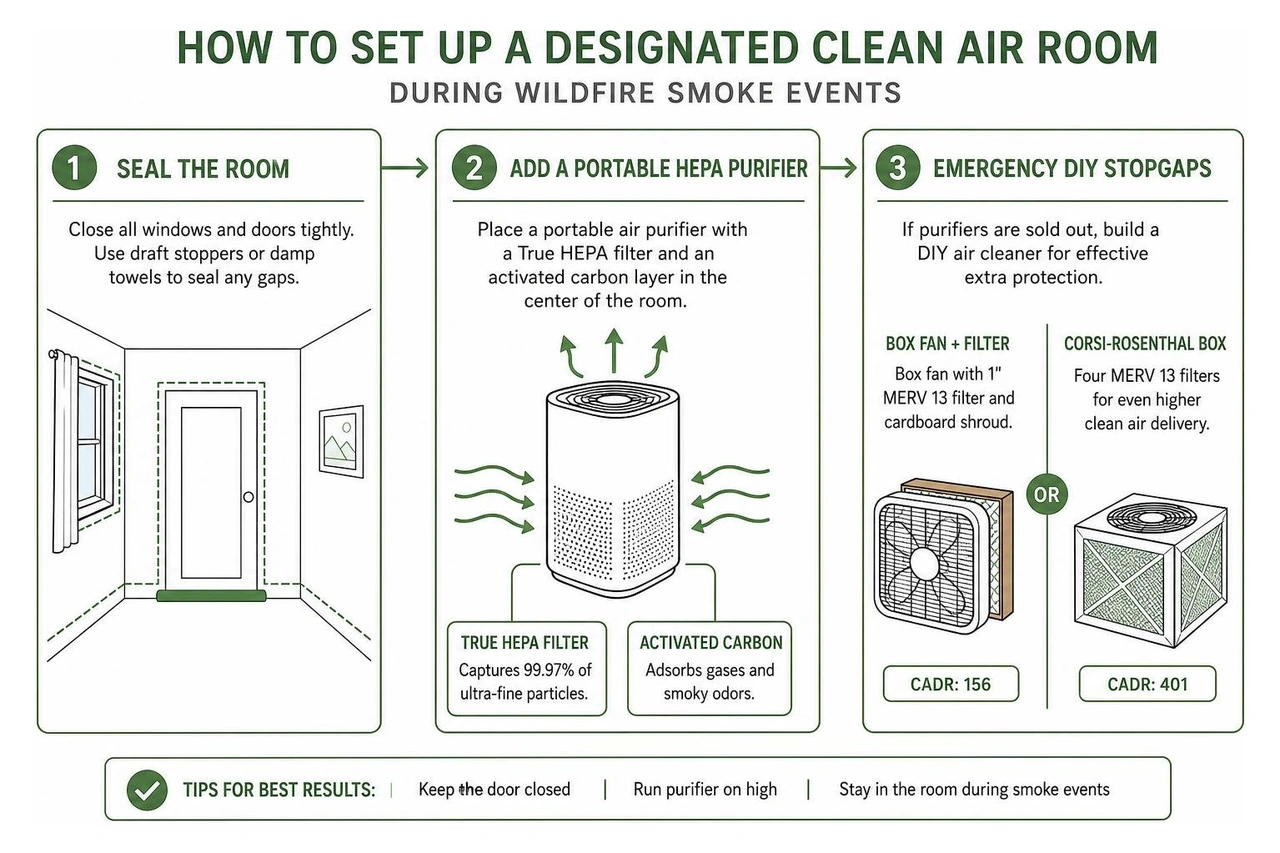
To set up a Clean Air Room:
1. Seal the Room: Close all windows and doors tightly. Use draft stoppers or damp towels to seal any gaps under the door.
2. Add a Portable HEPA Purifier: Place a portable air purifier equipped with a True HEPA filter and an activated carbon layer in the center of the room. The HEPA filter will capture 99.97% of ultra-fine particles, while the activated carbon adsorbs the toxic gases and smoky smells that standard filters miss.
3. Emergency DIY Stopgaps: If commercial air purifiers are sold out, you can build a highly effective DIY air cleaner. Research by the EPA shows that a standard box fan paired with a 1-inch MERV 13 filter and a cardboard shroud can achieve a Clean Air Delivery Rate (CADR) of 156. If you build a four-filter "Corsi-Rosenthal Box" using four MERV 13 filters, that CADR jumps to an impressive 401 — outperforming many expensive commercial units!
Frequently Asked Questions About Wildfire Smoke Filtration
What MERV rating is best for filtering wildfire smoke?
A MERV 13 filter is the best and most commonly recommended rating for residential HVAC systems. It provides the ideal balance between high-efficiency filtration (capturing approximately 90% of PM2.5 smoke particles) and manageable airflow resistance for modern heating and cooling systems.
How often should I check and replace my HVAC filter during wildfire season?
You should visually check your filter every single week during active smoke events. While a standard filter can last months, heavy wildfire smoke can clog a high-efficiency pleated filter in 2 to 4 weeks. Replace it immediately if it looks grey, dark, or if you notice reduced airflow from your vents.
Can a high-MERV filter damage my HVAC system?
Yes, if your system is not designed to handle the increased airflow resistance. Older systems with standard PSC motors can overheat or suffer blower motor failure if paired with a dense MERV 13 filter without proper calibration. Always consult a professional to test your system’s static pressure before upgrading.
Conclusion: Breathe Easier with Stone Heat & Air
Preparing your home for wildfire season doesn't have to be overwhelming. By investing in high-quality hvac filter upgrades for wildfire smoke season, keeping a close eye on your filter's condition, and sealing your home's ductwork, you can create a safe, clean, and comfortable oasis for your family no matter what is happening outside.
At Stone Heat & Air, we are proud to serve our communities across Southern Oregon, including Central Point, the Rogue Valley, Roseburg, Brookings, and Klamath Falls. We treat your home just like ours, offering honest recommendations, Carrier-certified installations, and 24/7 emergency services to keep your family comfortable year-round.
Want ultimate peace of mind? Ask us about our exclusive Stone Comfort Membership Club, which includes regular seasonal maintenance, priority service, and routine air quality checks so you are always ready before the smoke rolls in.
Don't wait for the skies to turn grey. Schedule an indoor air quality assessment with Stone Heat & Air today, and let’s make sure your home's comfort system is fully prepared to protect your family this season.