

Why Knowing How Often Should You Clean Your Dryer Vent Could Save Your Home
How often should you clean your dryer vent depends on your household, but here's a quick answer most homeowners can use right now:
• Average household (1-4 people, 4-6 loads/week) — Recommended Cleaning Frequency: Once a year
• Large family or heavy use (10+ loads/week) — Recommended Cleaning Frequency: Every 6 months
• Homes with pets or heavy shedding — Recommended Cleaning Frequency: Every 6 months
• Long or complex vent runs (multiple bends) — Recommended Cleaning Frequency: Every 12-18 months minimum
• Commercial or rental properties — Recommended Cleaning Frequency: Every 3-6 months
Most people don't think about their dryer vent until something goes wrong. It's easy to forget — the vent is hidden behind the dryer, tucked inside a wall, and never really in view. Out of sight, out of mind.
But that hidden duct is quietly collecting lint with every single load you dry. And lint is highly flammable.
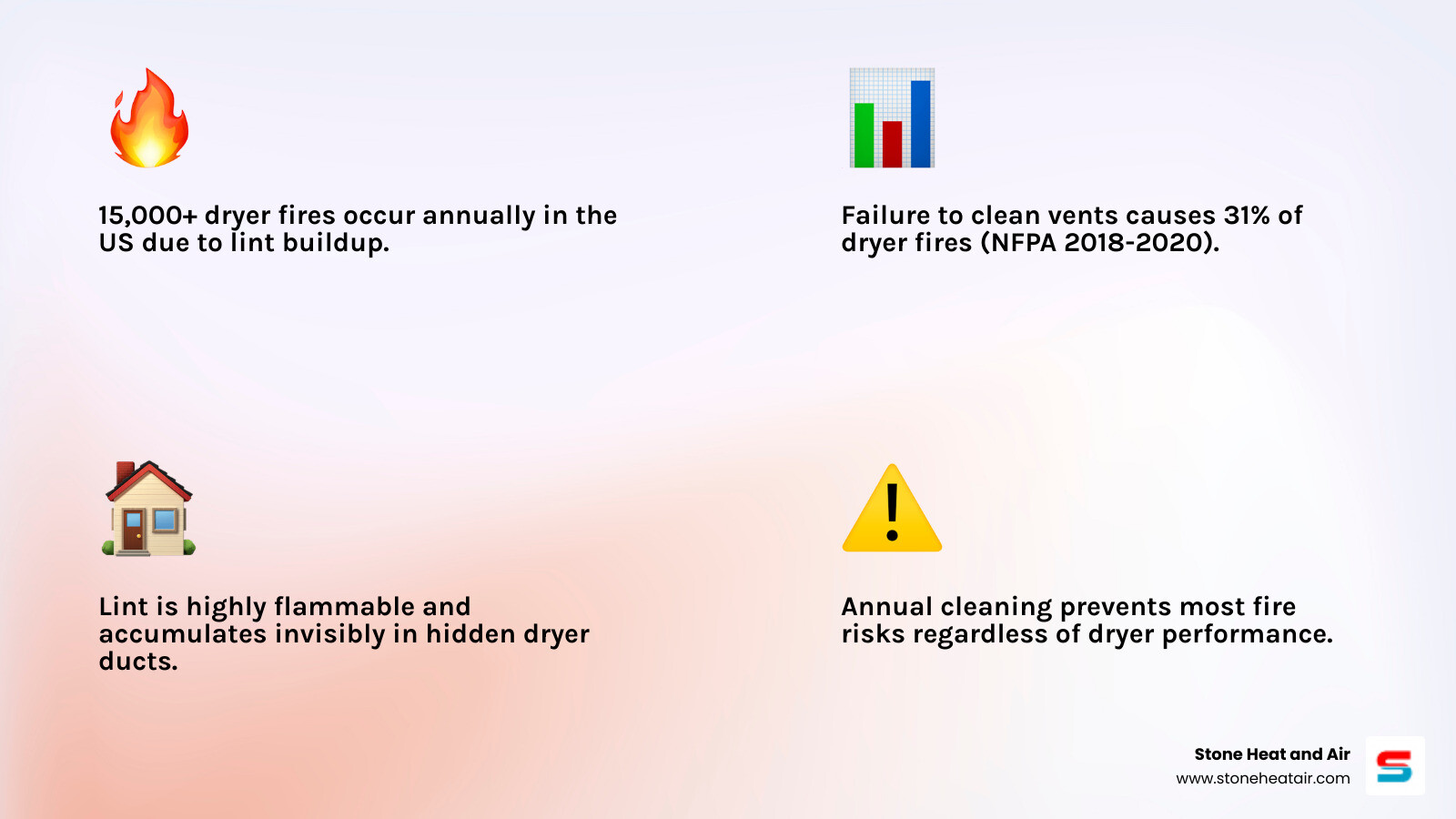
According to the U.S. Fire Administration, failure to clean dryer vents is the leading cause of more than 15,000 dryer-related fires every year in the United States. The National Fire Protection Association confirms that failure to clean was the number one factor in dryer fires from 2018 to 2020, accounting for 31% of all incidents.
Here in the Rogue Valley, keeping up with home maintenance like this isn't just good practice — it's a real safety issue for your family and your home.
The good news? Regular dryer vent cleaning is simple, affordable, and one of the most effective fire prevention steps you can take.
How Often Should You Clean Your Dryer Vent for Optimal Safety?
For most residents in Central Point and the surrounding Rogue Valley, the gold standard for maintenance is an annual cleaning. Even if your dryer seems to be performing perfectly, lint accumulates invisibly. Think of it like changing the oil in your car; you don't wait for the engine to seize before taking action.
A 12-month standard is recommended by the National Fire Protection Association (NFPA) to mitigate fire hazards effectively. When we perform Dryer Vent Cleaning, we often find that even "clean" looking vents have significant restrictions further down the line.
While once a year is the baseline, your specific lifestyle might require a more aggressive schedule. Below is a breakdown of how different factors change that timeline:
• Low — Laundry Volume: 1-3 loads per week — Suggested Schedule: Every 18-24 months
• Standard — Laundry Volume: 4-7 loads per week — Suggested Schedule: Every 12 months
• High — Laundry Volume: 10+ loads per week — Suggested Schedule: Every 6 months
• Professional/Pet Heavy — Laundry Volume: Daily loads — Suggested Schedule: Every 3-6 months
Why Household Size Affects How Often You Should Clean Your Dryer Vent
It’s simple math: more people mean more clothes, and more clothes mean more lint. A large family in Southern Oregon running 10 or more loads a week will generate a massive amount of debris compared to a single-person household.
Furthermore, if your family includes members who work in trades or enjoy outdoor sports, the heavy fabrics and specialized work uniforms produce thicker, heavier lint. Then there is the "pet factor." If you have shedding dogs or cats, their hair bypasses the lint screen and binds with the fabric fibers in the vent, creating a thick, felt-like mat that blocks airflow much faster than standard lint.
How Vent Design Impacts How Often You Should Clean Your Dryer Vent
Not all vent systems are created equal. The architecture of your home in Central Point plays a huge role in how quickly debris builds up.
• Vent Length: Building codes typically suggest a 35-foot maximum for dryer vents. The longer the pipe, the harder the dryer has to push the air. As the air slows down near the end of a long run, it drops the lint it’s carrying, leading to faster clogs.
• Bends and Turns: Every 90-degree bend in your vent system is equivalent to adding 5 feet of length to the run. These elbows are "trap points" where lint loves to snag and accumulate.
• Vertical or Roof-Vented Systems: In many modern Rogue Valley homes, laundry rooms are located in the center of the house, requiring the vent to go up through the roof. Gravity works against these systems; lint that doesn't make it all the way out falls back down and settles in the duct, necessitating more frequent professional attention.
Critical Risks of Neglecting Dryer Exhaust Maintenance
Neglecting this simple task carries risks that go far beyond just "damp towels." In 2026, energy efficiency and home safety are more important than ever.
Fire Safety and FlammabilityLint is the perfect fuel for a fire. It is lightweight, airy, and highly combustible. When a vent is clogged, the heat from the dryer cannot escape. This causes the internal temperature of the appliance to skyrocket. If that heat reaches the ignition point of the accumulated lint, a fire can start inside the machine or the wall ducting in seconds.
Energy Consumption and 2026 GoalsWith rising energy costs in Oregon, an inefficient dryer is a drain on your wallet. A clogged vent forces your dryer to run longer—often requiring two or three cycles for a single load. This wastes electricity (or gas) and prevents you from meeting modern energy efficiency goals for your home.
Appliance LifespanDryers are designed to last 10 to 13 years, but only if they have proper airflow. When the vent is blocked, the heating element, thermal fuse, and motor have to work twice as hard. This leads to premature component overheating and expensive mechanical failures that could have been avoided with a simple cleaning.
Carbon Monoxide RisksFor our neighbors with gas dryers, a clogged vent is a health hazard. If the exhaust cannot escape outside, carbon monoxide—a colorless, odorless, and deadly gas—can back up into your laundry room and living spaces.
Red Flags: Signs Your System Needs Immediate Attention
If you haven't had your vents serviced recently, keep an eye out for these warning signs. If you notice any of these, you should stop using the dryer and call us immediately.
1. Extended Drying Cycles: If your clothes are still damp after a standard 45-minute cycle, the air isn't circulating. This is the most common early warning sign.
2. Excessive Heat: Do your clothes feel painfully hot to the touch when you take them out? Is the top of the dryer hot? This means the heat is trapped inside the drum.
3. Burning Odors: If you smell something scorched or smoky while the dryer is running, shut it off immediately. This is often the smell of lint beginning to singe.
4. Laundry Room Humidity: A clogged vent often leaks moist air back into the room. If your laundry room feels like a sauna or you see condensation on the windows, your vent is likely blocked.
5. Visible Debris: Check your outside vent flap. If it doesn't open when the dryer is on, or if you see lint "mustaches" hanging out of the exterior opening, the system is backed up.
Professional Maintenance vs. Basic Lint Trap Care
Many homeowners think that because they "clean the lint screen every time," they are safe. While that is a vital habit, it isn't enough.
Lint screens are only about 90% to 95% efficient. That remaining 5% of fine fibers bypasses the screen and enters the internal dryer chassis and the exhaust ducting. Over a year of laundry, those tiny percentages add up to inches of flammable buildup.
The Professional AdvantageWhen we visit a home in the Rogue Valley for maintenance, we do more than just brush out the hose. Our process includes:
• Internal Chassis Cleaning: We open the dryer cabinet to remove lint that has settled around the motor and heating element.
• Transition Hose Inspection: We ensure the flexible hose behind your dryer isn't crushed or kinked, which is a major cause of airflow restriction.
• HEPA Vacuum Technology: We use specialized high-powered vacuums to ensure that the lint we remove doesn't just end up floating around your home's air.
• Airflow Velocity Testing: We use tools to measure the actual speed of the air exiting the vent, ensuring it meets the manufacturer's specifications for safety and efficiency.
Frequently Asked Questions about Dryer Maintenance
What is the difference between the lint trap and the full vent system?
The lint trap is the removable screen inside your dryer that you should clean after every load. The "full vent system" includes the internal cabinet of the dryer, the transition hose (the silver tube behind the machine), and the rigid ductwork that travels through your walls or attic to the outside of your house. Cleaning the trap is daily maintenance; cleaning the system is a professional safety requirement.
Can a clogged vent cause my dryer to break down?
Absolutely. A lack of airflow is the #1 cause of heating element failure and blown thermal fuses. When the dryer can't "breathe," the internal components reach temperatures they weren't designed to handle. This stresses the motor and can lead to a total system breakdown, often resulting in repairs that cost significantly more than a maintenance visit.
Is annual cleaning enough for homes with multiple pets?
Usually, no. If you have high-shedding breeds like Golden Retrievers or Huskies, their fur is incredibly effective at clogging vents. For these homes, we recommend a 6-month cleaning interval. We also suggest washing your lint screen with soap and water monthly, as pet oils and dryer sheet residue can create an invisible film that blocks air even when the screen looks clean.
Conclusion
At Stone Heat and Air, we believe in treating your home like ours. Serving Central Point, Roseburg, Brookings, and the entire Rogue Valley, we’ve seen how a little bit of prevention can save a family from a devastating fire or a costly appliance replacement.
Don't wait for a burning smell or a broken dryer to take action. Whether you need a routine check-up or a deep cleaning of your commercial exhaust system, our team is here to provide honest recommendations and professional workmanship.
Ready to breathe easy and keep your home safe? Visit stoneheatair.com/commercial/dryer-vent-cleaning to learn more about our services or to join our Stone Comfort Membership Club for year-round peace of mind. Let’s keep the Rogue Valley safe, one laundry room at a time.