



Why Generator Maintenance Tips for Homeowners Deserve Your Attention
Following the right generator maintenance tips for homeowners can mean the difference between the lights staying on during a storm and a dead machine sitting in your yard when you need it most.
Here are the essential maintenance steps every homeowner should know:
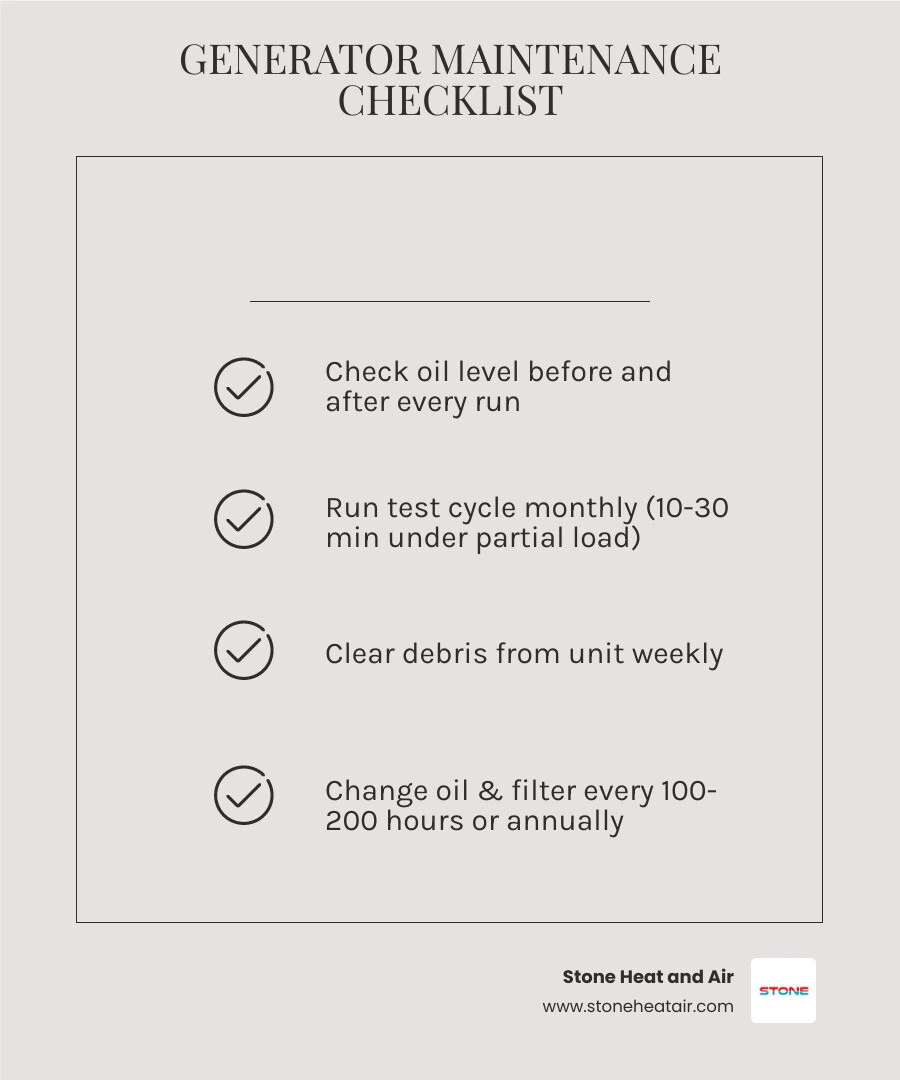
1. Check oil level before and after every run
2. Run a test cycle monthly (10-30 minutes under partial load)
3. Add fuel stabilizer to gasoline and rotate stored fuel regularly
4. Inspect battery terminals for corrosion and keep the battery charged
5. Clear debris from around the unit weekly
6. Change oil and filter every 100-200 hours or at least once a year
7. Replace spark plugs and air filter annually or per manufacturer schedule
8. Schedule a professional inspection once a year, including load testing
Poorly maintained generators fail at a rate 63% higher than those that receive regular care. And a generator that sits neglected can break down in as few as 5-7 years, while a well-maintained unit can run reliably for 15-20 years. For homeowners in the Rogue Valley, where wildfire season, winter storms, and power outages are a real part of life, that difference is not just about convenience — it's about keeping your family safe and comfortable when the grid goes down.
This guide walks you through everything you need to know to keep your generator ready, from simple weekly checks to annual professional service.
Why Regular Generator Maintenance Matters for Homeowners
A generator is a little like a fire extinguisher: we hope we do not need it often, but when we do, it had better work immediately. Regular maintenance keeps that promise intact.
Maintenance matters because generators often fail for boring reasons, not dramatic ones. A weak battery, stale fuel, a blocked vent, old oil, or corrosion can stop a perfectly good unit from starting during an outage. Many manufacturers also expect homeowners to follow the recommended service schedule and keep records, especially for warranty support.
Why skipped maintenance causes generator failures
When generator upkeep gets postponed, small issues stack up fast:
• Battery charge drops over time, and the battery is the most common point of failure
• Gasoline begins degrading after about 30 days, creating gum and varnish that can clog the carburetor
• Moisture inside the unit can encourage corrosion on terminals and connections
• Missed exercise runs allow seals to dry and moving parts to sit too long
• Dirty oil loses its ability to protect engine parts
• Debris around the enclosure can restrict airflow and trap heat
That is why neglected units are far more likely to fail during emergencies. And unfortunately, storms do not care whether your maintenance reminder got snoozed three times.
How maintenance protects lifespan, safety, and performance
A well-cared-for generator can often last 15 to 20 years. A neglected one may struggle much sooner. Consistent maintenance helps by:
• Reducing wear on engine parts
• Keeping voltage and frequency more stable to protect appliances
• Improving starting reliability
• Catching leaks, corrosion, and damage before they become major repairs
• Supporting safer operation during long outage events
Even if your generator rarely runs, it still needs annual attention. Time, weather, and inactivity can be just as hard on equipment as heavy use.
Generator Maintenance Tips for Homeowners: Standby vs. Portable Basics
Not all generators need the same kind of care. The big divide is standby versus portable.
• Startup — Standby Generator: Automatic — Portable Generator: Manual
• Typical fuel — Standby Generator: Natural gas or propane — Portable Generator: Usually gasoline, sometimes diesel or propane
• Connection — Standby Generator: Hardwired to home with transfer switch — Portable Generator: Extension cords or manual transfer setup
• Exercise cycle — Standby Generator: Often automatic weekly exercise — Portable Generator: Must be started manually
• Storage — Standby Generator: Stays outdoors in enclosure — Portable Generator: Often stored in garage or shed
• Key maintenance concern — Standby Generator: Battery, enclosure, transfer switch, fuel supply — Portable Generator: Fuel quality, carburetor, storage prep
Generator maintenance tips for homeowners with standby generators
Standby systems are designed for convenience, but they are not maintenance-free. Homeowners should:
• Check the unit weekly for leaves, weeds, nests, standing water, or visible damage
• Maintain proper clearance around the enclosure for airflow
• Watch for warning lights or alarm messages on the controller
• Check oil level and, if applicable, coolant level based on the manual
• Confirm the exercise cycle is running as scheduled
• Inspect propane levels if the unit is propane-fed
• Schedule annual service, including transfer switch and output testing
If you are planning a new backup power setup or replacing an older unit, you can learn more about generator installation in Medford, OR.
Generator maintenance tips for homeowners with portable generators
Portable generators need more hands-on attention because they are stored, moved, fueled, and started manually. Key habits include:
• Start and run the generator every 30 days for 10 to 30 minutes
• Use fresh fuel and stabilize gasoline meant for storage
• Inspect the fuel tank, lines, and carburetor area for leaks or residue
• Check oil before every use
• Keep the spark arrestor clean if your model uses one
• Store it in a dry place, never with untreated old gas sitting for months
• Use only heavy-duty outdoor-rated cords if powering appliances directly
How climate and environment change your maintenance schedule
Southern Oregon conditions can be tough on generators. In the Rogue Valley and surrounding areas, we need to think about:
• Dust and wildfire smoke clogging filters and coating vents
• Winter cold making batteries weaker and cold starts harder
• Rain and snow increasing the risk of moisture intrusion
• Hot summer weather causing oil to break down faster
• Rodents nesting inside warm enclosures or chewing wires
• Falling debris during storms blocking airflow or damaging the unit
In dusty or harsh conditions, oil, air filter, and visual inspections may need to happen more often than the minimum schedule.
Your Simple Home Generator Maintenance Schedule
The easiest way to stay on track is to use three things:
• A calendar reminder
• Your generator hour meter
• A simple maintenance log
Write down the date, run hours, task completed, and any notes like low battery voltage, new noises, or oil added. This helps with troubleshooting, warranty support, and plain old memory.
Weekly and monthly checks every homeowner should know
For most homeowners, these are the routine checks that make the biggest difference.
Weekly checks:
• Look for leaks, rust, loose panels, or damage
• Remove leaves, grass, branches, and debris around the unit
• Make sure vents and louvers are not blocked
• Confirm the standby exercise cycle ran normally
• Check the control panel for alerts
Monthly checks:
• Check oil level and top off if needed
• Inspect battery terminals for corrosion and tightness
• Run a portable generator under partial load
• Listen for rough running, rattles, or surging
• Inspect cords, plugs, and connection points
• Verify propane supply if applicable
A simple habit helps: every time the generator runs, give it a quick walk-around before and after.
Hour-based and annual maintenance milestones
Most generators follow a mix of hour-based and time-based service intervals. Always confirm your model's exact schedule in the owner's manual, but these are common milestones:
• First break-in service after 25 hours
• Oil and filter every 100 to 200 hours, or more often in very hot or cold conditions
• Spark plug inspection or replacement around 400 hours on many models
• Air filter replacement per schedule, or sooner in dusty conditions
• Annual inspection even if the generator hardly ran
• Coolant checks for liquid-cooled models
• Electrical output and load testing during professional service
Annual service matters because oil ages, batteries weaken, and corrosion does not take the year off.
Post-outage and seasonal maintenance tasks
After a long outage, do not just pat the generator on the lid and walk away.
Post-outage checklist:
• Let the unit cool
• Check oil level, especially after extended runtime
• Inspect for leaks, loose parts, or debris damage
• Refill fuel safely if needed
• Reset the standby unit to automatic mode
• Note total run hours in your log
Seasonal reminders for Southern Oregon:
• Before winter, check battery strength and clear drainage around the pad
• During wildfire season, inspect filters and vents more often
• In summer heat, watch oil condition closely
• After wind or snow events, remove branches, ash, or buildup around the unit
How to Care for the Most Important Generator Components
Some parts deserve extra attention because they affect starting, lubrication, and combustion more than anything else.
How to change the oil and oil filter correctly
Oil changes are one of the most important maintenance tasks. Exact steps vary by model, so follow your manual first, but the safe general process is:
1. Shut the generator down and let the engine cool.
2. Turn off the fuel supply if required by the manual.
3. Disconnect the battery if the manual instructs it.
4. Place a drain pan under the oil drain.
5. Remove the drain plug or open the drain tube and let old oil drain completely.
6. Remove the old oil filter if your generator has one.
7. Lightly oil the gasket on the new filter, then install it hand-tight.
8. Reinstall the drain plug securely.
9. Add the correct type and amount of oil using a funnel.
10. Check the dipstick.
11. Start the generator briefly, shut it down, and recheck the oil level.
12. Dispose of used oil and filter properly at an approved recycling location.
Many generators need the first oil change after about 25 hours of operation, then routine changes every 100 to 200 hours or annually. In extreme temperatures, some units need shorter intervals.
Fuel system maintenance and fuel storage best practices
Fuel problems are some of the most common generator problems, especially for portable models.
For gasoline generators:
• Do not let untreated gasoline sit for long periods
• Add fuel stabilizer if the fuel will be stored
• After adding stabilizer, run the generator 10 to 15 minutes so treated fuel reaches the carburetor
• Rotate stored fuel regularly
• For long-term storage, follow the manual on draining the tank or running the carburetor dry
• Avoid running the tank completely dry during operation unless the manufacturer specifically recommends that for storage prep
For propane and natural gas generators:
• Inspect connections for signs of leaks or corrosion
• Make sure propane tanks have enough fuel before storm season
• Keep regulators and supply lines protected and unobstructed
• Have suspected fuel leaks handled professionally right away
Water contamination, stale fuel, and dirty fuel lines can all cause hard starting, rough running, and shutdowns.
Battery, air filter, and spark plug care
Battery:
• Check voltage monthly if you can; many healthy 12-volt batteries read about 12.4 to 12.7 volts at rest
• Clean corrosion from terminals carefully
• Make sure cable connections stay tight
• Replace the battery every 3 to 5 years, or sooner if testing shows weakness
• Use a trickle charger for some portable units if recommended
Air filter:
• Inspect it regularly, especially during smoky or dusty seasons
• Replace it if it is heavily dirty, damaged, or oil-soaked
• A clogged filter can reduce performance and increase wear
Spark plugs:
• Inspect for carbon buildup, worn electrodes, or cracking
• Replace according to the manual or if misfiring starts
• Keep the gap set to manufacturer specification
Safety Rules, Common Mistakes, and When to Call for Help
Generator maintenance is not difficult, but it does require respect. Fuel, electricity, moving parts, and carbon monoxide are a combination we should never take lightly.
Safety precautions during generator maintenance and use
Follow these basics every time:
• Keep portable generators at least 20 feet from doors, windows, and vents
• Never run a generator in a garage, crawlspace, shed, or indoors
• Install carbon monoxide detectors on every floor and near sleeping areas
• Work in dry conditions when possible
• Shut the unit down before maintenance
• Disconnect the battery before tasks the manual identifies as requiring it
• Watch for hot mufflers and engine surfaces
• Keep fuel away from sparks and ignition sources
• Never backfeed a home through an outlet
• Use proper transfer equipment for home connection
Common generator maintenance mistakes homeowners make
The most common mistakes are simple ones:
• Skipping the break-in oil change
• Letting gasoline sit too long
• Forgetting monthly exercise runs
• Ignoring battery corrosion
• Allowing leaves or weeds to block airflow
• Overloading the generator
• Failing to keep a maintenance record
• Assuming "it worked last year" means it is ready now
Warning signs your generator needs immediate attention
Do not wait on these symptoms:
• Hard starting or repeated failed starts
• Rough idle or surging
• New rattling or knocking sounds
• Fuel smell or visible leaks
• Oil leaks
• Excessive smoke
• Warning lights or alarm codes
• Low voltage or lights flickering on connected loads
• Repeated shutdowns under normal load
These signs usually mean the unit needs diagnosis before the next outage, not during it.
Which tasks are safe for homeowners and which need a professional
Safe for many homeowners:
• Visual inspections
• Debris clearing
• Checking oil level
• Logging run hours and maintenance
• Basic battery terminal cleaning
• Running exercise cycles
• Replacing simple service items if the manual allows and you are comfortable
Best left to a professional:
• Fuel leak diagnosis or repair
• Transfer switch inspection
• Electrical troubleshooting
• Control board or alarm diagnosis
• Load bank testing
• Voltage and frequency testing
• Internal engine repairs
• Major wiring or fuel system work
If you need help with system readiness, replacement planning, or local support, learn more about generator installation in Central Point, OR.
Frequently Asked Questions About Generator Maintenance Tips for Homeowners
How often should a home generator be serviced?
Most home generators need annual service at minimum, even if they barely run. Many also need:
• First service after 25 hours
• Oil and filter changes every 100 to 200 hours
• Monthly exercise or test runs
• More frequent checks in dusty, smoky, very hot, or very cold conditions
The owner's manual always wins if your model specifies a different interval.
What is the most common reason a generator will not start?
The battery is the most common culprit. Common causes include:
• Low charge
• Corroded terminals
• Old battery
• Loose connections
For portable units, stale fuel is another frequent reason. On standby generators, alarms, controller faults, or fuel supply problems can also prevent starting.
Can a generator sit unused for months?
It can, but it should not do so without preparation. A generator that sits too long may develop:
• Fuel degradation
• Dry seals
• Moisture buildup
• Weak battery
• Corrosion or rodent damage
Run the generator monthly when possible, and prepare it correctly for storage if it will be inactive for an extended period.
Conclusion
A reliable generator is not built on luck. It is built on habits: quick inspections, regular exercise runs, fresh fuel, battery care, oil changes, and good recordkeeping. Those small steps go a long way toward protecting your home, your appliances, and your family during the next outage.
For homeowners across the Rogue Valley and Southern Oregon, generator readiness is part of staying comfortable through storms, wildfire-related outages, and seasonal weather swings. If you want added peace of mind, our Stone Comfort Membership Club can help you stay ahead on home comfort maintenance, and our team is here when you need dependable service and support.
If you are exploring backup power options or want help with your system, visit our specialty services page.