

Why Choosing the Right Commercial HVAC Provider Can Make or Break Your Business
Choosing the right commercial HVAC provider is one of the most important decisions a business owner in Central Point, OR can make. A failed system doesn't just mean uncomfortable employees — it can mean lost productivity, unhappy customers, and costly emergency repairs that could have been avoided.
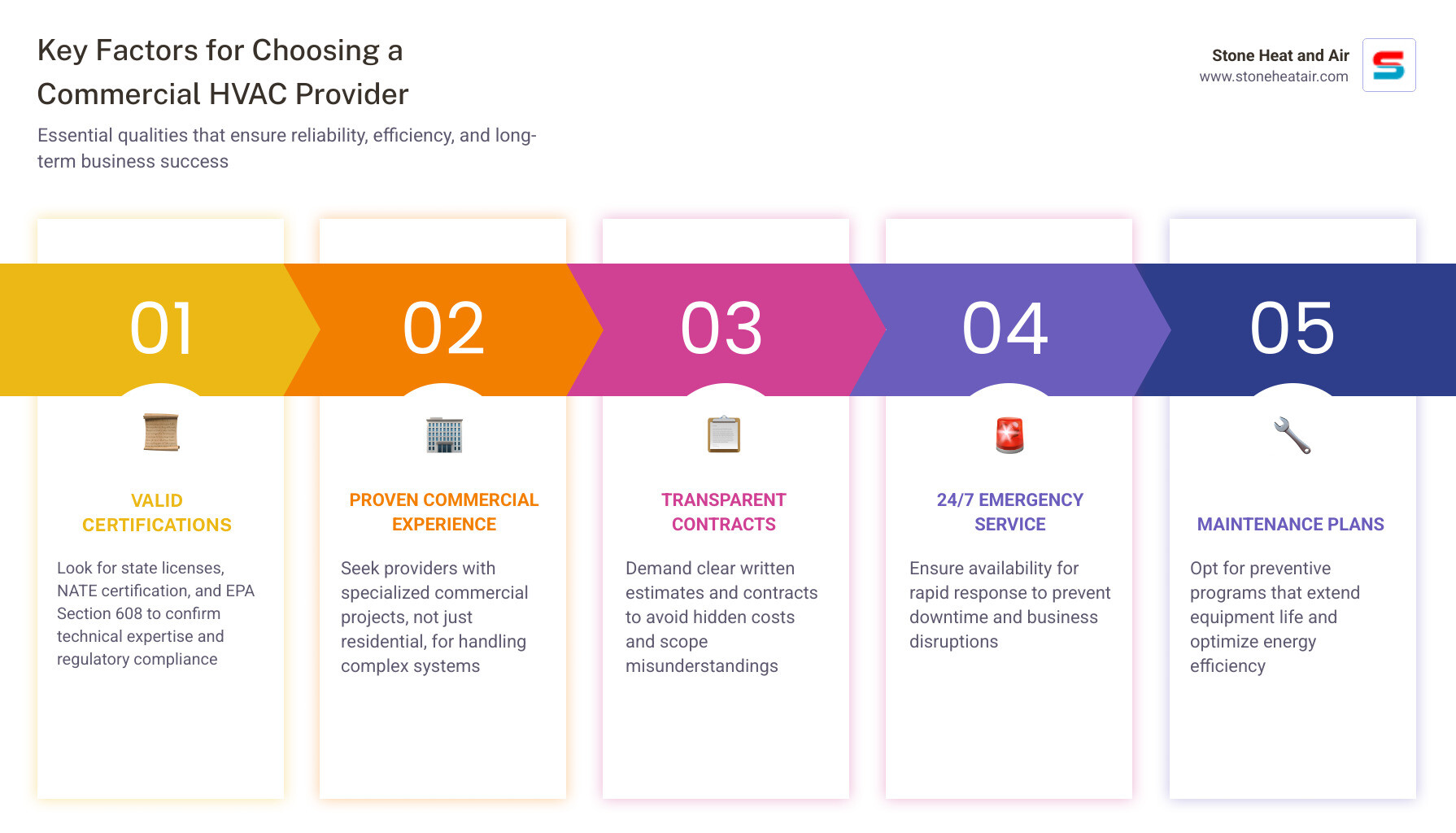
Here's a quick summary of what to look for:
1. Valid licenses, NATE certification, and EPA Section 608 certification
2. Proven commercial experience (not just residential)
3. Transparent written estimates and contracts
4. 24/7 emergency service availability
5. Preventive maintenance plans for long-term reliability
6. Strong references and verifiable reviews
7. Energy-efficient system recommendations
Commercial HVAC systems are far more complex than residential ones. They manage zoned temperature control, handle larger square footage, and often sit on rooftops — requiring specialized skills that not every contractor has. In fact, the U.S. HVAC market is projected to reach $49.7 billion by 2030, meaning more providers are entering the space — making it harder to separate the truly qualified from the rest.
The stakes are real. A mismatched system or an underqualified contractor can lead to temperature complaints, rising energy bills, and equipment that wears out years too soon. Choosing wisely from the start protects your investment and keeps your business running smoothly.
Understanding Building Needs and System Types
When we look at the skyline of Central Point or the Rogue Valley, we see a diverse range of commercial structures, from boutique retail shops to sprawling warehouses. Each of these buildings has a unique "thermal footprint." Before you can succeed in choosing the right commercial hvac provider, you need a basic understanding of the hardware that keeps your operations running.
Commercial systems are not just "big residential units." They are sophisticated pieces of infrastructure. At Stone Heat and Air, we categorize these into several main types:
• Packaged Rooftop Units (RTUs): These are perhaps the most common choice for commercial buildings. All four components of the refrigeration cycle are housed in one unit, usually installed on the roof to save indoor space.
• Split Systems: Similar to residential setups but on a much larger scale, these connect indoor air handlers to outdoor compressors.
• Water-Source Heat Pumps: These use a water loop to reject or absorb heat, offering incredible efficiency for multi-room buildings like hotels or office complexes.
• Chillers: These systems use water as a heat transfer medium and are typically reserved for very large facilities or industrial processes.
Commercial vs. Residential: The Complexity Gap
It is a common misconception that any HVAC tech can handle a commercial job. As of April 2026, the technological gap between home systems and business systems has never been wider.
• Placement — Residential HVAC: Ground level or crawlspace — Commercial HVAC: Primarily rooftop or dedicated mechanical rooms
• Zoning — Residential HVAC: Simple (one or two zones) — Commercial HVAC: Highly complex (dozens of independent zones)
• Drainage — Residential HVAC: Single condensate line — Commercial HVAC: Intricate multi-line systems to prevent roof damage
• Ventilation — Residential HVAC: Natural/Simple mechanical — Commercial HVAC: Critical for IAQ and code compliance
Selecting the right system requires a Commercial Design Build approach. We don't just guess the size of the unit; we perform detailed load calculations that account for building materials, occupancy rates, and even the heat generated by your office equipment. For businesses looking for Commercial Design Build Medford OR, this precision is what prevents the "hot and cold" spots that lead to employee complaints.
Essential Qualifications for Choosing the Right Commercial HVAC Provider
In Southern Oregon, the "chuck in a truck" approach doesn't work for commercial infrastructure. You need a partner who meets rigorous professional standards. When vetting a Commercial HVAC Central Point OR provider, look for these non-negotiables:
1. State Licensing: Ensure the contractor is fully licensed to operate in Oregon. This ensures they are registered with the state and meet basic competency requirements.
2. NATE Certification: North American Technician Excellence (NATE) is the gold standard. It proves the technicians have passed rigorous testing on real-world HVAC knowledge.
3. EPA Section 608 Certification: This is legally required for any technician handling refrigerants. Without it, they are operating illegally and could face massive fines—and so could you.
4. Insurance and Bonding: A quality provider must carry significant general liability and workers' compensation insurance. This protects your property from damage and shields you from liability if a technician is injured on your site.
Beyond the paperwork, there are 3 important traits a commercial HVAC company needs to have: technical mastery, a commitment to safety training, and a reputation for honesty.
Red Flags to Avoid When Choosing the Right Commercial HVAC Provider
Trust your gut, but also look for these specific warning signs:
• Unresponsiveness: If they don't return your call when they're trying to win your business, imagine how they'll behave during an emergency in mid-July.
• Lack of References: A reputable company should be proud to show off their work. If they can't provide a list of local commercial clients, move on.
• No Physical Address: Be wary of companies that operate solely out of a P.O. Box. You want a provider with deep roots in the Rogue Valley.
• Refusal to Provide Written Contracts: Never allow work to begin based on a handshake. You need a detailed scope of work, timelines, and warranty information in writing.
Being aware of these avoidable commercial HVAC issues you should know can save you thousands in "correction" costs later.
Key Questions to Ask When Choosing the Right Commercial HVAC Provider
Before signing on the dotted line, we recommend putting your potential contractor in the hot seat with these questions:
• "Do you have experience with my specific industry (e.g., medical, retail, or industrial)?"
• "What is your average response time for emergency calls?"
• "Can you explain what to expect in a commercial HVAC service call from your team?"
• "How do you keep your technicians updated on the latest energy-efficiency technologies?"
• "Do you provide itemized, written estimates before starting work?"
Assessing Technical Capabilities and Modern Technology
In April 2026, HVAC is no longer just about "blowing cold air." It is about data and automation. A top-tier provider must be comfortable with Building Automation Systems (BAS) and Building Management Systems (BMS). These interfaces allow you to monitor your energy usage in real-time and even predict failures before they happen.
Using smart thermostats is just the beginning. Modern Commercial Design Build projects now integrate IoT sensors that can detect a drop in static pressure or a rise in compressor temperature, sending an alert to us before your building even starts to warm up.
If your business is pursuing LEED certification or simply wants to slash its carbon footprint, your provider must be able to recommend high-SEER (Seasonal Energy Efficiency Ratio) and EER (Energy Efficiency Ratio) equipment. Energy-efficient solutions often pay for themselves through lower utility bills and available tax incentives, but only if they are designed and installed correctly.
Prioritizing Long-Term Support and Reliability
The relationship with your HVAC provider shouldn't end when the last bolt is tightened. In fact, that's when it truly begins. For a commercial entity, downtime is the enemy. Whether you operate a restaurant in Roseburg or a medical clinic in Central Point, a system failure can halt your revenue.
This is why your commercial HVAC system needs maintenance. We advocate for a proactive approach rather than a reactive one. A well-structured preventive maintenance plan ensures that:
• Small issues are caught before they become catastrophic failures.
• Energy efficiency remains at peak levels.
• The life expectancy of commercial HVAC systems is maximized (often reaching 15–20 years with proper care).
So, how often should commercial HVAC be serviced? For most Southern Oregon businesses, we recommend a minimum of two major inspections per year—once in the spring and once in the fall. However, high-demand environments like server rooms or commercial kitchens may require quarterly visits.
When disaster does strike, you need to know how to handle your commercial HVAC emergency. This is where Stone Heat and Air stands apart; our 24/7 emergency response means you are never left "out in the cold" (or the heat).
Frequently Asked Questions about Commercial HVAC
What is the difference between commercial and residential HVAC?
The primary differences are scale, complexity, and placement. Commercial systems are designed to handle much higher "loads" (the amount of heating or cooling required). They also feature complex zoning—allowing one office to be 68 degrees while a conference room remains at 72. Additionally, commercial units are modular; if your business grows, we can often add modules to your existing system rather than replacing the whole thing.
Why is industry-specific experience important?
Every industry has "hidden" requirements. For example, maintaining hotel HVAC systems requires a focus on guest comfort and noise reduction. A data center, on the other hand, requires ultra-precise humidity control and massive cooling capacity to protect servers. A restaurant needs specialized ventilation to handle grease and heat from the kitchen. If your contractor doesn't understand these nuances, they can't build a system that truly works for you.
How can I ensure my system remains energy efficient?
Start with the basics: regular air filter changes. Clogged filters force your blowers to work harder, spiking your energy bill. Next, consider Commercial Duct Cleaning. Over time, dust and debris build up, restricting airflow. Finally, ensure your ducts are sealed. Even the most efficient unit in the world will waste money if it's pumping conditioned air into your ceiling or crawlspace.
Conclusion: Partnering for Success in the Rogue Valley
Choosing the right commercial hvac provider is about more than just finding someone to fix a broken heater. It’s about finding a partner who understands that your HVAC system is the heartbeat of your business operations.
At Stone Heat and Air, we’ve built our reputation across Central Point, Medford, and the entire Rogue Valley by providing honest, fair dealings and unmatched technical expertise. As a Carrier-certified dealer, we bring the highest level of installation standards to every project.
For business owners who want total peace of mind, we offer our exclusive "Stone Comfort Membership Club." This program provides priority service, regular maintenance, and the assurance that your facility will remain comfortable year-round. Don't leave your business comfort to chance. Whether you need a new installation, emergency repair, or a long-term service plan, we are here to ensure your business stays up and running.
Ready to secure your facility's comfort? Explore our Commercial HVAC services today and experience the Stone Heat and Air difference.