

When the Neighborhood Starts Smelling Like a Campfire Indoors
You wake up on a crisp September morning, brew a cup of coffee, and immediately notice it: your living room smells strongly of wood smoke. In our experience at Stone Heating and Air, successfully navigating wood smoke and IAQ in Rogue River during fall requires understanding exactly where this odor is coming from and how it bypasses your home's defenses. Unlike the massive, sky-darkening plumes of summer wildfire events, this is a localized, neighborhood-level issue. As the overnight temperatures drop, your neighbors are firing up their wood stoves, and that exhaust is finding its way straight into your bedrooms and living spaces.
The immediate reaction for most homeowners is to turn on the HVAC fan, hoping the system will clear the air. But after an hour of the fan running, the campfire smell remains just as strong, and allergy symptoms start to flare up. This brings you to a critical decision point: realizing that simply running the blower isn't working, and questioning whether your standard filters are actually equipped to block this type of pollution. Protecting your family's respiratory health during the early fall wood stove season requires a proactive approach to your home's air filtration strategy.
If your current setup isn't keeping the exhaust out, you need to look beyond basic dust screens. Upgrading your indoor air purification system before the cold weather fully sets in is the most effective way to ensure your home remains a safe, breathable sanctuary, regardless of what your neighbors are burning.
The Science of Rogue Valley Atmospheric Inversions
To understand why your home fills with smoke on cool autumn mornings, you have to look at the unique weather patterns of the region. Our technicians see the effects of this daily: The Rogue River and Southern Oregon valleys are geographically shaped like a massive bowl, surrounded by steep terrain. While this geography provides beautiful scenery, it also creates the perfect conditions for a weather phenomenon known as an atmospheric inversion.
The Problem: Trapped Ground-Level Air
Under normal weather conditions, warm air sits near the ground and rises, carrying pollutants up and away into the atmosphere. However, during the transition months of fall, overnight temperatures drop sharply. This creates an inversion layer, where a band of cold air becomes trapped directly beneath a layer of warmer air above it. The warm air acts like a heavy lid on top of the valley.
The Cause: Neighborhood Wood Stoves Meet the Inversion Lid
When neighbors start their wood stoves in the early morning, the smoke exits their chimneys and attempts to rise. Because of the inversion layer, the smoke hits that "lid" of warm air and is pushed right back down to the ground. Instead of dissipating into the sky, the exhaust spreads laterally across the neighborhood. It becomes highly concentrated, hovering just a few feet off the ground—exactly where your home's doors, windows, and ventilation intakes are located.
The Solution: Defending the Indoor Environment
Because you cannot change the weather patterns of the valley, the only way to stop this concentrated, ground-level smoke from ruining your indoor air quality is to fortify your home's mechanical systems. These inversion events are most common during the crisp mornings of autumn, meaning your home will be subjected to this daily smoke bath for months. Acknowledging the science behind the valley's weather is the first step in realizing why standard home defenses simply aren't enough.
Why Standard 1-Inch Filters Fail Against Wood Smoke
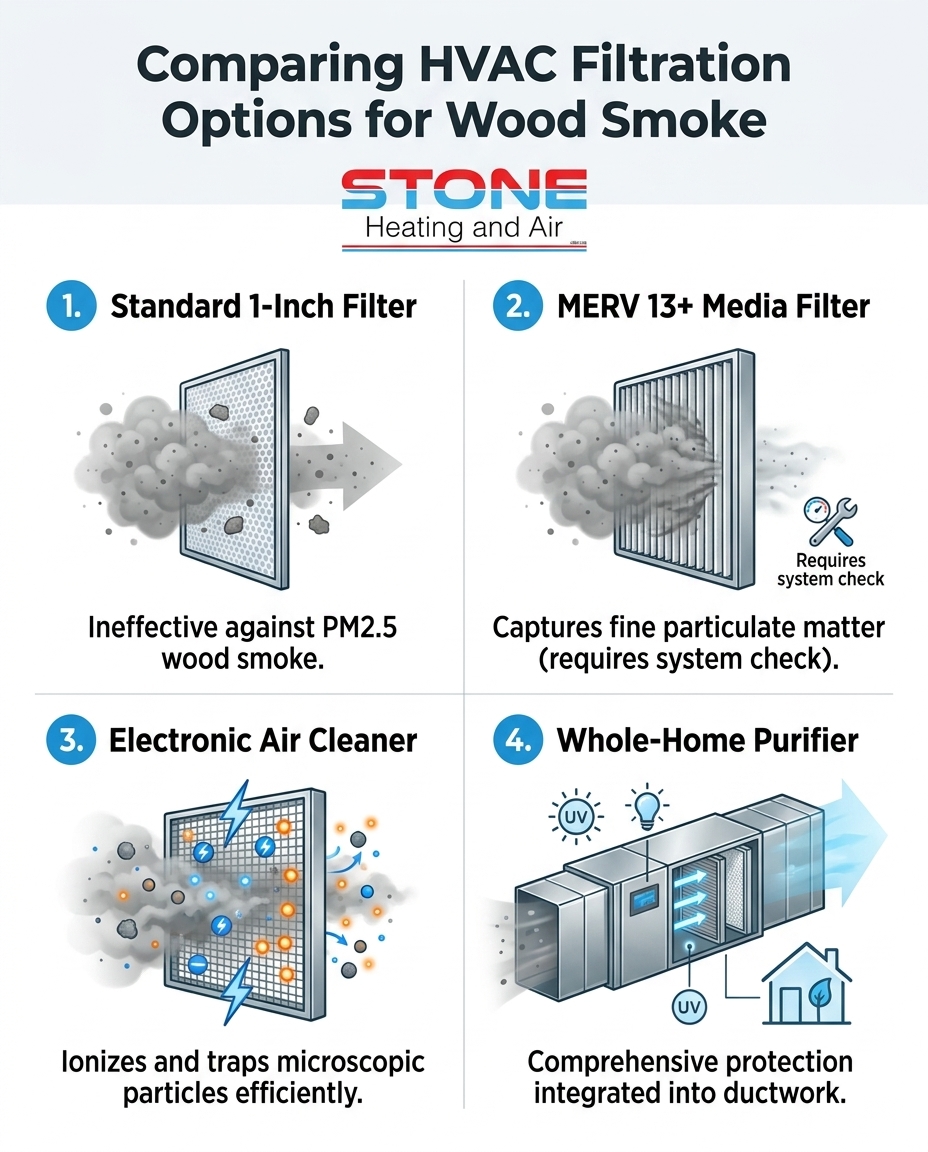
Most homes are equipped with standard 1-inch fiberglass filters, which are often mistakenly viewed as air purifiers. In reality, these basic filters were designed decades ago with a single purpose: to protect the HVAC equipment's internal blower motor from large debris like pet hair, heavy dust, and insects. They were never engineered to clean the air you breathe, which is why they fail completely when exposed to neighborhood wood smoke. In the homes we service throughout Central Point and Rogue River, we see this issue constantly.
Wood smoke is primarily composed of PM2.5 particulate matter. These are microscopic solid particles and liquid droplets that are 2.5 micrometers in diameter or smaller. To put that in perspective, a single PM2.5 particle is about 30 times smaller than the width of a human hair.
• Human Hair — Approximate Size (Micrometers): 50 - 70 — Standard 1-Inch Filter Capture Rate: High
• Pollen and Heavy Dust — Approximate Size (Micrometers): 10 - 20 — Standard 1-Inch Filter Capture Rate: Moderate to High
• Pet Dander — Approximate Size (Micrometers): 5 - 10 — Standard 1-Inch Filter Capture Rate: Low
• PM2.5 particulate matter (Wood Smoke) — Approximate Size (Micrometers): 2.5 or smaller — Standard 1-Inch Filter Capture Rate: Nearly Zero
Because the weave of a standard fiberglass filter is relatively wide, these microscopic smoke particles easily bypass the filter material. Once they slip past the filter, they enter your ductwork and are blown continuously into every room of your house. According to EPA guidelines, prolonged exposure to indoor wood smoke particulates can trigger asthma attacks, aggravate respiratory conditions, and negatively impact overall cardiovascular health.
If you want to stop these hazardous particles from circulating through your living space, upgrading HVAC filters for smoke is absolutely essential. We always tell our customers that relying on a cheap, see-through filter during peak inversion days is like trying to stop a flood with a chain-link fence.
Upgrading Your Filtration Strategy for the Fall Season
Beating the early fall wood stove season requires stepping up to high-efficiency media filters. These filters are rated using the MERV system (Minimum Efficiency Reporting Value), which grades a filter's ability to capture particles on a scale from 1 to 16. The higher the number, the tighter the weave, and the smaller the particles it can trap.
Understanding High-MERV Requirements
Standard filters usually sit between MERV 1 and MERV 4. To effectively capture microscopic smoke particles, ASHRAE (the American Society of Heating, Refrigerating and Air-Conditioning Engineers) recommends using a filter rated at MERV 13 or higher. These dense media filters are specifically designed to trap fine pollutants before they can enter your home's air distribution system.
The Danger of Restricting Airflow
The quick fix isn't always safe: You cannot simply walk into a hardware store, buy a MERV 13 filter, and shove it into an older system. Because these high-efficiency filters have a much tighter weave, they create significant air resistance. If your HVAC system's blower motor isn't calibrated to handle this increased static pressure, it will struggle to pull air through the thick filter. This can lead to overheating, frozen evaporator coils, and premature system failure.
Our team recently helped a local homeowner who ran into this exact challenge during a fall upgrade. They had system components tucked into difficult installation areas, making modifications tricky. Our technicians carefully installed the correct widened filter cabinets and educated the customer along the way, ensuring the system could handle the new heavy-duty filters without choking the blower motor.
Routine Checks and Maintenance
As neighborhood wood stove usage peaks, your new high-efficiency filters will fill up with trapped particulate matter much faster than standard dust screens. Checking these filters monthly and maintaining routine HVAC maintenance ensures that your system continues to breathe easily while providing maximum protection against outdoor smoke.
Heavy-Duty Solutions: Electronic Air Cleaners and Whole-Home Systems
For homes situated in the lowest parts of the valley where smoke settles the thickest, our team often finds that even a high-MERV media filter might require constant replacement. In these severe cases, permanent, heavy-duty filtration solutions are the most reliable way to maintain pristine indoor air quality.
Electronic air cleaners offer a sophisticated alternative to traditional thick paper filters. Instead of forcing air through a restrictive physical barrier, these systems use electricity to charge incoming PM2.5 particulate matter. Once the smoke particles are ionized, they are pulled toward oppositely charged collector plates like a magnet. This method offers superior protection against microscopic pollutants while maintaining excellent, unrestricted airflow through your ductwork.
Whole-home purification systems take this a step further by integrating directly into your existing HVAC infrastructure. Unlike standalone, portable room air purifiers that only clean the air in a single bedroom, a whole-home system treats every cubic foot of air circulating through the house. This means that whether you are cooking in the kitchen or sleeping in the master bedroom, you are protected from the campfire smell.
As a local company, Stone Heating and Air possesses a deep understanding of Southern Oregon's specific air quality challenges. We have proven local expertise in installing heavy-duty filtration systems tailored specifically for heavy valley smoke. Proper installation by our local experts ensures the system is calibrated for your specific home's footprint. For instance, a customer setting up a home office environment last fall needed their ventilation configuration completely overhauled to keep the smoke out. We replaced and optimized the configuration with new ducts and vents, completing the installation quietly and efficiently so they could work in clean, fresh air.
Investing in expert HVAC services to install these integrated systems provides long-term peace of mind, knowing your home is shielded from the valley's toughest air quality days.
Identifying Smoke Infiltration Points and Leaky Ducts
Even with the best filtration system in the world, you will still smell smoke if your home's mechanical pathways are actively pulling polluted air inside. Addressing how the air enters your house is just as important as how you filter it once it arrives.
Your ductwork is the circulatory system of your home. However, during our pre-heating-season tune-ups, our technicians frequently discover homes with ductwork routed through unconditioned spaces like hot attics or damp crawlspaces. If these ducts have microscopic cracks, loose joints, or disconnected segments, they act like a vacuum for outdoor air. When your blower motor kicks on, it pulls the concentrated wood smoke from the Rogue River and Southern Oregon valleys directly through these leaky ducts and blasts it out of your living room vents.
• Negative Pressure Vacuums: If your home exhausts more air than it takes in (often caused by strong kitchen vents, bathroom fans, or imbalanced HVAC systems), it creates negative pressure. The house will naturally try to equalize this pressure by sucking outdoor air in through gaps around windows, doors, and unsealed ducts.
• Attic and Crawlspace Vulnerabilities: Smoke settling in the valley easily drifts into vented crawlspaces and attics, sitting right next to your vulnerable ductwork.
• Poor Ventilation Optimization: Without a balanced fresh air intake system, your home has no control over where its makeup air comes from.
Thorough duct sealing and ventilation optimization are critical steps in maintaining a clean indoor environment. Late-season system assessments can identify these hidden vulnerabilities before the coldest winter months arrive. Securing your ductwork ensures that your filtration system isn't fighting a losing battle against constant infiltration. If you suspect your ductwork is compromised, reaching out for AC repair in Rogue River to seal and optimize your system is a vital step in your fall preparation.
Frequently Asked Questions About Fall Wood Smoke and Air Quality
Does my HVAC system filter out neighbor's wood smoke?
Standard systems with 1-inch fiberglass filters do not filter out wood smoke. These basic filters are designed only to catch large dust and pet hair to protect the machinery. To actually capture microscopic smoke particles, upgraded systems with high-MERV media filters or electronic air cleaners are required.
What MERV rating do I need for wood stove smoke?
ASHRAE recommends using a filter with a rating of MERV 13 or higher to effectively capture fine particulate matter. However, you must verify your system's compatibility with a professional before upgrading. High-MERV filters are very thick and can severely restrict airflow, potentially damaging older or improperly calibrated blower motors.
Why does my house smell like smoke in the fall?
Inversion layers trap early morning wood stove smoke close to the ground, preventing it from dissipating into the upper atmosphere. If your home has leaky ductwork or suffers from negative pressure, it will act like a vacuum, pulling this trapped, concentrated neighborhood smoke indoors through tiny gaps and unsealed vents.
How does PM2.5 get inside my house?
PM2.5 particulate matter is incredibly small—about 30 times smaller than a human hair. Because of its microscopic size, it easily drifts through tiny gaps around window frames, under doors, and through unsealed ductwork located in attics or crawlspaces. Once inside, standard filters fail to catch it, allowing it to circulate freely.
Are electronic air cleaners better than media filters for smoke?
Electronic air cleaners can be highly effective at capturing microscopic particles without restricting airflow as much as thick, pleated media filters. By using electricity to ionize and trap pollutants on collector plates, they offer excellent protection. However, they do require professional installation and routine cleaning to maintain their high efficiency.
Protect Your Family's Respiratory Health This Season
Living in the Rogue River and Southern Oregon valleys doesn't mean you have to accept smelling campfire smoke inside your own home every morning. While atmospheric inversions and neighborhood wood stoves are a permanent part of the local climate, your indoor air quality is entirely within your control.
Standard 1-inch filters are completely insufficient for protecting your family's respiratory health against fine particulate matter. Upgrading to high-efficiency media filters, electronic air cleaners, and properly sealed ductwork will transform your home into a clean-air fortress. At Stone Heating and Air, we recommend taking action before the peak of the heating season arrives; schedule an assessment to determine the best, safest filtration upgrades for your specific HVAC setup, and enjoy a fresh, breathable home all season long.