


Navigating the Chill: Why Fall Mornings Trigger Premature Furnace Use
The September early fall transition in Central Point is finally here, and if you are looking into maximizing passive solar heating in your home this fall, you are already one step ahead of the crisp morning chill. Before the sun fully rises, those 45-degree mornings make it incredibly tempting to walk over to the thermostat and switch the system straight to "Heat." Your house feels cold, the floors are chilly, and you want instant comfort. But our team at Stone Heating and Air often sees that turning on your furnace at the first sign of autumn frost leads to unnecessary energy use and premature wear on your equipment.
Instead of relying immediately on mechanical heating, you can use the architecture of your home to your advantage. Passive solar heating is a mechanical advantage that allows you to delay early furnace reliance simply by managing natural sunlight and your existing window treatments. By strategically timing when you open and close your blinds, you turn your windows into a natural heat source. This simple routine serves as your first line of defense against the cold, keeping your living spaces comfortable long before the furnace ever needs to ignite.
If you want to keep your heating systems running efficiently all season, pairing natural solar heat with a routine HVAC maintenance plan is the smartest strategy.
Understanding Passive Solar Gain in High-Variation Climates
To truly take advantage of natural warmth, you need to understand how passive solar heat gain works, especially in regions with massive daily temperature swings. Passive solar heat gain happens when sunlight passes through your windows, strikes the materials inside your home, and converts from light energy into thermal energy. Because the autumn sun sits lower in the southern sky than it does in the summer, its rays penetrate deeper into your south-facing rooms, delivering free, natural heat exactly where you need it most.
In Central Point and the broader Rogue Valley, our team has spent years helping homeowners navigate a very specific climate pattern during the fall transition. You might wake up to near-freezing temperatures, only to see the afternoon sky clear up and push outdoor temperatures into the upper 70s. This significant diurnal temperature variation—chilly mornings followed by intensely sunny afternoons—creates the absolute perfect environment for passive solar heating. If you manage your home correctly, you can capture that abundant afternoon heat and use it to offset the evening temperature drop.
The architectural advantage: You do not need a custom-built, eco-friendly house to make this work. Every standard home has windows, walls, and floors that can absorb sunlight. By letting your home's architecture do the heavy lifting during the warmest parts of the day, you create a buffer of warm air inside. That buffer keeps your indoor temperature stable even as the sun goes down and the outside air cools off, meaning your furnace stays dormant for a few extra hours every evening.
Your Daily Window Treatment Routine for Maximizing Passive Solar Heating in Your Home This Fall
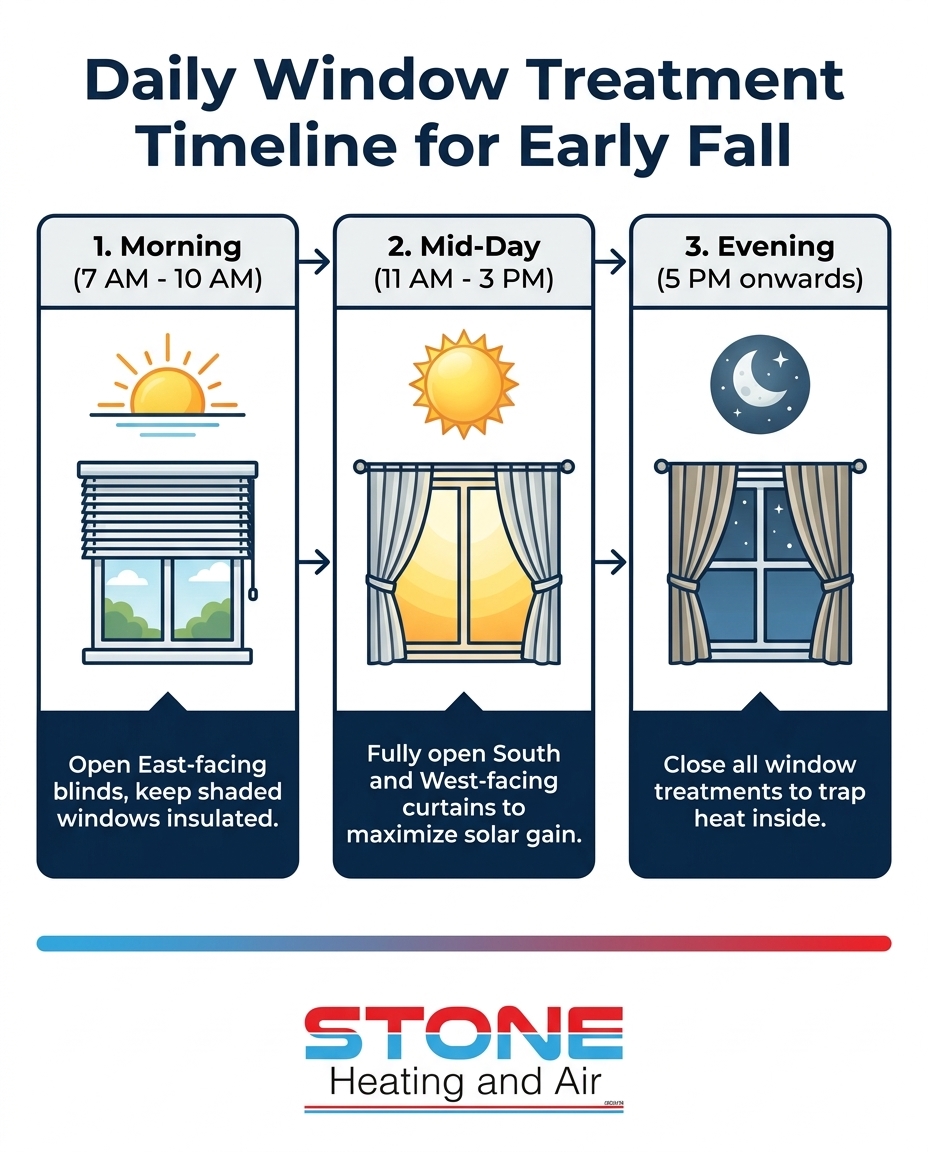
Capturing natural heat requires a bit of daily rhythm. Leaving your blinds open 24/7 will actually make your house colder, as glass is a poor insulator and will leak heat overnight. To get the most out of the September early fall transition, you need a targeted routine that adapts to the shifting sun.
Morning Strategy: Insulate and Assess
• Keep heavy drapes closed on shaded windows: Windows facing north or west won't receive morning sunlight. Keep their coverings tightly closed to insulate against the early morning frost.
• Open east-facing treatments: As the sun rises, open the blinds or curtains on your east-facing windows to catch the very first rays of the day and begin warming your breakfast nook or eastern bedrooms.
• Check for drafts: Morning is the best time to feel around your window frames for cold air leaks. A drafty window will undo all your passive heating efforts.
Afternoon Strategy: Maximize Solar Radiation
• Expose your thermal mass: If you have dark tile, concrete, or hardwood floors, make sure they are in direct sunlight. Move small rugs or temporary obstacles out of the way.
• Clear south-facing windows: By 11:00 AM, your south-facing windows should be completely unobstructed. Pull curtains all the way back and pull blinds all the way up.
• Open west-facing treatments late in the day: As the sun moves across the sky, open your west-facing blinds to capture the intense late-afternoon heat before sunset.
Evening Strategy: Trap the Warmth
• Close everything at dusk: The moment the sun dips below the horizon, close every blind, shade, and curtain in the house. You want to trap the accumulated heat before the glass cools down.
• Utilize cellular shades: If you have honeycomb or cellular shades, pull them down tight. Their pocketed design creates an excellent thermal barrier against the cold glass.
• Lock the windows: Ensure all window sashes are fully locked, which tightens the seal and prevents warm air from seeping out overnight.
Weekend vs. Weekday Adjustments: If you work away from home during the week, you cannot manually adjust your blinds at noon. On weekdays, leave your south-facing blinds open before you leave for work, but keep east, west, and north windows closed to retain heat. When you get home, immediately close the south-facing blinds to lock in whatever warmth was collected during the day.
Integrating Natural Sunlight with Smart Thermostat Schedules
Passive solar heating works best when it communicates effectively with your mechanical HVAC controls. If your thermostat is fighting against the natural heat you are bringing into the home, you will end up wasting energy and creating uncomfortable hot spots.
One of the most common issues our technicians at Stone Heating and Air encounter during the fall transition is poor thermostat placement. If your thermostat is mounted on a wall that receives direct afternoon sunlight, the sensor will read the ambient temperature as much warmer than the rest of the house. For example, the sunlit hallway might read 78 degrees, while the shaded back bedrooms are sitting at a chilly 64 degrees. Because the thermostat thinks the house is warm, it won't signal the furnace to turn on, leaving half your family freezing.
To fix this, follow these numbered steps to align your natural heating with your mechanical system:
1. Adjust your schedule for peak sun: Program your thermostat to remain off or drop to a much lower setpoint (like 62 degrees) between 11:00 AM and 4:00 PM. Let the sun do the heating during these hours.
2. Pre-heat slightly before dawn: If your mornings are bitterly cold, schedule the furnace to run for 30 minutes right before you wake up, then shut off as the sun rises.
3. Deploy remote sensors: Place smart thermostat sensors in shaded, north-facing rooms. Tell your main thermostat to average the temperature across the house, rather than relying solely on the sunlit hallway.
4. Set a wider deadband: A "deadband" is the temperature range where neither heating nor cooling turns on. Widen this gap during the fall so your system doesn't accidentally trigger the AC when a room gets a little too much sun.
If you are struggling to get your digital controls to cooperate with the shifting weather, professional smart thermostat optimization is a great next step. For even more detailed programming strategies, check out our guide on Transitioning Your Thermostat Settings for Unpredictable Fall Weather.
How Passive Heating Protects Your HVAC System from Early-Season Wear
Using the sun to warm your home isn't just about saving on utility bills; it is a strategic mechanical advantage that protects your heating equipment. Southern Oregon's unpredictable fall weather is notoriously hard on furnaces. When the temperature bounces up and down, your HVAC system is forced into a stressful pattern called "short-cycling."
Preventing the Short-Cycle Trap
Short-cycling happens when your furnace turns on, runs for a very brief period, shuts off, and then immediately turns back on a few minutes later. During transition weather, a chilly draft might trigger the thermostat, but the ambient daytime warmth quickly satisfies it, causing the furnace to shut down prematurely. Starting and stopping a heavy blower motor requires a massive surge of electricity and puts immense physical strain on the heat exchanger and internal components.
By utilizing natural solar heating, you create a thick buffer zone of warm air inside the house. This ambient heat keeps the thermostat satisfied for hours at a time, completely eliminating those rapid, damaging on-and-off cycles. Delaying heavy furnace use in the early fall extends the lifespan of your internal components, ensuring the motor and igniter aren't overworked before winter even begins.
Preparing for the Winter Load
Eventually, passive solar won't be enough to combat the deep winter freezes. That is why the September early fall transition is the ideal time to get your mechanical systems inspected. We frequently see this first-hand; for instance, a homeowner recently new to the area reached out to us for heating system maintenance and a filter change just as the cold weather started creeping in. Because they weren't used to the local climate swings we see here in Southern Oregon, our technicians took the time to walk them through their equipment, changed out the restrictive house filters, and ensured the system was fully prepped for the heavy lifting ahead.
Protecting your equipment now means fewer breakdowns later. By relying on solar gain today and prioritizing professional HVAC efficiency checkups, your system will be ready to perform flawlessly when the snow finally falls.
Leveraging Thermal Mass to Retain Afternoon Warmth
If you want to take your natural heating strategy to the next level without remodeling your home, you need to understand the concept of thermal mass. Thermal mass refers to dense materials inside your home that have the ability to absorb, store, and slowly release heat energy. While sunlight warms the air quickly, air also loses heat quickly. Dense materials, on the other hand, hold onto that warmth for hours.
Common thermal mass materials include tile floors, concrete slabs, stone fireplaces, and even heavy, dark rugs. When direct sunlight hits these dense surfaces, they act like a thermal battery. They soak up the solar radiation all afternoon. Then, as evening arrives and the indoor air temperature begins to drop, these materials slowly radiate that stored heat back into the room, keeping the space comfortable well past sunset.
• Dark Tile / Stone — Heat Absorption Rate: High — Heat Retention (Thermal Mass): Excellent — Best Use in Fall Heating: Keep fully exposed to direct south-facing sunlight.
• Hardwood Floors — Heat Absorption Rate: Medium — Heat Retention (Thermal Mass): Moderate — Best Use in Fall Heating: Remove light-colored rugs to expose dark wood to sun.
• Carpet / Light Rugs — Heat Absorption Rate: Low — Heat Retention (Thermal Mass): Poor (Acts as insulator) — Best Use in Fall Heating: Use in shaded rooms to keep cold floors from chilling feet.
• Plush Furniture — Heat Absorption Rate: Medium — Heat Retention (Thermal Mass): Low — Best Use in Fall Heating: Move out of direct sunlight so light can hit the floors instead.
You can maximize your existing thermal mass with very little effort. Take a look at your south-facing rooms. Are your heavy sofas or light-colored area rugs blocking the sunlight from hitting your dark tile or hardwood floors? By simply rearranging your furniture for the winter season, you can expose more dense flooring to the sun. The more thermal mass you expose to direct light, the more heat you will retain for the evening, further reducing the need for your furnace.
Frequently Asked Questions About Natural Home Heating
How do you maximize passive solar heating?
The most effective way to maximize passive solar heating is to keep your south-facing windows completely clean and unobstructed during peak daylight hours. Pull all curtains and blinds fully open by mid-morning to let sunlight hit your floors and walls. Additionally, utilize thermal mass by exposing dark, dense materials to the sun to absorb heat, and make sure you seal any window drafts so the warm air doesn't escape.
When should I open my curtains to heat my house in the fall?
You should open your east-facing curtains right at sunrise to catch the early morning warmth, and then open your south and west-facing curtains by mid-morning. The key is to leave them open during the brightest, warmest parts of the day. Just as importantly, you must close all curtains immediately at dusk to trap the heat inside before the glass cools down.
Can passive solar heating completely replace my furnace?
In the September early fall transition, passive solar heating can significantly delay furnace use and keep your home comfortable during the day. However, a mechanical heating system is still absolutely required for reliable overnight comfort and to handle the deep winter months. Natural sunlight is a supplement to your furnace, not a total replacement.
Do cellular shades help with passive solar heating?
Yes, cellular shades are fantastic for passive solar heating strategies. While you leave them open during the day to let heat in, they provide excellent insulation when closed at night. Their honeycomb design traps a layer of air against the glass, preventing the solar heat you gained during the afternoon from escaping back outside.
How does natural sunlight affect my thermostat readings?
Direct sunlight hitting your thermostat can cause it to read artificially high, tricking the system into thinking the entire house is warm. This prevents the furnace from running when other, shaded rooms are actually cold. If your thermostat sits in a sunny hallway, you may need to rely on remote room sensors or adjust your programming to compensate for the false reading.
Master Your Home's Comfort Before the Winter Freeze
Maximizing passive solar heating in your home this fall is one of the easiest, most effective ways to stay comfortable during unpredictable transition weather. By establishing clear, actionable daily routines for managing your blinds, curtains, and natural sunlight, you can naturally warm your living spaces and delay the need for heavy mechanical heating. It takes just a few minutes a day to open south-facing treatments and trap the heat at dusk, but the payoff in comfort and reduced equipment strain is massive.
These passive strategies work perfectly alongside a well-maintained heating system. While the sun handles the afternoon warmth, your furnace needs to be ready to take over during the freezing nights. Don't wait until the deep cold sets in—schedule your seasonal maintenance now so your equipment is clean, tuned, and ready to perform when you need it most.