

Is Annual HVAC Maintenance Worth It? Here's the Short Answer
Annual HVAC maintenance is it worth it for most homeowners — and the evidence is hard to argue with. If you want the quick answer before diving deeper:
Yes, annual HVAC maintenance is worth it because it:
• Extends your system's lifespan from as little as 8-10 years up to 15-20 years
• Reduces energy bills by up to 15% by keeping your system running efficiently
• Lowers the risk of unexpected, costly breakdowns
• Helps protect your manufacturer's warranty, which often requires documented annual service
• Catches small problems early — before a $20 part becomes a $2,000 repair
When it may be less critical:
• Your system is brand new (under 2-3 years old) and still under full warranty
• You are planning to replace the system within the next 12 months
For the vast majority of homeowners in the Rogue Valley, scheduling professional maintenance at least once a year — ideally twice — is one of the smartest things you can do for your home comfort and your budget.
Think of it the same way you think about oil changes or dental cleanings. You do not wait for something to break before you take care of it. Your HVAC system works the same way. It runs hard every season, quietly building up dust, wear, and small faults that go unnoticed until they become expensive problems. Routine professional service interrupts that cycle before it costs you.
What is an HVAC Maintenance Plan and What Does It Include?
An HVAC maintenance plan is a structured service agreement between you and a trusted heating and cooling provider. Instead of calling a technician only when your heater blows cold air in December or your air conditioner fails during a scorching July heatwave, a maintenance plan establishes a proactive schedule.
At its core, preventative care is about keeping your home comfort systems in peak operating condition. When a professional technician services your system, they perform a comprehensive series of diagnostics, cleanings, and safety checks designed to optimize performance. Understanding The Importance of Regular HVAC Maintenance begins with looking at what actually happens during these scheduled visits.
During a typical maintenance appointment, a technician will focus on several key areas:
• System Inspection: Checking the overall structural integrity of the furnace, heat pump, or air conditioner, looking for wear and tear, and ensuring all mechanical parts move freely.
• Coil Cleaning: Dust and pollen act as an insulating blanket on your indoor evaporator coil and outdoor condenser coil. Cleaning these coils is essential for proper heat transfer.
• Electrical Connections: Loose electrical connections are a common cause of system failure and can pose a safety hazard. Technicians inspect and tighten all wiring terminals.
• Thermostat Calibration: Ensuring your thermostat reads the indoor temperature accurately prevents your system from running too long or cycling on and off too frequently.
Standard Tasks in a Professional Tune-Up
A true professional tune-up goes far beyond a simple visual check. It is a meticulous, multi-point process that addresses both the heating and cooling components of your system.
To help homeowners understand what to expect, we rely on a comprehensive HVAC Maintenance Checklist for 2022 as our baseline, adapting it to the specific demands of modern systems in 2026. Standard technical tasks in a professional tune-up include:
• Refrigerant Levels: Checking that the system has the correct charge. Low refrigerant indicates a leak, which strains the compressor and prevents proper cooling.
• Condensate Drain Line: Flushing and clearing the drain lines to prevent algae buildup, mold, and water damage caused by overflows.
• Safety Controls: Testing the limit switches and safety controls to ensure the heating system shuts down automatically if it overheats or experiences a malfunction.
• Blower Assembly: Cleaning and adjusting the blower motor and fan to maximize airflow throughout your ductwork.
Seasonal Timing for Heating and Cooling Systems
Timing is everything when it comes to HVAC maintenance. To get the most out of your system, you want to schedule service before you actually need to turn the unit on for the season.
We recommend scheduling a spring service for your air conditioning system and a fall service for your heating system. This ensures that your cooling equipment is primed for the summer heat and your furnace or heat pump is ready for the winter chill.
To help you stay ahead of the weather, you can review our Spring AC Maintenance Checklist for Homeowners to prepare for the warmer months. When the season shifts, our guide on Pre-Winter Preparations: A Fall HVAC To-Do List will help ensure your home remains warm and safe all winter long.
Annual HVAC Maintenance Is It Worth It for Energy Efficiency and Lifespan?
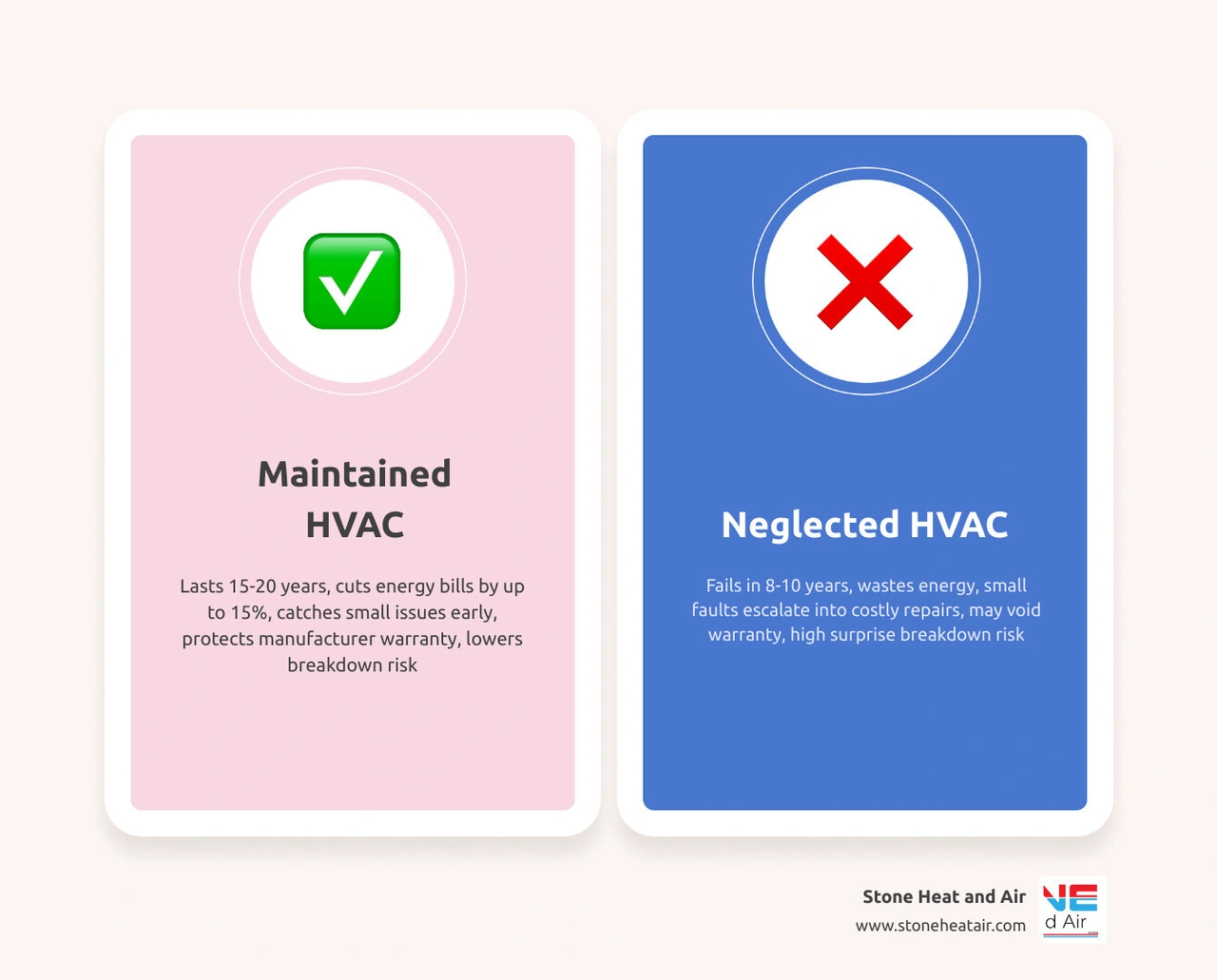
When evaluating whether annual hvac maintenance is it worth it, it helps to look at the hard data. Over time, neglected systems degrade in performance, leading to higher monthly utility bills and premature equipment failure.
• Average Lifespan — Well-Maintained HVAC System: 15 to 20 years — Neglected HVAC System: 8 to 10 years
• Energy Consumption — Well-Maintained HVAC System: Peak efficiency (minimal waste) — Neglected HVAC System: Increases by ~5% every year
• Utility Bills — Well-Maintained HVAC System: Lower and predictable — Neglected HVAC System: Consistently rising
• Breakdown Risk — Well-Maintained HVAC System: Very low (up to 95% of repairs prevented) — Neglected HVAC System: High (frequent emergency calls)
• Warranty Status — Well-Maintained HVAC System: Fully compliant and protected — Neglected HVAC System: Often voided due to lack of service
• Air Quality & Comfort — Well-Maintained HVAC System: High filtration, even temperatures — Neglected HVAC System: Poor airflow, dust buildup, hot/cold spots
As this comparison shows, the financial and operational differences are stark. If you are asking yourself Is an HVAC Maintenance Plan Worth It, the long-term savings on energy and replacement costs provide a clear answer.
Why annual hvac maintenance is it worth it for system longevity
An HVAC system is one of the most expensive appliances in your home. Extending its equipment lifespan directly protects your investment.
When a system is neglected, dust and grime accumulate on internal components, creating friction and resistance. This forces major parts—like the compressor or the blower motor—to work twice as hard to achieve the same temperature settings.
The compressor is the heart of your air conditioner. If it fails due to overheating or low refrigerant, the repair can be incredibly costly, often forcing an early system replacement. Similarly, in a gas furnace, a neglected system can lead to a cracked heat exchanger, which is not only expensive to repair but also poses a dangerous carbon monoxide risk to your family. Knowing How Often Should You Service Your HVAC System is key to catching these issues before they turn into catastrophic failures.
Why annual hvac maintenance is it worth it for energy efficiency
According to the U.S. Department of Energy, regular maintenance can restore your system's efficiency, reducing energy consumption and lowering your monthly heating and cooling bills.
When dirt builds up on your system's coils, it restricts airflow and acts as an insulator, making it much harder for your air conditioner to release heat or your heater to warm the air. By keeping the coils clean, lubricating moving parts, and ensuring proper airflow, your system does not have to run as long or as hard to keep your home comfortable. This direct reduction in runtime keeps your utility bills manageable and lowers your home's carbon footprint. Practicing consistent Home HVAC Maintenance is the most reliable way to maintain this high level of efficiency.
Evaluating HVAC Service Contracts and Maintenance Plans
If you decide that routine maintenance is necessary, the next step is deciding whether to pay for individual tune-ups as you go or to invest in an organized service contract.
A high-quality maintenance plan—such as our exclusive Stone Comfort Membership Club—offers several key benefits that go beyond the actual technical tune-up:
• Priority Scheduling: When extreme weather hits the Rogue Valley, HVAC companies get flooded with emergency calls. Maintenance plan members jump to the front of the line, ensuring they do not have to wait days in a freezing or boiling home.
• Repair Discounts: If a technician does find a part that needs to be replaced, members typically receive a percentage off parts and labor.
• Emergency Service Perks: Some plans include waived diagnostic fees or reduced rates for after-hours emergency calls, providing true peace of mind.
To weigh these options for your specific home, ask yourself: Do I Need an HVAC Service Contract? For most homeowners, the added benefits and automatic reminders make a contract highly worthwhile.
Warranty Compliance and Protection
One of the most overlooked aspects of HVAC maintenance is the manufacturer's warranty. Many homeowners assume that because their system is relatively new, any major repair will be fully covered.
However, almost every major HVAC manufacturer requires proof of regular professional maintenance to keep the warranty valid. If a major component like the compressor or heat exchanger fails, the manufacturer may require you to provide documented service records before they will honor the parts warranty. Skipping annual maintenance could leave you paying out of pocket for a repair that should have been covered.
Professional Service vs. Basic Homeowner Tasks
While professional maintenance is essential, there are several basic tasks that homeowners can—and should—perform themselves to keep their systems running smoothly between scheduled visits.
The most important task is regular filter replacement. You should check your filter monthly and replace it every 30 to 90 days, especially if you have pets, allergies, or live in an area prone to seasonal dust. Additionally, you should keep the outdoor condenser unit clear of leaves, grass clippings, and weeds, maintaining at least a two-foot clearance around the unit.
However, more technical tasks—such as testing electrical capacitors, checking refrigerant pressures, and inspecting gas connections—require specialized tools, training, and safety certifications. To help you understand the boundary between DIY tasks and professional care, refer to What Should Be on Your Summer HVAC Maintenance Checklist.
Frequently Asked Questions about HVAC Maintenance
How often should HVAC maintenance be performed?
For standard split systems (a separate furnace and air conditioner), professional maintenance should be performed twice a year—once in the spring for the AC, and once in the fall for the heating system.
If you use a heat pump system, which handles both heating and cooling year-round, bi-annual service is even more critical because the system never gets a seasonal break. If you are preparing your home for the cooler months, our guide on Your HVAC Maintenance To-Do List for September provides a helpful timeline for scheduling your fall tune-up.
What common issues are prevented by routine maintenance?
Routine maintenance is highly effective at preventing some of the most common and disruptive HVAC failures:
• Frozen Evaporator Coils: Dirty filters or low refrigerant restrict heat absorption, causing moisture on the coil to freeze solid and block all cooling.
• Water Damage: Clogged condensate lines can back up, causing water to overflow into your ceilings, walls, or crawlspaces.
• Electrical Failure: Loose connections or failing capacitors can burn out blower motors or compressors.
To protect your home before winter arrives, review HVAC Maintenance: A Quick To-Do List for Early Fall to address these common vulnerabilities.
Does skipping professional maintenance void my manufacturer warranty?
Yes, in many cases, skipping professional maintenance will void your manufacturer's warranty. Manufacturers view routine maintenance as a prerequisite for their equipment performing safely and correctly. Without documented proof of annual service from a licensed professional, a warranty claim for expensive parts may be denied, leaving you with a hefty repair bill.
Conclusion
When you look at the long-term benefits—lower monthly utility bills, an extended equipment lifespan, fewer emergency breakdowns, and guaranteed warranty protection—the answer to "annual hvac maintenance is it worth it" is a resounding yes. It transforms your heating and cooling system from a source of sudden financial stress into a reliable, invisible asset that keeps your home comfortable year-round.
At Stone Heating & Air, we treat your home like ours. Serving Central Point, OR, and communities across the Rogue Valley, we are dedicated to providing honest recommendations, meticulous attention to detail, and the ultimate peace of mind.
If you are ready to protect your home's most important appliance and enjoy uninterrupted comfort through every season, explore our exclusive Maintenance Plan and join the Stone Comfort Membership Club today!