

Do Maintenance Plans Save Money Over Time? Here's What Homeowners Need to Know
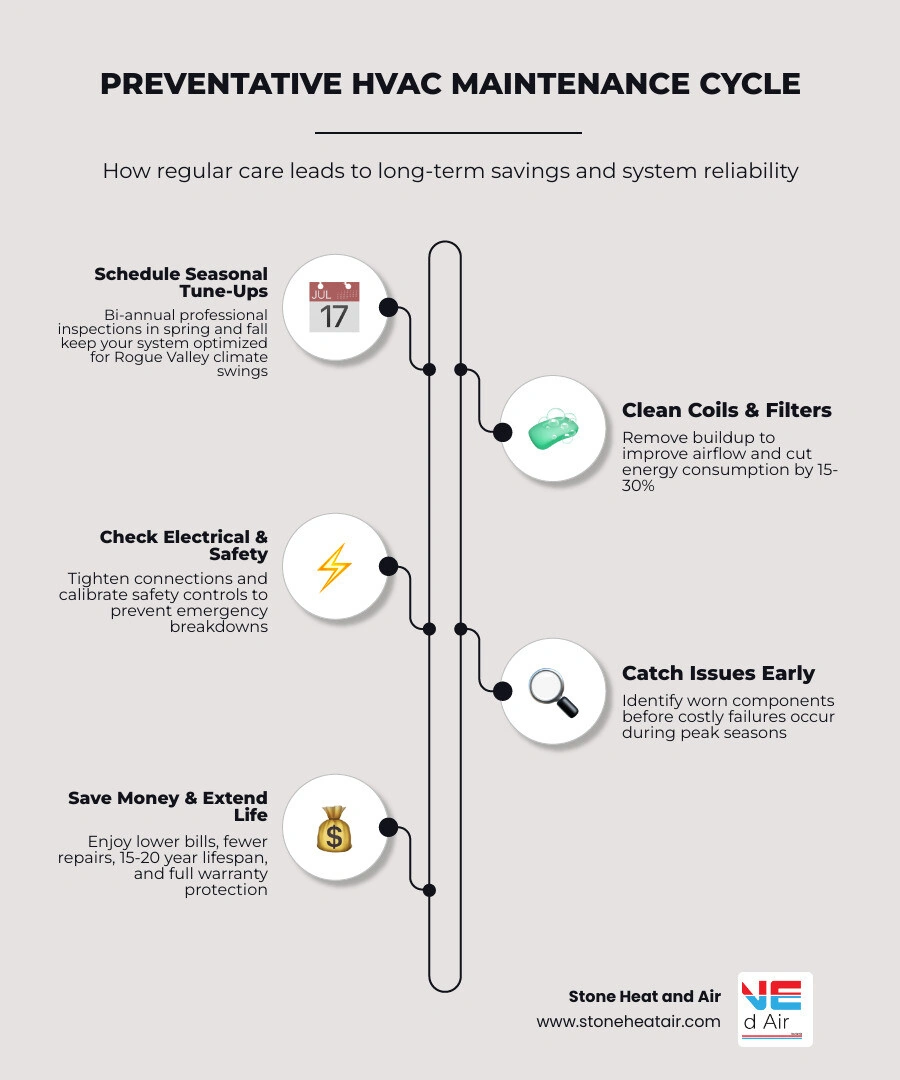
Do maintenance plans save money over time — and the short answer is yes, for most homeowners they do. A maintenance plan keeps your HVAC system running efficiently, helps prevent costly breakdowns, and can extend the life of your equipment by years. Here's a quick look at how the savings stack up:
How maintenance plans save money:
• Lower energy bills — A well-maintained system runs up to 15–30% more efficiently than a neglected one
• Fewer emergency repairs — Catching small problems early prevents expensive component failures
• Longer equipment lifespan — Maintained systems can last 15–20 years vs. 10 years or less without care
• Warranty protection — Most manufacturers require documented professional maintenance to honor parts warranties
• Priority service and repair discounts — Plan members often pay less when repairs are needed
For Rogue Valley homeowners, where summer heat and winter cold put real seasonal stress on HVAC systems, staying ahead of problems isn't just smart — it's the difference between a comfortable home and an unexpected repair bill at the worst possible time.
Think of it like regular oil changes for your car. Skipping them saves a little money now, but the engine pays the price later. Your heating and cooling system works the same way.
What is an HVAC Maintenance Plan?
An HVAC maintenance plan is a structured service agreement between you and a professional heating and cooling provider. Instead of waiting for your system to break down during a scorching July afternoon in Central Point or a freezing January night in Klamath Falls, you proactively schedule regular checkups.
When you enroll in a plan, you essentially secure a standing appointment for seasonal tune-ups. These visits are split into two key periods: a cooling inspection in the spring to prep your air conditioner for summer, and a heating tune-up in the fall to ensure your furnace or heat pump is ready for winter.
During these visits, a certified technician performs a comprehensive checklist of tasks designed to optimize your system. This isn't a simple visual glance-over. A thorough professional inspection includes:
• Tightening electrical connections: Loose wires can cause system failures, short circuits, or even damage expensive control boards.
• Cleaning condenser and evaporator coils: Dirty coils restrict heat transfer, forcing your system to work significantly harder to cool your home.
• Calibrating thermostats: Ensuring your thermostat reads the temperature accurately prevents unnecessary cycling.
• Inspecting the heat exchanger and burners: Crucial for safety, this step checks for cracks that could leak carbon monoxide into your living space.
• Lubricating moving parts: Reducing friction in motors and fans prevents premature wear and tear.
• Clearing condensate drain lines: Preventing water backups that can cause property damage or system shut-offs.
By keeping these components in peak condition, you avoid the gradual decline in performance that naturally occurs over months of heavy use. To understand why these individual steps make such a massive difference in your system's day-to-day operation, you can read more about The Importance of Regular HVAC Maintenance.
Do Maintenance Plans Save Money Over Time?
The core question most homeowners ask when presented with a service agreement is simple: Is this actually going to save me money, or is it just another monthly subscription I don't need?
To find the honest answer, we have to look at the long-term return on investment (ROI) and how a plan changes your household budgeting.

When you pay for heating and cooling services à la carte, you are entirely at the mercy of unpredictable breakdowns. If a capacitor fails on a weekend during a heatwave, you are looking at after-hours diagnostic fees, emergency service surcharges, and the full retail price for parts and labor.
Conversely, a maintenance plan provides predictable budgeting. You pay a consistent, manageable membership fee, and in return, you receive pre-scheduled visits that dramatically reduce the likelihood of those emergency failures.
To help visualize how these two approaches compare over several years, look at the table below:
• Biannual Tune-Ups — Standard Pay-Per-Service (À La Carte): Paid individually per visit — Structured Maintenance Plan: Included in the membership
• Diagnostic & Trip Fees — Standard Pay-Per-Service (À La Carte): Full price, including emergency premiums — Structured Maintenance Plan: Often waived or heavily discounted
• Parts & Labor on Repairs — Standard Pay-Per-Service (À La Carte): Full retail pricing — Structured Maintenance Plan: Discounted (typically 10% to 20% off)
• Emergency Priority — Standard Pay-Per-Service (À La Carte): Standard queue (can wait days in peak season) — Structured Maintenance Plan: Front-of-the-line priority scheduling
• System Efficiency — Standard Pay-Per-Service (À La Carte): Gradually declines, raising utility bills — Structured Maintenance Plan: Maintained at peak performance levels
• Warranty Compliance — Standard Pay-Per-Service (À La Carte): Hard to track without strict self-documentation — Structured Maintenance Plan: Automatically documented and preserved
As the table shows, the value of a maintenance agreement extends far beyond the tune-ups themselves. For example, if a minor part like a contactor or capacitor begins to weaken, a technician will spot it during a routine check. Under a plan, you can replace it before it fails, often with a member-exclusive discount on the part, and with no emergency trip charges.
Furthermore, if an unexpected issue does arise during peak season, plan members receive priority service. When outdoor temperatures spike in Roseburg or Brookings, being at the front of the line for service isn't just a financial benefit—it is a massive relief for your family's comfort.
If you are currently weighing these options for your home, exploring Is an HVAC Maintenance Plan Worth It can help you run the numbers for your specific household needs. For a broader look at how to incorporate these services into your household finances, check out our guide on Budgeting for HVAC Maintenance.
Financial Benefits of Preventative HVAC Care
To truly understand how do maintenance plans save money over time, we have to break down the three primary pillars of financial savings: system efficiency, equipment longevity, and warranty protection. When these three factors work together, they transform preventative care from an expense into an investment that actively pays you back.
By taking a proactive approach, you protect one of the most expensive appliances in your home from the silent wear and tear that leads to early replacement. You can read more about how this works in our article on How to Prevent HVAC Emergencies with Maintenance.
How Do Maintenance Plans Save Money Over Time on Energy Bills?
The most immediate financial return you will notice from a maintenance plan is on your monthly utility bill. Your HVAC system is the single largest energy consumer in your home, often accounting for over half of your total monthly power usage.
When a system is neglected, it doesn't just stop working overnight; instead, it slowly loses efficiency. Dust accumulates on the blower fan, condenser coils become coated in outdoor grime, and registers get restricted.
According to the U.S. Department of Energy, a neglected air conditioner or furnace runs 5% to 15% less efficiently each year it goes without service. In areas with high seasonal demands like Southern Oregon, that drop in efficiency can easily translate to hundreds of dollars in wasted energy costs annually.
When a technician performs a tune-up, they optimize airflow and clean the condenser coils. Clean coils allow heat to transfer much more rapidly, meaning your air conditioner doesn't have to run as long to achieve your desired indoor temperature. Optimized airflow reduces the strain on your blower motor, lowering its electrical draw.
This optimization doesn't just apply to residential comfort, either. In commercial settings, keeping these systems running perfectly has a direct impact on the bottom line, as discussed in our look at How HVAC Maintenance Promotes Employee Productivity.
How Do Maintenance Plans Save Money Over Time by Preventing Repairs?
Emergency repairs are almost always more expensive than planned maintenance. When a system fails during extreme weather, the physical strain on the equipment is at its peak, which often leads to a domino effect of component failures.
For example, a dirty air filter or a failing capacitor might seem like minor issues. However, if a capacitor fails entirely, it can cause the indoor blower motor or the outdoor compressor to overheat and burn out. Replacing a capacitor is a simple, quick fix during a routine maintenance visit. Replacing a compressor or a blower motor, on the other hand, is one of the most expensive repairs an HVAC system can undergo.
By catching these small, weakening components early, you completely avoid the high-stress, high-cost scenarios of emergency breakdowns. You also avoid paying emergency after-hours diagnostic fees.
To learn more about maximizing the lifespan of your heating and cooling equipment through proactive care, read our detailed guide on How to Extend the Life of Your HVAC System.
Frequently Asked Questions About Maintenance Agreements
Deciding on a home service agreement often brings up practical questions about scheduling, warranties, and what tasks you can manage on your own. If you are trying to decide if a structured agreement is right for your property, you might find our article Do I Need an HVAC Service Contract helpful.
How often should HVAC maintenance be scheduled?
For standard residential systems, we recommend scheduling professional maintenance twice a year.
The ideal schedule is to have your air conditioning system serviced in the spring before the summer heat arrives, and your heating system serviced in the fall before the winter chill sets in. If you have a heat pump—which handles both heating and cooling duties year-round—this biannual schedule is even more critical because the system never gets a seasonal break.
Does regular maintenance keep my manufacturer warranty valid?
Yes. This is one of the most overlooked financial benefits of professional maintenance. Almost every major HVAC manufacturer (such as Carrier) requires documented annual professional maintenance to keep their 10-year parts warranties valid.
If a major component like a compressor or heat exchanger fails within the warranty period, the manufacturer may require proof of professional service before they will ship the replacement part. Without these documented records, you could find yourself paying entirely out of pocket for a part that should have been covered. A maintenance plan automatically tracks and documents these visits for you.
Can I perform HVAC maintenance tasks myself?
While there are several important tasks you should handle as a homeowner, they do not replace professional service.
Between professional visits, you should:
• Change your air filters every 30 to 90 days, depending on pets and household size.
• Keep the outdoor unit clear of weeds, leaves, and debris, maintaining a two-foot clearance around the cabinet.
• Ensure indoor supply and return vents are kept open and unobstructed by furniture.
However, advanced diagnostic tasks—such as testing electrical voltage, measuring refrigerant charge, cleaning internal drain lines, and inspecting heat exchangers for micro-cracks—require specialized tools, training, and safety equipment. Attempting to perform these technical tasks yourself can void your manufacturer warranty, damage the system, or expose you to high-voltage electrical hazards.
Conclusion
When you look at the big picture, investing in preventative care is one of the most reliable ways to protect your home and your budget.
By keeping your heating and cooling systems running efficiently, catching small component issues before they turn into major breakdowns, keeping your manufacturer warranties fully intact, and extending the overall life of your equipment, a structured agreement pays for itself year after year.
At Stone Heating & Air, we are proud to serve families throughout Central Point, OR, the Rogue Valley, and Southern Oregon—from Roseburg down to Brookings and Klamath Falls. We believe in providing honest, fair dealings and treating your home exactly like we would treat ours.
To help our neighbors enjoy uninterrupted comfort and complete peace of mind, we offer our exclusive Stone Comfort Membership Club. As a member, you will receive regular preventative care, priority scheduling, and exclusive discounts, ensuring your home remains a sanctuary of comfort no matter what the Oregon weather brings.
Ready to start saving and protect your home's comfort system? Explore our Maintenance Plan options today or reach out to our team to find the perfect fit for your home.