



The Frustration of Uneven Heating During the Fall Transition
Your living room feels perfectly cozy, but the moment you step into the guest bedroom, you need a heavy sweater. Understanding the importance of balancing your home's airflow before winter is the key to solving this frustrating temperature divide. As the weather begins to cool down, our team at Stone Heating and Air receives countless calls from homeowners noticing that certain rooms simply refuse to warm up, no matter how long the furnace runs. This uneven heating creates a daily battle for comfort, leaving some family members sweltering while others are shivering.
The most common reaction to a chilly bedroom is simply walking over to the wall and cranking up the thermostat. However, this reactionary habit rarely solves the underlying issue. Instead of pushing warm air into the freezing bedroom, turning up the temperature usually just forces more heat into the rooms that are already warm. You end up wasting significant amounts of energy while making your main living areas uncomfortably hot. True whole-home comfort relies on the underlying mechanics of your air distribution network, not just the temperature setting on your wall.
During the September pre-heating season, addressing these stubborn cold spots requires looking deeper into your ductwork. Getting the most out of your home heating systems means acknowledging that warm air needs a clear, balanced path to reach every corner of your house. To truly resolve these temperature drops and ensure even heat distribution, we frequently recommend professional duct services as the necessary solution to properly evaluate and balance the system.
The Hidden Cost of Ignoring Airflow Issues
Ignoring uneven temperatures does more than just cause physical discomfort; it actively drives up your monthly utility bills. When a system is unbalanced, it runs longer cycles trying to satisfy the thermostat, which is often located in the warmest room of the house. This constant cycling accelerates wear and tear on internal components. By addressing airflow distribution early in the fall, you can stabilize your home's internal climate and prevent excessive energy waste before the coldest months arrive.
Why Your Home Develops Stubborn Cold Spots
To understand why certain rooms feel like an icebox, you have to look at the basic physics of forced-air heating. HVAC airflow balancing is the process of regulating and distributing the air volume produced by your furnace so that every room receives the precise amount of conditioning it needs. In many Central Point OR homes we service, the ductwork layout naturally favors the rooms closest to the indoor blower unit. Because air follows the path of least resistance, the vents closest to the furnace receive a massive rush of warm air, while the rooms at the end of the line receive a weak, struggling breeze.
The natural physics of forced air dictate that as air travels further through your ductwork, it loses velocity and heat energy. Every turn, bend, and long stretch of metal ducting creates friction. By the time the air reaches a distant second-story bedroom or an addition over the garage, the pressure has dropped significantly. This poor airflow distribution directly degrades overall HVAC system performance, forcing the equipment to work harder to push air to the furthest reaches of the house.
Capacity Versus Distribution
The underlying truth: Homeowners often assume their furnace is simply too small or too old to heat the house. In reality, a pattern we see often is that uneven heating is rarely a furnace capacity issue. If the equipment is sized correctly for the square footage, the problem is almost always a solvable distribution issue. The furnace is generating enough heat; that heat is just getting trapped or dumped into the wrong areas of the home.
• Weak airflow at the register: Hold your hand over the vent in the cold room; if the breeze is barely noticeable, distribution is failing.
• Whistling sounds from vents: High-pitched noises often indicate that air is being forced through a restricted space elsewhere in the system.
• Hot and cold extremes: Experiencing a 5-to-10 degree temperature difference between the main floor and the bedrooms.
• Short cycling: The furnace turns on and off rapidly because the thermostat area heats up too quickly, leaving the rest of the house cold.
Why Shutting Registers Damages System Static Pressure
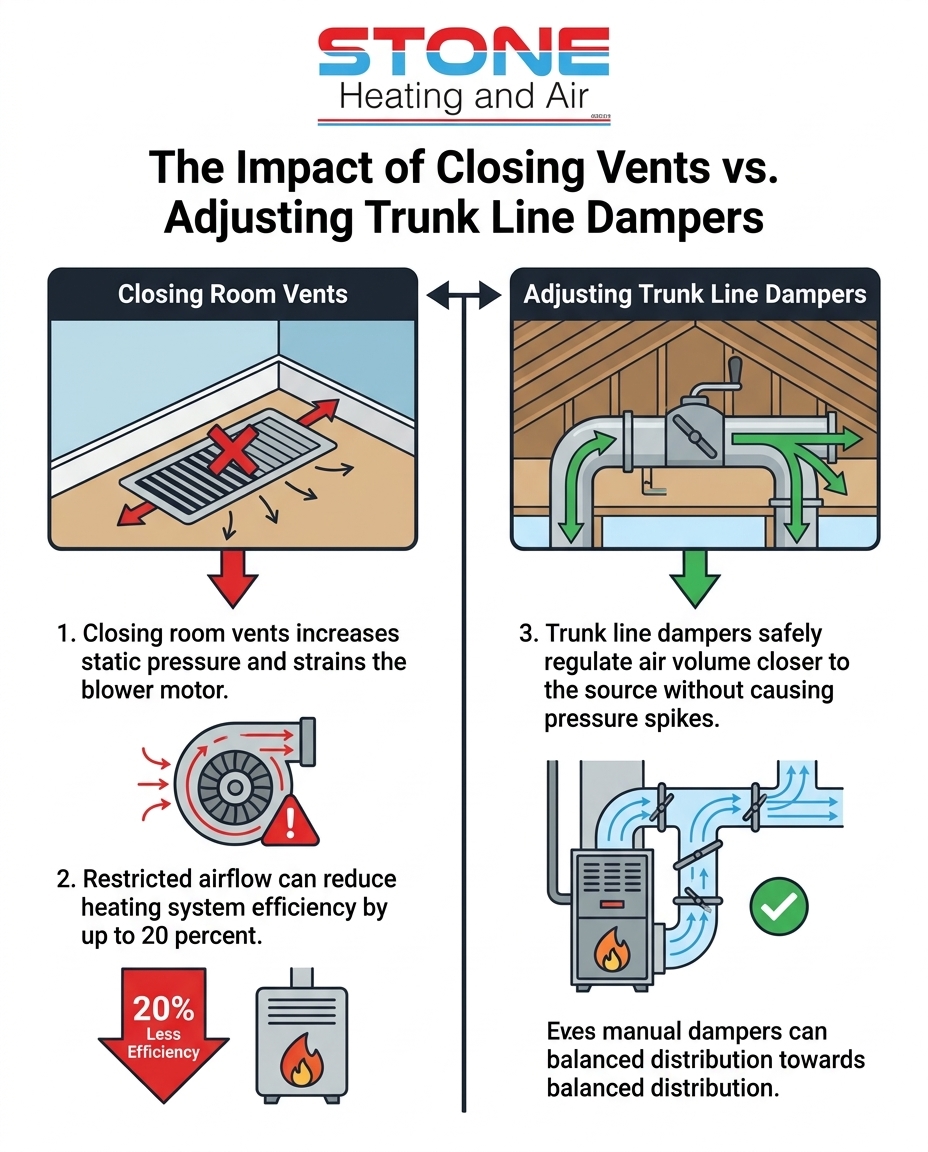
One of the most persistent DIY myths our technicians encounter in the field is the idea that closing vents in unused rooms will magically force more warm air into the colder parts of the house. It seems logical on the surface, but modern heating systems are not designed to operate with blocked registers. Your furnace relies on a delicate balance of incoming return air and outgoing supply air. When you shut room registers, you disrupt this balance and create a severe mechanical problem known as high static pressure.
Think of static pressure like placing your thumb over the end of a flowing garden hose. If you cap off the exit, the water doesn't just disappear; the pressure builds up inside the hose, expanding the rubber and forcing water backward toward the spigot. In your ductwork, closing registers acts like a cap on the system. The blower motor is still trying to push the exact same volume of air through the ducts, but now it has fewer places to escape. This increased static pressure restricts overall airflow, reduces system efficiency, and places an immense, dangerous strain on the blower motor.
During the September pre-heating season, it is critical to leave your room registers open. According to data from the Department of Energy and ENERGY STAR, leaky, poorly insulated, or unbalanced ducts—often exacerbated by blocked registers—can reduce heating system efficiency by as much as 20 percent. The restricted airflow forces the heat exchanger to run hotter than intended, which can trigger safety switches, cause the system to shut down prematurely, and eventually lead to a cracked heat exchanger.
The Consequences of High Static Pressure
The domino effect: Restricting airflow at the end of the line creates a chain reaction of mechanical failures.
• Overheated components: Without enough air moving over the heat exchanger to absorb the heat, the internal temperature of the furnace spikes.
• Blower motor burnout: The fan has to work exponentially harder to push air against the artificial resistance, leading to premature motor failure.
• Increased duct leakage: The built-up pressure forces conditioned air out through tiny seams and gaps in the ductwork, wasting heat in your attic or crawlspace.
• Reduced indoor air quality: Restricted airflow means less air makes it back through the return vents to be filtered, leaving more dust and allergens circulating in your home.
The Difference Between Room Registers and Trunk Line Dampers
If closing room registers is harmful, how do you actually redirect air to the cold rooms in Central Point OR homes? The answer lies deeper inside your duct system. Proper airflow balancing happens at the trunk line dampers, not at the superficial room vents. A trunk line damper is a small metal valve located inside the main ductwork, usually situated close to the central indoor unit where the main supply branches off to different zones of the house.
The critical difference between a damper and a register is their location and function. A room register only blocks air at the very end of its journey, which causes air to back up and create high static pressure in that specific branch. A trunk line damper, on the other hand, regulates the volume of air right at the source. By slightly adjusting a damper, you safely restrict how much air enters a specific branch in the first place, smoothly redirecting the remaining volume to other areas of the house without causing dangerous pressure spikes.
Understanding this internal ductwork adjustment is meant to be an educational overview, not a DIY project. Because dampers are hidden within the sheet metal and directly impact the static pressure of the entire system, adjusting them requires precise measurement. Blindly turning damper levers can easily throw the entire home out of balance, creating new cold spots and straining the equipment.
Comparing Registers and Dampers
• Location — Room Registers (Vents): On the floor, wall, or ceiling of individual rooms. — Trunk Line Dampers: Inside the main ductwork near the indoor blower unit.
• Primary Function — Room Registers (Vents): Directs the angle of the air entering the room. — Trunk Line Dampers: Regulates the actual volume of air flowing into a duct branch.
• Impact on Pressure — Room Registers (Vents): Closing them causes dangerous static pressure spikes. — Trunk Line Dampers: Adjusting them safely redirects air at the source.
• Adjustment Safety — Room Registers (Vents): Should remain fully open at all times. — Trunk Line Dampers: Requires professional tools to measure and adjust safely.
Why Precision Duct Adjustments Require Professional Tools
Achieving true whole-home comfort involves much more than just guessing which way to turn a metal lever. Because adjusting airflow impacts the fundamental operation of your furnace, precision duct adjustments require professional expertise, testing, and measurement. At Stone Heating and Air, our professional expertise in whole-home comfort means we understand that true heating efficiency involves precise duct and damper adjustments rather than guesswork. Attempting to balance a system by feel often results in restricted airflow, leading to the exact mechanical failures we want to avoid.
During the September pre-heating season, ensuring your system operates within safe parameters is critical. Just recently, a local homeowner reached out to our team for system maintenance to ensure peak performance before the cold weather set in. During the visit, our technicians took the time to explain how proper maintenance supports balanced airflow and provided clear guidance on maintaining peak system performance throughout the year. This level of thorough evaluation is what separates a quick fix from long-term reliability.
Airflow balancing is a critical component of a comprehensive routine maintenance plan. Professionals use specialized tools to map out the air distribution and ensure the furnace can breathe properly while delivering heat exactly where it is needed.
The Professional Balancing Process
1. Static Pressure Testing: Technicians use a digital manometer to measure the exact pressure inside the supply and return ducts, establishing a baseline of how hard the blower is working.
2. Airflow Measurement: Using an anemometer or a flow hood at the registers, professionals measure the exact cubic feet per minute (CFM) of air entering each room.
3. Damper Calibration: Based on the measurements, the trunk line dampers are precisely adjusted to restrict air to overheating rooms and redirect it to the cold spots.
4. System Verification: After adjustments are made, the static pressure is tested again to guarantee the blower motor is operating within the manufacturer's safe limits.
5. Temperature Mapping: Finally, the temperature drop across the house is measured to ensure the adjustments successfully resolved the uneven heating.
Addressing Airflow Before the Pacific Northwest Winter Arrives
Timing is everything when it comes to home comfort. In the Pacific Northwest, the transition into fall brings a specific type of weather that makes unbalanced heating incredibly obvious. Central Point's damp, chilly fall weather makes isolated cold rooms feel even more uncomfortable compared to dry winter climates. High humidity in the air pulls heat away from your skin faster, meaning a bedroom that sits just a few degrees colder than the living room can feel like an absolute icebox by late October.
Discussing these issues and acting during the fall transition is a strategic move. By addressing distribution issues before peak winter heating demands begin, you ensure your system is ready to handle freezing temperatures without straining. Recently, our team visited a homeowner who was new to the area and scheduled a visit for system maintenance and filter changes. Because they weren't used to the local climate, our knowledgeable technicians ensured their system was perfectly tuned, changed the filters, and provided excellent service to prepare the home for the damp months ahead. The system was left well-maintained, giving the homeowner confidence for the upcoming season.
In many Central Point OR homes, proactive maintenance is the best defense against winter breakdowns. Simple steps, like ensuring your air filter is clean, heavily support balanced airflow. A clogged filter acts just like a closed vent, restricting incoming air and driving up static pressure. Reassuringly, addressing these airflow and maintenance issues early prevents emergency discomfort later, allowing you to enjoy a consistently warm home no matter what the Pacific Northwest weather brings.
The Benefits of Proactive Fall Maintenance
Staying ahead of the cold: Taking action before the first freeze provides several distinct advantages.
• Flexible scheduling: Booking duct evaluations in the fall means avoiding the massive rush of emergency no-heat calls that happen in early winter.
• Lower utility bills from day one: A balanced system operates efficiently, meaning you save energy throughout the entire heating season.
• Reduced breakdown risk: Identifying static pressure issues early prevents blower motor burnout on the coldest night of the year.
• Consistent comfort: Every room in the house remains usable and comfortable, eliminating the need for dangerous space heaters in chilly bedrooms.
Frequently Asked Questions
How do you balance airflow in a house?
Balancing airflow involves adjusting the trunk line dampers inside your main ductwork to ensure even air distribution. A professional will measure the air volume at each register and safely restrict air to over-conditioned rooms, redirecting it to areas that need more heat. This process requires specialized tools like manometers to ensure the system's static pressure remains within safe limits.
Why is one room colder than the rest of the house?
Rooms that are consistently colder are usually located furthest from the indoor blower unit or have complex ductwork routing. Because air loses heat and velocity as it travels through long stretches of ducting, these distant rooms receive less conditioning. It is typically a distribution issue rather than a problem with the furnace's overall heating capacity.
Does closing vents help balance heat?
Closing vents does not help balance heat and actually harms your system. When you shut room registers, you block the air's exit path, which causes static pressure to build up inside the ductwork. This excess pressure restricts overall airflow, reduces system efficiency, and forces the blower motor to work much harder than it should.
What happens if you close too many vents in a house?
Closing too many vents creates severe static pressure that can cause immediate mechanical failures. The restricted airflow prevents enough air from moving over the heat exchanger, causing the furnace to overheat and potentially crack. Additionally, the blower motor can burn out prematurely from the strain of pushing air against closed exits.
Can a dirty air filter cause uneven heating?
Yes, a dirty air filter severely restricts the amount of air entering the furnace, which weakens the airflow throughout the entire house. When the system cannot pull in enough air, it cannot push enough warm air out to the furthest rooms. Regularly changing your filter is one of the easiest ways to support balanced and efficient heating.
How often should duct dampers be evaluated by a professional?
Duct dampers and overall airflow should be evaluated during your annual pre-season maintenance visit. Because ductwork can shift, and system performance changes over time, a yearly check ensures your static pressure remains safe and your home stays evenly heated. If you notice new hot or cold spots, an immediate evaluation is recommended.
Achieving Consistent Comfort This Season
Dealing with a freezing bedroom while the rest of the house overheats is a frustrating way to spend the fall. By understanding how your system distributes air, you can move past temporary fixes and achieve reliable, whole-home warmth. Getting your airflow professionally balanced ensures every room stays comfortable, protecting your equipment and lowering your energy waste before the winter chill truly sets in.