

The Late-Summer Reality for Southern Oregon Rural Homes
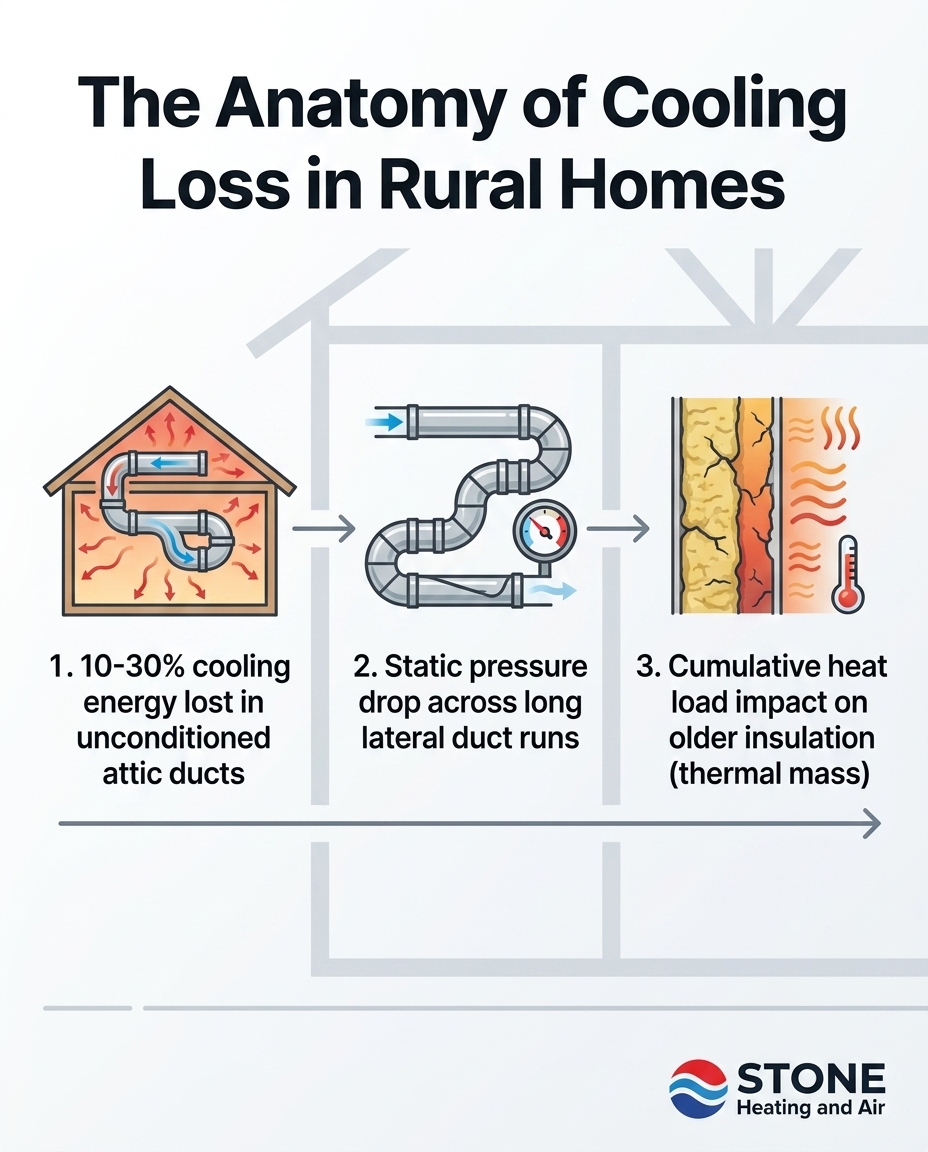
According to the U.S. Department of Energy, ductwork located in unconditioned spaces can lose 10 to 30 percent of the energy used to cool the air before it ever reaches your living space. If you are wondering why Applegate Valley homes struggle with consistent cooling, our team at Stone Heating and Air often points to this staggering hidden energy loss as the primary culprit. It is late August, your air conditioner is running non-stop, yet the bedrooms at the far end of the hall still feel uncomfortably warm. This frustrating dynamic is rarely caused by a broken unit. Instead, as we see on countless late-summer service calls across Central Point and surrounding areas, it is a direct result of the physical limitations found in the unique architecture of rural properties.
Many rural homeowners reach a critical decision point at the end of the season: continue forcing an overworked system to cool distant rooms, or finally address the underlying airflow and thermal envelope inefficiencies. Understanding the physical science behind your home's layout is the first step toward lasting comfort. Whether you are maintaining your current air conditioning systems or looking into long-term upgrades, solving uneven airflow requires looking beyond the equipment itself.
How Sprawling Footprints Sabotage Airflow
The architectural reality of Applegate Valley rural properties often includes sprawling single-story ranch houses, extended farmhouses, and long, customized additions. In our years of designing HVAC solutions for these wide-open footprints, we have seen firsthand how they create massive hurdles for standard residential heating and cooling systems. The core issue comes down to a principle called static pressure.
Understanding static pressure: Static pressure is essentially the resistance to airflow within your ductwork. When your blower motor pushes cold air into the ducts, that air has to travel through a maze of turns, branches, and long lateral runs. The further the air travels from the central blower motor, the more velocity it loses. By the time the air reaches the registers in an addition or a distant master suite, the force behind it has often dropped significantly.
Standard residential blowers are simply not designed to push air through 50 or 60 feet of extended lateral ductwork without a severe drop in velocity. If you place your hand over a vent in the main living room and feel a strong blast of cold air, but feel only a weak trickle of air at the far end of the house, you are experiencing a static pressure drop in real time. If you need AC repair in Applegate, OR because a distant room won't cool down, we find that the solution often requires addressing these ductwork limitations rather than just servicing the outdoor unit.
• Standard Two-Story Urban Home — Typical Duct Run Length: Short, vertical, centralized — Airflow Resistance (Static Pressure): Low to Moderate — Cooling Impact on Distant Rooms: Generally consistent if sized correctly
• Sprawling Single-Story Ranch — Typical Duct Run Length: Long, horizontal, extended — Airflow Resistance (Static Pressure): High (significant velocity loss) — Cooling Impact on Distant Rooms: Weak airflow, rooms stay 5-10 degrees warmer
• Farmhouse with Additions — Typical Duct Run Length: Complex, branched, varying sizes — Airflow Resistance (Static Pressure): Very High (frequent bottlenecks) — Cooling Impact on Distant Rooms: Highly uneven, some rooms over-cooled while others bake
This sprawling layout means that the blower motor is constantly fighting an uphill battle against the physical length of the house. Without specialized modifications, the air simply runs out of momentum before it can effectively condition the furthest corners of your home.
The Hidden Impact of Unconditioned Attics on Ductwork
Even if your blower motor is strong enough to push air to the end of the house, the journey that air takes can completely ruin its cooling capacity. In most rural homes, ductwork runs through an unconditioned attic space. The journey of conditioned air traveling through thin sheet metal or flexible ducting in these environments actively fights the cooling system.
The thermal gain effect: When your air conditioner cools the air to a crisp 55 degrees, that air immediately enters the duct system. If those ducts are sitting in an attic that is baking in the late-summer sun, a process called thermal gain occurs. The ambient heat of the attic transfers through the walls of the ductwork, warming the cooled air as it travels.
Southern Oregon's hot, dry late-summer climate creates brutal attic temperatures. When our Stone Heating and Air technicians inspect these spaces in late August, we routinely measure temperatures exceeding 130 degrees. When 55-degree air travels through 40 feet of ductwork surrounded by 130-degree heat, it absorbs a tremendous amount of thermal energy. By the time that air finally reaches the distant bedrooms, it may have warmed up to 70 or 75 degrees. You end up with lukewarm airflow that does absolutely nothing to lower the temperature of the room. This is a pattern we see frequently when diagnosing poor airflow in older homes across the region.
Furthermore, older ductwork often suffers from degraded insulation and tiny leaks at the joints. Not only is the air absorbing heat from the attic, but a percentage of your expensive conditioned air is physically escaping into the attic space before it ever reaches your living areas. Inspecting, sealing, and upgrading duct insulation is critical to protecting the cold air on its long journey across a sprawling house.
Older Insulation Standards and the Cumulative Heat Load
Ductwork is only half of the equation when it comes to late-summer cooling inconsistencies. The other major factor is the home's thermal envelope—the physical barrier between the conditioned air inside and the extreme heat outside. Older rural homes were often built using outdated insulation standards that fail to protect the living space against prolonged heat exposure.
To understand why your home feels significantly harder to cool in late August than it did in June, you have to understand thermal mass. Building materials like wood framing, drywall, brick, and roofing shingles absorb heat. During the first few weeks of summer, the house can cool down overnight and release that stored heat. But after weeks of relentless 95-degree days, the building materials become saturated with thermal energy. The house essentially bakes, holding onto the heat around the clock.
Degraded thermal envelopes: Older rural homes often lack modern R-value attic and wall insulation. When the thermal envelope is weak, the cumulative heat load penetrates the living space faster than the HVAC system can remove it. The air conditioner is no longer just cooling the air; it is fighting the radiant heat pouring out of the walls and ceiling.
This dynamic places immense strain on aging equipment. When a local homeowner reached out to Stone Heating and Air during a recent late-summer heatwave, their very old system had finally stopped keeping up with the overwhelming heat load. After assessing the severely outdated equipment and the home's sprawling layout, our team replaced two old AC units efficiently and followed up to ensure the new systems were properly managing the thermal load. Qualifying high-efficiency AC or heat pump installations may also be eligible for federal tax credits or local utility incentive programs, though we always advise homeowners to verify current programs with their utility provider or a tax professional. We remind our customers constantly: when insulation is poor and the equipment is outdated, the house will always win the battle against the air conditioner.
Why Upgrading to a Larger Unit Won't Solve the Problem
When faced with a house that won't cool evenly, a homeowner's first instinct is often to buy a higher-tonnage air conditioner. The logic seems sound: if the current unit can't push cold air to the back bedrooms, a bigger, more powerful unit should be able to force it there. Unfortunately, our technicians frequently have to explain why this is one of the most expensive and damaging misconceptions in residential HVAC.
Cooling capacity, measured in tonnage, dictates how much heat the unit can remove from the air per hour. It does not dictate how far the blower motor can push that air through undersized or excessively long ductwork. If you attach a massive air conditioner to restrictive ductwork, you do not get better airflow; you get a host of severe mechanical problems.
• Short-cycling: An oversized unit will blast the main living areas with cold air, satisfying the central thermostat in a matter of minutes. The unit shuts off before the distant rooms ever receive any cooling. This rapid on-and-off cycle destroys energy efficiency and burns out compressors prematurely.
• Poor humidity removal: Air conditioners need to run for extended cycles to pull moisture out of the indoor air. An oversized unit that short-cycles will leave your home feeling cold but clammy and uncomfortable.
• Increased static pressure: Trying to force too much air through narrow, long ducts increases static pressure to dangerous levels, causing blower motors to overheat and fail.
The ductwork and the unit must be properly matched to the home's specific architectural footprint. Upgrading your equipment is often necessary, but a new AC installation must be precisely sized to match the volume of air the ducts can safely handle. Bigger is rarely better; correctly matched is always best.
Targeted Solutions for Complex Architectural Layouts
Generic, cookie-cutter HVAC solutions fail in sprawling farmhouses. Slapping a standard system onto a complex rural footprint will always result in hot spots and high energy bills. As the local authority on Southern Oregon rural architecture, our team at Stone Heating and Air moves past generic "change your filter" advice to provide expert evaluations of duct length, static pressure, and thermal envelopes.
Solving these issues requires targeted airflow and envelope solutions rather than just swapping out a metal box outside. When one local customer experienced an emergency heater outage requiring a full system replacement, our technicians didn't just install a generic unit. We diagnosed the underlying layout issues, presented targeted replacement choices, and installed a new system that restored comfort quickly and efficiently to the entire home. That level of customized problem-solving is exactly what we deliver for sprawling layouts.
Evaluating Duct Length and Static Pressure
The first step our technicians take in solving inconsistent cooling is a professional measurement of airflow at the furthest registers. We use specialized tools to measure static pressure drops across the system. This evaluation identifies exactly where the air is losing its momentum.
During these inspections, we often find bottlenecks, crushed flex ducts, or completely disconnected joints hidden deep in the attic. By sealing leaks, upgrading duct insulation to modern R-values, and sometimes adding targeted return vents to balance the pressure, we can drastically improve the volume of cold air reaching the distant rooms without replacing the central AC unit.
Supplementing with Ductless Technology
For some homes, we find that the architectural layout is simply too long for any central duct system to handle efficiently. In these cases, our team often recommends ductless mini-splits as the ideal solution for distant additions, master suites, or second stories.
Bypassing the central ductwork: Ductless systems operate independently of your main central air. They require no ductwork, meaning there is zero static pressure loss and zero thermal gain from a hot attic. A small indoor air handler is mounted directly in the hard-to-cool room, connected to a dedicated outdoor compressor.
This allows you to create independent temperature control zones. You can keep the distant master suite at a crisp 68 degrees without freezing out the main living room or overworking the central system. Whether you need precise duct modifications, zoning dampers, or ductless integration, exploring comprehensive HVAC services ensures your home gets a solution tailored to its unique footprint.
Frequently Asked Questions About Rural Home Cooling
Why are distant rooms warm when the AC is running?
Distant rooms stay warm because the conditioned air loses its velocity and cooling capacity as it travels through long duct runs. By the time the air reaches the end of the house, friction has slowed the airflow, and the ambient heat of the attic has warmed the air inside the ducts. This results in weak, lukewarm airflow at the furthest registers.
How does duct length affect cooling in a large house?
Duct length directly impacts static pressure, which is the resistance to airflow. Standard residential blower motors can only push air so far before the air loses its momentum. In sprawling houses with extended lateral ducts, the air simply runs out of force, leaving the distant rooms starved for conditioned air.
Can you add HVAC zoning to an older rural home?
Yes, HVAC zoning can be added to older rural homes, though it requires a careful evaluation of the existing ductwork. Zoning uses motorized dampers inside the ducts and multiple thermostats to direct cold air only to the rooms that need it. If the existing ducts are severely undersized or damaged, supplementing with ductless mini-splits is often a more effective zoning strategy.
Why is one room hotter than the rest of the house during late summer?
During late summer, building materials absorb and retain weeks of solar heat, a concept known as thermal mass. If a specific room faces the afternoon sun, lacks proper insulation, or sits at the very end of a long duct run, it will absorb heat much faster than the HVAC system can remove it, making it noticeably hotter than the rest of the house.
How do you push cool air to the end of a long ranch-style house?
Pushing cool air to the end of a long house requires reducing static pressure and protecting the air from attic heat. At Stone Heating and Air, we achieve this by sealing duct leaks, upgrading duct insulation, ensuring the blower motor is set to the correct speed, and keeping interior doors open to allow return air to circulate. In extreme cases, bypassing the ducts entirely with a mini-split is the best option.
Does upgrading to a larger AC unit fix uneven cooling?
No, in our experience, upgrading to a larger AC unit rarely fixes uneven cooling caused by ductwork limitations. An oversized unit will cool the central rooms too quickly and shut off (short-cycling) before the cold air ever reaches the distant rooms. It also leads to poor humidity removal and increased wear and tear on the equipment.
Stop Fighting Your Home's Architecture for Comfort
Inconsistent cooling is a structural challenge, not a personal failing of the homeowner. If you have spent the entire summer closing vents, setting up box fans, and watching your energy bills climb while the back bedrooms remain stubbornly hot, it is time to stop fighting your home's architecture. The physical realities of sprawling layouts, long duct runs, and late August heat loads require specific, targeted solutions.
A clear, localized evaluation of your ductwork and thermal envelope by our experts can finally explain why your home struggles with airflow. By addressing the root causes of static pressure drops and thermal gain, we can help you restore even, reliable comfort to every room in the house. Schedule a professional evaluation of your airflow distribution with Stone Heating and Air today, and take the first step toward a home that cools consistently from end to end.