

Is the Jump to a High-Efficiency Furnace Really Worth the Investment?
When you start researching the process of upgrading to a high-efficiency furnace: calculating the real payback period is often the most confusing part of the decision. Are you staring at an aging heater and wondering if the higher upfront cost of a premium model is genuinely justified? You are not alone. Every fall, our team at Stone Heating and Air helps homeowners face the exact same dilemma: choosing between a standard 80% efficiency unit and a 96% or higher high-efficiency model. While the initial installation costs differ, the true cost of ownership is determined by the energy your system consumes over its entire lifespan.
If you need immediate assistance evaluating your options before the cold weather sets in, scheduling professional heating services is the best way to get a clear picture of your home's needs.
The September pre-heating season is the critical window to evaluate these options. Waiting until your current system fails in the dead of winter often forces a rushed decision based on what is in stock rather than what makes long-term sense for your home. To make an informed choice, you need to look past unpredictable national dollar averages and dive into the actual thermal efficiency math. By understanding how these systems use fuel, you can make a calculated decision that maximizes your comfort and minimizes energy waste for the next two decades.
Reframing the Payback Period: Understanding 80% vs. 96% AFUE Ratings
To truly understand the value of a new system, you have to understand how efficiency is measured. Furnaces are graded by their AFUE rating, which stands for Annual Fuel Utilization Efficiency. This percentage tells you exactly how much of the energy your furnace consumes is converted directly into usable heat for your home, versus how much is lost as exhaust gases out of the flue.
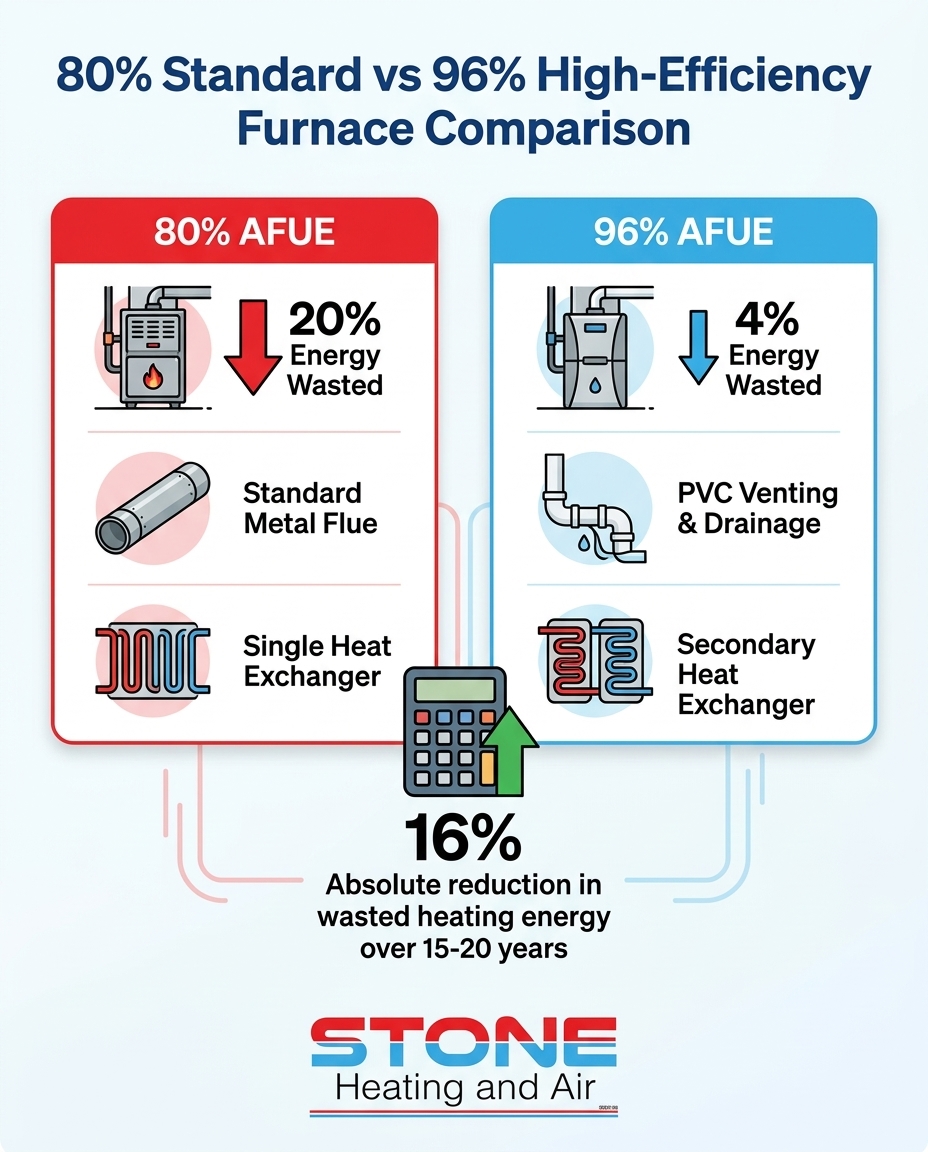
The math is straightforward but powerful. An 80% AFUE furnace turns 80% of its fuel into heat, meaning it wastes 20% of the energy it consumes right up the chimney. On the other hand, a 96% AFUE model wastes only 4% of its fuel. That is a massive 16% absolute reduction in wasted heating energy every single time the system cycles on.
• Energy Converted to Heat — Standard 80% AFUE Furnace: 80% of consumed fuel — High-Efficiency 96%+ AFUE Furnace: 96% or more of consumed fuel
• Energy Wasted as Exhaust — Standard 80% AFUE Furnace: 20% lost up the flue — High-Efficiency 96%+ AFUE Furnace: 4% or less lost as exhaust
• Heat Exchanger Design — Standard 80% AFUE Furnace: Single primary heat exchanger — High-Efficiency 96%+ AFUE Furnace: Primary and secondary heat exchangers
• Venting Requirements — Standard 80% AFUE Furnace: Traditional metal flue pipe — High-Efficiency 96%+ AFUE Furnace: Specialized PVC venting
When comparing standard and high-efficiency HVAC systems, we always advise our customers that this 80% vs 96% AFUE rating comparison is the most important factor in your decision. It shifts the focus from unpredictable variables to guaranteed mechanical performance.
Moving Away from Unpredictable Dollar Averages
Many homeowners try to calculate their payback period using raw dollar amounts, but this method is fundamentally flawed. Utility rates fluctuate constantly, and national average savings rarely reflect your local reality. Instead of trying to guess future energy prices, reframe your payback period around the absolute 16% reduction in energy waste. Over the typical 15 to 20-year lifespan of a furnace, consistently wasting 16% less fuel adds up to a massive reduction in overall energy consumption. By focusing on the percentage of heat delivered to your living space, you get a much more accurate picture of the system's true long-term value.
Condensing Technology: How Secondary Heat Exchangers Change the Installation Scope
The reason a 96% AFUE furnace costs more upfront isn't just a markup for the label; it is because the internal technology is fundamentally different. Standard furnaces use a single heat exchanger. High-efficiency models use two. This secondary heat exchanger is the secret to extracting that extra 16% of heat, but it also completely changes the scope of the installation process.
Here is what our installers at Stone Heating and Air actually do during a high-efficiency condensing furnace installation:
1. Extracting Latent Heat: The secondary heat exchanger pulls additional thermal energy from the combustion exhaust gases that a standard furnace would simply vent outside.
2. Managing Cooler Exhaust: Because so much heat is extracted, the resulting exhaust gases are much cooler than those from an 80% furnace.
3. Retrofitting PVC Venting: This cooler exhaust is prone to condensation and is slightly acidic. Therefore, traditional metal flues cannot be used. Our team must run specialized PVC piping to safely vent the gases outside.
4. Installing Condensate Drainage: The condensation created by the secondary heat exchanger must go somewhere. Our installers must route a dedicated PVC drainage line to safely remove this acidic water from your system.
These complex retrofits require careful planning and precise execution. For example, our crew responded to a homeowner who experienced a complete heater failure last spring. Our technicians diagnosed the issue and presented several options for system replacement without any high-pressure sales tactics, ultimately getting their heat back up and running efficiently. While emergency replacements are sometimes necessary, planning a complex high-efficiency installation proactively with our team is always a smoother process.
Why Fall is the Ideal Time for Complex Retrofits
Retrofitting PVC venting and routing new drainage lines takes significantly more time than a simple, like-for-like furnace swap. Tackling these difficult installation areas is much easier during the September pre-heating season. When our technicians can work before freezing temperatures arrive, they can route pipes and optimize your system without the pressure of an actively freezing house. Planning this work in the fall ensures your home is fully prepared before the first major cold snap hits.
Why Chilly Rogue Valley Winters Accelerate Your Energy Returns
Payback periods and energy returns are heavily dependent on how often your system actually runs. A high-efficiency furnace in a mild climate will take much longer to demonstrate its value than one installed in a region with demanding winters. Here in the Central Point and Rogue Valley area, our team sees first-hand how winter lows frequently drop into the 30s. This climate requires a consistent, heavy heating load from late fall all the way through early spring.
When your furnace runs constantly to combat freezing outdoor temperatures, that 16% efficiency gap compounds incredibly fast. Upgrading your heating equipment is often part of a larger effort to modernize an older home. For instance, our technicians recently helped a local customer who needed a bulky, inefficient 1950s wall heater removed; we quickly dismantled and hauled it away to make room for safer, more effective heating. Whether you are removing outdated wall units or replacing a central furnace, modernizing your HVAC systems in a cold climate means you tap into those efficiency gains every single day.
For local homes, the rigorous heating demand makes a 96% unit highly practical. The strong, consistent heat provided by condensing technology ensures your home stays perfectly comfortable, while the advanced efficiency significantly reduces the amount of fuel wasted to achieve that comfort.
Navigating the Upfront Investment Without the Guesswork
It is important to acknowledge that the expanded scope of a 96% AFUE installation—including the secondary heat exchanger, new PVC venting, and condensate drainage—requires a larger initial investment. However, bridging the gap between that upfront cost and the long-term energy reduction doesn't have to drain your fall savings.
Accessing flexible HVAC financing options allows you to upgrade to premium, high-efficiency technology without compromising your current household budget. By spreading the installation cost over time, you can start benefiting from the 16% reduction in wasted energy immediately. Additionally, generic federal tax credits or local utility rebates may apply to qualifying high-efficiency installations, which can further offset your initial costs. It is always recommended to verify current eligibility with a tax professional or your local utility provider.
The most crucial step is getting transparent, honest guidance from a trusted local team. At Stone Heating and Air, our professionals take accurate measurements, assess your current venting, and provide a pressure-free estimate based on real-world payback math. The ultimate goal is reliable winter comfort. One of our customers who needed a new heater during a bitter winter snap found that their Stone Heating and Air installation worked wonders, providing strong and hot heat right when their family needed it most. By securing a transparent evaluation during the fall, you guarantee that same level of comfort for your own home.
Frequently Asked Questions About Furnace Efficiency Upgrades
Is a 96 percent efficient furnace worth it?
Yes, especially in climates with heavy winter heating loads like we see here in the Rogue Valley. Because a 96% AFUE furnace wastes significantly less fuel than standard models, the reduction in wasted energy compounds rapidly over the unit's lifespan. The heavier your heating demand, the faster you realize the benefits of that efficiency.
How much energy does a 96 AFUE furnace save compared to an 80?
A 96% AFUE furnace wastes only 4% of its fuel, compared to a full 20% waste from an 80% model. This results in a 16% absolute reduction in wasted heating energy every time the system runs. Over a 15 to 20-year lifespan, this difference equates to a massive reduction in total energy consumption.
Do high-efficiency furnaces require different venting?
Yes, high-efficiency condensing furnaces require specialized PVC venting instead of traditional metal flues. Because the secondary heat exchanger extracts so much thermal energy, the resulting exhaust gases are cooler and slightly acidic. PVC safely handles this condensation and vents it outside without corroding.
What is the expected lifespan of a high-efficiency condensing furnace?
With proper installation and annual maintenance, a high-efficiency condensing furnace typically lasts 15 to 20 years. This long lifespan provides an extended runway to realize your energy reductions. Regular pre-heating season tune-ups are essential to keeping the secondary heat exchanger and drainage lines clear.
Are there tax credits available for upgrading to a 96% AFUE furnace?
Many high-efficiency units qualify for generic federal tax credits or local utility incentive programs designed to encourage energy conservation. Because these programs frequently change, homeowners should consult a tax professional or their local utility provider to confirm current eligibility and requirements before installation.
Finalize Your Fall Upgrade Strategy and Lock in Long-Term Savings
Choosing a 96% AFUE furnace is a calculated decision to drastically reduce your home's energy waste over the next two decades. By understanding the 80% vs 96% AFUE rating comparison, you can confidently weigh the expanded installation scope against the long-term benefits of condensing technology.
As the September pre-heating season comes to a close, installation schedules will fill up quickly with emergency cold-weather calls. Now is the time to evaluate your options, explore flexible financing, and get your new system seamlessly installed before the winter freeze. Take control of your home's comfort today by reaching out to our team at Stone Heating and Air for a comprehensive, pressure-free free estimate to determine the perfect high-efficiency solution for your property.