




The Late-Summer Airflow Crisis in Your HVAC System
Here in Central Point, August heat is unforgiving. When our team at Stone Heating and Air evaluates the performance of standard 1-inch filters vs. media cabinets for heavy summer use, the mechanical limitations of basic filtration quickly become obvious. You slide a fresh, clean filter into the return grille, only to pull it out just two weeks later and find it completely choked with a thick, gray layer of dust and debris. During August / late-summer continuous AC cycling, your cooling equipment pulls massive volumes of air through a very small surface area hour after hour. This creates a severe airflow crisis right when your home needs reliable cooling the most.
This constant, heavy strain forces a critical decision for homeowners: continue the frustrating, endless bi-weekly replacement cycle, or upgrade the return ductwork to handle a high-capacity filtration system. Making the right choice protects the longevity of your air conditioning systems while maximizing the effectiveness of your indoor air quality and purification solutions.
The standard 1-inch filter was never designed to handle the sheer volume of air moved during peak summer months. When your system runs continuously, every particle of dust, pet dander, and airborne debris is pulled directly into that thin barrier. Once the surface is coated, the system begins to suffocate, forcing the blower motor to work exponentially harder just to pull enough air to keep the house cool. Understanding why this happens—and how to fix it—is the first step toward a more efficient, reliable cooling season.
The Physics of Airflow: Why 1-Inch Filters Struggle Under Stress
The Problem: When extreme heat settles over the region, cooling systems are pushed to their absolute mechanical limits. In one recent case during a severe summer heatwave, our technicians at Stone Heating and Air responded to a local homeowner who experienced a complete system failure and required a same-day service call to restore their air conditioning on one of the hottest days of the year. Often, these sudden, extreme-heat breakdowns trace back to a surprisingly simple cause: a suffocated blower motor struggling against a dirty, restrictive air filter.
The Cause: Standard 1-inch filters inherently restrict airflow due to their physical design. They rely on dense, tightly packed fibers squeezed into a very narrow frame. As the filter loads with particulates during heavy summer use, the static pressure inside your ductwork skyrockets. Static pressure is the resistance to airflow within the heating and cooling system. When resistance increases, the blower motor must work significantly harder to pull air through the clogged fibers, which can increase your system's energy consumption by up to 15%.
Furthermore, when airflow drops below critical thresholds during continuous operation, your system faces the immediate risk of an evaporator coil freeze-up. The indoor coil relies on a steady stream of warm return air to keep the refrigerant inside from dropping below freezing. When a clogged 1-inch filter blocks that warm air, the condensation on the coil turns to solid ice, completely halting the cooling process and potentially damaging the compressor.
The Solution: Recognizing that standard 1-inch filters were originally engineered merely to protect the internal equipment from large, damaging debris—not to handle heavy, continuous micro-particulate loads—is essential. To maintain proper airflow without sacrificing air quality, we always recommend a filtration method with significantly more surface area.
The High-MERV Trap
Homeowners frequently try to improve their indoor air quality by purchasing the highest MERV (Minimum Efficiency Reporting Value) 1-inch filter available at the hardware store. While a higher MERV rating means the filter can trap smaller particles, it also means the fibers are packed much tighter together. Without sufficient surface area to distribute the airflow, these high-efficiency 1-inch filters clog almost immediately during peak season. Instead of improving your home's air, they effectively suffocate the HVAC system, leading to higher utility bills and accelerated wear and tear on the blower motor.
Unpacking the 4-Inch Pleated Media Cabinet Advantage
To resolve the airflow restriction issues inherent in thin filters, HVAC engineers developed the 4-inch pleated media cabinet. This upgrade fundamentally changes how your system breathes, prioritizing both high-efficiency filtration and unobstructed airflow. Here is how the media cabinet advantage works in practice:
1. Massive Surface Area Expansion: A 4-inch pleated media cabinet contains 20 to 30 times more surface area than a standard 1-inch fiberglass or pleated filter. If you were to unfold the accordion-like pleats of a 4-inch media filter and lay them flat, the material would stretch across an entire room. This vast surface area allows the filter to trap a massive volume of dust and debris without blocking the flow of air.
2. Sustained Low Static Pressure: Because the air has so many different pathways to pass through the deep pleats, the static pressure remains consistently low. This means you can utilize a high-efficiency media filter (such as MERV 11 or MERV 13) to capture microscopic particles, allergens, and smoke without causing the restrictive pressure drop that suffocates the blower motor.
3. Professional Installation Process: Transitioning to a media cabinet requires a permanent modification to your HVAC system. A professional technician from our team will alter the return ductwork, usually right next to the furnace or air handler, to fit the wider, specialized metal cabinet housing. Once the heavy-duty cabinet is sealed and integrated into the ductwork, the thick media filter slides easily inside on a track.
4. Dramatically Extended Lifespan: The most immediate benefit for homeowners is the extended replacement schedule. Instead of moving from bi-weekly or monthly changes during peak season, upgrading to a 4-inch pleated media cabinet allows you to replace the filter just one to two times per year, even with heavy, continuous August usage.
By spreading the particulate load across a much larger physical area, the media cabinet ensures that your air conditioner receives the precise volume of air it was engineered to condition, keeping the equipment safe and your home comfortable.
Head-to-Head Comparison: 1-Inch vs. 4-Inch Media Filters
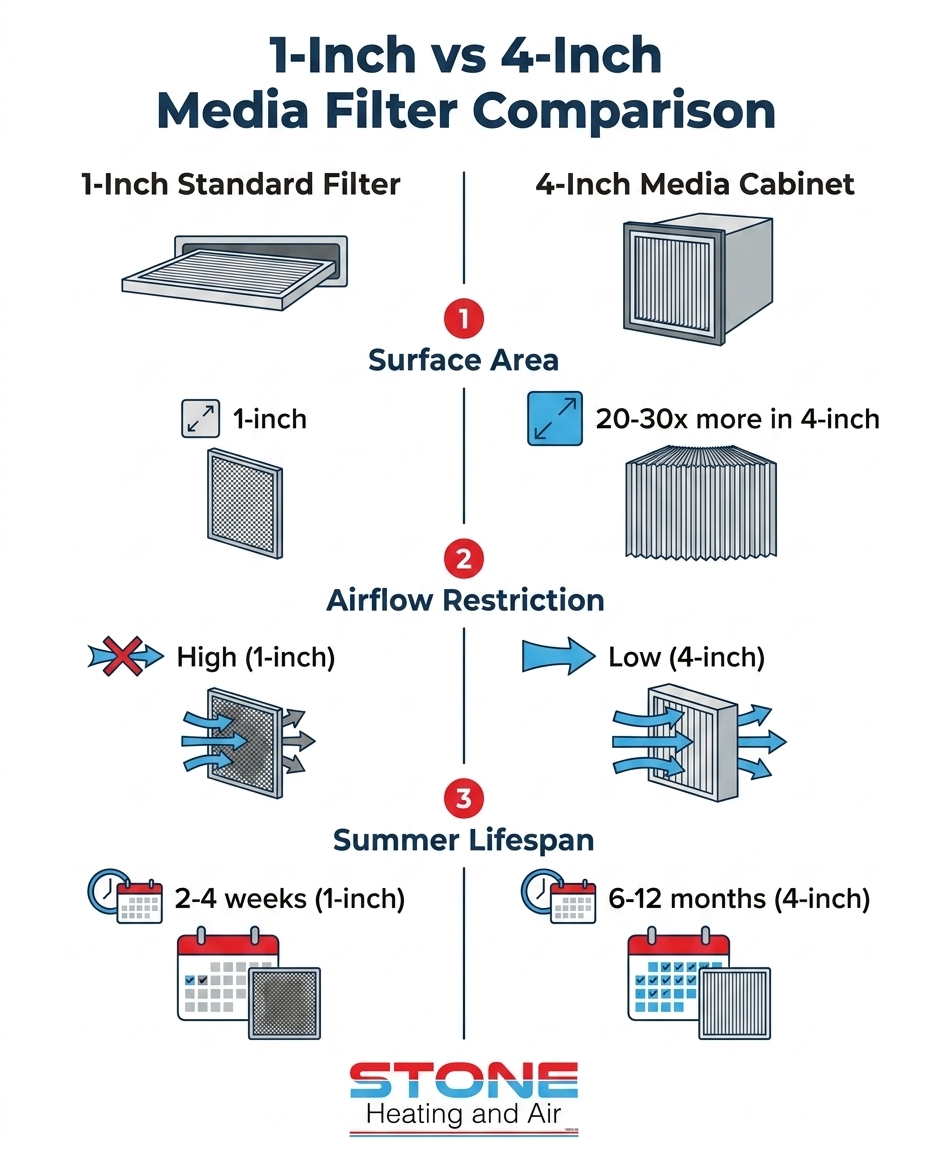
When deciding between sticking with standard filters or investing in a ductwork upgrade, looking at the direct performance metrics makes the choice clear. The following comparison highlights how a 4-inch pleated media cabinet outperforms traditional options across every critical category during the summer months.
• Surface Area — Standard 1-Inch Filter: Minimal; highly restrictive when dirty. — 4-Inch Media Cabinet: 20 to 30 times greater surface area.
• Airflow Protection — Standard 1-Inch Filter: High restriction; increases static pressure quickly. — 4-Inch Media Cabinet: Sustained low static pressure; protects blower motor.
• Summer Replacement Frequency — Standard 1-Inch Filter: Every 2 to 4 weeks during continuous AC cycling. — 4-Inch Media Cabinet: Every 6 to 12 months, even under heavy usage.
• Smoke Handling Capacity — Standard 1-Inch Filter: Clogs almost instantly under heavy particulate load. — 4-Inch Media Cabinet: High capacity for capturing dense micro-particulates.
The data clearly shows that while 1-inch filters are cheap to purchase upfront, their hidden costs in system strain and frequent replacements quickly add up. A media cabinet is an investment in the long-term health of your cooling infrastructure.
Navigating Regional Wildfire Smoke and Back-to-School Dust
Late summer introduces a compounding effect that acts as the ultimate stress test for your home's ductwork and filtration. In our years of keeping homes comfortable in Central Point, OR, we've seen how the combination of hot, dry weather and frequent regional smoke alerts creates an environment where standard filters simply cannot keep up. You are dealing with continuous cooling cycles pulling massive amounts of air, combined with a massive influx of heavy environmental particulates.
The PM2.5 Challenge: Regional wildfires produce PM2.5 micro-particulates—tiny particles of ash and soot that are 2.5 microns or smaller. When air quality alerts are issued and you keep your windows tightly closed, your HVAC system becomes the primary lung of the house. These micro-particulates overwhelm thin 1-inch filters almost instantly. If the filter is already partially clogged from regular dust, the added smoke particles will completely block airflow, or worse, bypass the compromised filter entirely and coat the blower wheel and indoor coil in a sticky layer of soot.
Back-to-School Activity: Simultaneously, the late-summer transition back to school brings increased foot traffic, kicked-up dust, and pet dander circulating through the closed-up house. This surge in indoor dust compounds the outdoor smoke issue.
Because of these severe regional factors, upgrading HVAC filters for wildfire smoke season is not just about keeping the air smelling fresh; it is about preventing a catastrophic breakdown. A 4-inch pleated media cabinet is uniquely equipped to capture high volumes of PM2.5 particulates without starving your air conditioner of the airflow it needs to survive August / late-summer continuous AC cycling.
The Hidden Costs of Sticking with Standard Filters
As local technicians at Stone Heating and Air who spend every summer diagnosing preventable breakdowns across Southern Oregon heatwaves, we offer this practical, honest advice: a 1-inch filter is often the weakest link in your system. Failing to maintain proper airflow does not just result in a slightly warmer house; it causes severe mechanical damage.
The consequences of restricted airflow are severe year-round, but they peak right now. Just last late-summer season, our crew found another local homeowner's cooling system completely unresponsive, requiring an urgent diagnosis and ultimately a full system replacement to restore comfort quickly. Whether it is struggling through a smoke advisory or enduring August / late-summer continuous AC cycling, a choked system will eventually fail under pressure.
When a choked 1-inch filter starves the system of air, several hidden costs begin to accrue:
• Overheated Blower Motors: The motor has to work much harder to pull air through a wall of dirt. This added electrical and mechanical strain causes the motor to run hot, significantly shortening its lifespan and often leading to emergency burnouts on the hottest evenings of the year.
• Frozen Evaporator Coils: As mentioned earlier, lack of warm return air causes the indoor cooling coil to freeze solid, which can send liquid refrigerant back to the outdoor compressor—a fatal blow to the most expensive component of your AC.
• Insulated Indoor Coils: When a 1-inch filter clogs, the static pressure can cause the filter to bend or bow in the return track. Dirt bypasses the filter entirely and lands directly on the wet indoor coil. This dirt acts as an insulator, drastically reducing cooling efficiency and driving up your monthly utility bills.
Proper filtration is foundational to complete HVAC performance, not just an optional air quality accessory. Protecting the mechanical health of your equipment starts at the return grille.
Is a Media Cabinet Upgrade Right for Your Home?
Determining whether a 4-inch pleated media cabinet is the right investment for your home comes down to evaluating your current routine and the specific demands placed on your system. At Stone Heating and Air, we use this checklist to help homeowners assess their situation:
• Assess your current replacement frequency: If you find yourself checking and changing standard filters every 2 to 3 weeks in August just to keep them from turning black, an upgrade is highly recommended.
• Consider the age of your system: Upgrading ductwork to accommodate a media cabinet is easily done during a full system replacement, as the sheet metal is already being modified. However, a skilled technician can also easily retrofit a media cabinet to existing, healthy systems.
• Evaluate your home's air quality needs: Homes with multiple pets, family members with allergies, or high dust infiltration from nearby dirt roads or construction will see an immediate, profound benefit from high-capacity filtration.
• Review your maintenance strategy: Keeping the system clean internally through high-capacity filtration is a core component of any effective routine maintenance plan. It reduces the need for expensive chemical coil cleanings and blower wheel pulls.
By upgrading your filtration infrastructure, you remove the constant worry of tracking bi-weekly filter changes and provide your equipment with the clean, unobstructed airflow it needs to thrive through the toughest late-summer heat.
Frequently Asked Questions
Does a 4-inch filter restrict airflow more than a 1-inch?
No, a 4-inch filter actually restricts airflow significantly less than a high-MERV 1-inch filter. Because the 4-inch filter has deep pleats, it contains 20 to 30 times more surface area for the air to pass through. This massive surface area ensures sustained, low static pressure, allowing your blower motor to breathe easily even as the filter captures microscopic dust and debris.
How often do you change a media cabinet filter during summer?
Even under heavy summer usage, a 4-inch media cabinet filter typically only needs to be replaced every 6 to 12 months. Unlike standard 1-inch filters that clog in a matter of weeks during continuous cooling cycles, the high-capacity design of a media filter handles heavy particulate loads for much longer periods without choking the system.
Is a 4 inch HVAC filter better than a 1 inch?
Yes, a 4-inch HVAC filter is vastly superior to a 1-inch filter in both air purification and mechanical protection. It captures a higher volume of microscopic pollutants while maintaining much lower static pressure. This combination protects your blower motor from overheating and prevents your indoor evaporator coil from freezing during peak operation.
Can I replace my 1 inch filter with a 4 inch without modifying ductwork?
Generally, you cannot simply slide a 4-inch filter into a slot designed for a 1-inch filter. The return ductwork or the furnace plenum must be professionally modified to accommodate the wider metal housing of a media cabinet. Once the new cabinet is installed and sealed, the thicker filters will slide perfectly into the new track.
Do thicker air filters increase static pressure?
Thicker filters, specifically 4-inch pleated media filters, actually reduce static pressure compared to tightly packed 1-inch filters of the same MERV rating. The depth of the pleats spreads the airflow over a much larger area, which lowers resistance. This allows your HVAC system to operate efficiently without straining the blower motor.
What is the best MERV rating for a 4-inch media cabinet during smoke season?
During regional wildfire smoke events, a MERV 11 or MERV 13 rating is highly effective for a 4-inch media cabinet. These ratings are dense enough to capture PM2.5 micro-particulates, ash, and soot. Because the 4-inch design offers extensive surface area, you can safely use these higher MERV ratings without causing the severe airflow restrictions that would occur in a 1-inch filter.