

Is Your Outdoor AC Unit Suffocating?
If you find yourself asking, "How Much Clearance Does Your Outdoor AC Unit Actually Need?" especially when your system runs for hours on end yet your house still feels uncomfortably warm, you are not alone. As we move deep into late-summer August and the back-to-school transition, our technicians at Stone Heating and Air notice many local systems working harder than ever to maintain the temperature on the thermostat. Often, the culprit isn't a broken mechanical part inside the machine—it is the overgrown landscaping outside. When bushes, weeds, and tall grasses peak at the end of the season, they can severely restrict your outdoor unit's airflow. This forces the entire system to overwork just to dissipate heat.
The key to solving this problem is identifying exactly how much vegetation to trim back based on precise measurement guidelines for side and overhead clearance. Whether you are looking for broad information on air conditioning systems or you need to schedule professional AC maintenance in Central Point, understanding these exact clearances is your first line of defense against a suffocating condenser.
The Exact Measurements: How Much Space Should Be Around an Air Conditioner?
Our team believes in establishing trust by providing exact, professional measurement guidelines rather than vague advice like "keep the area clear." When you know the precise dimensions required by major manufacturers, you can maintain your landscaping with total confidence. For Central Point area homes, adhering to these rules prevents unnecessary strain on your equipment and keeps your cooling bills predictable.
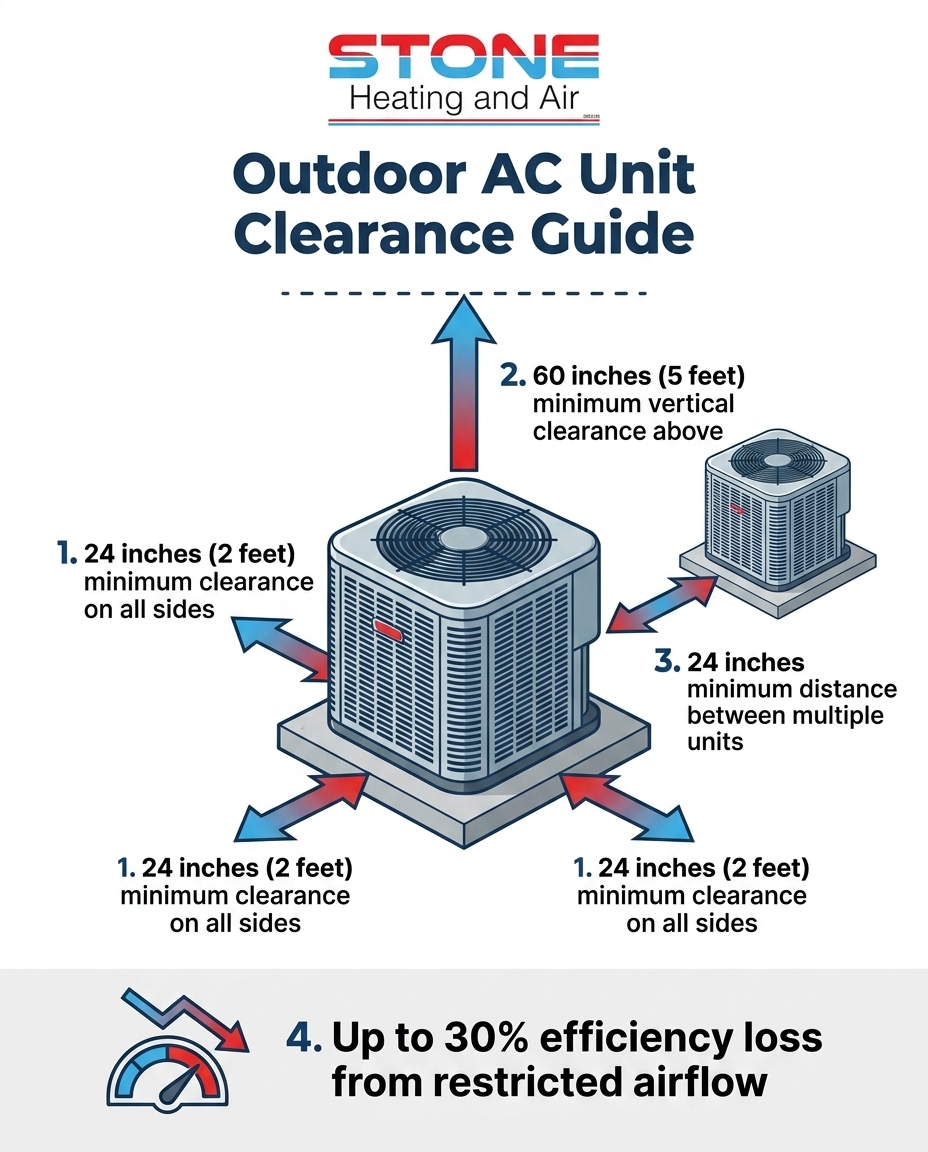
• The 24-inch side rule: Maintain a minimum of 24 inches (2 feet) of completely clear space on all sides of the outdoor unit. This allows adequate ambient air to be drawn through the side panels without restriction.
• The 60-inch vertical rule: Ensure a minimum of 60 inches (5 feet) of unobstructed vertical clearance above the unit. The large fan on top needs this space to exhaust hot air straight up and safely away from the house.
• Spacing for multiple units: If your home has more than one air conditioner or heat pump sitting side-by-side, there must be at least 24 inches of space between the units themselves so they do not pull in each other's exhausted heat.
• Standardized specifications: These are not arbitrary numbers. Major HVAC manufacturers like Carrier, Trane, and Lennox design their systems around these specific clearances to guarantee optimal performance and longevity.
Understanding these measurements is often part of a broader learning curve for homeowners. For example, one customer who was new to the area reached out to our Stone Heating and Air team during the winter for a routine filter change. The technicians arrived on time, swapped the indoor filters, and took the opportunity to explain how maintaining these exact outdoor clearances year-round exceeds basic upkeep and actively protects the equipment long-term.
The Physics of Cooling: Why Airflow is Critical for Heat Dissipation
To understand why 24 inches of clearance is an absolute necessity, it helps to look at the physical mechanics of how your system actually cools your house. Your air conditioner does not simply pump cold air inside; it actively removes heat from your indoor air and transfers it outside.
The Core Function: The outdoor unit, known as the condenser, houses a compressor and a network of coils. Its primary job is to release the absorbed indoor heat into the outdoor air. The large fan on top of the unit pulls ambient air through the side fins, over the hot coils, and blasts the heated air upward.
The Restriction Problem: When airflow is restricted by encroaching bushes, dense weeds, or accumulated debris, the exhausted heat is trapped in a small pocket around the unit. Instead of pulling in fresh, cooler air, the system ends up recirculating its own trapped, superheated air. Because the ambient air is already hot, the condenser coils cannot cool down the refrigerant effectively.
The Damaging Result: Providing the necessary breathing room stops this vicious cycle. Without proper clearance, the compressor has to work significantly harder, drawing more electrical current and generating even more internal heat. This excessive motor strain drastically increases the risk of a complete compressor burnout during peak heat waves, which explains exactly why late summer is the hardest time for your air conditioner's motor.
Southern Oregon's Unique Airflow Threats
While the 2-foot rule applies universally across the country, the specific climate challenges in the Rogue Valley make strict adherence even more critical. General guidelines often assume a standard suburban lawn, but in our years of servicing Southern Oregon homeowners, we see a distinct set of environmental factors at play.
As we hit late-summer August, dry brush and tall grasses reach their peak density at the exact same time your cooling demands are highest. This vegetation doesn't just block airflow; it dries out and sheds, sending organic material directly toward your condenser's delicate fins.
Furthermore, this region experiences high dust levels during the dry season. When airflow is already sluggish due to nearby plants, the fan struggles to pull air efficiently. This creates a vacuum effect that draws fine dirt and dust directly into the aluminum fins. The dust coats the condenser coils, acting like a thick insulating blanket. This compounding effect—restricted air volume combined with insulated coils—can reduce your system's overall cooling efficiency by up to 30%.
Certain local vegetation types, such as fast-growing blackberry vines or dense ornamental shrubs, tend to encroach aggressively on equipment spaces. If left unchecked, they can completely engulf the lower half of a condenser unit in just a few weeks of warm weather, choking the system completely.
Warning Signs Your AC Condenser is Choking on Vegetation
If you are unsure whether your landscaping has crossed the line from decorative to destructive, your system will usually give you warning signs. Diagnosing clearance issues early can save you from a major mechanical failure.
• Constant running with poor results: The system runs constantly but struggles to reach the thermostat's set temperature. If it feels like your AC never shuts off but the house remains warm, the condenser might be suffocating.
• Spiking utility costs: You notice unusually high energy bills. When operational efficiency drops due to restricted airflow, the system draws significantly more power to do the same amount of cooling.
• Overheating equipment: The outdoor casing feels excessively hot to the touch, or the system frequently trips the circuit breaker. This is a direct result of the compressor straining against high internal pressures.
• Short cycling: The unit turns on and off rapidly without completing a full cooling cycle. This is often a protective measure triggered by internal overheating to prevent the motor from melting down.
Clearing the perimeter is the first step, but if the unit has been running choked for weeks, internal damage may have already occurred. One local homeowner noticed their AC unit was not functioning correctly during a particularly hot stretch. A technician arrived after a long day, fixed the immediate mechanical issue, and took the time to explain how maintaining proper outdoor clearance prevents the problem from recurring. If clearing the vegetation doesn't immediately resolve your symptoms, it is time to look into professional AC repair services.
Smart Landscaping Rules for HVAC Efficiency
Maintaining the area around your outdoor unit doesn't mean you have to stare at a bare metal box in the middle of a dirt patch. You can still have a beautiful landscape, provided you follow a few smart rules to protect your HVAC efficiency. For Central Point area homes, balancing aesthetics with airflow is entirely achievable.
1. Choose the right plants: Avoid planting thorny bushes, dense shrubs, or heavy-shedding trees directly against the unit's perimeter. If you must plant nearby, choose spaced-out perennials that won't create a solid wall of foliage.
2. Manage ground cover carefully: Keep mulch, fallen leaves, and lawn clippings swept completely away from the base. Mulch holds moisture and can easily be sucked into the delicate fins by the powerful draft of the condenser fan.
3. Maintain the canopy: Trim back overhanging branches to maintain the critical 5-foot vertical clearance. Hot air must escape upward; if a low-hanging tree branch blocks it, the hot air deflects right back down into the unit.
4. Upgrade the base: Consider using crushed gravel, river rock, or paving stones around the unit's base instead of bare soil or bark mulch. Stone minimizes dust generation, deters weed growth, and keeps the immediate area clean.
5. Plan for growth: When planting new shrubs, factor in their mature size, not their current size. A small sapling planted two feet away today might have a four-foot spread in three years, completely violating the clearance zone.
DIY Debris Clearing vs. Professional Maintenance
When it comes to keeping your condenser clear, there is a strict dividing line between what you should tackle on a Saturday afternoon and what requires a licensed professional. Attempting the wrong kind of maintenance can permanently damage your system and void your warranty.
• Trimming bushes and raking leaves — DIY or Professional?: DIY — Why It Matters: Homeowners should regularly ensure the 2-foot perimeter is clear to maintain basic airflow.
• Washing the exterior cabinet — DIY or Professional?: DIY (with caution) — Why It Matters: You can use a standard garden hose on a gentle spray to rinse loose dirt, but never use high-pressure washers on the delicate aluminum fins, which can bend and permanently ruin airflow.
• Opening the cabinet and cleaning internal coils — DIY or Professional?: Professional — Why It Matters: Removing the casing exposes high-voltage electrical components and delicate refrigerant lines. Deep cleaning requires specialized chemical foaming agents.
• Checking refrigerant levels — DIY or Professional?: Professional — Why It Matters: Only a licensed technician can legally handle refrigerant and accurately gauge system pressures.
Proactive, scheduled upkeep is the absolute best defense against efficiency loss. While keeping the bushes trimmed is your responsibility, enrolling in a comprehensive HVAC maintenance plan ensures the internal components remain just as clear, safe, and efficient as the exterior.
Frequently Asked Questions About AC Condenser Clearance
Can I put a fence around my AC unit to hide it?
Yes, but the fence must be louvered or slatted to allow adequate airflow. A solid privacy fence will trap heat and suffocate the condenser. The enclosure must still maintain the minimum 2-foot clearance on all sides, and it should ideally have a wide gate or removable panels so technicians can easily access the unit for repairs.
What happens if my AC unit is blocked?
The system cannot expel the heat it removes from your home, causing the internal compressor to overheat. When this happens, your cooling efficiency drops dramatically, your energy bills rise, and the system may eventually shut down entirely. Over time, running a blocked unit will lead to permanent motor or compressor damage.
How much clearance does a heat pump need compared to an AC?
Heat pumps generally require the exact same clearance as traditional air conditioners: 24 inches on the sides and 60 inches above. Because heat pumps run year-round to provide both heating and cooling, maintaining this clearance in all seasons—including keeping it clear of winter snowdrifts or autumn leaves—is just as critical.
Can I plant bushes around my AC unit?
Yes, provided they are kept trimmed back at least 2 feet from the unit at all times. It is best to avoid plants that shed excessive leaves, drop seeds, or require constant, heavy watering near the equipment pad, as excess moisture and organic debris can accelerate corrosion on the condenser's base.
Is it safe to cover my AC unit in the winter?
Generally, modern outdoor units are built to withstand winter weather and do not require full covers. Covering a unit completely can actually trap moisture inside, leading to rust, and create a warm, sheltered environment that attracts rodents. If you must protect it from falling icicles or heavy debris, place a simple piece of plywood over the top fan grate, but leave the sides completely open to breathe.
Restore Peak Airflow Before the Next Heat Wave
Clear, exact measurement guidelines ensure your system has the breathing room it desperately needs to function efficiently. By maintaining 24 inches of side clearance and 60 inches of vertical space, you protect your equipment from the severe strain of restricted airflow. Restoring this proper airflow is the very first step to lowering your monthly utility bills and preventing a catastrophic mid-summer breakdown.
Take a walk around your yard today and measure the distance between your landscaping and your condenser. If your system is still struggling to keep your home cool despite a perfectly clear perimeter, the restriction may be internal. Promptly contact your local experts for comprehensive maintenance to ensure your home stays comfortable, efficient, and perfectly cooled all season long.