

The Frustration of Unexplained High Energy Usage
You know the sinking feeling: the first real chill of autumn hits, your heater kicks into high gear, and you immediately start bracing yourself for the upcoming utility costs. Tracing high winter heating bills back to hidden duct leaks is often the last thing on a homeowner's mind when the house feels drafty. Instead, a common initial reaction is to blame the heating unit itself, assuming the furnace is failing, losing its power, or simply too old to keep up with the dropping temperatures.
Before you assume the worst about your primary equipment, it helps to understand how your heating systems distribute that warmth throughout your home. The true culprit behind your high energy usage often lies entirely out of sight, silently draining your system's efficiency before the heated air ever reaches your living spaces.
Addressing this hidden issue during the September pre-heating season can save significant energy and prevent unnecessary, premature equipment replacements. When you take the time to evaluate the delivery network rather than just the heat source, you gain a much clearer picture of your home's true energy profile.
The Diagnostic Crossroads
When a home struggles to stay warm, homeowners typically face a critical diagnostic choice. In our experience at Stone Heating and Air, you can either assume the furnace needs to be replaced, or you can investigate the unseen pathways carrying the air. Making the right choice early in the fall prevents you from spending resources on a new heating unit that will ultimately suffer from the exact same delivery issues as the old one.
The False Alarm: Is It Your Furnace or Your Ductwork?
Symptoms like uneven heating, stubborn cold spots, and equipment that runs constantly are frequently misdiagnosed by homeowners as a dying furnace. When a system struggles to maintain the temperature set on the thermostat, the immediate assumption is that the primary unit simply lacks the mechanical power to perform its job.
However, a thorough diagnostic check must focus on the entire distribution network, ensuring the system is operating at peak performance rather than just treating surface symptoms. It is a common pattern our Stone Heating and Air technicians see in the field across Southern Oregon: a homeowner notices their system is not working at peak performance and assumes the worst. Yet, as we often explain during routine fall maintenance visits, ensuring correct maintenance of the hidden ductwork is what actually gets the system working at peak performance again.
Choosing to evaluate the ductwork before committing to a major equipment replacement is a critical first step in early fall maintenance. A furnace can generate all the heat in the world, but if the delivery system is compromised, that warmth will never reach your family.
Misinterpreting the Warning Signs
It is incredibly easy to misread the signals your home is sending you. The symptoms of a failing furnace and a leaking duct system overlap significantly, leading to understandable confusion. Here is what our team typically recommends watching out for:
• Thermostats that never reach their set temperature: The furnace runs continuously, but the indoor temperature stalls out several degrees below your comfort setting.
• Drafty rooms despite constant operation: You feel a noticeable chill or draft in certain rooms, even while you can hear the blower motor running at full speed.
• The psychological dread of utility bills: Receiving a massive utility bill for sub-par comfort, knowing you paid for heat that you never actually felt inside the home.
How Unconditioned Crawlspaces Drain Your Heating Efficiency
Our installation and repair teams frequently crawl under Central Point OR homes built over ventilated, unconditioned areas that remain completely exposed to outside temperature swings. These architectural features serve an important purpose for ventilation and moisture control, but they create a hostile environment for your home's climate control delivery system.
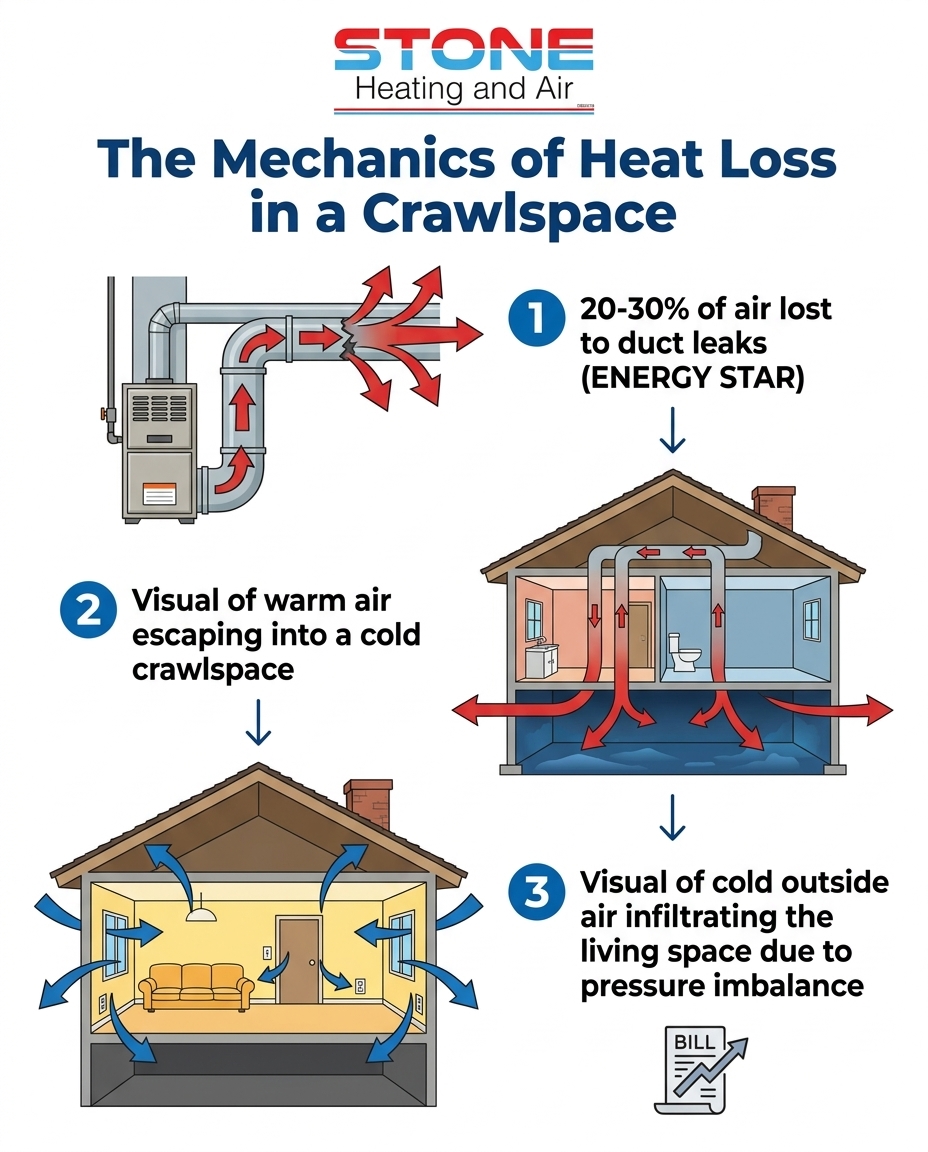
When Southern Oregon cold snaps hit, these unconditioned, ventilated crawlspaces act as massive heat sinks. They rapidly cool any warm air that escapes from compromised ductwork. If you have a disconnected duct run hanging in a freezing crawlspace, your system is literally heating the outdoors. The warmth your furnace worked so hard to generate is instantly neutralized by the freezing air circulating beneath your floorboards.
As a result, the primary heating unit is forced to overwork, attempting to compensate for the massive volume of heat lost in the dark. The furnace runs longer cycles, burns more fuel, and uses more electricity, all while your living room remains uncomfortably chilly. Understanding this dynamic is crucial for protecting the overall efficiency of your HVAC system.
The Anatomy of a Winter Heat Sink
To understand why crawlspaces are so detrimental to leaking ducts, you have to look at the thermal dynamics at play. A crawlspace is designed to let outside air flow through to prevent rot and mold. In the middle of winter, that means the air surrounding your ductwork is just as cold as the air on your front porch. Thin sheet metal or flexible plastic ducts offer very little resistance to that cold. When a seam splits open, the pressurized hot air is violently pushed out into the freezing void, wasting immense amounts of energy in seconds.
The Hidden Mechanics of Air Loss
The amount of energy wasted by compromised ductwork is staggering, and the mechanics behind this loss go far beyond just a little warm air seeping out of a crack. According to ENERGY STAR, a typical house loses about 20 to 30 percent of the air moving through its duct system due to leaks, holes, and poor connections.
This degradation does not happen overnight. Over time, the original mastic or tape used to seal duct joints can deteriorate, crack, or completely detach due to thermal expansion and contraction. As the metal heats up and cools down season after season, the seals weaken until they eventually fail.
When air escapes into the crawlspace, it creates a severe pressure imbalance inside the home, pulling in cold, unconditioned air through gaps around windows and doors to replace the air that was lost. This continuous cycle of heat loss and cold air infiltration drastically inflates utility costs.
The Physics of Pressure Imbalances
Understanding how air loss affects the pressure inside your home is key to diagnosing the problem. When ducts leak, they do more than just waste air; they actively fight against your home's natural envelope.
• Supply Leaks — Mechanism of Action: Hot air is pushed out into the crawlspace before reaching the vents. — Impact on the Home: Depressurizes the living space, creating a vacuum that sucks cold outside air in through window seals and door frames.
• Return Leaks — Mechanism of Action: The system pulls air from the crawlspace instead of the living rooms. — Impact on the Home: Pressurizes the home, forcing already-heated air out through cracks, while pulling contaminated, freezing air into the furnace.
Both of these scenarios force the equipment to run longer cycles, working twice as hard just to maintain a baseline level of comfort.
Why Hands-On Diagnostics in Difficult Areas Matter
Surface-level diagnostics often miss the root cause of heating inefficiencies, leading to band-aid fixes that do not solve the underlying problem. A technician might adjust the gas pressure on a furnace or recalibrate a thermostat, but if the ductwork is detached in the dark, those adjustments will not lower your utility bills.
True problem-solving requires navigating difficult areas like tight crawlspaces and attics to physically inspect the integrity of every single duct run. At Stone Heating and Air, our hands-on diagnostic approach means we don't just rely on digital readings from the living room; we physically inspect the crawlspaces to find the root cause of the failure. We frequently encounter situations where system installation or diagnostic work takes place in highly challenging environments. In one recent scenario, our crew went above and beyond to navigate a tight Central Point crawlspace to locate a massive duct separation, educating the customer along the way about why the failure occurred and how to prevent it.
Educating homeowners on the actual condition of their hidden infrastructure empowers them to make informed decisions. A physical inspection can reveal completely detached runs that no digital diagnostic tool could ever pinpoint from the comfort of a hallway.
What a Thorough Physical Inspection Entails
When our professionals evaluate your ductwork, we are looking for specific points of failure that common DIY checks miss. This includes:
• Checking the plenums: The main trunks connected directly to the furnace where pressure is highest and leaks are most severe.
• Inspecting branch connections: Verifying that the take-offs (where smaller ducts branch off the main trunk) are mechanically fastened and sealed.
• Evaluating structural support: Ensuring that flexible ducts are properly supported and not sagging, kinked, or resting on sharp objects that could tear the outer jacket.
The Secondary Impacts of Compromised Duct Integrity
Beyond the immediate financial cost of high utility bills, leaky ducts place severe, compounding strain on your heating equipment. When a system loses 30 percent of its air to the crawlspace, it has to run 30 percent longer to satisfy the thermostat. This constant operation overworks the blower motor and places undue thermal stress on the heat exchanger, leading to premature wear and tear.
Furthermore, when return ducts in a crawlspace leak, they act as a vacuum. Instead of pulling clean air from your living room, they pull dust, moisture, fiberglass particles, and musty odors directly from the dirt floor of the crawlspace into your home's breathing air. This is a critical factor in understanding how dirty ducts affect HVAC efficiency and overall indoor air quality.
Addressing these hidden leaks not only restores heating performance but also creates a significantly cleaner indoor environment. Ensuring a sealed system is vital for long-term comfort, respiratory health, and maintaining the mechanical lifespan of your entire climate control setup.
The Ripple Effect on Your Home
• Shortened Equipment Lifespan: Blower motors burn out faster when forced to run continuously against pressure imbalances.
• Excessive Dusting Required: Crawlspace dirt is pulled into the return side and blown out through your supply registers, coating your furniture in fine dust.
• Humidity and Moisture Issues: Pulling damp air from a crawlspace can introduce unwanted moisture into the home, making the air feel clammy and harder to heat.
Taking Action Before the Winter Cold Snaps
The September pre-heating season serves as the ideal transition month to perform comprehensive system checks before the deep cold sets in. Finding and fixing a disconnected duct run in the mild weather of early fall is far less stressful than discovering it during a freezing January night.
Professional sealing utilizes specialized mastics and mechanical fasteners that are designed to endure harsh temperature fluctuations. Unlike standard DIY cloth tapes—which dry out, peel, and fail rapidly in crawlspace environments—professional-grade sealants create a permanent, airtight bond. Securing the ductwork ensures that the heat generated by your furnace is actually delivered to the living spaces, maximizing your efficiency and comfort.
Additionally, taking steps to improve your home's thermal envelope can have financial benefits beyond lower monthly bills. Homeowners may also qualify for generally applicable energy rebates or federal tax credits when upgrading their home's efficiency through professional sealing and insulation measures. Always verify current incentive programs with your utility provider or a tax professional when planning your fall maintenance.
Professional Sealing vs. DIY Solutions
Many homeowners attempt to patch visible leaks themselves, but we strongly advise against this because crawlspace environments require specialized materials to ensure a lasting fix.
• Standard Duct Tape — Durability in Crawlspaces: Fails rapidly; adhesive dries out and peels under thermal stress. — Professional Verdict: Never recommended for permanent HVAC sealing.
• Foil Tape (UL Listed) — Durability in Crawlspaces: Good for minor seams on rigid metal, but requires perfectly clean surfaces. — Professional Verdict: Useful for specific applications, but not a universal fix.
• Fibered Mastic Sealant — Durability in Crawlspaces: Exceptional; goes on wet, cures into a flexible, airtight rubber-like seal. — Professional Verdict: The industry standard for permanent, reliable duct sealing.
Common Questions About Duct Leaks and Heating Bills
Can leaking ducts cause high heating bills?
Yes, leaking ducts are a primary cause of inflated heating bills. When heated air escapes into unconditioned spaces like attics or crawlspaces, your furnace must run significantly longer to warm the living areas. This wasted energy translates directly into higher monthly utility costs.
How much energy is lost through leaky ducts?
In a typical home, about 20 to 30 percent of the air moving through the duct system is lost due to leaks, holes, and poor connections. This staggering amount of loss means you are paying to heat a substantial volume of air that never benefits your family's comfort.
How do you find hidden duct leaks?
Finding hidden leaks requires a physical inspection of the ductwork in unconditioned spaces, often combined with specialized diagnostic testing like a duct blaster test. Professionals navigate tight crawlspaces to visually inspect joints, connections, and flexible duct integrity to pinpoint exact areas of failure.
Does duct sealing really save money?
Absolutely, professional duct sealing provides one of the most reliable returns on investment for home energy efficiency. By ensuring all generated heat reaches the living space, the heating equipment runs shorter cycles, reducing fuel and electricity consumption while extending the lifespan of the unit.
Why are crawlspace duct leaks particularly wasteful?
Crawlspaces are ventilated and exposed to outside temperatures, acting as massive heat sinks during the winter. When warm air leaks into a freezing crawlspace, the heat is instantly neutralized, and the resulting pressure imbalance actively pulls cold outside air into your home, compounding the energy loss.
Secure Your Heating Efficiency This Fall
Your heating unit might be perfectly fine, but it needs a secure, airtight delivery system to keep your home comfortable when the temperatures drop. Understanding how unconditioned spaces impact your energy usage is the first step toward achieving lower utility costs and more consistent indoor temperatures.
Don't wait until the first major freeze to find out your system is heating the outdoors. Explore professional inspection options to ensure your ductwork is fully sealed and your entire system is ready for the colder months ahead. Investing in professional duct repair today guarantees that the warmth you pay for actually stays inside your home, keeping your family comfortable all winter long.