

Facing a Total System Failure When the Permit Office is Closed
Your air conditioning system has completely failed, the indoor temperature is rapidly climbing, and you suddenly find yourself navigating the complexities of Central Point Permitting Requirements for Emergency HVAC Replacements. A sudden, total AC failure during an August late-summer heatwave creates a genuine health and safety emergency for any household. At Stone Heating and Air, our team typically sees a spike in these end-of-season cooling breakdowns right around the back-to-school transition. Homeowners often panic in these moments, assuming they must wait for municipal offices to open, file extensive paperwork, and wait days for a permit to be processed before a new system can be legally installed.
If you are dealing with a sudden breakdown, understanding your options for emergency HVAC service is the first step toward restoring your home's comfort and safety without violating local regulations.
The primary decision point in this crisis is figuring out how to legally and quickly proceed with an emergency replacement without running afoul of local building codes. When the temperature inside a home approaches 90 degrees on a Friday evening, waiting until Monday morning to speak with a city clerk is simply not a viable option. Fortunately, local regulations account for these exact scenarios. Professional HVAC contractors can initiate specific emergency protocols to restore your cooling immediately, taking on the burden of municipal compliance so you do not have to endure dangerous indoor temperatures.
Understanding how these emergency rules work provides immediate relief. You do not have to choose between following the law and keeping your family safe. The system is designed to prioritize human health during extreme weather, provided the correct administrative steps are taken by a licensed professional shortly after the crisis is resolved.
Understanding Mechanical Permits in the Central Point Municipal Jurisdiction
To understand the emergency exceptions, it is helpful to first understand the standard rules. Mechanical permits are strictly required in the Central Point municipal jurisdiction for the installation, alteration, or replacement of any central HVAC system. These rules are not mere bureaucratic hurdles; they are essential safeguards designed to protect homeowners.
These regulations exist to ensure that high-voltage electrical connections, pressurized refrigerant lines, and heavy mechanical equipment are installed safely. Furthermore, the permitting process verifies that new systems meet current energy efficiency standards and adhere strictly to all overlapping Oregon building codes. Under normal circumstances, a mechanical permit must be applied for, reviewed, and issued by the city before any physical work begins on the property.
While these rules are strict and heavily enforced, the state and local municipalities recognize a distinct difference between a planned, elective system upgrade and a sudden, dangerous breakdown that threatens a family's well-being. Standard procedures apply to standard situations, but emergency provisions are activated when time is of the essence.
What Constitutes a Mechanical Alteration?
It is important to differentiate between routine maintenance and a mechanical alteration. Swapping out major, integral components of your HVAC system qualifies as an alteration requiring municipal oversight. Basic upkeep does not.
• Routine Maintenance — Common Examples: Changing filters, cleaning coils, clearing condensate drains — Municipal Permit Required?: No
• Minor Component Repair — Common Examples: Replacing a capacitor, swapping a contactor, repairing a wire — Municipal Permit Required?: No
• Major Component Replacement — Common Examples: Installing a new compressor, replacing an evaporator coil — Municipal Permit Required?: Yes
• Full System Replacement — Common Examples: Installing a new air conditioner, heat pump, or furnace — Municipal Permit Required?: Yes
If your system requires a full replacement or a major component swap, municipal oversight is mandatory. The key difference in an emergency is simply when that oversight takes place.
The Emergency Replacement Exemption in Oregon Building Codes
The core search intent for homeowners facing a sudden breakdown revolves around legality and speed. Oregon building codes generally allow emergency mechanical replacements to proceed immediately to restore essential services. This legal mechanism is the exact provision that allows a contractor to remove a dead unit and install a new one on a Saturday afternoon.
This exemption is specifically designed for situations where a delay in restoring service would cause undue hardship, severe health risks, or structural property damage. The state recognizes that a home without climate control during extreme weather quickly becomes uninhabitable. However, this exemption comes with a very specific, legally defined caveat.
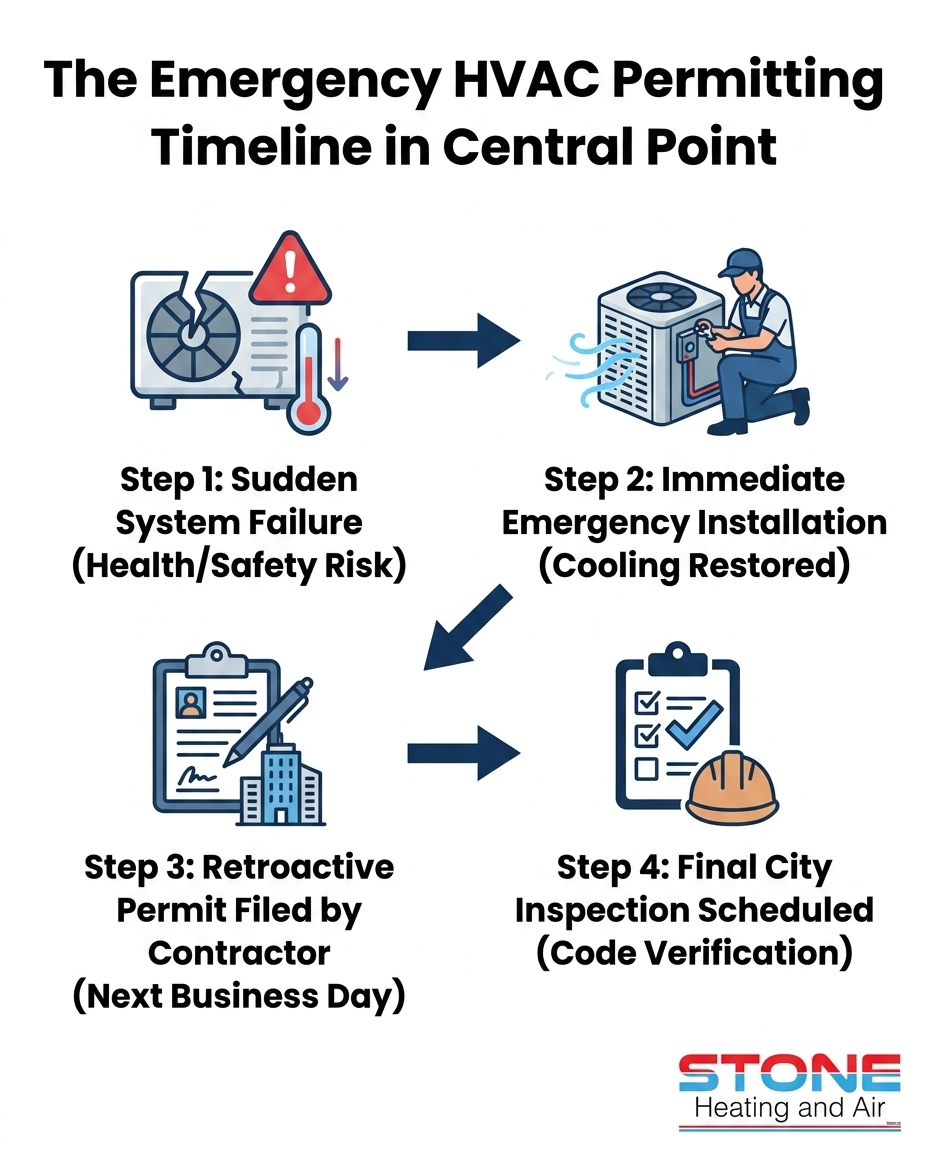
The Emergency Permitting Process Steps:
1. Immediate Action: The physical installation work can commence immediately to mitigate the emergency and restore cooling or heating to the home.
2. Retroactive Filing: The formal mechanical permit application must be submitted to the Central Point municipal jurisdiction within a legally defined short window—typically the very next business day after the installation begins.
3. Full Compliance: The installed equipment must still meet all current building and safety codes, just as it would if the permit had been pulled prior to installation.
4. Required Inspection: The standard post-installation inspection by a city official is still mandatory to close out the permit.
This legal provision ensures that safety is prioritized without abandoning the required municipal oversight. It allows homeowners to get immediate relief while ensuring the city still gets to verify the safety and efficiency of the final installation.
Prioritizing Health and Safety During Extreme Summer Temperatures
The specific microclimate of the Rogue Valley makes late-summer heatwaves particularly brutal. During an August late-summer heatwave, the thermal mass of a home absorbs solar radiation rapidly. If the air conditioning fails, indoor temperatures can quickly reach dangerous levels, often exceeding the outdoor temperature due to trapped heat and poor ventilation.
In these conditions, immediate AC replacement becomes a critical safety priority rather than a luxury that can wait for standard administrative timelines. Vulnerable populations, including the elderly, infants, and those with respiratory conditions, cannot safely remain in a home that is actively baking in the summer sun. The emergency permitting exemptions exist precisely because local authorities recognize these severe health risks.
Our own service records at Stone Heating and Air highlight the necessity of this exemption across all seasons. In one instance our team handled during a severe cold snap, a local homeowner experienced a complete heater failure. Our responding technician diagnosed the catastrophic issue immediately, provided options for a full system replacement, and installed the new system without delay. The heat was restored quickly and efficiently, preventing freezing pipes and severe discomfort. The exact same principle applies to the late-summer cooling emergencies we handle every August.
When the heat index spikes, local codes support immediate action to protect your family's well-being. A professional contractor will leverage these codes to ensure you are safe first, handling the bureaucratic requirements once the immediate danger has passed.
How a Turnkey Contractor Manages the Red Tape for You
During a household crisis, the last thing any homeowner wants to do is study municipal zoning laws or attempt to navigate an online permitting portal. The burden of navigating the Central Point municipal jurisdiction does not fall on the homeowner during an emergency. This is where the value of a professional, experienced HVAC team becomes apparent.
A licensed, professional HVAC contractor acts as an administrative shield. They execute the emergency replacement immediately to restore your comfort, while simultaneously handling all the necessary paperwork on the backend. This turnkey administrative service means you get the physical cooling relief you need without having to worry about compliance, code violations, or filing deadlines.
Our daily service logs at Stone Heating and Air demonstrate how this turnkey approach works in practice. When one Central Point homeowner required immediate HVAC service on a sweltering late-summer day, our professional team arrived the same day, explained exactly what was needed, and completed the work quickly. The issue was resolved with professional, honest service, and we even helped them identify where generic federal tax credits might apply to their new qualifying high-efficiency heat pump installation. Behind the scenes, our team managed all the necessary compliance requirements, submitting the retroactive permit application to the city on the next business day.
By choosing a contractor who provides comprehensive AC installation in Central Point, you are securing more than just a piece of equipment. You are securing a team that fully manages the permitting process retroactively, ensuring total compliance so you can simply enjoy a cool, safe home.
Transitioning from Repair to Replacement in an Emergency
Not every emergency service call begins with the assumption of a full system replacement. Often, a service visit starts as an attempt to fix a broken unit. A technician arrives, evaluates the system, and attempts to isolate the failing component. However, severe damage—such as a grounded compressor on a twenty-year-old unit or a cracked heat exchanger—frequently necessitates a full replacement.
When an emergency repair is no longer viable, the transition to an emergency replacement must be seamless. A qualified technician will provide immediate options so the homeowner can make an informed decision on the spot. If the decision is made to replace the unit, the emergency permitting protocols are immediately activated.
This seamless transition is critical because it prevents the homeowner from having to schedule a second appointment days later. The technician can often dispatch an installation crew immediately, turning a failed Central Point AC repair call into a fully compliant, same-day emergency replacement.
Applying the Same Rules to Heating Systems
It is worth noting that these exact same rules apply to winter emergencies. If a catastrophic failure occurs during a freezing winter night, the emergency permitting logic allows for a retroactive filing. Whether you are dealing with a failed air conditioner in August or a dead furnace in December, compliance is managed by the professional team after the essential services are restored.
The Risks of Skipping the Retroactive Permit Process
While the emergency exemption allows work to begin immediately, it is absolutely not a free pass to skip the permitting process altogether. It simply shifts the timeline. The requirement for a permit in the Central Point municipal jurisdiction remains absolute, and ignoring this requirement carries significant risks.
Failure to obtain proper mechanical permits retroactively can result in severe consequences for the homeowner, even if the installation itself was performed correctly. Working with a contractor who strictly follows the rules protects your home's value, your safety, and your peace of mind.
• Code Violations and Fines: Municipalities actively look for unpermitted work. If caught, homeowners face steep fines and mandatory retroactive permitting fees that are often much higher than the original cost.
• Failed Municipal Inspections: Without a permit, there is no final inspection. If the work was done improperly, you have no municipal safety net to catch electrical or structural hazards.
• Real Estate Complications: Unpermitted HVAC work can cause major complications during future real estate transactions. Savvy buyers and home inspectors will request the permit history for any major system, and missing permits can derail a sale or force costly concessions.
• Voided Warranties: Many manufacturers require proof of a permitted, code-compliant installation to honor their equipment warranties. Skipping the permit for a heating system replacement or AC install can leave you financially responsible for future factory defects.
What to Expect During the Post-Installation Inspection Phase
Once the emergency installation is complete, the house is cooling down, and the retroactive permit has been successfully filed by your contractor, there is one final step to close out the project. The city will require a final mechanical inspection to verify the work.
Your contractor will schedule this inspection at a time that is convenient for you. It is a standard part of the process and nothing to be intimidated by. The purpose of the inspection is simply to verify that the emergency work meets all local safety codes, energy efficiency standards, and manufacturer specifications.
The Final Inspection Process:
1. Scheduling: The contractor coordinates with the municipal building department to find a suitable time for the inspector to visit your home.
2. The Walkthrough: The inspector will examine the physical installation, checking electrical disconnects, refrigerant line insulation, and equipment clearances.
3. Sign-Off: Once the inspector confirms the work is code-compliant, they will sign off on the permit, officially closing the project with the city.
Understanding these timelines and expectations for emergency replacements ensures there are no surprises after your cooling is restored. The inspection is the final seal of approval that your emergency crisis was handled correctly and legally.
Restore Your Comfort Immediately with Turnkey Administrative Support
You do not have to suffer through an August late-summer heatwave waiting for municipal offices to open and process paperwork. The rules in the Central Point municipal jurisdiction are designed to protect you, not punish you during a breakdown. Emergency replacements can happen immediately, restoring your home's safety and comfort without delay.
By relying on the professional team at Stone Heating and Air for turnkey administrative support, all the necessary paperwork, retroactive filings, and inspection scheduling are handled on your behalf. Talk to our experts about your specific situation to get immediate, code-compliant relief and put your end-of-season HVAC emergency behind you.
Frequently Asked Questions
Do I need a permit to replace my AC in Central Point?
Yes, a mechanical permit is always required to replace an air conditioning system in Central Point. This ensures the equipment is installed safely and meets current Oregon energy codes. While emergency exemptions allow the work to start immediately, the permit must still be filed retroactively by your contractor.
How do emergency HVAC permits work in Oregon?
Oregon building codes allow licensed contractors to begin emergency mechanical replacements immediately to protect health and property. The contractor is then legally required to submit the formal permit application on the next available business day. This process balances the urgent need for climate control with the necessity of municipal safety oversight.
Who is responsible for pulling the mechanical permit?
When you hire a licensed professional, the HVAC contractor is responsible for pulling the mechanical permit. They act as your administrative representative, handling all the paperwork, fees, and scheduling with the city to ensure the installation is fully compliant with local codes.
What happens if you replace HVAC without a permit?
Replacing an HVAC system without a permit can lead to significant fines, code violations, and safety hazards due to a lack of municipal inspection. Additionally, unpermitted mechanical work often causes major delays or lost value during future real estate transactions when buyers demand permit histories.
Can a homeowner pull an HVAC permit?
While homeowners can technically pull permits for certain types of work on their primary residence, it is highly recommended that the licensed contractor performing the installation pulls the mechanical permit. The permit holder assumes liability for ensuring the work meets all complex electrical, structural, and mechanical codes.
How fast can an emergency AC replacement be completed during a heatwave?
Thanks to emergency permitting exemptions, an AC replacement can often be completed the same day or the next day during a severe heatwave. Professional contractors prioritize these health and safety emergencies, restoring your cooling immediately and handling the city paperwork retroactively.