


When a Dead Air Conditioner Becomes a True Summer Emergency
Your air conditioner is completely silent, and the indoor thermostat reading is climbing by the minute. Navigating Emergency AC Replacements in Medford: Timelines and Expectations can feel overwhelming when your house is rapidly turning into an oven. At Stone Heating and Air, we know there is a massive difference between a cooling system that is blowing slightly warm air and one that has suffered a catastrophic, total failure. When you face a complete breakdown during the peak summer cooling season, your immediate priority is evaluating a contractor's timeline to determine if their emergency replacement schedule is realistic and reliable.
If you are looking for reliable Air Conditioning services or need an immediate AC replacement, knowing exactly what to expect is your best defense against the heat. A structured process—starting with a rapid, on-site assessment—is the absolute fastest path to restoring your home's comfort. Vague promises of "fast service" do not cool your home; concrete timelines do.
With local temperatures frequently exceeding 90 degrees and easily reaching into the 100s during July and August, a dead AC is a time-sensitive safety risk, not just a minor inconvenience. The heat trapped inside a well-insulated home can quickly surpass outdoor temperatures, creating an environment that is deeply uncomfortable and potentially hazardous. Understanding the exact steps of an emergency replacement helps you make confident decisions without the added pressure of panic.
Defining an AC Replacement Emergency in the Rogue Valley
Extreme heat waves create highly localized spikes in air conditioning failures across Medford and Central Point OR. When temperatures soar, older HVAC systems are forced to run continuously just to maintain a baseline temperature. This relentless workload pushes aging compressors, failing blower motors, and degraded electrical components past their breaking point. What might have been a minor wear-and-tear issue in May quickly escalates into a complete system failure by July.
A typical emergency pattern our technicians at Stone Heating and Air see in Medford and Central Point OR involves total system failure during extreme summer weather. When an aging AC unit dies in the middle of a July heatwave, the situation demands rapid diagnosis. In our experience, homeowners need a professional who can quickly assess the damage, provide several no-pressure choices for system replacement, and restore comfort efficiently. Local contractors prioritize these total-failure calls because they understand that prolonged heat exposure in poorly ventilated homes is a serious liability.
Not every cooling issue requires an immediate system swap. A clogged condensate drain line or a blown dual run capacitor can often be fixed with a standard emergency HVAC service call. However, when our team finds a compressor grounded out, a refrigerant leak emptying an obsolete R-22 system, or a severely compromised coil, standard repairs are no longer viable or safe. At that threshold, a full emergency replacement is the only logical path forward.
Safety vs. Inconvenience
Knowing when to escalate a service request to emergency status depends heavily on the conditions inside your home. Modern homes are built tightly for energy efficiency, which is great for retaining conditioned air but dangerous when the AC fails, as the house traps solar heat like a greenhouse.
• Indoor Temperature — Standard Inconvenience: 75°F to 80°F, slightly uncomfortable. — True Summer Emergency: Rapidly climbing past 85°F, trapping heat indoors.
• System Status — Standard Inconvenience: Running constantly but struggling to keep up. — True Summer Emergency: Completely unresponsive, tripping breakers, or smoking.
• Household Vulnerability — Standard Inconvenience: Healthy adults who can use fans or open windows. — True Summer Emergency: Elderly residents, infants, or pets in the home.
• Weather Forecast — Standard Inconvenience: Mild evening temperatures approaching. — True Summer Emergency: Multi-day heatwave with high overnight lows.
If your situation aligns with the emergency column, time is of the essence. You need a contractor who understands the urgency and has a structured logistical plan to get a new system installed as quickly as physically possible.
Step 1: The Next-Day Measurement and System Assessment
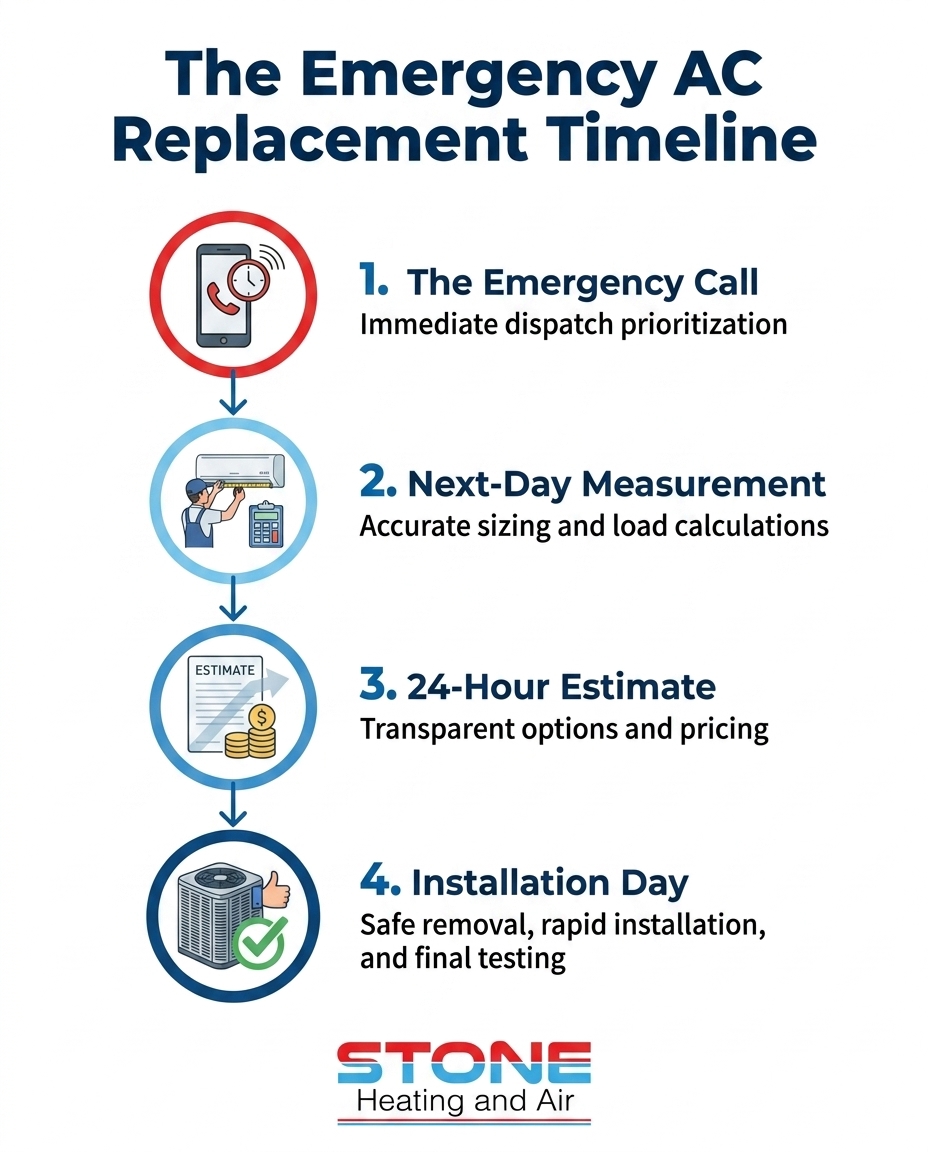
The first critical phase of the emergency replacement timeline is the on-site assessment. You cannot simply order a new air conditioner over the phone based on the square footage of your house. The first step to a successful replacement is an accurate, on-site measurement, and a reliable contractor will commit to performing this assessment by the very next day.
During this initial visit, technicians are doing much more than just looking at the broken unit. They are evaluating the entire HVAC infrastructure of your home. This includes inspecting the condition of your existing ductwork to ensure it can handle the airflow of a modern, high-efficiency system. They also check the electrical panel to verify that the current wiring and breakers meet the specifications of new equipment. If you previously relied on frequent AC repair in Medford to keep an undersized unit limping along, the assessment phase is where those historical sizing errors are finally corrected.
At Stone Heating and Air, we guarantee next-day measurements because it is a crucial differentiator in emergency service. It fast-tracks the replacement process without sacrificing the technical accuracy required for a flawless installation. By getting a technician on-site within 24 hours of your emergency call, the logistical wheels begin turning immediately.
Why Accurate Sizing Cannot Be Skipped
When your house is sweltering during the summer cooling season, it is tempting to tell a contractor to just install whatever unit they have in the warehouse. However, rushing this step or skipping proper load calculations leads to disastrous system performance down the road.
• The danger of oversized units: An AC that is too large for your home will "short cycle," turning on and off rapidly. This fails to remove humidity, spikes your energy bills, and burns out the new compressor prematurely.
• The danger of undersized units: A unit that is too small will run continuously without ever reaching your set temperature, completely defeating the purpose of buying a new system.
• Handling peak regional heat: Proper measurement ensures the new system is specifically calibrated to handle the extreme heat unique to the Rogue Valley, providing reliable cooling even when outdoor temperatures peak.
Transitioning from a diagnostic visit to a full replacement assessment requires specialized knowledge. The technician must perform a precise calculation that accounts for your home's insulation levels, window quality, and sun exposure, ensuring the replacement unit is a perfect match for your property.
Step 2: Securing a 24-Hour Estimate Turnaround
Once the measurements are complete, the clock is ticking to get concrete numbers in your hands. The logistics of generating an accurate replacement estimate rapidly is what separates a highly organized HVAC company from the rest. Immediately following the assessment, the team begins sourcing available equipment from local suppliers.
Providing a 24-hour estimate turnaround is a core standard for rapid, reliable, and transparent emergency service. This rapid turnaround empowers you to review your options, make an informed decision, and approve the estimate quickly so you can lock in your installation date. You should never be left waiting days for a quote while your family suffers in the heat.
Another common pattern we see at Stone Heating and Air when homeowners need a new HVAC unit installation is the timeline from assessment to completion. A technician comes out for precise measurements, provides detailed recommendations and a comprehensive estimate within 24 hours, and then the final installation is scheduled and completed within a week. This structured timeline removes the anxiety of the unknown.
A comprehensive emergency estimate should be highly detailed. It must clearly outline the cost of the equipment, the labor required, any necessary modifications to ductwork or electrical systems, and the exact timeline for installation. Transparency at this stage ensures there are no surprise fees on installation day. If you want to know more about the entire process, reviewing what to expect during an emergency HVAC call can provide additional peace of mind.
Navigating Supply and Availability
The reality of the summer cooling season is that equipment demand is at its absolute highest. Navigating supply chain logistics requires deep industry expertise.
1. Peak season demand: In our years of managing peak-heat installations, we've seen regional warehouses sell out of popular AC tonnages in a matter of hours when a heatwave hits Medford and Central Point OR.
2. Local distributor relationships: A reputable contractor leverages long-standing relationships with local distributors to secure priority access to high-quality equipment, bypassing the delays that often plague smaller operations.
3. Providing multiple tiers: A proper 24-hour estimate will offer you multiple equipment tiers—ranging from standard efficiency models to high-efficiency, variable-speed systems—so you can choose the option that best fits your immediate budget and long-term comfort goals.
Step 3: Managing the Gap Before Installation Day
Even with rapid turnarounds and priority scheduling, there may be a brief gap of a few days between estimate approval and the moment the installation crew arrives. Acknowledging this gap is important for setting realistic expectations. While the logistical planning, equipment ordering, and permit filing are happening behind the scenes, you need a strategy to survive the heat.
Implementing safe, temporary cooling strategies is essential, especially when dealing with the intense, dry heat typical of the Rogue Valley. Because the air lacks humidity, our team recommends certain strategies that work better here than they would in a muggy coastal climate.
• Deploy portable cooling: If you have access to portable AC units or window units, set them up in a single, central room. Keep the door closed to create a localized "cool zone" for sleeping and resting.
• Block solar heat gain: Close all blinds, curtains, and shades on south- and west-facing windows during the day. Sunlight beaming through glass accounts for a massive amount of indoor heat buildup.
• Strategic ventilation: In the dry heat of the valley, temperatures often drop significantly at night. Open windows strategically after sundown to create cross-ventilation, then seal the house up tight first thing in the morning.
• Limit heat-producing appliances: Avoid using the oven, stove, dryer, or dishwasher during the hottest parts of the day. Opt for microwave meals or outdoor grilling.
You can also use this brief gap to prepare the work area for the installation team. Clear away any patio furniture, garden hoses, or debris from around the outdoor compressor unit. Indoors, ensure there is a clear, unobstructed path to the furnace or air handler, whether it is located in the garage, basement, or attic. Preparing the site ensures that when the technicians arrive, they can immediately begin the removal process without delays.
Step 4: Installation Logistics and Local Compliance
The final step of the emergency replacement process is installation day. By demystifying this phase, homeowners can feel completely at ease while the crew works. A typical installation day for our Stone Heating and Air crews in Medford and Central Point OR begins with a morning arrival and a brief walkthrough to confirm the scope of work.
The first physical task is the safe recovery of the old refrigerant, followed by the complete removal of the dead unit. Once the site is prepped, the new indoor evaporator coil and outdoor condenser are set into place. Technicians will braze the new copper refrigerant lines, connect the high-voltage and low-voltage wiring, and ensure the condensate drain system is properly routed.
Local municipal processes and permits play a role in this timeline. Professional contractors pull the necessary permits required by city or county regulations to ensure the work is legally compliant and safe. While the permit process operates in the background, it culminates in a final municipal inspection to verify that all mechanical and electrical work meets strict local codes.
Final Testing Under Peak Load
Once the physical installation is complete, the system is not just turned on and left alone. The final testing and commissioning phase is arguably the most critical part of the day, especially during the summer cooling season.
• Calibrating for extreme temperatures: Technicians measure the refrigerant charge using digital gauges to ensure the subcooling and superheat levels are perfectly dialed in for peak summer performance.
• Verifying airflow: The team checks the static pressure of the ductwork and confirms that the thermostat is communicating flawlessly with the newly installed equipment.
• Homeowner education: Before leaving, the lead installer will conduct a final walkthrough with you. They will explain how to operate your new thermostat, show you where and how to change the air filter, and answer any final questions.
A professional crew will also meticulously clean the work area, hauling away all old equipment, boxes, and debris, leaving your home exactly as they found it—just much, much cooler.
Frequently Asked Questions About Emergency Replacements
How long does it take to get a new AC unit installed in an emergency?
In a true emergency scenario, a new AC unit can typically be installed within a few days of your initial call. The timeline begins with a next-day measurement, followed by a 24-hour estimate turnaround. Once you approve the estimate, the actual physical installation usually takes a single day, provided the equipment is readily available from local distributors.
What is considered a true AC emergency during the summer?
A true AC emergency occurs when a system completely fails during extreme heat, posing a safety risk to the occupants. This is especially critical if indoor temperatures are rapidly climbing past 85°F and there are vulnerable individuals, such as the elderly, infants, or pets, in the home. Minor issues like a strange noise or a slight drop in cooling efficiency are urgent, but complete unresponsiveness during a heatwave is an emergency.
Can an AC unit realistically be replaced in just one day?
Yes, the physical installation of a residential AC unit is almost always completed in a single day. However, the entire replacement process—including the necessary load calculations, equipment sourcing, and estimate approval—takes a few days leading up to that installation day. Rushing the measurement phase to force a same-day install often results in poorly sized equipment and long-term performance issues.
How long can you safely go without AC in the summer heat?
Safety depends entirely on outdoor temperatures, home insulation, and the health of the occupants. In the extreme dry heat of the Rogue Valley, an un-air-conditioned home can reach dangerous temperatures within 24 to 48 hours. It is highly recommended to use portable cooling units, stay hydrated, and utilize cross-ventilation at night while waiting for your emergency replacement.
What happens during the initial emergency AC replacement assessment?
During the initial assessment, a technician measures your home to perform a proper load calculation. They will inspect your existing ductwork, evaluate your electrical panel's capacity, and determine the exact specifications needed for the new unit. This visit ensures that the estimate you receive within 24 hours is highly accurate and tailored to your home's unique infrastructure.
Do local permits delay emergency HVAC installations?
No, local permitting processes generally do not delay the actual installation of an emergency HVAC system. Professional contractors are familiar with the municipal requirements in Medford and Central Point OR and can usually begin the work while the permit applications are being processed. The final municipal inspection simply takes place after the new system is already up and running.
Restoring Your Comfort with Clear, Realistic Timelines
A dead air conditioner during a heatwave is undeniably stressful, but understanding the step-by-step process removes the uncertainty and anxiety from the situation. By knowing exactly what happens between the initial breakdown and the final installation, you can navigate the crisis with confidence.
The value of guaranteed next-day measurements and rapid 24-hour estimates cannot be overstated. These precise logistical steps ensure that your home gets the exact equipment it needs to battle the intense heat of Medford and Central Point OR, without unnecessary delays or guesswork. Clear timelines mean you aren't left wondering when relief will arrive.
If you are facing a sudden system failure, do not wait for the indoor temperature to become unbearable. Reach out to the team at Stone Heating and Air for an immediate assessment so you can review your options, approve a transparent estimate, and get your emergency AC replacement scheduled before the heat takes over your home.