

Why the New HVAC Benefits Beyond Comfort Matter for Rogue Valley Homeowners
The new HVAC benefits beyond comfort may surprise you — today's high-efficiency systems do far more than keep your home at the right temperature. If you're wondering what else a new system can do for you, here's a quick answer:
Top benefits of a new HVAC system beyond comfort:
• Better indoor air quality — advanced filtration removes allergens, VOCs, mold spores, and wildfire smoke particles
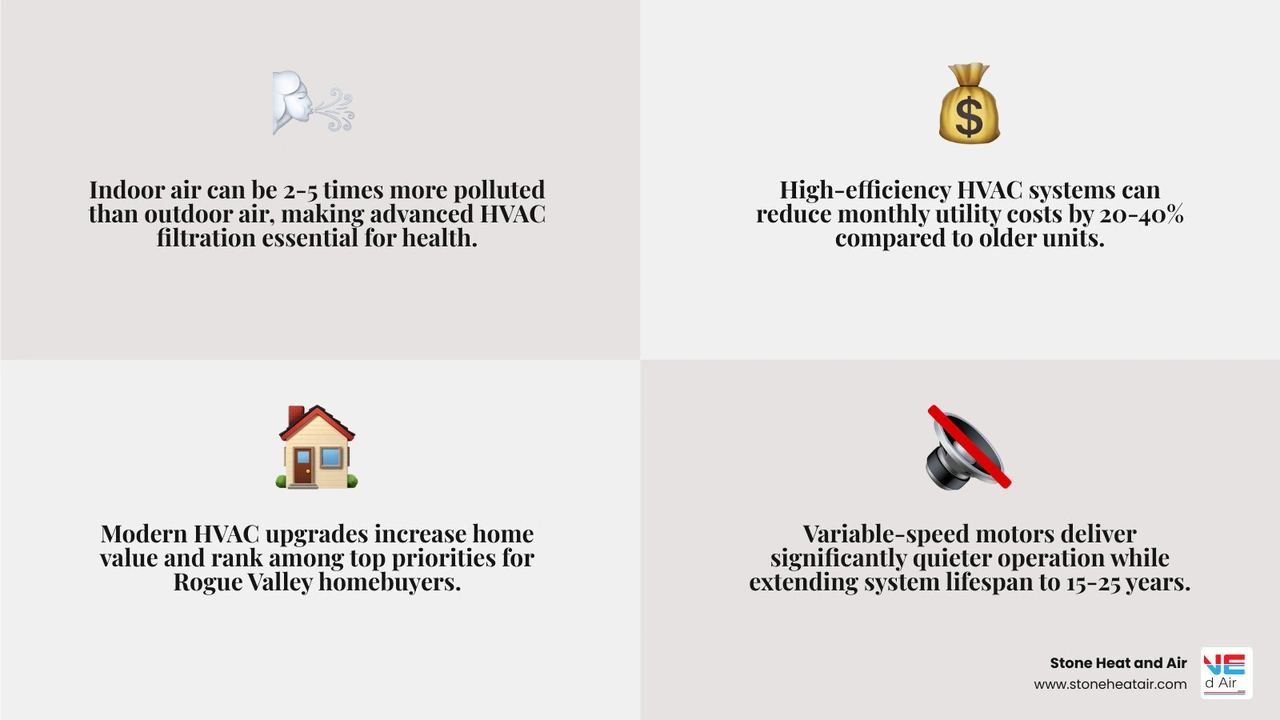
• Lower utility bills — high-efficiency systems can cut monthly energy costs by 20–40%
• Humidity control — protects your home's structure and prevents mold growth
• Higher home value — modern systems are a top priority for homebuyers
• Improved safety — built-in monitoring reduces risks from carbon monoxide and electrical faults
• Quieter operation — variable-speed motors run at lower speeds with significantly less noise
• Longer lifespan — professionally installed systems can last 15–25 years
Most homeowners think about HVAC only when something breaks. But the reality is, the air inside your home can be two to five times more polluted than the air outside — and an aging system often makes that worse, not better. Americans spend roughly 90% of their time indoors, which means the quality of your home's air has a direct impact on your health every single day.
In the Rogue Valley, where wildfire smoke, dry summers, and cold winters create real seasonal stress on HVAC equipment, upgrading to a modern system isn't just about staying comfortable. It's about protecting your health, your home, and your wallet at the same time.
This guide from Stone Heating & Air walks through every major benefit you can expect from a new high-efficiency HVAC system in 2026 — from cleaner air to a stronger home inspection report.
1. Breathe Easier: The New HVAC Benefits Beyond Comfort for Indoor Air Quality
When you think about your heating and cooling system, you probably think about temperature. But your HVAC system is actually the absolute lung center of your home. If your system is outdated, it might be circulating dust, pet dander, and pollen over and over again.
Understanding Indoor Air Quality: How Improving It Can Keep You Healthy is the first step toward a healthier household. Older HVAC units simply do not have the power or the design to handle modern filtration standards without putting a massive strain on the system's fan motor. When you upgrade your system, you gain immediate access to advanced filtration options that completely transform your indoor environment. There are several proactive 5 Things You Can Do to Improve Indoor Air Quality, and installing a modern system designed for high-efficiency filtration is easily the most impactful.
Advanced Filtration and Allergen Reduction
For local families dealing with seasonal allergies in Southern Oregon, spring and summer can feel like a continuous battle. Standard fiberglass filters only catch the largest particles — essentially "catching basketballs while the gnats fly right through."
Modern high-efficiency HVAC systems are designed to accommodate MERV 13 and HEPA filters without restricting airflow. These thick, pleated filters are incredibly dense, capturing up to 99.97% of airborne particles as small as 0.3 microns. If you are wondering, Can an Air Purifier Help Relieve Your Allergy Symptoms, the answer is a resounding yes — especially when integrated directly into a whole-home system. This is exactly Why an Air Purifier is Worth Investing in This Allergy Season if you want to keep outdoor pollen from settling in your living room.
Controlling Volatile Organic Compounds (VOCs)
Pollen and dust are only part of the story. Everyday household activities release invisible chemical vapors known as Volatile Organic Compounds (VOCs). These come from aerosol sprays, new carpets, fresh paint, household cleaners, and even cosmetic products.
Because modern homes are built tightly to prevent energy loss, these chemical vapors often get trapped inside. Fortunately, there are proven 5 Ways to Reduce VOC Levels in Your Home. A new HVAC system equipped with advanced indoor air quality accessories can actively target these gases. By understanding What Specific Pollutants Do Air Purifiers Target, you can see how pairing a new system with an activated carbon matrix or a photocatalytic oxidation (PCO) system neutralizes chemical fumes that a standard paper filter would let pass completely untouched.
Mitigating Wildfire Smoke in the Rogue Valley
Rogue Valley residents in Central Point, Roseburg, and Klamath Falls know all too well that summer often brings wildfire smoke. Smoke particles are exceptionally fine and can easily bypass standard HVAC filters, bringing hazardous ash and carbon right into your bedrooms.
Understanding How Wildfire Smoke Impacts HVAC Maintenance Needs is essential for anyone living in Southern Oregon. When smoke levels spike, an older system can quickly become overwhelmed, clogging your filters and circulating toxic particulate matter. Modern systems with dedicated air purification attachments can run on low-energy air-cleaning cycles to continuously scrub your air. There are 4 Ways an Air Purifier Improves Indoor Air Quality during smoke season, including the continuous capture of microscopic ash particles and the elimination of heavy smoke odors.
2. Maximizing Energy Efficiency and Utility Savings in 2026
Building operations consume about 40% of the energy and 74% of the electricity produced in the United States annually. On a global scale, cooling equipment alone consumed an estimated 5,000 terawatt-hours (TWh) of electricity in 2022 — roughly equivalent to the entire electricity consumption of the U.S. By 2050, that demand is projected to more than triple to 18,000 TWh.
With energy demands climbing rapidly, efficiency is no longer just a buzzword; it is a financial necessity.
Modern HVAC systems are built to meet strict efficiency regulations. In 2023, the U.S. Department of Energy transitioned to SEER2 (Seasonal Energy Efficiency Ratio 2) standards, which measure system efficiency under realistic, real-world conditions rather than ideal laboratory settings.
• Older Systems (Pre-2010) — Average SEER/SEER2 Rating: 10 – 13 SEER — Estimated Energy Use: High — Average Lifespan: 10 – 15 Years
• Standard Modern Systems — Average SEER/SEER2 Rating: 14 – 16 SEER2 — Estimated Energy Use: Moderate — Average Lifespan: 15 – 20 Years
• High-Efficiency Systems (2026) — Average SEER/SEER2 Rating: 18 – 25 SEER2 — Estimated Energy Use: Extremely Low (20-40% savings) — Average Lifespan: 15 – 25 Years
Upgrading an outdated, single-stage system to a modern, high-efficiency system can reduce your monthly utility bills by 20% to 40%.
Variable-Speed Motors and Smart Climate Control
Traditional HVAC systems operate like a light switch: they are either 100% on or completely off. When your thermostat registers a temperature change, the system kicks on at full blast, consumes a massive spike of electricity, cools or heats the home rapidly, and then shuts off. This constant cycling is incredibly inefficient.
Modern high-efficiency systems feature variable-speed motors (often called inverter technology). These motors act more like cruise control on a car. Instead of stopping and starting constantly, they can adjust their output anywhere from 25% to 100% capacity based on the exact demand of the home. By running for longer periods at lower, highly efficient speeds, they eliminate energy-heavy start-and-stop cycles and dramatically lower your overall electricity demand.
Environmental Sustainability and Carbon Footprint Reduction
Choosing an eco-friendly HVAC system directly reduces your home’s environmental footprint. Many modern systems are entirely electric, utilizing advanced air-source heat pumps that deliver up to three times more heat energy than the electricity they consume. By transitioning away from fossil fuels and reducing daily energy consumption, you play an active role in lowering greenhouse gas emissions.
Furthermore, these systems use the latest eco-friendly refrigerants, ensuring that your home's climate control does not come at the expense of our planet’s ozone layer or atmosphere.
3. Advanced Humidity Management and Structural Protection
Temperature is only half of the comfort equation; humidity is the other. In Southern Oregon, we experience a wide range of moisture levels — from the damp, coastal-influenced breezes of Brookings to the drier, high-altitude climate of Klamath Falls.
When relative humidity inside your home climbs above 60%, it creates a breeding ground for mold, mildew, and dust mites. Conversely, when it drops too low, it can dry out your nasal passages and skin. Managing this balance is crucial, and understanding How Humidity Affects HVAC Energy Efficiency explains why a balanced home feels much more comfortable at moderate temperatures.
How New HVAC Benefits Beyond Comfort Protect Your Home from Humidity
Traditional air conditioners only remove moisture from the air while they are actively cooling. Because they cycle on and off rapidly, they often don't run long enough to pull significant moisture out of the air. This leads to that sticky, humid feeling indoors.
Variable-speed systems solve this problem completely. Because they run longer, gentler cycles, they continuously pass indoor air over the cold evaporator coil, allowing moisture to condense and drain away safely. This steady dehumidification process prevents mold spore germination and mitigates biological contaminants, keeping your family safe from respiratory irritants.
Protecting Your Home's Structural Integrity
Excess humidity doesn't just impact your health; it slowly degrades your home's physical structure. Over time, high moisture levels can lead to:
• Wood rot in wall framing and floor joists
• Drywall damage, peeling paint, and sagging ceilings
• Warping of hardwood floors and wooden furniture
• Rusting of metal fixtures and structural brackets
By maintaining indoor humidity levels within the optimal 30% to 50% range, a new HVAC system acts as a shield for your home's physical structure, preventing costly repairs and preserving the integrity of your property's "bones."
4. Boosting Property Value and Marketability for Rogue Valley Sellers
If you plan to sell your home in Central Point, Roseburg, or anywhere in the Rogue Valley in the near future, a new HVAC system is one of the most valuable upgrades you can make. Today's homebuyers are incredibly tech-savvy and highly focused on operating costs.
When buyers tour a home, they look closely at the age of the major mechanical systems. An HVAC system that is over 12 years old represents an impending emergency expense. Conversely, a brand-new, high-efficiency system signals immediate peace of mind. Knowing How a New HVAC System Increases Home Value can help you position your property as a premium listing in a competitive market.
New HVAC Benefits Beyond Comfort for Home Sellers in Central Point
In Southern Oregon, energy efficiency is a major selling point. Highlighting a new system with a high SEER2 rating can make your home stand out during open houses.
• Green Certifications: High-efficiency upgrades can help your home qualify for energy-efficiency certifications, which attract environmentally conscious buyers.
• Home Inspections: A new HVAC system easily passes home inspections, avoiding the last-minute repair negotiations that often delay or derail home sales.
• Market Differentiation: Sellers who can provide documented proof of low utility bills and upgraded air filtration will always have a competitive edge.
Long-Term Financial Peace of Mind
For both you and the future buyer, system longevity is key. A professionally installed, modern HVAC system can last between 15 and 25 years with routine maintenance. Additionally, many premium systems come with generous manufacturer warranties that can be fully transferred to the new homeowner, providing an incredible incentive for buyers seeking long-term financial security.
5. Enhanced Safety, Reliability, and Quiet Operation
Older heating and cooling systems are inherently more prone to mechanical failure. More importantly, as components age, they can present genuine safety hazards to your household. Upgrading your system eliminates these worries by introducing advanced manufacturing standards and smart safety controls.
Built-In Safety Monitoring and Risk Mitigation
Modern HVAC systems are built to comply with the latest safety standards, addressing risks associated with older models, such as potential fire hazards and gas leaks.
• Carbon Monoxide Prevention: Aging furnaces can develop cracks in the heat exchanger, allowing odorless, dangerous carbon monoxide gas to leak into your home. New systems feature robust heat exchangers and automatic shut-off mechanisms that instantly disable the system if any combustion irregularities are detected.
• Electrical Safety: Modern units use advanced circuitry and built-in diagnostic capabilities to prevent electrical shorts and overheating, reducing fire risks.
• Proactive Alerts: Many smart-enabled systems can detect minor performance drops and alert you (and your trusted technician) to potential issues before they turn into major breakdowns.
The Sound of Silence: Modern Noise Reduction
If your current outdoor unit sounds like a jet engine taking off every time it cycles on, you will love the whisper-quiet operation of modern systems. Older units get louder over time as bearings wear down and compressor mounts degrade.
Thanks to advanced noise-reduction features, variable-speed compressors, and insulated dampening blankets, modern outdoor units run at decibel levels as low as 42 dB(A) — which is barely louder than a gentle hum. This quiet performance ensures you, your family, and your neighbors can enjoy peaceful nights and uninterrupted sleep.
Frequently Asked Questions
How much can I save on utility bills with a new system in 2026?
Upgrading an outdated HVAC system can reduce your monthly utility bills by 20% to 40%. By utilizing variable-speed technology and high SEER2 ratings, modern systems consume significantly less energy to maintain a perfect indoor climate, allowing the system to pay for itself over time in energy savings.
How does a new HVAC system impact my family's health?
A new HVAC system directly improves respiratory health by utilizing advanced MERV 13 or HEPA filtration, which captures up to 99.97% of dust, pollen, pet dander, and wildfire smoke. Additionally, precise humidity control keeps indoor moisture between 30% and 50%, preventing the growth of mold, mildew, and dust mites.
What is the expected lifespan of a high-efficiency HVAC unit?
With professional installation and regular preventative maintenance, a high-efficiency HVAC system can easily last between 15 and 25 years. This longevity is supported by advanced design features that reduce wear and tear on major mechanical parts, such as variable-speed motors that avoid harsh start-and-stop cycles.
Conclusion
Upgrading your heating and cooling system is one of the most valuable investments you can make for your home, your health, and your long-term financial peace of mind. The new HVAC benefits beyond comfort — from breathing cleaner air during wildfire season to enjoying lower utility bills and quiet, reliable operation — make a modern system a true home health upgrade.
At Stone Heating & Air, we are proud to serve families throughout the Rogue Valley, including Central Point, Roseburg, Klamath Falls, and Brookings. We are committed to honest and fair dealings, and we back all our work with 24/7 emergency service. For year-round peace of mind and uninterrupted comfort, we invite you to join our exclusive Stone Comfort Membership Club, which ensures your system receives the routine maintenance it needs to run efficiently for decades.
Ready to experience a healthier, more efficient home? Contact us today to explore our professional HVAC Services and find the perfect high-efficiency system for your family.