

The Stress of an Unexpected Late-Summer Cooling Failure
Your air conditioner is running nonstop, but the vents are barely pushing out cool air, and the house is growing uncomfortably warm. Understanding your AC's SEER2 rating when shopping for a replacement might be the last thing on your mind when you are just trying to get your home cool again in late August. However, rushing into a sudden replacement without grasping these basic efficiency metrics can lead to years of unnecessary utility waste. Modern cooling systems are measured quite differently than the unit currently sitting in your backyard, and the rules governing how they operate have recently changed.
Dealing with an aging cooling unit that decides to fail right when the heat is most oppressive is incredibly frustrating. The last thing you need in that moment is a stack of brochures filled with dense engineering terms. Instead of letting industry terminology add to the panic of an emergency installation, we are here to provide a plain-English translation of exactly what these ratings mean for your home. If you are looking to upgrade your air conditioning systems, getting a firm handle on these concepts is the best way to protect your long-term comfort.
Decoding the Jargon: What Does SEER2 Actually Mean?
When you start looking at new cooling equipment, the most common acronym you will encounter is SEER2, which stands for Seasonal Energy Efficiency Ratio 2. To put it simply, you can think of a SEER2 rating as the "miles per gallon" measurement for your air conditioner. Just as a car with a higher MPG rating requires less fuel to drive the same distance, an air conditioner with a higher SEER2 rating requires less electricity to produce the same amount of cooling for your home.
Our goal is to provide transparent, jargon-free education so you feel empowered to make the right choice for your household, rather than feeling confused by technical specifications. You absolutely do not need an engineering degree to make an informed choice. You simply need to know that a higher number translates directly into less energy consumed, which ultimately impacts your monthly utility statements.
The Difference Between SEER and SEER2
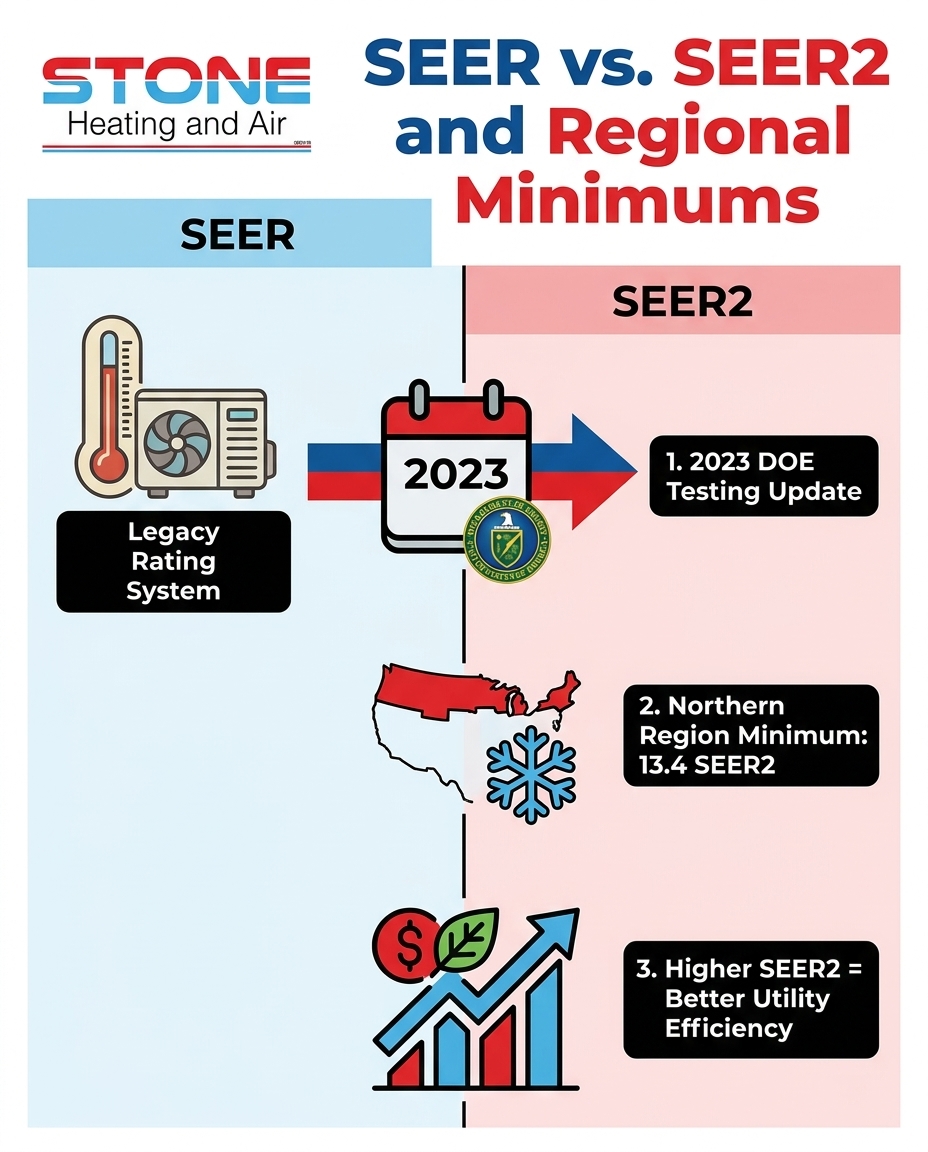
If you replaced an air conditioner a decade ago, you likely remember seeing standard SEER ratings. However, the Department of Energy (DOE) implemented a nationwide update on January 1, 2023, transitioning the entire industry to the SEER2 standard. This change was designed to make efficiency testing much more accurate for everyday homeowners.
Key differences in the testing process:
• Real-world conditions: The old SEER testing did not accurately reflect the airflow restrictions found in typical residential ductwork.
• Higher static pressure: SEER2 testing accounts for higher external static pressure, mimicking the real-world resistance a system faces when pushing air through a home's vents.
• Rating conversions: Because the testing is more rigorous, a modern SEER2 rating is numerically slightly lower than an equivalent older SEER rating. For example, a system that would have been rated 15 SEER under the old rules might be rated around 14.3 SEER2 today.
Understanding these minimum efficiency standards ensures you are comparing apples to apples when looking at new equipment quotes.
Navigating the 2023 DOE Updates and Regional Minimums
Because the climate varies drastically across the country, the Department of Energy divides the United States into three distinct climate regions for efficiency standards: the North, the Southeast, and the Southwest. The legal baseline for efficiency depends entirely on where your home is located.
Oregon falls into the Northern region. Under the current federal guidelines, the absolute legal minimum baseline required for new residential central air conditioning installations in this region is 13.4 SEER2. HVAC contractors cannot legally install a central air conditioner that falls below this threshold. These SEER2 minimum regional standards were put in place to reduce overall grid strain and improve national energy conservation.
While the minimum rating is legally required to pass inspection, it is important to recognize that "minimum legal compliance" is rarely the optimal choice for long-term utility management. A baseline unit will cool your home effectively, but it will consume more electricity to do so than a mid-range or premium-tier system.
• Northern Region — Included Areas (Examples): Oregon, Washington, Colorado, New York — Minimum Permitted SEER2: 13.4 SEER2
• Southeast Region — Included Areas (Examples): Florida, Georgia, Texas, North Carolina — Minimum Permitted SEER2: 14.3 SEER2
• Southwest Region — Included Areas (Examples): California, Arizona, Nevada, New Mexico — Minimum Permitted SEER2: 14.3 SEER2 (plus EER2 requirements)
Why the Local Climate Demands a Closer Look at Efficiency
Abstract numbers on a manufacturer's brochure are one thing, but the reality of cooling a home during prolonged heatwaves requires a more practical perspective. In Central Point, Oregon, and throughout the Rogue Valley, summer brings consecutive days of intense, unrelenting heat. When the temperature stays high for weeks on end, your cooling system is forced to run almost continuously to keep your indoor environment comfortable.
Baseline SEER2 ratings might be perfectly sufficient for mild climates where the air conditioner only runs a few weeks out of the year. However, in hotter areas that experience heavy seasonal usage, higher ratings offer significantly better utility management. The more your system runs, the faster a high-efficiency unit pays for itself through monthly utility conservation.
How advanced technology boosts SEER2 ratings:
• Single-stage compressors: Typically found in baseline minimum units. They run at 100% capacity until the house reaches the target temperature, then shut off completely.
• Two-stage compressors: Found in mid-range SEER2 units. They can operate at a lower capacity (usually around 65%) on milder days, which saves energy and removes humidity more effectively.
• Variable-speed compressors: Found in the highest SEER2 tiers. These units make tiny, constant adjustments to their output, maintaining consistent indoor temperatures without massive energy spikes.
Connecting the choice of your efficiency rating directly to your monthly utility statements during peak summer months is crucial. A variable-speed, high-SEER2 system will sip electricity steadily, whereas a baseline single-stage system will constantly surge on and off, drawing maximum power each time it starts up.
Balancing Speed and Efficiency During an Urgent Replacement
It is a common reality that emergency replacements often feel rushed. When your current unit is completely dead and the indoor temperature is rising by the hour, you may feel you have limited time to research your options. However, evaluating a few clearly presented choices can dramatically streamline the decision-making process without sacrificing long-term efficiency.
One local homeowner ran into this exact problem during the summer when they started having trouble with a very old AC and furnace system. A professional quickly assessed the situation, provided a few clear replacement options, and efficiently installed two new AC units and two furnaces. Because the options were laid out clearly, the homeowner was able to make a fast decision and get the system up and running quickly.
To navigate an urgent replacement smoothly, follow these steps:
1. Assess the immediate need: Confirm whether the existing system is truly beyond repair or if a temporary fix can buy you time to evaluate your options.
2. Review three distinct tiers: Ask your technician to present a baseline (minimum legal SEER2), a mid-range, and a premium efficiency option. This makes comparison much easier.
3. Check ductwork compatibility: It is vitally important to match the new SEER2 equipment with your existing ductwork. If your ducts are undersized or leaking, even the highest-rated unit will not achieve its advertised efficiency.
4. Evaluate the indoor unit: A new outdoor AC unit must be paired with a compatible indoor blower motor (furnace or air handler) to reach its official SEER2 rating.
An expert assessment can quickly narrow down the best HVAC equipment choices for your home's specific footprint, ensuring you do not make a hasty decision you will regret when the next utility statement arrives.
Exploring Options to Offset Higher Efficiency Costs
It is a simple fact of the industry that units with higher SEER2 ratings typically require a larger upfront investment. The advanced technology that allows variable-speed compressors and high-efficiency coils to operate so quietly and effectively costs more to manufacture than standard baseline equipment. However, looking only at the initial installation quote only tells half the story.
The true cost of an air conditioner includes both the day-one installation and the electricity it will consume over the next 15 to 20 years. This is the concept of return on investment through monthly utility efficiency over the lifespan of the equipment. A high-efficiency unit will cost less to operate every single month. Over a decade of hot Rogue Valley summers, that accumulated efficiency can significantly offset the premium upfront cost.
Furthermore, there are often external programs designed to make high-efficiency upgrades more accessible. Energy rebates, federal tax credits, and utility incentive programs may apply to qualifying high-efficiency installations. These programs are frequently updated to encourage homeowners to transition to greener technology, such as high-SEER2 heat pumps and advanced air conditioners. We highly advise readers to consult with a professional to explore flexible HVAC financing options that make premium efficiency accessible, allowing you to enjoy the comfort of a top-tier system while managing the investment over time.
Frequently Asked Questions About SEER2 Ratings
What is the minimum SEER2 rating in Oregon?
Oregon requires a minimum of 13.4 SEER2 for residential central air conditioners. Because Oregon is classified under the Department of Energy's Northern region, any newly installed split-system air conditioner must meet or exceed this baseline to legally pass inspection and comply with current federal energy standards.
How does SEER2 affect my utility bills?
Higher ratings mean the system uses less electricity to produce the same amount of cooling, which can lower monthly utility usage. Think of it like a highly fuel-efficient vehicle; a system with a high SEER2 rating will require less power to maintain your set thermostat temperature, helping to insulate you from rising seasonal energy rates.
Is 14.3 SEER2 considered a good rating?
Yes, 14.3 SEER2 is a solid standard-efficiency rating that exceeds the Northern region minimums and provides reliable cooling. It is a very common rating for mid-range, single-stage, or entry-level two-stage air conditioners, offering a great balance between upfront affordability and dependable daily performance.
What is a good SEER2 rating for hot climates?
In areas with prolonged heatwaves, ratings of 16 SEER2 or higher are often recommended to maximize utility efficiency. When an air conditioner has to run for several hours a day to combat intense outdoor temperatures, the advanced variable-speed technology found in 16 to 20+ SEER2 units provides vastly superior humidity control and utility management.
Can I upgrade my SEER2 rating without changing my furnace?
Sometimes, but the indoor blower motor must be compatible to achieve the advertised SEER2 efficiency of the outdoor unit. If your existing furnace has an older, less efficient blower motor, pairing it with a high-efficiency outdoor AC unit will bottleneck the system, preventing you from ever reaching the SEER2 rating you paid for.
Next Steps for Your Cooling Upgrade
Understanding SEER2 is the first critical step to making a confident, informed replacement decision. The right choice for your household will always be the one that balances your initial upfront investment with your goals for long-term utility management. High-efficiency systems offer incredible comfort and quiet operation, while standard models provide reliable cooling that meets all federal requirements.
Every home is unique, and a proper evaluation requires looking at your ductwork, your insulation, and your specific cooling needs. For example, another local homeowner who recently needed a new HVAC unit installation reached out to us for guidance. We came out to take detailed measurements, provided clear recommendations alongside a transparent estimate, and scheduled the installation within a week—ensuring everything was completed exactly on the agreed-upon date.
If you are ready to explore your options, we encourage you to reach out for a personalized, jargon-free assessment of your home's cooling needs. Contact our team today to discuss your AC replacement options, and let us help you find the perfect balance of efficiency, comfort, and reliability for your home.