

Is It Time for a Gas Furnace Replacement in Rogue River, OR?

Gas furnace replacement in Rogue River, OR is something many homeowners face as their heating systems age past the 15-year mark — especially when Southern Oregon winters demand reliable warmth from October through May. If your furnace is struggling to keep up, the decision to replace it sooner rather than later can mean the difference between a warm home and a cold, stressful breakdown.
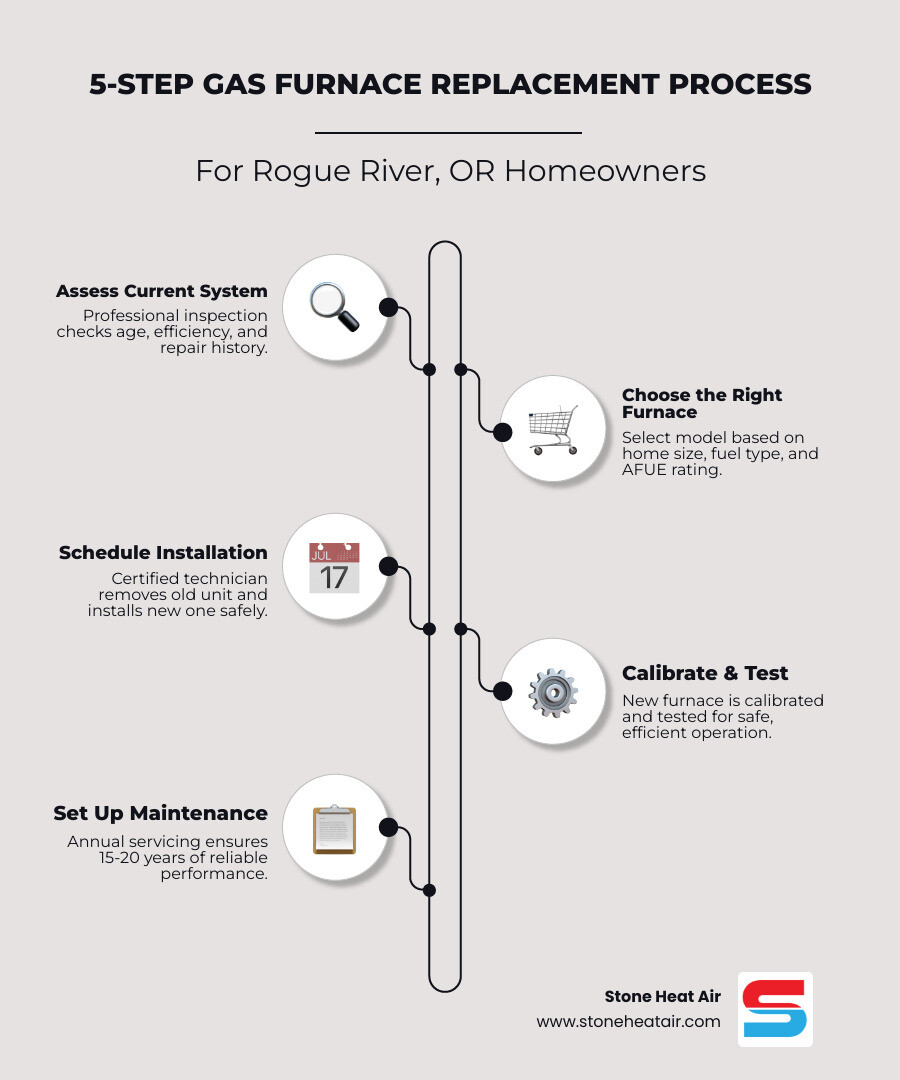
Here's a quick overview of what the gas furnace replacement process looks like:
1. Assess your current system - A professional inspects your furnace for age, efficiency, and repair history.
2. Choose the right furnace - Select a model based on your home's size, your fuel type, and an AFUE efficiency rating that fits your needs.
3. Schedule professional installation - A certified technician removes the old unit and installs the new one safely, handling all gas line and venting connections.
4. System calibration and testing - The new furnace is carefully calibrated and tested to confirm safe, efficient operation.
5. Set up a maintenance plan - Annual servicing after installation helps your new furnace last 15 to 20 years.
Furnaces in Rogue River work hard. The heating season is long, and an aging or inefficient system puts real stress on your household budget and your comfort. Whether you're noticing rising energy bills, strange noises, or rooms that just won't warm up, understanding the replacement process helps you make a confident, informed decision.
Recognizing the Signs for Gas Furnace Replacement in Rogue River, OR
Living in the Rogue Valley means we rely on our heating systems for a significant portion of the year. While we all want our appliances to last forever, the reality is that furnaces have a finite lifespan. Typically, a well-maintained gas furnace lasts about 15 to 20 years. If your unit is blowing out candles on its 15th birthday, it is likely nearing the end of its reliable service life.
It can be difficult to know exactly time-to-get-a-new-furnace, but your home often sends subtle (and sometimes not-so-subtle) hints. One of the most obvious signs is a spike in your monthly utility bills. As components wear out, the system has to run longer and work harder to reach the temperature set on your thermostat.
Other red flags include:
• Strange Odors: If you find yourself wondering why-your-furnace-smells, it could be anything from dusty burners to a cracked heat exchanger.
• Unusual Noises: Banging, screeching, or rattling sounds often indicate mechanical failure or loose parts.
• Startup Issues: There are many reasons-why-your-furnace-isnt-turning-on, ranging from a faulty igniter to a failing motor.
• Frequent Repairs: If you have your HVAC technician on speed dial, you’re likely throwing good money after a system that is destined for the scrap heap.
Identifying Performance Issues
Beyond the mechanical sounds, keep an eye on the quality of the heat produced. A healthy gas furnace should have a steady, blue flame. If you see a flickering yellow flame, this is a serious warning sign of incomplete combustion, which can lead to carbon monoxide leaks.
Furthermore, pay attention to the air quality in your Rogue River home. Old furnaces often struggle to manage humidity, leading to air that feels excessively dry or causes wood furniture to creak. You might also notice electric-furnace-component-failures if you have a hybrid system, or issues where the all-you-need-to-know-about-the-furnace-limit-switch causes the system to cycle on and off too rapidly (short-cycling).
When to Call for Professional Inspection
If you are experiencing any of these symptoms, it’s time to move beyond DIY troubleshooting. We recommend scheduling professional-inspections-of-your-gas-furnace to get a clear picture of your system's health. A technician can perform a combustion analysis and check the integrity of the heat exchanger. If you’re located nearby, looking into gas-furnace-repair-in-medford-or/ can provide a baseline for whether a fix is viable or if a full gas furnace replacement in Rogue River, OR is the smarter financial move.
FactorRepairReplaceAgeUnder 12 yearsOver 15 yearsRepair CostLess than 30% of new unit costMore than 50% of new unit costEfficiencyStill meets original specsSignificantly lower than modern unitsReliabilityRare breakdownsFrequent "emergency" calls
Key Factors in Selecting Your New Heating System
Choosing a new furnace isn't as simple as picking the first box you see at the store. Because this is an investment that will stay with your home for two decades, you need to consider several technical factors.
When shopping-for-a-new-furnace-in-southern-oregon, the most important acronym you'll encounter is AFUE (Annual Fuel Utilization Efficiency). This percentage tells you how much of the fuel you pay for is actually turned into heat for your home. Older units might have an AFUE of 60-70%, meaning 30-40 cents of every dollar is wasted. Modern high-efficiency units can reach 95-98% AFUE.
Here is what we look at when helping you choose:
• Size and Capacity: A furnace that is too small won't keep you warm, but one that is too large will "short-cycle," wearing out parts prematurely and wasting energy. We calculate the exact BTU (British Thermal Unit) needs based on your home's square footage, insulation, and window quality.
• Fuel Type: While we are focusing on gas, it's worth considering-a-new-furnace-what-to-know-about-gas-furnace-replacement-in-central-point/ if your home is better suited for natural gas or propane.
• Blower Motor Type: Variable-speed motors are much quieter and more efficient than older, single-speed models.
Understanding Efficiency and Capacity
The "guts" of your furnace matter. High-efficiency models often feature dual heat exchangers, which extract even more heat from the combustion gases before they are vented outside. This technology significantly boosts your BTU output without increasing your gas consumption.
In some cases, homeowners are replacing-your-furnace-with-a-heat-pump-what-you-need-to-know to take advantage of electricity-based heating and cooling in one unit. However, for the consistent, intense heat needed during a cold Rogue River snap, a high-efficiency gas furnace remains the gold standard for many.
The Professional Installation Process and Safety Standards
Why is professional installation so critical? Because a furnace is more than just a heater; it’s a combustion device. Incorrectly handling gas lines or venting can lead to catastrophic gas leaks or carbon monoxide poisoning.
When we arrive for a gas furnace replacement in Rogue River, OR, our process is meticulous. There are several questions-you-need-to-ask-before-a-furnace-job, such as how the technician plans to handle the venting and if the existing ductwork is sufficient.
Our installation involves:
1. Safe Removal: We carefully disconnect and remove your old unit, ensuring no damage to your home.
2. Custom Ductwork: Sometimes, the new unit doesn't perfectly match the old footprint. We utilize precision sheet metal fabrication to ensure a perfect, airtight seal.
3. Gas Line Integrity: We test every connection to ensure there are zero leaks.
4. Flue and Venting: We ensure that all exhaust gases are safely directed out of your home.
5. Calibration: We don't just "turn it on." We calibrate the gas pressure and airflow to match the manufacturer's peak performance specifications.
Ensuring Long-Term Reliability
Once the unit is in place, the work isn't over. To protect your investment, you must stay on top of maintenance. We provide comprehensive guides for different areas, such as gas-furnace-maintenance-medford-tips, gas-furntime-to-get-a-new-furnaceace-maintenance-in-talent-or, and our gas-furnace-maintenance-central-point-guide. Regular check-ups prevent small issues from turning into expensive mid-winter failures.
Frequently Asked Questions about Gas Furnace Replacement in Rogue River, OR
How long does a gas furnace replacement in Rogue River, OR typically take?
Many homeowners worry that they will be without heat for days. In most standard cases, how-long-does-it-usually-take-to-replace-a-furnace is just a single day. A typical installation takes between 4 to 8 hours. If the job requires extensive ductwork repair or moving the unit to a new location (like from a crawlspace to an attic), it may take longer, but we always aim to have your heat back on by the time the sun goes down.
What is the best time of year for a gas furnace replacement in Rogue River, OR?
The "emergency" time is usually January, but that is the hardest time to get on a schedule. The best time for a gas furnace replacement in Rogue River, OR is during the "shoulder seasons"—late spring or early fall. By replacing your unit in September or October, you ensure you aren't stuck in a long queue when the first frost hits the Rogue Valley.
Can I replace just my furnace without replacing the air conditioner?
Yes, you can. However, it’s not always the most cost-effective choice in the long run. Since the furnace and AC often share the same blower motor and ductwork, replacing them together can save on labor costs. If your AC is also over 10-12 years old, replacing both ensures that the entire system is perfectly matched for maximum efficiency.
Conclusion
At Stone Heat Air, we understand that your home is your sanctuary. We are proud to serve the Rogue Valley, from Central Point and Medford to the heart of Rogue River. Our commitment to honest dealings and quality workmanship means we don't just install a box; we install peace of mind.
With our 24/7 emergency service, you are never left in the cold. For even greater security, our Stone Comfort Membership Club offers priority scheduling and regular maintenance to keep your new system running perfectly for years to come. If you’re tired of shivering or worrying about your old unit, we are here to help with 247-heating-repair-in-rogue-river-or and expert installation.
Don't wait for a winter breakdown to take action. Schedule your gas furnace replacement in Rogue River, OR today and enjoy the comfort you deserve.