

When August Winds Arrive, Standard Air Quality Routines Fail
Late summer in the Rogue Valley brings intense heat, but it also delivers something far more intrusive to your living space. Preparing Your Home's Air Quality for Southern Oregon's Late Summer Dust is an absolute necessity when dry, aggressive August winds start blowing through the region. You might be following the textbook rules for home maintenance, but standard 90-day filter replacement schedules completely fail against heavy, wind-blown particulate matter. Now is the time to decide whether to stick with a failing routine or upgrade your filtration strategy to protect both your lungs and your end-of-season cooling equipment.
Protecting your home requires a combined approach, ensuring your HVAC system can breathe efficiently while integrating advanced indoor air purification solutions to capture what standard filters miss.
The Unique Anatomy of Southern Oregon's Late Summer Dust
Most homeowners assume that dust is just dust. Under normal conditions, the dust settling on your bookshelves consists mostly of indoor generated particles like skin cells, fabric fibers, and pet dander. However, the environmental load shifts dramatically in late summer.
The Rogue Valley Topography Trap
The geography of Central Point and Southern Oregon creates a unique challenge for indoor air quality. The Rogue Valley acts like a natural basin. When late summer inversions occur, a layer of warm air traps cooler air—and all the suspended particulate matter—close to the valley floor. Combine this topographical trap with dry, aggressive seasonal winds, and you get a massive volume of fine, abrasive soil and agricultural dust suspended in the air around your home.
Why Standard Defenses Fall Short
This specific type of wind-blown particulate matter is incredibly fine. When the outdoor air quality drops and the winds pick up, your first instinct is to keep all the windows and doors tightly shut. While this blocks the largest debris, microscopic dust particles still infiltrate your home through tiny drafts, gaps in weatherstripping, and normal foot traffic.
Once inside, your home's mechanical filtration becomes the only reliable barrier keeping that dust out of your lungs. Unfortunately, this specific environmental load rapidly overwhelms standard 1-inch fiberglass filters. Because the particles are so fine and the volume is so high, a basic filter either lets the dust pass right through into your equipment, or it clogs so quickly that it chokes your system of air.
Why the 90-Day Filter Rule Is Obsolete During Dry Season
If you look at the packaging on a standard air filter, the manufacturer likely recommends replacing it every three months. That guideline might work perfectly for a mild spring in a different climate, but it is entirely obsolete during the peak dry season.
The Flaw in the Manufacturer's Manual
Standard manufacturer recommendations for three-month filter changes simply do not account for extreme local dust events. At Stone Heating and Air, our team routinely educates homeowners on exactly how our specific environment impacts their equipment. One key lesson we always share is just how quickly Rogue Valley dust saturates a fresh filter. In our years of servicing Central Point homes, our technicians consistently observe that filters which should last 90 days are often completely compromised in less than 30 days during August and late summer.
Visual and Operational Signs of a Failing Filter
You do not need special tools to know your filter is failing. The signs are both visual and operational:
• The color test: A healthy filter looks white or off-white. A clogged filter takes on a thick, dark gray or black surface coating, often with visible debris caked between the pleats.
• Extended run times: If your AC seems to run continuously without actually cooling the house down to the set temperature, a clogged filter is often the culprit.
• Uneven cooling: Rooms at the far end of your ductwork may suddenly feel warmer because the system lacks the airflow to push conditioned air that far.
• Increased dust accumulation: If you find yourself dusting hard surfaces twice a week instead of twice a month, your filter is no longer trapping airborne particles.
For this high-stress season, revise your timeline. Check your filter every two weeks. If you hold it up to a light and cannot see the light shining through, it is time to replace it. You may also need to consider HVAC filter upgrades for wildfire smoke if the late summer winds bring ash along with the dust.
Selecting the Right Filtration Power for Fine Particulate Matter
Understanding how often to change your filter is only half the battle. You also need to ensure you are using a filter capable of actually capturing the fine particulate matter blowing through the valley.
Decoding the MERV Scale
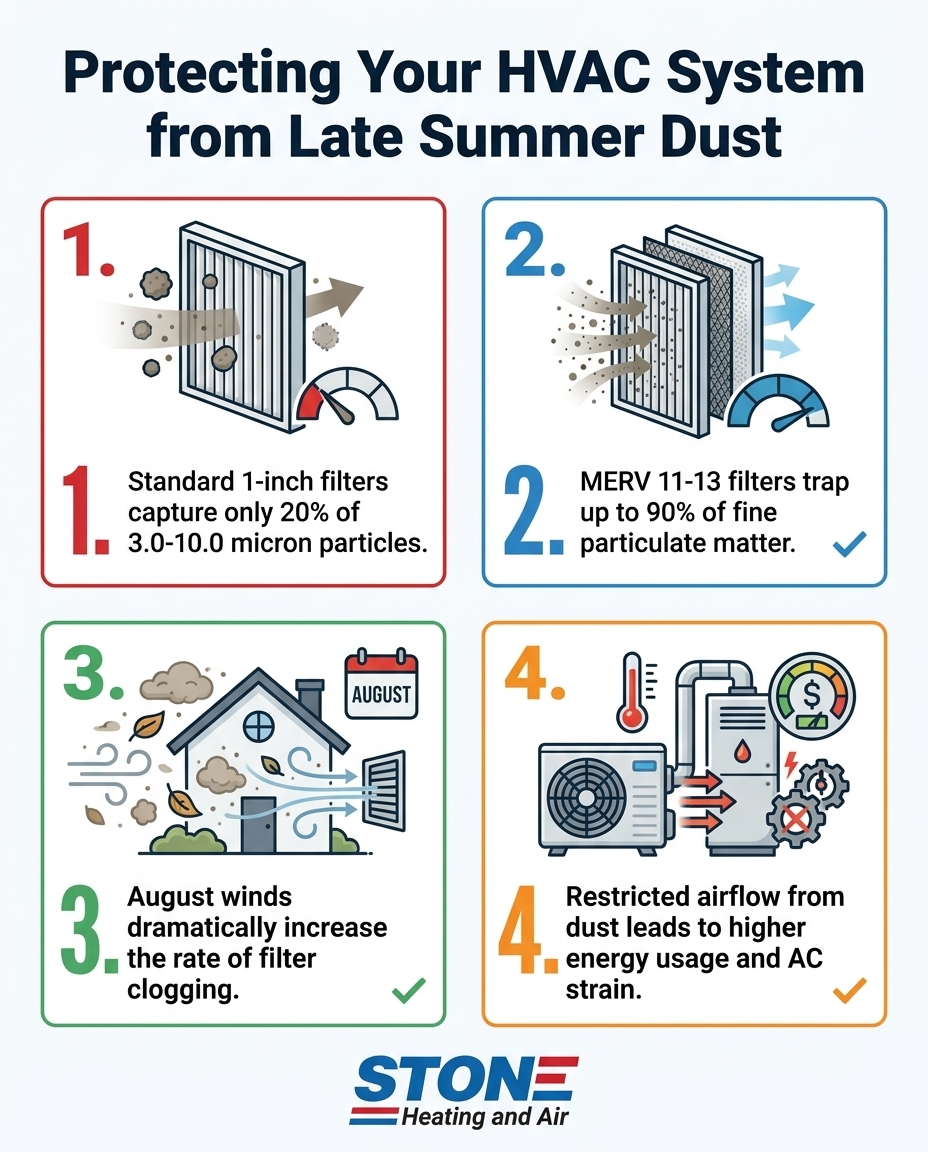
Filters are graded on the Minimum Efficiency Reporting Value (MERV) scale. The higher the number, the finer the particles the filter can trap. Standard 1-inch fiberglass filters usually sit between MERV 1 and MERV 4. These filters are designed strictly to protect the HVAC equipment from large debris like hair and carpet fibers. They only capture about 20% of particles between 3.0 and 10.0 microns, making them virtually useless for heavy, wind-blown dust.
When looking at MERV rating recommendations for fine dust, you need a pleated filter with a higher density.
• MERV 1 - 4 — Primary Targets Captured: Pollen, dust mites, large fibers — Effectiveness for Late Summer Dust: Poor. Allows fine wind-blown dust to pass through easily.
• MERV 5 - 8 — Primary Targets Captured: Mold spores, hair spray, larger dust — Effectiveness for Late Summer Dust: Moderate. Better than fiberglass, but still misses microscopic particles.
• MERV 11 - 13 — Primary Targets Captured: Fine dust, auto emissions, pet dander — Effectiveness for Late Summer Dust: Excellent. Traps up to 90% of fine particulate matter.
• MERV 14+ — Primary Targets Captured: Bacteria, smoke, microscopic allergens — Effectiveness for Late Summer Dust: Requires professional assessment to prevent severe airflow restriction.
The Danger of Over-Filtering
While upgrading to a MERV 11 or MERV 13 filter is highly recommended for trapping up to 90% of fine particles, you must be careful not to go too high. Filters rated MERV 14 or above are incredibly dense. If your HVAC system's blower motor was not designed to push air through such a thick barrier, you will inadvertently choke the system, causing the same damage as a severely clogged filter. We see this issue frequently when homeowners try to tackle late summer dust on their own. Our team at Stone Heating and Air always recommends having a professional assess your system's airflow capacity before jumping to the highest possible rating.
The Hidden Toll Heavy Dust Takes on End-of-Season AC Performance
Poor indoor air quality does not just trigger allergies; it actively damages your cooling equipment. There is a direct link between the dust floating in your living room and the mechanical strain on your air conditioner.
The Domino Effect of Restricted Airflow
Your air conditioning system requires a specific, constant volume of air moving over the indoor evaporator coil to function correctly. When rapid dust accumulation restricts airflow to the air handler, a dangerous domino effect begins. First, the system has to run longer to achieve the same cooling result, which drives up your monthly energy bills.
Next, because there is not enough warm household air blowing over the cold evaporator coil, the condensation on the coil can actually freeze. A frozen evaporator coil completely halts the cooling process and can cause severe liquid damage to the compressor outside if the system keeps running.
Protecting Your Compressor When It Matters Most
This extreme mechanical strain occurs exactly when your AC has already been working hard all summer long. By the time August arrives in Central Point and Southern Oregon, your equipment has already logged hundreds of hours of run time. Adding a choked, dust-filled filter to an already tired system is a recipe for a sudden breakdown during a late summer heatwave. Proactive monitoring and scheduling a routine HVAC maintenance plan prevents these end-of-season failures by keeping the internal components clean and calibrated.
Beyond Filters: Comprehensive Strategies to Seal Out Rogue Valley Dust
Pivoting from reactive filter changes to proactive home management is the best way to handle August and late summer dust. While a good filter catches the dust that makes it into your return vents, a comprehensive strategy stops the dust from entering your home in the first place.
• Seal your home's envelope: Inspect the weatherstripping around your exterior doors and the caulking around your windows. Wind-blown dust easily penetrates dried, cracked, or missing seals. Replacing these barriers is a fast way to reduce dust intrusion.
• Manage indoor humidity: Dry air keeps fine particulate matter suspended longer. Maintaining optimal indoor humidity levels (between 30% and 50%) gives those suspended particles enough weight to settle out of the air, making them easier to clean up.
• Upgrade your vacuuming routine: Sweeping often kicks fine dust right back into the air. Use a vacuum cleaner equipped with a true HEPA filter to permanently remove settled dust from your floors and upholstery without redistributing it.
• Evaluate purification options: Standalone room purifiers are great for a single bedroom, but they cannot clean the air in an entire house. Integrated whole-home air purifiers work in tandem with your HVAC system to neutralize and capture particles across every square foot of your living space.
How Your Ventilation Network Contributes to Indoor Air Quality
Even with high-quality filters and a well-sealed home, dust inevitably bypasses your defenses over time and settles inside your ductwork. Your ventilation network plays a massive role in your daily air quality.
The Hidden Highway for Dust
Think of your ductwork as the respiratory system of your home. When dust settles inside these dark, hidden metal or flex tubes, it does not stay there forever. Every time your thermostat calls for cooling and the blower motor engages, a rush of air sweeps through the ducts. This sudden pressure change kicks the settled dust back up, blowing it directly through your supply vents and into your living space.
The Impact of Compromised Ducts
The problem multiplies if your ductwork is compromised. Leaky, disconnected, or poorly sealed ducts can create negative pressure, acting like a vacuum that pulls dusty, unconditioned air directly from your hot attic or dusty crawlspace into the airflow.
When our installation crews replace and optimize ventilation configurations for local homes, we frequently uncover staggering amounts of settled dust inside the old network. A thorough assessment and professional duct service from our team can completely reset your home's baseline air quality, ensuring that the air blowing out of your vents is actually clean as you close up the house for the end of the cooling season.
Frequently Asked Questions
How often should I change my AC filter in dusty conditions?
During heavy dust seasons, you should check your filter every two weeks and replace it at least once a month. Standard 90-day recommendations do not apply when high winds and dry weather dramatically increase the volume of airborne particulate matter. Waiting three months in these conditions will almost certainly lead to restricted airflow and system strain.
What MERV rating is best for fine dust?
A filter rated between MERV 11 and MERV 13 is generally the best choice for capturing fine, wind-blown dust. These filters are dense enough to trap up to 90% of fine particulate matter, including pollen and agricultural dust. However, we advise against going up to MERV 14 or higher unless our professionals have confirmed your system can handle the restricted airflow.
How do you filter dust out of the air in your home?
Filtering dust requires a multi-layered approach starting with a high-quality pleated HVAC filter. You can supplement this by running the HVAC fan in the "ON" position rather than "AUTO" to keep air constantly moving through the filter. Additionally, installing a whole-home air purification system will actively capture the microscopic particles that slip past traditional media filters.
Does duct cleaning help reduce dust in the house?
Yes, professional duct cleaning significantly reduces the amount of dust circulating in your home. Over the years, a thick layer of dust and debris settles inside your ductwork, which gets blown back into your rooms every time the AC turns on. Removing this buildup eliminates a major source of recurring indoor pollution.
Can a clogged air filter cause my AC to stop working?
Absolutely. A clogged air filter chokes the airflow to your air handler, which can cause the indoor evaporator coil to freeze solid. Once the coil freezes, the system can no longer cool your home, and the resulting strain can lead to a catastrophic failure of the outdoor compressor.
What is the difference between a standalone purifier and a whole-home system?
A standalone purifier is a portable unit designed to clean the air in a single, enclosed room, making it useful for targeted areas like a bedroom. A whole-home system is installed directly into your central HVAC ductwork, allowing it to actively filter and purify the air circulating through every room in your entire house simultaneously.
Before the late summer dust fully takes over your home and the back-to-school chaos begins, now is the time to rethink your filtration strategy. Upgrading your filters and scheduling a professional system assessment with Stone Heating and Air ensures your equipment survives the rest of the season while keeping your indoor air clean and breathable. Reach out today to secure the exact solutions you need to protect your home and your health.