

Why Is My Heat Pump Blowing Warm Air When I Need Air Conditioning?
Are you sweating indoors while your system runs constantly but only produces warm air? If you are asking yourself, "why is my heat pump blowing warm air in cooling mode?" you are dealing with one of the most frustrating HVAC issues a homeowner can face. When the peak heat of August hits Central Point OR, a cooling failure quickly turns your home from a comfortable refuge into an uncomfortable trap.
Finding warm air coming from your vents leaves you with an immediate decision to make: is this a simple airflow issue you can check safely on your own, or a complex mechanical failure that requires a licensed professional? Many homeowners immediately assume their entire system has failed, but the reality is often tied to a few specific, diagnosable components.
This guide will help you understand exactly what is happening inside your system and how to differentiate between basic operational hiccups and a stuck reversing valve. If you discover that your system requires professional attention, our team provides comprehensive HVAC services, including expert heat pump and AC repair in Central Point to restore your home's comfort.
Safe Troubleshooting: What You Can Check First
Before you assume your system has suffered a major mechanical breakdown during the stress of August late-summer cooling fatigue, there are several safe, straightforward checks you can perform. Sometimes, the issue stems from a simple setting or a basic maintenance oversight rather than a failed part.
Thermostat and Airflow Verification
The very first place to look is your thermostat. It sounds overly simple, but accidental bumps or brief power interruptions can alter your settings.
• Verify the cooling mode: Ensure the system is explicitly set to "cool" and the temperature is set at least five degrees below the current room temperature.
• Check the fan setting: Look at the fan switch on your thermostat. If it is set to "on" rather than "auto," the fan will blow air continuously, even when the outdoor compressor cycles off. This means you will feel unconditioned, warm room air circulating through your vents between cooling cycles.
• Inspect the air filter: A severely clogged air filter restricts the volume of air moving over your indoor evaporator coil. Without enough warm indoor air passing over it, the coil can literally freeze solid. Once encased in ice, the coil cannot absorb heat, and the system will begin blowing warm air. Locate your filter and replace it immediately if it is visibly coated in dust or debris.
• Examine the outdoor unit: Walk outside and look at your heat pump. For the system to cool your home, it must be able to release heat outdoors. If the metal fins are choked by fallen leaves, built-up dirt, or overgrown vegetation, heat transfer stops. Clear at least two feet of space around the entire unit.
If you perform these safe checks and the system still fails to cool, it is time to turn the unit off at the thermostat to prevent further damage. Staying on top of these basic checks is a core part of routine HVAC maintenance, but when they do not solve the problem, you are likely facing a mechanical failure.
The Culprit Behind the Heat: Understanding the Reversing Valve
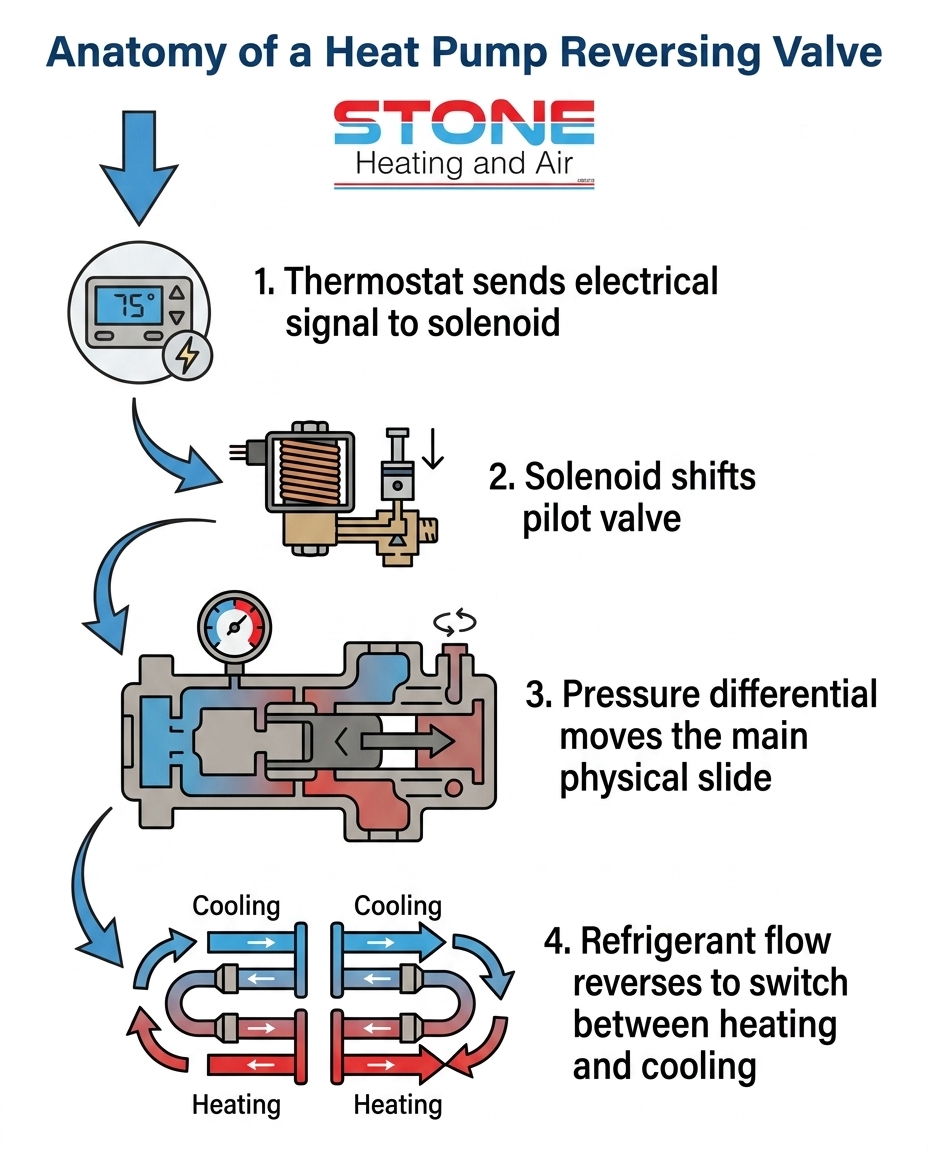
If your airflow is clear and your thermostat is set correctly, the most common mechanical reason a heat pump blows warm air in summer is a faulty reversing valve. This specific component is what makes a heat pump different from a traditional air conditioner. It allows the system to provide both heating and cooling by physically reversing the directional flow of the chemical refrigerant.
How the Solenoid Operates
The reversing valve assembly consists of an electrical coil called a solenoid and a physical sliding mechanism housed inside a brass tube. When your thermostat calls for cooling, it sends a low-voltage electrical signal to the solenoid. The solenoid then becomes magnetized, which shifts a smaller pilot valve. This shift creates a pressure differential that forces the main physical slide to move, routing the hot, pressurized refrigerant outside and the cold refrigerant inside.
If the reversing valve gets stuck in its default heating position, your outdoor unit will run, the indoor fan will blow, but the system will actively heat your home instead of cooling it. This mechanism is critical year-round in Central Point OR. If you have ever wondered, Heat Pump Not Heating When It's Cold Outside?, a stuck reversing valve failing to shift into heating mode is often the exact same culprit, just operating in reverse.
How Late-Summer Heat Causes Cooling Fatigue
A stuck reversing valve rarely happens out of nowhere. It is frequently a symptom of cumulative seasonal wear. Southern Oregon's intense, prolonged summer heat forces heat pumps to run continuously for weeks on end. By the time August arrives, your system has endured hundreds of hours of high-stress operation, increasing the risk of reversing valve solenoids failing or physical slides getting stuck.
The Impact of Continuous Operation
Every time your heat pump cycles on, the electrical components generate heat. Over a long, grueling summer, this continuous thermal stress takes a toll on the reversing valve's solenoid. The thin wire inside the solenoid coil can eventually degrade or short out entirely due to the constant electrical load and high ambient outdoor temperatures.
Simultaneously, the physical slide inside the valve is exposed to extreme temperatures and high-pressure refrigerant. Over time, friction, microscopic debris in the refrigerant line, or degraded internal seals can cause that slide to jam physically. This is what we call August late-summer cooling fatigue.
We see the effects of cumulative thermal stress all the time in older, heavily used equipment. For example, one local homeowner reached out last fall regarding a completely exhausted 1950s wall heater; a crew quickly removed the old unit and hauled it away. While your heat pump is a much more modern piece of technology, its internal moving parts face a similar kind of severe, cumulative wear after running hard all summer. When the solenoid burns out or the slide jams, the system defaults to heating mode, blowing warm air directly into your home on the hottest days of the year.
Other Reasons Your Heat Pump Is Blowing Warm Air
While the reversing valve is a prime suspect, it is not the only mechanical failure that shares this symptom. Several other critical issues can cause your system to blow warm air during a bout of August late-summer cooling fatigue. Because these issues involve high-voltage electricity and pressurized chemicals, they legally require a licensed professional to diagnose and repair.
Refrigerant and Coil Issues
Your heat pump relies on a precise volume of chemical refrigerant to absorb indoor heat and move it outside. If a leak develops, the system loses its ability to transfer heat. You might notice the air coming from your vents slowly getting warmer over a few days, or you might hear a faint hissing sound near the outdoor unit. Low refrigerant alters the internal pressure of the entire system, forcing the compressor to work harder until it eventually overheats and shuts down entirely.
Another major culprit is heavily soiled condenser coils. If dirt, mud, and debris form an insulating layer over the outdoor coils, the system cannot release the heat it absorbed from your home. The compressor will continue to run, but the air returning to your rooms will remain warm. Keeping these coils clean is a vital part of cooling system maintenance.
• Warm air blowing constantly between cooling cycles — Likely Underlying Cause: Thermostat fan set to "on" instead of "auto" — Required Action: Switch fan to "auto" on the thermostat panel
• Weak airflow that feels slightly warm — Likely Underlying Cause: Severely clogged air filter causing a frozen indoor coil — Required Action: Replace filter and turn system off to thaw
• Sudden shift to hot air while set to "cool" — Likely Underlying Cause: Stuck reversing valve or failed solenoid — Required Action: Call a licensed HVAC technician for diagnostics
• Air gradually getting warmer over several days — Likely Underlying Cause: Refrigerant leak reducing cooling capacity — Required Action: Require professional leak search and system recharge
Professional Diagnostics: What to Expect from an HVAC Technician
When basic troubleshooting does not restore your cooling, calling in a professional is the safest and most effective next step. Demystifying the repair process helps you understand exactly what you are paying for. At Stone Heating and Air, we believe in transparent diagnostics. We do not just guess at the problem; we follow a rigorous testing protocol to determine exactly why your Central Point OR home is not cooling.
Transparent Testing Procedures
A professional technician will approach a warm-air issue systematically to prevent unnecessary part replacements. Here is what that diagnostic process typically looks like:
1. Electrical Solenoid Testing: The technician will start by using a multimeter to test the reversing valve's solenoid coil. They will check if the thermostat is successfully sending the correct low-voltage signal to the outdoor unit. If voltage is present but the valve isn't shifting, they will test the coil for electrical continuity to see if the internal wiring has burned out.
2. Refrigerant Pressure Checks: Using specialized manifold gauges, the technician will measure the high and low-pressure sides of your refrigerant lines. This safely identifies whether the system is low on charge due to a leak, or if the compressor is failing to pump the refrigerant effectively.
3. Mechanical Verification: If the electrical signals are correct and the refrigerant levels are accurate, the technician will physically verify the reversing valve. They will observe the temperature differences on the copper lines connected to the valve to confirm if the internal slide is jammed.
4. Clear Communication: Once the testing is complete, the technician will explain the exact point of failure. Whether it is a burned-out solenoid that can be replaced on its own, or a mechanically failed valve that requires recovering the refrigerant and brazing in a new part, you will know exactly what is required to restore your cooling.
Frequently Asked Questions About Heat Pump Cooling Issues
Why is my heat pump blowing warm air in cooling mode?
The most common reason a heat pump blows warm air in cooling mode is a stuck reversing valve or a failed solenoid. When this valve fails to shift, the system defaults to heating mode, actively pumping hot air indoors. Other frequent culprits during August late-summer cooling fatigue include severely clogged air filters, incorrect thermostat fan settings, or a low refrigerant charge caused by a leak.
How do I know if my reversing valve is stuck?
You can often tell a reversing valve is stuck if your thermostat is clearly set to "cool," but the air coming from your vents is noticeably hot, similar to how it feels in the middle of winter. Additionally, if you hear the outdoor unit click and run, but the copper lines leading into your home are hot to the touch instead of cold and sweating, the valve has likely failed to reverse the refrigerant flow.
Does a heat pump use a reversing valve for cooling?
Yes, the reversing valve is the specific component that allows a heat pump to provide air conditioning. By default, many heat pumps are physically built to heat. The reversing valve must actively shift to reverse the flow of refrigerant, absorbing heat from inside your home and releasing it outdoors to create a cooling effect.
Why is my AC running but blowing warm air?
If your system is running but blowing warm air, it usually means the indoor blower motor is working, but the outdoor compressor is either not running or cannot absorb heat. This is frequently caused by a frozen indoor evaporator coil (due to a dirty filter), a tripped circuit breaker to the outdoor unit, or a significant loss of refrigerant.
Can I unstick a heat pump reversing valve myself?
No, you should never attempt to unstick a reversing valve yourself. The valve is connected directly to high-pressure refrigerant lines and involves high-voltage electrical components. Tapping or hitting the valve can easily rupture a copper line, causing a dangerous chemical leak and turning a localized repair into a massive system failure.
How long does a heat pump reversing valve typically last?
A reversing valve is designed to last the lifespan of the heat pump itself, which is typically 12 to 15 years. However, high-stress environments, continuous short-cycling, or a lack of routine maintenance can cause the electrical solenoid to burn out or the internal slide to jam much earlier in the system's life.
Get Your Cooling System Back on Track
Dealing with a heat pump that blows warm air when you desperately need cooling is highly disruptive, but it is also a highly diagnosable issue. Whether your system is suffering from a simple airflow restriction or the mechanical realities of a stuck reversing valve, understanding the root cause is the first step toward restoring your comfort.
Remember that late-summer wear is a common culprit, and pushing a struggling system will only lead to further damage. If you have verified your thermostat settings and checked your air filter, but your home in Central Point OR is still uncomfortably warm, it is time to bring in an expert. Schedule a professional diagnostic inspection today to pinpoint the exact failure safely. A licensed technician can quickly identify the problem, explain your options clearly, and get your cooling system back on track.