

The Disconnect: Why the Blower Runs While the Air Stays Warm
You hear the familiar rush of air coming from your vents, but soon realize something is wrong—which is exactly why your AC is running but not cooling your home: a technician's perspective is the best way to understand this frustrating mechanical disconnect. At Stone Heating and Air, it is incredibly common for our technicians to walk into a Central Point home on a scorching July afternoon, hear the system working loudly, and yet feel the indoor temperature steadily climbing. This happens because the components that circulate the air and the components that actually cool the air operate on entirely separate electrical circuits.
Need immediate assistance? Learn more about our comprehensive air conditioning systems to see how we keep local homes comfortable.
The Mechanical Divide Between Inside and Outside
To understand why this disconnect occurs, you have to look at how a split-system air conditioner is built. The indoor unit, known as the air handler or furnace, contains the blower motor. This motor runs on standard 120-volt household electricity. Its only job is to pull warm air from your rooms, push it across the cooling coils, and send it back out through the ductwork. If the thermostat tells the fan to turn on, it will happily circulate air all day long, regardless of what is happening outside.
Meanwhile, the outdoor unit—the condenser—houses the compressor and the outdoor fan. These heavy-duty components require a much stronger 240-volt circuit to operate. When a failure occurs in the outdoor cooling mechanism, the indoor blower often continues to run perfectly fine. You hear the system running, but without the outdoor unit removing the heat, you are essentially just operating a very expensive, whole-house fan.
During the peak summer cooling season, experiencing this failure is incredibly frustrating. The house feels stuffy, the humidity rises, and the system runs nonstop trying to reach a temperature it can no longer achieve. When you notice this disconnect, the most critical decision you can make is what to do next to prevent a simple breakdown from becoming a catastrophic failure.
Immediate Action: Turn the Thermostat to OFF
The moment you realize warm air is blowing from your vents, your very first step should be to walk over to the thermostat and switch the system from "COOL" to "OFF." Leaving a malfunctioning air conditioner running is one of the most dangerous things you can do to the equipment. While it might feel counterintuitive to turn off your only source of airflow on a hot day, doing so protects the heart of your system: the compressor.
Why Continuous Running Causes Permanent Damage
Air conditioners are designed to operate in a closed, balanced loop. The outdoor compressor pumps cold refrigerant inside, which absorbs heat, and then pumps that heat back outside. The compressor relies on the returning cool refrigerant to keep its own internal motor from overheating. If the system is running but not cooling, that means the cooling cycle has stopped. The compressor is now running without its primary source of thermal protection.
Just last summer, our team at Stone Heating and Air responded to a local family experiencing this exact issue during a stretch of peak summer heat when their unit was running but not cooling the house; because they reached out promptly, our technicians repaired the AC unit to get it up and running before permanent damage occurred. Had they left the system straining for hours, the outcome could have been much worse.
The risks of ignoring the problem:
• Compressor burnout: The internal windings melt from excessive heat, requiring a total system replacement.
• Electrical damage: Overworking components can cause wires to short out or melt near the contactor.
• Skyrocketing energy bills: A system running constantly without satisfying the thermostat will waste massive amounts of electricity.
Protecting the equipment is always the priority before professional diagnostics begin. If you are dealing with this situation right now, turn the system off and schedule AC repair in Central Point to safely resolve the issue.
The Culprit You Can Check: Airflow and Clogged Filters
While most electrical and mechanical failures require professional tools, there is one major culprit that homeowners can—and should—check themselves: the indoor air filter. Severe airflow restrictions can perfectly mimic complex mechanical failures, causing the system to run continuously while blowing warm air.
How Restricted Airflow Freezes Your System
Your air conditioner needs a constant, heavy volume of warm indoor air blowing across the indoor evaporator coil to function. The refrigerant inside that coil is extremely cold. If a severely clogged air filter blocks the warm air from reaching the coil, the temperature of the coil drops below freezing. The natural humidity in the air then turns to ice on the metal fins.
Once the coil is encased in a block of ice, it can no longer absorb heat from the house. The indoor blower keeps running, pushing air around the ice block, resulting in lukewarm or warm air coming out of your vents.
In our years of servicing local cooling systems, we've found this to be a particularly severe problem in our specific climate. High particulate matter from Central Point and Southern Oregon wildfire smoke can reduce a standard air filter's lifespan by up to 75%. During a heavy smoke event, a filter that normally lasts three months might become completely impacted in just three weeks. This rapid degradation causes the exact airflow restrictions that stop an AC from cooling.
• Clean (New) — Impact on System Performance: Optimal airflow, maximum heat transfer — Risk of Freezing: None
• Moderately Dirty — Impact on System Performance: System runs longer to cool the house — Risk of Freezing: Low
• Severely Clogged (Smoke/Dust) — Impact on System Performance: Airflow choked, warm air from vents — Risk of Freezing: High (Ice formation likely)
Checking and replacing a dirty filter is the only safe homeowner-level troubleshooting step. If you replace the filter and the system is still blowing warm air, you must look at other reasons your AC is not cooling properly.
What a Technician Checks First: The Capacitor and Condenser
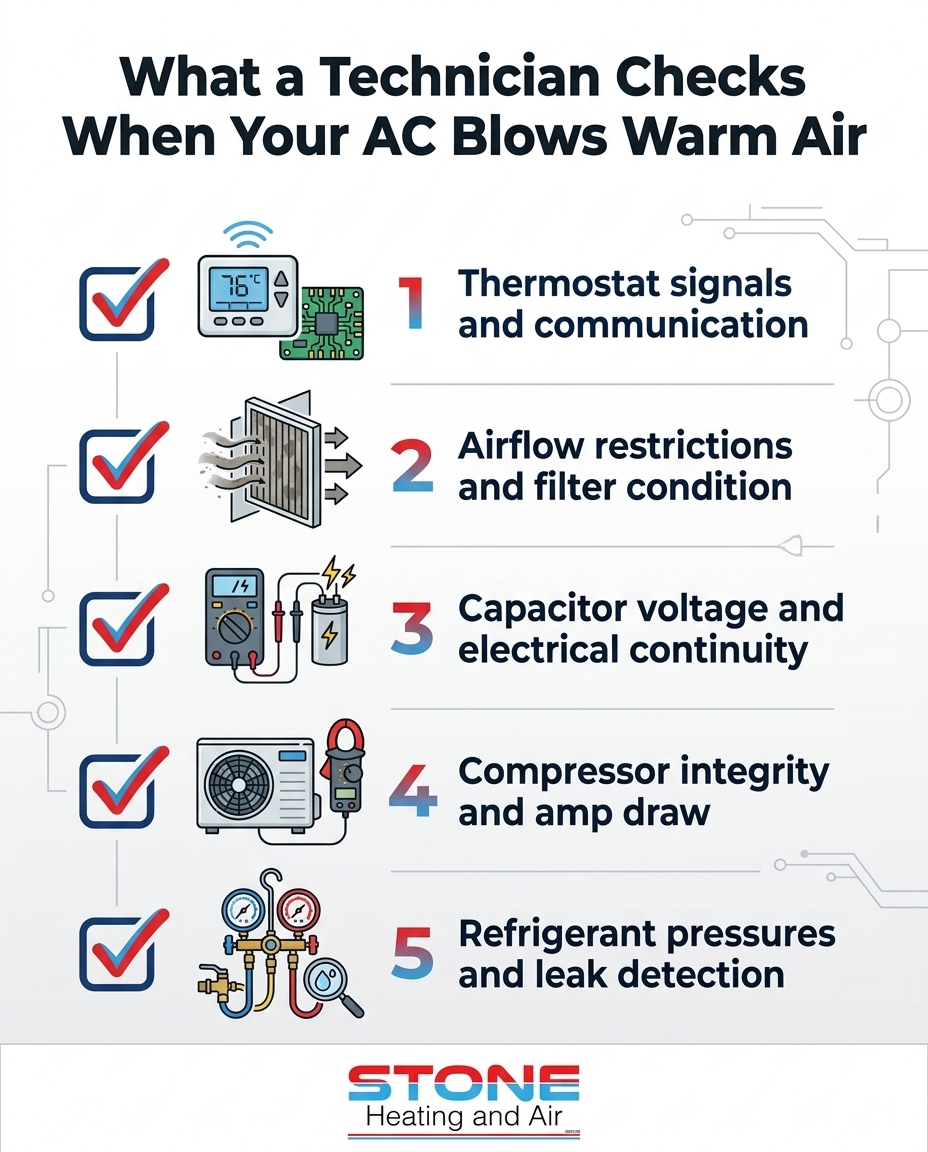
When you call for help, the first place a professional looks is usually the outdoor condenser. Demystifying the professional diagnostic process shows exactly why specialized tools are required for electrical failures. As an insider look at Stone Heating and Air's exact diagnostic protocol, our technicians always start by isolating the high-voltage components that drive the cooling cycle.
The Role of the Dual Run Capacitor
The most common reason an outdoor unit fails to start is a blown dual run capacitor. This small, cylindrical component acts like a powerful battery. It stores a massive electrical charge and delivers the initial jolt of electricity needed to start the heavy compressor and the outdoor fan motor. If the capacitor fails, the motors simply cannot overcome their own resting inertia.
During a recent peak-summer emergency outage, a homeowner called us for help, and our owner personally went out to diagnose and repair the problem on the spot. Our diagnosis revealed a swollen capacitor that had completely lost its ability to hold a charge.
Our diagnostic protocol for outdoor units:
1. Visual inspection: We check for a humming sound coming from the outdoor unit. A hum often means the system is receiving power and trying to start, but the capacitor has failed.
2. Safety disconnect: We pull the high-voltage disconnect to ensure the unit is entirely isolated from the electrical grid.
3. Multimeter testing: Technicians use a multimeter to safely test the capacitor's microfarad reading. If the reading falls below the manufacturer's rating, the part is dead.
4. Motor testing: We test the compressor and fan motor windings to ensure the failed capacitor didn't cause collateral electrical damage.
Because these components deal with 240 volts of electricity—enough to cause fatal injury—this testing absolutely requires a licensed professional. Never attempt to open the electrical panel of your outdoor unit yourself.
Diagnosing Refrigerant Leaks and Pressure Issues
If the electrical components are working perfectly but the system still blows warm air, the diagnostic focus shifts to the chemical side of the system. Refrigerant is the lifeblood of your air conditioner. Its sole purpose is to absorb indoor heat, travel through the copper lines, and release that heat outdoors through the condenser coils.
The Myth of "Consuming" Refrigerant
A very common misconception our technicians hear is that air conditioners "use up" or consume refrigerant over time, similar to how a car uses gas. The short answer is that they do not. An air conditioning system is a sealed, closed loop. If our crew finds that your system has low refrigerant, it always indicates a leak somewhere in the copper lines, the indoor coil, or the outdoor coil.
To pinpoint chemical and pressure-related cooling failures, professionals use specialized manifold gauges. These gauges connect to the service valves on the outdoor unit and read the exact pressures of the refrigerant in both a liquid and gaseous state.
Signs of low refrigerant:
• Hissing or bubbling noises: Sounds coming from the refrigerant lines indicate a physical breach.
• Ice on the copper lines: Low pressure causes the refrigerant to drop below freezing, turning condensation into ice on the outdoor pipes.
• Long cooling cycles: The system runs all day but struggles to drop the temperature in Central Point OR homes even a few degrees.
Running a system with low refrigerant is highly destructive. The compressor relies on a specific volume of cold refrigerant returning to it to stay cool. Without it, the compressor will quickly overheat, trip its internal thermal overload switch, and eventually burn out entirely.
The Value of Professional Diagnostics Over Guesswork
A residential cooling system is a complex machine where electrical power, mechanical force, and airflow dynamics must work in perfect harmony. When one of these pillars fails, the entire system stops cooling. This is why relying on DIY guesswork often leads to wasted money and recurring breakdowns.
Finding the True Root Cause
It is easy to guess that a system needs more refrigerant, or to blindly swap out a capacitor hoping it fixes the problem. However, true professional diagnostic tools provide definitive answers. If a capacitor keeps blowing, a thorough technician will investigate why. Is the fan motor drawing too many amps? Is the compressor struggling to start against unequal pressures? Identifying the true root cause prevents you from paying for the same repair twice.
At Stone Heating and Air, this approach highlights our commitment to thorough, honest diagnostics that explain the "why" behind every repair. When dealing with AC issues requiring service, one Central Point customer needed an appointment quickly; our team provided a next-day appointment, showed up early, and thoroughly explained the service so they understood exactly what was failing and how we were fixing it.
Ultimately, proactive care is the best way to keep the system running efficiently year-round. By scheduling routine AC maintenance before the summer cooling season begins, a technician can spot a failing capacitor, a dirty coil, or a tiny refrigerant leak long before it causes your system to blow warm air on a 100-degree afternoon.
Frequently Asked Questions About AC Cooling Failures
Why is my AC running but not cooling the house?
The indoor blower is circulating air, but the outdoor condenser, compressor, or refrigerant lines have failed to remove heat. Because the indoor fan and outdoor compressor run on separate electrical circuits, the fan will continue to push air even if the cooling mechanism is entirely broken. This mechanical disconnect is the primary reason you feel warm air coming from the vents.
How do you fix an AC that is blowing warm air?
Turn it off immediately, check the air filter for severe clogs, and call a professional to test the electrical and refrigerant systems. Leaving it running can cause severe damage to the compressor. A licensed technician will need to use a multimeter and manifold gauges to isolate the exact failed component.
Will a dirty filter cause an AC not to cool?
Yes, severe restriction stops airflow over the evaporator coil, causing it to freeze and preventing heat transfer. When the coil turns into a block of ice, the indoor fan can only blow warm, unconditioned air around it. In areas like Central Point OR, heavy wildfire smoke can clog a filter fast enough to cause this issue in just a few weeks.
How do I know if my AC capacitor is blown?
The outdoor unit may hum or click, the fan might not spin, and the compressor won't start. This requires a professional multimeter test to confirm, as the capacitor holds dangerous high-voltage electricity even when the power is turned off. If you hear a buzzing sound outside but the fan blades are still, the capacitor is the most likely culprit.
Is it safe to leave the AC fan ON if the compressor is broken?
Running the fan alone can circulate air, but it will not cool the home and may draw in humid, warm air from outside. It also forces the blower motor to run constantly without providing any actual comfort relief. It is always safer and more energy-efficient to turn the entire system to "OFF" until our professionals can perform repairs.
Restoring Your Home's Comfort Safely and Efficiently
Dealing with an air conditioner that sounds like it is working but fails to cool your home is a stressful experience, especially during the peak summer cooling season. By understanding the disconnect between your indoor blower and outdoor condenser, you are better equipped to handle the situation. Always remember that turning the system off immediately is the absolute best way to protect your investment from permanent compressor damage.
When you need a clear, step-by-step breakdown of why your system is failing, rely on professional diagnostic tools rather than guesswork. Reach out to our local experts at Stone Heating and Air who can safely test your high-voltage components and refrigerant lines, ensuring your home's comfort is restored quickly and correctly.